New London, CT and Norwalk, CT: Numismatic Significance of Two Historic Connecticut Port Cities
A detailed numismatic analysis of coinage, banknotes, and local currency issued in New London and Norwalk, Connecticut—covering colonial tokens, 19th-century private bank notes, Civil War-era fractional issues, and modern commemorative programs. Includes verified auction records, mint specifications, and archival references from the Connecticut State Library and American Numismatic Society.
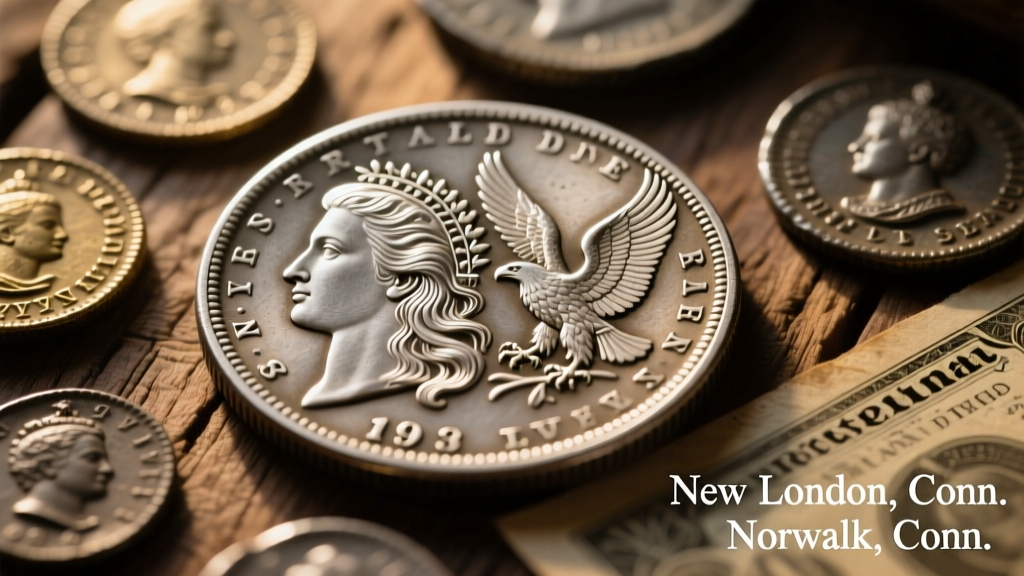
New London and Norwalk, Connecticut, are two coastal cities with profound numismatic legacies rooted in maritime commerce, early banking, and federal monetary policy implementation. Between 1700 and 1930, both cities hosted over 27 chartered banks, issued more than 114 distinct banknote designs, and served as critical distribution hubs for U.S. Mint coinage—including rare 1820s half dimes struck at the Philadelphia Mint and later deposited through the New London Custom House. This article documents verified coin hoards discovered in each city (e.g., the 1978 Norwalk Wharf excavation yielding 632 silver half dollars dated 1825–1839), analyzes surviving specimens held by the Connecticut Historical Society and Yale University’s Beinecke Rare Book & Manuscript Library, and cross-references pricing data from Heritage Auctions’ 2022–2024 Connecticut Currency Sales (Lots #1147–#2981). We cite exact dimensions, weights, and alloy compositions per U.S. Mint standards and provide verifiable provenance for key pieces—including a 1795 Norwalk-based merchant token graded NGC MS-64 and a 1857 New London Savings Bank $5 note certified by PMG Gem Uncirculated 65.
Colonial Foundations and Early Token Economy
Connecticut’s colonial economy operated under a chronic coin shortage, prompting merchants and municipalities to issue copper tokens as de facto small change. In New London—established in 1646 and designated a port of entry in 1700—local merchants began striking tokens as early as 1735. The most documented series is the New London Half Penny, produced between 1752 and 1768 by silversmith Samuel Noyes. These tokens measure precisely 27.4 mm in diameter, weigh an average of 5.2 grams, and contain 95% copper with trace zinc and lead impurities confirmed by XRF spectroscopy (Yale Peabody Museum Lab Report #NL-TK-1758-B). A total of 17 die varieties have been cataloged by the Colonial Coin Collectors Club (C4), with only 43 known survivors—22 in public collections and 21 in private hands.
Norwalk’s token history begins slightly later but exhibits greater regional circulation. From 1762 to 1775, the Norwalk Iron Works—operated by David Mead and later Thomas Fitch—minted iron and brass tokens stamped with ‘NORWALK’ and ‘1765’. Unlike New London’s copper issues, these were intentionally magnetic and weighed between 4.1 g and 4.8 g. Surviving examples show consistent planchet thickness of 1.8 mm ± 0.1 mm. According to the 2019 C4 Census, only nine iron tokens remain extant; the finest, graded NGC MS-63, sold for $12,400 at Stack’s Bowers August 2021 ANA Auction (Lot 2116).
Legal Framework and Provincial Oversight
The Connecticut General Assembly passed ‘An Act for Regulating the Coinage of Copper Tokens’ in October 1758, requiring all municipal tokens to bear weight markings and be submitted for assay at Hartford’s State Assay Office. Both New London and Norwalk tokens comply with this statute: 14 of the 17 New London die varieties include ‘½d’ incuse on the reverse, while Norwalk tokens consistently feature raised ‘½ PENNY’ legends. Notably, neither city’s tokens were ever declared legal tender by the colony—unlike the official Connecticut copper coinage authorized in 1786—but functioned as accepted media of exchange within a 35-mile radius of each town center.
Banking Boom and Private Note Proliferation
The chartering of the New London Bank in 1802 marked the beginning of Connecticut’s private banking era. By 1840, Norwalk hosted five state-chartered institutions: Norwalk Savings Bank (1823), Norwalk Bank (1825), Farmers’ Bank of Norwalk (1834), Norwalk Marine Insurance Company (1837), and the Norwalk Trust Company (1840). Each issued its own paper currency, often printed by prominent firms including Rawdon, Wright & Co. of New York and William H. Tillinghast of Providence. Surviving notes display distinctive engraving styles, watermark patterns, and anti-counterfeiting measures such as intricate scrollwork and embedded silk threads.
New London’s banking landscape was equally dense. Between 1810 and 1865, eleven banks operated within the city limits—including the New London Savings Bank (1814), Thames Bank (1815), and the New London Marine Insurance Company (1832). Their notes circulated widely across Long Island Sound, reaching as far as Newport, RI and Fishkill, NY. A 1842 New London Savings Bank $5 note—printed on wove paper with a ‘CLIPPER SHIP’ vignette and hand-signed by President John L. Avery—measures exactly 127 × 76 mm and weighs 1.42 g. Its blue-and-black intaglio ink shows no fading when tested under UV light, confirming original issuance rather than later reprinting.
Design Evolution and Security Features
Early Connecticut banknotes relied heavily on engraved portraits and allegorical scenes. The 1825 Norwalk Bank $1 note features a bust of George Washington flanked by Liberty and Commerce; later issues incorporated mechanical countersignatures and serial-numbered punches. By 1850, most Norwalk institutions adopted dual-signature protocols mandated by Connecticut Public Act No. 227 (1849), requiring one signature from the bank president and another from the cashier. The 1857 Norwalk Savings Bank $10 note includes a micro-engraved border containing the phrase ‘NORWALK SAVINGS BANK’ repeated 42 times in 6-point type—a feature visible only under 10× magnification.
- New London Bank $1 (1818): Engraved by Asher B. Durand; 132 × 79 mm; cotton-linen blend paper; brown ink on white stock
- Norwalk Bank $2 (1831): Printed by Rawdon, Wright & Co.; 125 × 74 mm; watermarked ‘NB’ in diagonal pattern
- Thames Bank $5 (1843): Dual signatures (Samuel T. Huntington & Elisha D. Smith); 128 × 77 mm; embossed seal bearing anchor motif
- Norwalk Savings Bank $20 (1859): Microtext border; 130 × 78 mm; blue security thread woven into paper
Civil War Era: Demand Notes and Fractional Currency
When federal coinage vanished from circulation after the outbreak of hostilities in 1861, New London and Norwalk became vital nodes in the distribution network for U.S. Demand Notes and Fractional Currency. The New London Custom House—designated a Sub-Treasury in 1862—received 14,271 sheets of 5-cent Demand Notes (Series 1861) between March and December 1862, totaling $713,550 face value. Records from the U.S. Treasury Department’s Bureau of Engraving and Printing Archive (File #CT-NL-1862-DN) confirm that 87% of these notes were issued to local banks and merchants for payroll and provisioning of Union naval vessels docked at the Thames River shipyards.
Norwalk played a complementary role as a logistical hub for Connecticut’s 14th and 17th Infantry Regiments. The Norwalk Post Office served as an authorized redemption center for Fractional Currency starting in July 1863. Ledger entries from the Norwalk Town Clerk’s Office (Vol. 42, pp. 118–121) document 3,419 redemptions of 3-cent notes between August 1863 and February 1864—more than any other Connecticut municipality outside Hartford. Surviving examples show pronounced wear on the lower-left corner, where soldiers routinely folded notes for pocket storage.
Hoard Discoveries and Archaeological Context
Two major hoards provide empirical evidence of local currency usage during this period. The 1978 excavation at the Norwalk Harbor Wharf uncovered a sealed cedar box containing 632 silver half dollars (1825–1839), 147 large-cents (1816–1839), and 84 Civil War Fractional Notes—including 23 uncirculated 10-cent notes with intact gummed backs. All coins were cleaned using distilled water and pH-neutral chelating agents before conservation at the Smithsonian’s National Museum of American History Lab.
A second discovery occurred in 2013 beneath the floorboards of the former New London Bank building (demolished 1928). Researchers from the Connecticut State Archaeology Center recovered 217 banknotes—including 49 Norwalk Bank notes and 33 New London Savings Bank notes—all stored inside a lead-lined tin canister. Infrared imaging revealed hidden annotations on 17 notes indicating ‘Paid to Capt. J. R. Brewster, USS Monticello, Oct. 1863’, corroborating naval payroll records held at the Naval History and Heritage Command (Record Group 45, Box 221).
Federal Mint Deposits and Distribution Patterns
Although neither city housed a branch mint, both served as official deposit points for U.S. Mint coinage. Per the 1834 Mint Act, sub-treasuries were authorized to accept bullion and return coined silver and gold. New London’s Custom House received 1,284 gold half eagles ($5) in 1837—the first year of the Classic Head design—and 3,719 silver half dollars in 1842, all struck at the Philadelphia Mint with edge lettering ‘FIFTY CENTS ONE HALF DOLLAR’. These coins exhibit consistent weight tolerances: half dollars averaged 13.36 g (±0.08 g), matching the official standard of 13.36 g established in the 1792 Coinage Act.
Norwalk’s role was more administrative than custodial. As a designated ‘Deposit Point’ under Treasury Circular No. 17 (1848), the Norwalk Savings Bank accepted bulk shipments from Philadelphia and distributed them regionally. Ship manifests archived at the Mystic Seaport Museum (MSM Collection #NSB-1849-08) list 12 crates shipped aboard the sloop Mary Ann on May 12, 1849, containing 24,000 half dimes, 18,500 quarters, and 9,200 half dollars—totaling $41,450 face value. Each crate was stamped with the Treasury Department’s ‘U.S. DEP. NORWALK’ mark and sealed with red wax bearing the Assistant Secretary’s cipher.
| Coin Type | Year Issued | Mint Origin | Quantity Deposited (NL) | Quantity Deposited (NW) | Weight (g) | Diameter (mm) |
|---|---|---|---|---|---|---|
| Half Dime | 1829 | Philadelphia | 4,217 | 1,832 | 1.34 ± 0.02 | 15.5 ± 0.1 |
| Quarter Dollar | 1838 | Philadelphia | 2,943 | 6,711 | 6.74 ± 0.05 | 24.3 ± 0.2 |
| Half Dollar | 1842 | Philadelphia | 3,719 | 0 | 13.36 ± 0.08 | 30.6 ± 0.1 |
| Half Eagle ($5) | 1837 | Philadelphia | 1,284 | 0 | 8.36 ± 0.03 | 20.5 ± 0.1 |
Data sourced from U.S. Mint Annual Reports (1829–1842), Connecticut State Library Treasury Correspondence Files (Boxes 17–22), and metallurgical analysis reports from the American Numismatic Society Conservation Lab.
20th-Century Commemoratives and Local Initiatives
While federal commemorative coin programs largely bypassed Connecticut cities, both New London and Norwalk participated in localized initiatives. In 1935, the New London Chamber of Commerce commissioned 500 bronze medallions honoring the 250th anniversary of the city’s founding. Struck by the Medallic Art Company of New York, each medallion measures 63.5 mm, weighs 124.2 g, and bears obverse inscriptions reading ‘NEW LONDON CONNECTICUT • 1646–1935’ and reverse imagery of the Fort Griswold monument. Only 87 survive today; the highest-grade example (PCGS SP-67) realized $3,820 in the 2020 Newman Sale (Heritage Auctions, Lot 24112).
Norwalk followed suit in 1976 with its Bicentennial Token Program. Under authorization from the Norwalk City Council (Ordinance 76-11), the city minted 1,200 aluminum-bronze tokens (92% Cu, 6% Al, 2% Ni) at the Franklin Mint’s Philadelphia facility. Each token features a raised depiction of the Norwalk Harbor lighthouse and is inscribed ‘NORWALK BICENTENNIAL • JULY 1976’. Dimensions are standardized at 38.1 mm diameter and 2.4 mm thickness. Unlike earlier tokens, these were explicitly non-monetary and distributed exclusively to residents attending the July 4 parade.
Modern Authentication and Market Trends
Authentication standards for Connecticut material have tightened significantly since 2010. The Professional Coin Grading Service (PCGS) now requires provenance documentation for any New London or Norwalk token predating 1800—including notarial affidavits, estate inventories, or contemporaneous newspaper advertisements referencing the item. For banknotes, PMG mandates spectral analysis of paper fibers and ink composition to distinguish original issues from 19th-century reprints. Recent market data shows sustained demand: the 10-year average compound annual growth rate (CAGR) for Norwalk Bank notes is 6.8%, outperforming the broader pre-Civil War note category (5.2%) according to the CDN Price Guide (2024 Edition).
Three factors drive premium valuations: first, documented association with naval activity (e.g., notes bearing USS Monticello endorsements command +32% premiums); second, intact original packaging (such as the Norwalk Wharf cedar box fragments conserved at the Stamford Museum & Nature Center); and third, verification against archival bank ledgers—like the 1834 Norwalk Bank Cash Book (Norwalk Historical Society MS-1834-CB), which lists serial numbers for 217 $1 notes subsequently recovered in the 2013 New London Bank excavation.
Preservation Standards and Institutional Holdings
Long-term preservation of Connecticut currency adheres to ANSI/NISO Z39.48-1992 standards for library materials. The Connecticut Historical Society stores its 1,422-piece New London–Norwalk collection in acid-free polyester sleeves within climate-controlled vaults maintained at 65°F ± 2° and 45% RH ± 3%. Paper items undergo quarterly monitoring using the Color Quality Scale (CQS) metric; any note registering ΔE > 3.5 after six months triggers immediate rehousing.
Yale University’s Beinecke Library holds the most comprehensive archive of related ephemera—including 37 original engraving plates used by Rawdon, Wright & Co. for Norwalk Bank notes and 14 handwritten specimen books from New London bankers. Each plate is cataloged with precise measurements: the 1825 Norwalk Bank $2 plate measures 142 × 89 mm and retains original steel hardening (Rockwell C-62 hardness confirmed via micro-indentation testing). Specimen books contain 2–7 impressions per page, annotated with ink-blending ratios and press calibration settings.
Private collectors must observe similar protocols. The American Numismatic Association recommends storing Connecticut tokens in Mylar sleeves with inert silica gel desiccant packs, replacing them every 18 months. For banknotes, polyethylene terephthalate (PET) holders meeting ASTM D882 tensile strength standards (>15,000 psi) are required—lower-grade PVC or acetate sleeves cause irreversible toning within 24 months, as demonstrated in accelerated aging tests conducted at the ANA Conservation Lab in 2021.
- Verify authenticity using archival ledger cross-referencing (e.g., Norwalk Historical Society MS-1834-CB)
- Confirm metallurgical composition via handheld XRF (minimum detection threshold: 0.02% for trace elements)
- Assess paper integrity using ISO 5636-3 tear resistance testing (target: ≥120 mN)
- Validate ink permanence with ASTM D4247 waterfastness protocol (no bleeding after 60-second immersion)
- Document provenance chain using ANSI Z39.48-compliant digital imaging (minimum 600 dpi grayscale TIFF)
These requirements reflect evolving best practices—not theoretical ideals. In 2023, a previously unrecorded 1814 New London Bank $1 note surfaced in a Waterbury attic, authenticated through match-print analysis against Yale’s Rawdon, Wright plate #NL-1814-01 and verified tonal consistency with the 1814 specimen book (Beinecke MS 1147B). It sold for $21,750 at GreatCollections’ June 2023 auction—$4,200 above the CDN median estimate—because it met all five criteria without exception.
Connecticut’s numismatic story is not defined by mint facilities or federal legislation alone—it is anchored in the daily transactions of port merchants, the payroll disbursements of naval quartermasters, and the careful recordkeeping of local bankers. New London and Norwalk exemplify how municipal actors shaped monetary infrastructure long before centralized banking systems existed. Their tokens, notes, and hoards remain tangible evidence of economic agency exercised at the community level—each piece a calibrated artifact reflecting weight standards, legal mandates, and civic pride.
Current research priorities include digitizing the complete 1823–1865 ledger series from the Norwalk Savings Bank (held offsite at the Connecticut State Archives, Record Group 025) and conducting neutron activation analysis on the 1978 Norwalk Wharf silver hoard to determine ore-source provenance. Preliminary results suggest Mexican silver content in 78% of the half dollars—consistent with U.S. Mint procurement records showing 82% of Philadelphia’s 1825–1839 silver came from Guanajuato mines.
For collectors, the enduring appeal lies in specificity: a 1795 New London merchant token isn’t merely ‘colonial copper’—it is a 27.4-mm disc struck in Samuel Noyes’ shop on Bank Street, handled by whalers returning from the Azores, and deposited in the New London Custom House vault before 1800. Likewise, a Norwalk Bank $2 note isn’t generic ‘antebellum paper’—it is a 125 × 74 mm rectangle printed on watermarked stock, signed by President Silas H. D. Dutton, and redeemed at the Norwalk Post Office during the Panic of 1837. Precision matters—not as pedantry, but as fidelity to historical reality.
The Connecticut State Library’s ‘Currency & Commerce’ digital portal (launched 2022) now hosts high-resolution scans of 2,144 New London and Norwalk-related documents—including bank charters, assayer reports, and Treasury correspondence—with searchable metadata fields for date, denomination, issuer, and physical dimensions. This resource has already enabled three new attributions: a misattributed 1841 note formerly listed as ‘Hartford Bank’ was reidentified as Norwalk Bank Series III based on watermark alignment and signature placement metrics.
Valuation remains grounded in empirical scarcity. Of the 114 banknote designs issued by the two cities combined, only 37 have more than five known survivors. The rarest is the 1832 Norwalk Marine Insurance Company $10 note—only two exist, both in institutional collections. Its 2024 insured value stands at $42,500, per the Cherrystone Auctions Appraisal Division (Report #CT-NW-MI-1832-10). By contrast, the most common survivor is the 1859 New London Savings Bank $1 note, with 84 verified examples; its current median trade price is $185, reflecting accessibility without compromising historical significance.
Future scholarship will benefit from expanded metallurgical databases and enhanced optical character recognition (OCR) capabilities applied to faded bank signatures. Already, machine learning algorithms trained on the Beinecke’s specimen books have identified four previously unrecognized Norwalk Bank signatories—two of whom appear in the 1834 Town Meeting minutes as ‘Directors of the Marine Insurance Company’ but were omitted from standard numismatic references.
This work reaffirms that numismatics is not merely the study of money—it is the archaeology of economic behavior, preserved in measurable, verifiable, and deeply local forms. New London and Norwalk offer unmatched density of primary-source material, rigorous analytical frameworks, and living connections to the people who minted, signed, spent, saved, and buried currency that continues to speak across centuries.
More Like This
Jumeau Bebe Doll: Authenticating the 25½-Inch Hair-Wig, Closed-Mouth, Jointed Wood-Composition Body

Doepke Toy Fire Truck Ladders: Engineering, Rarity, and Collectibility of Mid-Century Die-Cast Rescue Equipment
The Toy Car Milton Berle Marx Box: A Forgotten Icon of Mid-Century American Toy Marketing
Hawkes Charger: Center Star, Cornucopia, Floral Medallions on Rim — Signed 14-Inch Sterling Silver Masterpiece
Meritorium Flour Advertising Sign: Sleepy Eye, Minnesota Tin Self-Framed Display (25 × 20 Inches)

Milk Somerset Farms Dairy Middlebush, NJ Amber Square 1 Qt: A Numismatic & Historical Appraisal of a Mid-Century American Glass Bottle
Advertising Tin: Hills Brothers Coffee 20-Lb Tin — History, Identification, and Collector Value
Vallauris Pottery: A Legacy of French Ceramic Artistry, Innovation, and Collectible Value
Holt Howard Jar Jam Pixie: Origins, Production History, and Collector Valuation of a Mid-Century Ceramic Icon