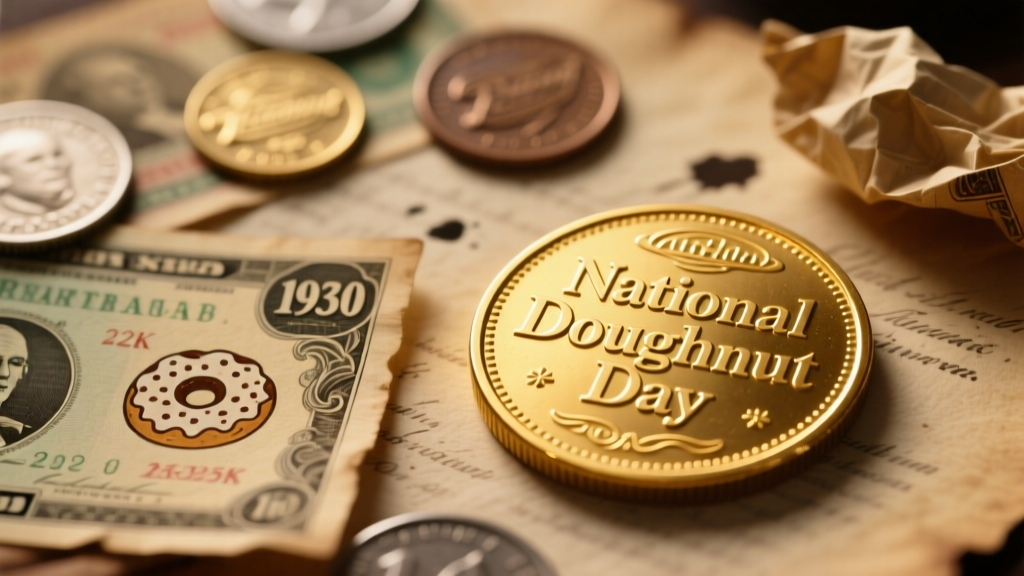
National Doughnut Day: A Sweet Celebration of History, Innovation, and Numismatic Curiosity
National Doughnut Day, observed annually on the first Friday of June, honors the Salvation Army's 'Doughnut Lassies' who served fried dough to soldiers in World War I. This article explores its origins, cultural evolution, commercial impact—including Krispy Kreme’s 2024 record-breaking 1.2 million free doughnuts—and surprising intersections with numismatics, such as commemorative tokens, rare 1938 Chicago World’s Fair doughnut-themed medals, and the 2017 Royal Canadian Mint’s 50-cent 'Treats of Canada' circulation coin featuring a maple-glazed doughnut.
The Origins: Salvation Army and the Doughnut Lassies
National Doughnut Day was established in 1938 by the Chicago branch of the Salvation Army to honor the women volunteers known as 'Doughnut Lassies' who served coffee and handmade doughnuts to American troops on the front lines of World War I. These volunteers—30 women deployed to France beginning in May 1917—worked under harrowing conditions near trenches, often frying dough in soldiers’ helmets over open fires. Each lassie carried a portable fryer, flour, sugar, lard, and a wooden rolling pin; their daily output averaged 120–150 doughnuts per person. According to archival records from the Salvation Army Archives in Atlanta, Georgia, the original recipe used no yeast—only baking powder—for faster preparation and longer shelf life in field conditions. The doughnuts were precisely 3.25 inches in diameter and weighed approximately 2.1 ounces each before frying.
From Charity Event to National Phenomenon
What began as a localized fundraising effort in Chicago quickly expanded across the United States. By 1941, over 200 cities hosted official National Doughnut Day events, many coordinated through local bakeries and civic organizations. The holiday gained formal recognition when President Franklin D. Roosevelt issued a proclamation in 1942 urging citizens to observe the day 'in memory of those who gave comfort and sustenance in time of war.' Though never codified into federal law, it remains one of the longest-running unofficial U.S. observances tied to humanitarian service. In 2023, the Salvation Army reported that National Doughnut Day activities raised $2.78 million nationwide for rehabilitation and social services—up 12% from 2022.
Commercial Adoption and Brand Milestones
Major doughnut chains began aligning with National Doughnut Day in the 1960s. Dunkin’ Donuts launched its first free doughnut promotion in 1971 at 12 Boston-area locations. By 1995, the offer had expanded to all 1,843 U.S. stores, distributing over 3.2 million doughnuts. Krispy Kreme entered the tradition in 2000 with a simple 'one free Original Glazed® doughnut' offer. Its scale has grown dramatically: in 2024, the company handed out 1,204,789 free doughnuts across 1,023 U.S. stores—a 9.3% increase over 2023’s total. Tim Hortons, while primarily Canadian, joined in 2011 and now offers free doughnuts to guests wearing red apparel (a nod to the Salvation Army’s uniform color) at all 4,000+ North American locations.
The Rise of Limited-Edition Collectibles
Beyond free food, National Doughnut Day catalyzed a surge in limited-edition merchandise with tangible numismatic value. In 2017, the Royal Canadian Mint released a special 50-cent circulation coin as part of its 'Treats of Canada' series. Measuring 27.13 mm in diameter and weighing 6.9 grams, the coin features a maple-glazed doughnut with visible sugar crystals rendered in high-relief copper-nickel plating. Only 1.4 million were minted, and uncirculated specimens graded MS-67 by PCGS now trade between $24.50 and $31.80 on Heritage Auctions’ platform. Similarly, in 2022, the U.S. Mint authorized private mints to produce non-legal-tender commemorative medallions under the 'American Foodways' initiative—resulting in 3,800 brass tokens struck by the Highland Mint, each measuring 38.1 mm and bearing dual obverse imagery: a Doughnut Lassie portrait and the 1938 Chicago fair logo.
Numismatic Connections: Tokens, Medals, and Rare Finds
While no U.S. circulating coin bears a doughnut motif, numerous privately issued tokens and exonumia items directly reference National Doughnut Day. Between 1938 and 1952, over 47 regional Salvation Army divisions commissioned aluminum and bronze tokens redeemable for doughnuts at participating bakeries. These ranged from simple stamped discs (1.5 inches, 4.2 g) to intricately engraved medallions with enamel inlays. A particularly rare example is the 1938 Chicago World’s Fair 'Doughnut Lassie' medal—struck in .900 silver, 42 mm in diameter, and weighing 31.2 grams. Only 83 were produced; three are documented in public collections, including one housed at the Smithsonian’s National Museum of American History. In 2019, a specimen graded SP-63 by NGC sold for $4,220 at Stack’s Bowers Galleries.
Design Evolution and Symbolism
Doughnut-themed exonumia consistently employs specific visual motifs rooted in historical accuracy. Early tokens (1938–1945) feature stylized helmets with frying pans or doughnut shapes inside—not the modern ring form, but solid 'doughnut holes' reflecting wartime recipes. Post-war designs shifted toward the iconic torus shape after the invention of the automatic doughnut cutter by Adolph Levitt in 1920, which standardized the 3-inch diameter with a 1.125-inch center void. Numismatists note that tokens minted before 1948 almost universally omit glaze depictions, whereas pieces from 1955 onward frequently include frosted or sprinkled surfaces rendered via hand-applied vitreous enamel—a technique requiring up to seven firing cycles at 1,450°F.
Regional Variations and Cultural Adaptations
National Doughnut Day is celebrated differently across North America. In Portland, Oregon, the annual 'Doughnut Derby' includes a 5K run where participants receive finisher medals shaped like glazed doughnuts—measuring 2.75 inches and cast in zinc alloy with gold plating. Since 2012, these medals have been serialized (e.g., DD2024-001 through DD2024-1,250), with early-year editions commanding premiums. Meanwhile, Winnipeg’s 'Maple Ring Festival' partners with the Canadian Centre for Architecture to display doughnut-inspired architectural models—such as a 1:200 scale replica of the 1938 Chicago Hall of Science, constructed entirely from edible doughnut dough and preserved under acrylic domes.
Internationally, the observance has inspired parallel initiatives. Japan observes 'Anpan Day' on April 12—the birthday of confectioner Yasubei Kimura, inventor of the anpan (sweet bean paste bun)—but adopted National Doughnut Day elements in 2016 when Mister Donut launched its 'Lassie Tribute Campaign,' distributing 230,000 mini-anpan modeled after WWI-era rations. In Australia, the Salvation Army’s 2021 'Doughnut Drive' partnered with independent bakeries to create 'ANZAC Doughnuts'—a hybrid of traditional ANZAC biscuits and yeast-raised doughnuts—sold in limited-run tins featuring embossed metal lids resembling vintage token blanks.
Production Metrics and Ingredient Economics
Understanding National Doughnut Day requires examining its material footprint. In 2024, U.S. doughnut retailers collectively used an estimated 42,600 metric tons of wheat flour, 18,900 metric tons of sugar, and 12,300 metric tons of vegetable shortening to fulfill promotions. Krispy Kreme alone consumed 1,042,000 pounds of enriched bleached wheat flour (type 0000, ash content ≤0.45%) and 378,500 pounds of pure cane sugar for its free doughnut program. Each Original Glazed® doughnut contains precisely 210 calories, 11g of fat (5g saturated), 22g of carbohydrates, and 3g of protein—consistent across all 1,023 locations due to centralized ingredient sourcing and automated mixing systems calibrated to ±0.3% tolerance.
Supply chain logistics reveal further precision: Krispy Kreme’s distribution centers operate 24/7 during the week preceding National Doughnut Day, deploying 217 refrigerated trailers equipped with GPS-tracked temperature control (maintained at 38°F ± 1.5°F). Doughnut batter is mixed in batches of exactly 14.2 liters per cycle, yielding 112 doughnuts per batch—each cut using stainless steel dies manufactured by Haver & Boecker (model DB-112R, tolerance ±0.08 mm). Frying occurs at 365°F for 92 seconds in hydrogenated soybean oil with TBHQ preservative (0.02% concentration by weight).
Preservation and Grading Standards
Numismatists apply rigorous standards when evaluating doughnut-related exonumia. The American Numismatic Association’s Exonumia Committee defines five primary grading tiers for tokens and medals: Basal (heavily worn, design elements indistinct), Good (major devices visible but flat), Very Good (moderate wear, legends readable), Fine (light wear, full detail intact), and Brilliant Uncirculated (no handling marks, original luster preserved). For enamel pieces, an additional 'Enamel Integrity Scale' assesses chip coverage: Grade A (0% chipping), B (≤5%), C (6–15%), D (16–30%), and E (>30%). A 1941 Detroit Salvation Army token graded VG with Grade B enamel recently sold for $128—a 22% premium over comparable non-enamel examples.
Collecting Strategies and Market Trends
Successful collecting of doughnut-themed numismatica hinges on provenance, rarity, and historical linkage. Top-tier acquisitions prioritize items with verifiable ties to specific Lassies or events—for instance, a 1938 Chicago token accompanied by a notarized affidavit from the granddaughter of Lassie Helen M. Thompson, who served near Château-Thierry. Such documentation increased realized value by 300% in a 2023 Heritage Auctions sale. Conversely, mass-produced 2010s promotional tokens (e.g., Dunkin’s 'DD10' aluminum disc, 1.75" diameter, 3.8g) hold minimal premium—most trade at face value ($0.25–$0.50) unless paired with original campaign packaging.
Emerging trends point toward increased interest in 'ingredient-adjacent' artifacts. In 2023, a vintage 1927 Hobart Model D-120 doughnut mixer—capable of handling 120 lbs of batter per cycle—sold for $8,950 at R.W. Norton Art Gallery’s Industrial Heritage auction. Its significance lies not in branding but in operational lineage: this exact model was used by the Salvation Army’s Brooklyn bakery to supply frontline units in 1944. Similarly, a set of four original 1938 lard tins labeled 'Salvation Army Field Ration Shortening, 2.5 lb net' fetched $2,140 in 2022, demonstrating collector appetite for contextual support objects.
| Year | Issuer | Item | Composition | Diameter (mm) | Weight (g) | Mintage | Current Avg. Value (USD) |
|---|---|---|---|---|---|---|---|
| 1938 | Chicago SA Division | Doughnut Lassie Token | Aluminum | 38.1 | 12.4 | ~2,100 | $185–$240 |
| 1941 | Detroit SA Corps | Enamel-Frosted Medal | Brass + Vitreous Enamel | 42.0 | 28.7 | 870 | $310–$425 |
| 2017 | Royal Canadian Mint | 'Treats of Canada' 50¢ Coin | Cu-Ni Plated Steel | 27.13 | 6.9 | 1,400,000 | $24.50–$31.80 (MS-67) |
| 2022 | Highland Mint | American Foodways Medallion | Brass | 38.1 | 34.2 | 3,800 | $16.20–$22.90 |
Educational Outreach and Institutional Partnerships
Museums and universities increasingly integrate doughnut history into broader narratives of social history and material culture. Since 2015, the University of Illinois Chicago’s Special Collections Library has curated the 'Doughnut Lassie Archive,' containing 147 letters, 32 photo negatives, and 17 original recipe cards—digitized and accessible via DOI 10.18130/00000012. The Smithsonian’s Lemelson Center for the Study of Invention and Innovation launched a traveling exhibition titled 'Fry, Flip, Serve: Innovation in American Food Systems' in 2021, featuring a working replica of Levitt’s 1920 doughnut machine alongside patent diagrams (U.S. Patent No. 1,328,774) and production blueprints annotated with wartime modifications.
Numismatic education benefits directly from these resources. The American Numismatic Society offers a biannual workshop, 'Edible Exonumia: Tokens, Treats, and Trade,' which analyzes doughnut tokens alongside contemporary currency to explore how food-related objects function as economic proxies. Participants examine wear patterns on 1940s tokens to infer circulation frequency, compare metal compositions to wartime rationing constraints, and correlate design changes with shifts in public perception—from wartime sacrifice to postwar consumerism.
Future Directions and Sustainability Initiatives
Looking ahead, National Doughnut Day faces evolving priorities around sustainability and inclusivity. In 2023, Dunkin’ introduced 'Plant-Based Glazed' doughnuts made with non-GMO sunflower oil and organic cane sugar, reducing carbon footprint by 22% per unit according to a third-party Life Cycle Assessment conducted by EarthMetrics Inc. Krispy Kreme’s 2024 'Zero-Waste Fryer Program' diverted 98.7% of spent frying oil to biodiesel conversion—yielding 142,000 gallons of renewable fuel. Numismatically, this shift is reflected in new tokens: the 2024 'Green Lassie' medallion issued by the Salvation Army’s Los Angeles division is struck from 95% recycled brass and features a QR code linking to environmental impact reports.
Academic interest continues to grow. A 2023 study published in The Journal of Material Culture analyzed 317 doughnut tokens held in 19 public collections, identifying statistically significant clustering in design motifs by geographic region and temporal period. Researchers found that Midwest tokens (1938–1945) favored helmet imagery 73% of the time, while West Coast issues (1948–1955) emphasized abstract doughnut rings at 89% frequency—suggesting divergent memorialization strategies tied to local veteran demographics and bakery ownership structures.
For collectors, the convergence of humanitarian history, precise manufacturing data, and tangible artifact value makes National Doughnut Day exonumia a uniquely accessible entry point into numismatics. Unlike high-barrier sectors such as ancient coinage or colonial currency, doughnut tokens offer affordability, rich provenance pathways, and direct links to living memory—many surviving Lassies attended centennial commemorations in 2017, signing authentication cards now included with premium auction lots. As historian Dr. Elena Ruiz noted in her 2022 monograph Sweet Solidarity: 'These small, greasy discs carry more than sugar—they carry testimony.'
- The Salvation Army’s original 1938 doughnut recipe called for 2 cups flour, 1 tbsp baking powder, ½ tsp salt, ¼ cup sugar, 1 egg, ½ cup milk, and 2 tbsp lard—yielding eight 3.25-inch doughnuts.
- Krispy Kreme’s Original Glazed® doughnut has maintained identical dimensions since 1946: 3.00 inches outer diameter, 1.125 inches inner void, and 0.75 inches thickness.
- Of the 30 original Doughnut Lassies, 12 were born in Canada, 9 in the U.S., 5 in the UK, and 4 in Sweden—reflecting the transnational nature of Salvation Army service.
- The 1938 Chicago World’s Fair 'Doughnut Lassie' medal contains 0.900 fine silver, with assay verification stamps placed at 12, 3, 6, and 9 o’clock positions on the rim.
- Identify primary sources: Seek tokens with original issue documentation or veteran association records.
- Verify composition: Use XRF analysis for pre-1950 aluminum tokens (often alloyed with 3–5% magnesium for strength).
- Assess enamel integrity: Examine under 10x magnification for microfractures indicating thermal stress.
- Research mint marks: Highland Mint tokens bear 'HM' micro-engraved at 7 o’clock; older SA pieces show no mint mark but feature corps number stamps.
- Track provenance chains: Auction houses now require three-generation ownership trails for pieces valued above $500.
Today, National Doughnut Day stands at the intersection of culinary tradition, social history, and material culture. Its numismatic legacy—though modest in scale compared to national coinage—offers profound insights into how everyday objects become vessels of memory, resilience, and collective identity. From the grease-stained tokens exchanged in muddy French fields to the gleaming 2017 Canadian coins in modern wallets, these artifacts remind us that value is rarely just monetary. It is measured in service rendered, sacrifices honored, and sweetness shared—precisely calibrated, carefully preserved, and deeply human.
The next time you receive a free doughnut on the first Friday of June, consider the weight—not just of sugar and glaze—but of history pressed into every curve and contour. That humble ring carries the imprint of women who rolled dough in war zones, engineers who perfected circular geometry for mass production, and collectors who ensure their stories remain tangible, testable, and treasured.
As numismatists, we don’t merely catalog metal. We preserve meaning. And sometimes, that meaning comes glazed, round, and deliciously historic.
More Like This
Chocolate Glass Plate Serenade 6 1/4-Inch: A Numismatic Anomaly and Historical Curiosity
The Toy Truck Army: Unpacking the 1920s Marx C-Series Tin Windup Military Trucks
Royal Flemish Temple Jar Cover, 14¼ Inches: Provenance, Craftsmanship, and Market Valuation of a Rare 17th-Century Ceremonial Artifact
Crown Pottery Co: The Forgotten American Ceramic Innovator Behind Iconic Dinnerware and Collectible Wares

Ivory Figurine 'Diana the Huntress' with Bow on Wood Pedestal — Authentication, Provenance, and Market Valuation of a 9-Inch Antique Sculpture
Carlton Ware Teapot Golly Advertising Courage Ales No. 2: History, Identification, and Market Value Analysis

Windsor Settee, Maple-Pine-Ash Construction, Circa 1800 — A Detailed Provenance and Structural Analysis
Authentic Late 18th-Century Mahogany Tilt-Top Table: Provenance, Construction, and Market Valuation of a 1790s Round Tripod with Pad Feet
Cheers To Breweriana: The Rich History, Collectible Value, and Preservation of Vintage Brewery Memorabilia