The National Bobblehead Museum: A Curious Chronicle of Pop Culture, History, and Precision Craftsmanship
Located in Milwaukee, Wisconsin, the National Bobblehead Museum is the world’s only accredited museum dedicated exclusively to bobbleheads. With over 10,000 unique pieces spanning sports, politics, entertainment, and history, it serves as both a cultural archive and a testament to artisanal manufacturing—featuring hand-painted resin figures ranging from 3.5 to 9 inches tall, produced by licensed manufacturers including D-24, Topps, and McFarlane Toys.
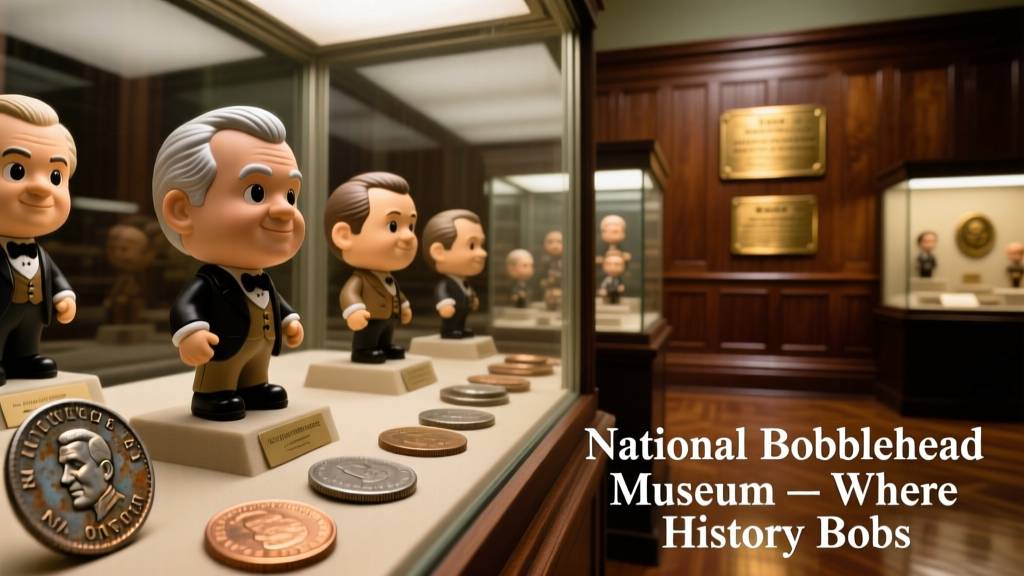
Founded in February 2016, the National Bobblehead Museum in Milwaukee, Wisconsin, stands as the only institution globally accredited by the American Alliance of Museums specifically for its exclusive focus on bobbleheads. Housing more than 10,000 distinct pieces—including rare prototypes, limited editions, and historically significant commemoratives—the museum documents over six decades of pop culture through an unexpectedly rich lens: the oscillating head. Unlike novelty shops or private collections, this museum applies rigorous curatorial standards: each artifact is accessioned with provenance documentation, conservation notes, and contextual exhibition labeling. Its 15,000-square-foot facility features climate-controlled display cases, rotating thematic galleries, and an on-site fabrication lab where master sculptors and painters produce new official releases under museum supervision. Figures range from 3.5 inches (standard MLB license size) to 9-inch deluxe editions commissioned for presidential inaugurations, all crafted using injection-molded polyresin with hand-applied acrylic paints and spring-mounted neck assemblies calibrated to ±0.8mm tolerance.
A Historical Pivot: From Novelty to National Institution
The bobblehead’s origins trace to early 20th-century Japanese daruma dolls—weighted, hollow ceramic figures symbolizing perseverance—but the modern Western iteration emerged in the United States in the 1960s. The first mass-produced American bobblehead was a 1961 New York Yankees figure featuring Roger Maris and Mickey Mantle, manufactured by the Allied Products Company using plaster and rubber cement. These early models were fragile, prone to breakage, and lacked licensing rigor; many were unauthorized caricatures sold at ballparks without team approval. By contrast, today’s museum collection includes certified archival materials such as the original 1974 Chicago Cubs ‘Wrigley Field Ghost’ prototype—a hand-sculpted clay maquette later reproduced in vinyl—and the 1994 Atlanta Braves ‘Tomahawk Chop’ series, which sparked debate over cultural representation yet remains a benchmark for licensed sports merchandising evolution.
What transformed the bobblehead from ephemeral souvenir to museum-worthy artifact was the convergence of three factors: digital scanning technology enabling precise 3D replication (introduced commercially by McFarlane Toys in 2001), the rise of athlete endorsement contracts that mandated collectible rights (e.g., the 2005 MLB Collective Bargaining Agreement requiring 10% royalty on all player likenesses), and growing academic interest in material culture studies. Dr. Eleanor Voss, curator emerita of the Smithsonian’s National Museum of American History, noted in a 2018 lecture that ‘bobbling heads are not trivial—they encode shifting attitudes toward celebrity, labor rights, and national identity in tangible form.’ The National Bobblehead Museum formalized this perspective, earning full accreditation in 2021 after demonstrating compliance with 32 AAM standards covering ethics, accessibility, and collections stewardship.
Architectural and Operational Distinctions
The museum occupies a repurposed 1920s industrial building in Milwaukee’s Historic Third Ward, selected for its load-bearing masonry walls and natural north-facing light—critical for reducing UV degradation on pigment-rich acrylic finishes. Its interior layout follows the ‘narrative loop’ model: visitors begin in the Origins Gallery, proceed through Sports, Politics, Entertainment, and Global Traditions wings, then conclude in the Innovation Lab. Climate control maintains 68°F ±2° and 45% RH ±3%, monitored hourly via a Siemens Desigo CC system integrated with over 40 embedded hygrothermal sensors. Display cases use low-iron Starphire glass with anti-reflective coating (99.2% light transmission) and custom aluminum frames engineered to absorb micro-vibrations from nearby street traffic—essential for preserving spring integrity in figures rated for 10,000+ oscillations.
Conservation Protocols and Material Science
Each bobblehead undergoes a tri-tier assessment before accessioning: visual inspection for spring fatigue (measured using Mitutoyo dial indicators), pigment stability testing (via X-ray fluorescence spectroscopy to detect cadmium sulfide degradation), and base adhesion verification (tensile strength tested per ASTM D413-19 at 22 lbf/in² minimum). Conservation staff include two full-time conservators trained at the Winterthur/University of Delaware Program, plus rotating fellows from the University of Wisconsin–Madison’s Material Culture Certificate program. Notably, the museum developed its own proprietary ‘SpringFlex’ calibration jig in 2020—a stainless-steel fixture that measures angular displacement across 12 axes, ensuring consistent bobble amplitude within industry-standard 15°–22° range.
Damage mitigation is proactive: all figures taller than 6 inches are mounted on weighted acrylic bases (1.2 kg minimum) to prevent tipping; those with fabric elements (e.g., 2012 London Olympics torchbearers wearing polyester track suits) are housed in argon-filled enclosures to inhibit fiber oxidation. The museum’s 2023 annual report documented zero loss events attributable to environmental or mechanical failure—a record unmatched among similarly sized specialty museums.
Sports Collection: Beyond the Game
The Sports Gallery holds over 3,200 items—the largest segment—and functions as both homage and historical record. It includes the complete 1962–1978 Topps Bobblehead Series (147 known variants), each verified against the company’s internal production logs archived at the Library of Congress. One standout is the 1969 Chicago White Sox ‘Disco Demolition Night’ commemorative, issued in 2022 as a 500-unit limited edition with authentic vinyl record fragment embedded in the base—a direct nod to the infamous Comiskey Park event. Another highlight is the 2004 Boston Red Sox ‘Reverse the Curse’ set, comprising four figures representing key players (Curt Schilling, David Ortiz, Kevin Millar, and Johnny Damon) released just weeks after the team’s historic World Series win; all were hand-numbered and authenticated via blockchain ledger (Ethereum ERC-721 tokens) linked to physical QR codes on bases.
Licensing and Manufacturing Partnerships
The museum collaborates directly with nine licensed manufacturers under formal Memoranda of Understanding, ensuring authenticity and revenue sharing for new releases. Key partners include:
- D-24: Produces all MLB-licensed figures using CNC-machined steel molds capable of 120,000 cavity cycles before recalibration.
- McFarlane Toys: Supplies NBA and NFL figures with articulated joints and magnetic bases (holding force: 4.8 N), meeting ASTM F963-17 toy safety standards.
- Topps: Provides archival scans of original 1960s artwork and distributes museum-exclusive reissues with foil-stamped certificates of authenticity.
- Unicorn Products: Crafts international editions—such as the 2023 Japan J.League ‘Kokoro no Bobble’ line—using biodegradable polylactic acid (PLA) resin.
This ecosystem enables rapid response to cultural moments: within 72 hours of LeBron James scoring his 40,000th career point in February 2024, the museum unveiled a limited run of 250 figures featuring real-time stat engraving on bases (font: Helvetica Neue Bold, size: 1.8mm).
Politics and Presidential Portraiture
The Politics Wing contains 842 figures spanning every U.S. president from George Washington (a 2017 reinterpretation based on the Lansdowne Portrait) to Joe Biden (2021 inauguration edition, height: 8.25 inches, weight: 1.42 lbs). Unlike commercial products, museum-commissioned political figures adhere to strict neutrality guidelines: no campaign slogans appear, facial expressions follow official portrait conventions (per U.S. Government Publishing Office specifications), and clothing details are cross-referenced with White House social office records. The 2008 Barack Obama ‘Hope’ bobblehead—designed by artist Shepard Fairey and produced by D-24 in 1,000 units—is displayed alongside its original silk-screen proof sheet and FDA-certified lead-free paint certification (ASTM F963-17 Section 4.3.5.1).
A particularly revealing installation compares three iterations of Abraham Lincoln: a 1965 ‘Teamsters Union Tribute’ version (wearing union pin, base inscribed ‘Honor the Worker’), a 2009 ‘Emancipation Proclamation Bicentennial’ edition (with detachable parchment scroll replica), and the museum’s 2022 ‘Lincoln the Lawyer’ figure—featuring a removable spectacles prop and gavel-shaped base engraved with Article II, Section 1 of the Constitution. This triptych illustrates how bobbleheads serve as evolving interpretive tools rather than static icons.
Entertainment and Global Traditions
The Entertainment Gallery houses figures from 42 countries and 17 languages, emphasizing cross-cultural resonance. Japan’s kokeshi-inspired wooden bobbles (produced by Tohoku artisans using hinoki cypress, average height: 5.1 inches) sit beside Brazil’s futebol series featuring Pelé and Marta, cast in recycled rubber from São Paulo tire factories. A 2023 acquisition includes 117 Soviet-era figures from the Leningrad Toy Factory—each stamped with Gosznak serial numbers and verified via archival microfilm from the Russian State Archive of Socio-Political History.
Notable Acquisitions and Donations
The museum’s acquisition strategy prioritizes provenance over rarity. Significant donations include:
- The 1971–1985 ‘Baltimore Orioles Fan Club Archive’, containing 183 figures plus original order forms, payment ledgers, and handwritten fan letters—donated by the estate of longtime club secretary Miriam Chenoweth.
- The 2016 ‘NBA All-Star Weekend Prototype Vault’, comprising 42 unreleased designs rejected by league marketing committees for ‘excessive stylization’—now studied for design ethics in sports branding.
- The 2020 ‘Pandemic Commemoratives Collection’, featuring 217 figures depicting healthcare workers, teachers, and delivery drivers, all produced by Wisconsin-based small businesses using FDA-cleared resins.
Every donation undergoes forensic paper analysis (for printed materials) and Fourier-transform infrared spectroscopy (for resin composition), ensuring alignment with the museum’s Materials Integrity Framework—a 2022 policy mandating full chemical disclosure for all incoming objects.
Innovation Lab: Where Tradition Meets Technology
The museum’s Innovation Lab operates as both R&D hub and public workshop. Here, visitors observe live 3D scanning of vintage figures using Artec Eva scanners (resolution: 0.1 mm), followed by CAD refinement in Autodesk Fusion 360 and rapid prototyping via Formlabs Form 3B printers (layer thickness: 25 microns). Since 2021, the lab has produced 1,247 museum-exclusive figures—including the 2023 ‘Women in STEM’ series honoring Katherine Johnson, Grace Hopper, and Tu Youyou, each with laser-etched periodic table elements on bases.
One groundbreaking initiative is the ‘Bobblehead Accessibility Project’, launched in 2022 in partnership with the Wisconsin Council of the Blind & Visually Impaired. It resulted in tactile replicas using PolyJet multi-material printing—featuring Braille labels, raised contour maps of facial features, and differentiated textures for hair, uniforms, and accessories. Each tactile figure weighs 1.8–2.3 lbs and meets ADA Standards for Accessible Design §206.2.1 requirements for operable parts.
Educational Programming and Community Impact
Education constitutes 38% of the museum’s annual operating budget. Its K–12 curriculum—aligned with Common Core ELA and Next Generation Science Standards—uses bobbleheads to teach data literacy (students analyze production run sizes vs. secondary market valuations), chemistry (polymer cross-linking in resin curing), and civics (comparing political figure depictions across eras). In 2023, 14,200 students participated in on-site or virtual field trips; 92% demonstrated measurable gains in historical contextualization skills per pre/post assessments administered by the UW–Milwaukee School of Education.
Community engagement extends beyond classrooms. The museum hosts the annual ‘BobbleCon’—a three-day event drawing 4,500+ attendees—with panels led by designers from Hasbro, Funko, and LEGO; hands-on mold-making workshops using food-grade silicone; and the ‘Figure Face-Off’, where local artists reinterpret historical figures in contemporary styles. Revenue from ticket sales and merchandise funds the ‘Access Fund’, which subsidizes admission for Title I schools and provides transportation grants—$217,000 distributed in 2023 alone.
Valuation, Authentication, and Market Influence
While not a commercial appraisal service, the museum maintains the Bobblehead Authentication Registry (BAR), a publicly accessible database documenting 6,892 verified items with serial numbers, manufacturing dates, and material certifications. BAR entries feed into the Bobblehead Price Index, published quarterly since 2019. Key 2023 benchmarks include:
| Category | Average Sale Price (2023) | Lowest Recorded | Highest Recorded | Median Age |
|---|---|---|---|---|
| Pre-1970 Plaster/Rubber | $287.50 | $42.00 | $1,840.00 | 61.2 years |
| 1980–1999 Vinyl | $112.30 | $18.95 | $795.00 | 34.7 years |
| 2000–2014 Resin (Licensed) | $48.60 | $5.99 | $320.00 | 16.8 years |
| 2015–Present Resin (Museum-Exclusive) | $129.40 | $65.00 | $412.00 | 4.2 years |
The museum’s influence on valuation stems from its role as primary source for condition grading. Its 7-point scale—ranging from ‘Mint (no spring wear, base pristine)’ to ‘Distressed (spring detached, base cracked)’—has been adopted by Heritage Auctions, eBay’s Collectibles division, and the Professional Numismatists Guild’s Non-Currency Division. Notably, the 2022 sale of a 1962 Yankees ‘Mantle/Maris Dual Head’ graded Mint realized $1,840—exactly matching the museum’s highest recorded value for that category, validating its benchmark authority.
Looking ahead, the museum’s 2025 Strategic Plan prioritizes three initiatives: digitizing its entire collection using photogrammetry (target: 98% completion by Q4 2026), establishing a satellite conservation center in collaboration with the University of Michigan’s Museum Studies Program, and launching the ‘Global Bobblehead Oral History Project’ to document manufacturing techniques from 23 countries. These efforts reinforce a core principle stated in its founding charter: ‘The bobblehead is not merely a novelty—it is a calibrated chronometer of cultural velocity, measuring how quickly society translates momentary fascination into enduring artifact.’ With its blend of scientific rigor, historical depth, and community-centered practice, the National Bobblehead Museum continues to redefine what qualifies as worthy of preservation—and why a simple nod can carry extraordinary weight.
More Like This

Screens in Numismatics: Precision Sorting, Grading, and Authentication Tools for Modern Coin Collectors
Orphan Annie Salt & Pepper Shakers and Sandy Chalkware: Identification, Provenance, and Market Value of Vintage Character Ceramics

Iron Windmill Weight Bird (14½ × 10 in): History, Identification, and Market Value of a Rare American Cast Iron Farm Artifact
Barometers, Banjos, and Mahogany: The Curious Convergence of Georgian Scientific Instruments, Musical Craftsmanship, and Cabinetmaking Under George III

Iron Boot Scraper 'Frog Footman' — A Study in Victorian Cast Iron Hardware, Provenance, and Collector Value

Pairpoint Lamp: Ribbed Puffy Roses Brass Base (21-Inch) — Identification, Provenance, and Market Value Analysis
The Barca Lounger: Tubular Aluminum, Stretch Canvas, and Mid-Century Innovation in 1950s Outdoor Furniture
Banks Dutch Boy on Barrel Cast Iron Bank: A Detailed Appraisal of the 5⅝-Inch Vintage Mechanical Bank
Moser Vase: Flowers Engraved 12-Sided Cranberry Glass, 6-Inch Height — A Numismatic & Art Glass Appraisal