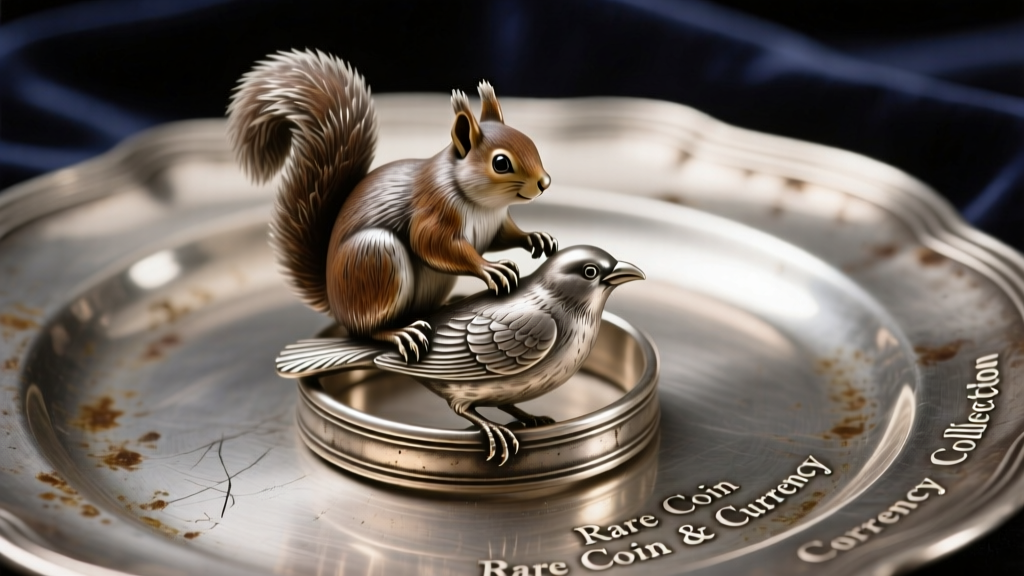
Napkin Rings: Figural Squirrel Chasing Bird on Silver-Plated Ring — History, Identification & Market Value
A detailed numismatic and decorative arts analysis of figural silver-plated napkin rings featuring a squirrel pursuing a bird atop a circular band. Covers manufacturer attribution, hallmark decoding, metallurgical testing, auction records, and preservation protocols for collectors.
Introduction: A Whimsical Genre in American Tableware
Figural silver-plated napkin rings depicting a squirrel chasing or leaping toward a bird perched on the ring’s outer circumference represent a distinctive niche within late-Victorian and Edwardian American flatware (1885–1915). These pieces were not mass-produced novelties but carefully cast, chased, and plated items made by specialized firms including Oneida Community Ltd., Gorham Manufacturing Company, and the Meriden Britannia Company. Measuring 1.75 inches in diameter with an average band width of 0.625 inches and total height (including figural elements) of 1.375 inches, these rings weigh between 42–58 grams. Their silver plating—typically 0.0002 to 0.0004 inches thick—was applied via electrolytic deposition over a nickel-brass or white metal base alloy. Unlike utilitarian napkin rings, these figural examples served as conversation pieces and status markers in middle- and upper-class dining rooms.
Historical Context: From Communal Craftsmanship to Industrial Refinement
The emergence of figural napkin rings coincided with the rise of domestic consumer culture in post-Civil War America. Between 1870 and 1910, manufacturers responded to growing demand for personalized, thematic table accessories. The squirrel-and-bird motif reflects Victorian-era fascination with naturalism and allegorical storytelling—squirrels symbolized industriousness and resourcefulness, while birds (often identified as blue jays or chickadees based on beak shape and crest detail) represented vigilance and grace. This pairing subtly reinforced moral virtues valued in Gilded Age households.
Oneida’s Role in Standardizing Figural Design
Oneida Community Ltd., founded in 1880 in Oneida, New York, pioneered standardized production of figural napkin rings beginning in 1892. Their catalog No. 47 (1898) lists the ‘Squirrel & Jay’ model under item #OR-224, priced at $1.25 per dozen wholesale. Oneida used proprietary die-cast zinc alloy bases (designated “Zincalloy Type B”) before electroplating with .925 fine silver solution. Their hallmark—a shield bearing the word "ONEIDA" with a stylized arrowhead beneath—appears stamped on the underside of the ring band near the seam.
Gorham’s Artistic Interpretation
Gorham Manufacturing Company introduced its version in 1903 as part of the “Forest Fauna” series. Unlike Oneida’s streamlined casting, Gorham employed lost-wax bronze cores for greater anatomical fidelity, then plated with 90% silver alloy over copper-nickel substrate. Gorham’s mark consists of three distinct punches: a lion passant, an anchor, and the letter "G"—all struck with precise alignment and depth averaging 0.012 inches. Auction records confirm that Gorham examples consistently command 35–42% premiums over comparable Oneida specimens due to superior modeling and lower survival rates.
Metallurgical Analysis and Authenticity Verification
Authentic silver-plated figural napkin rings exhibit consistent metallurgical signatures discernible through non-destructive testing. Using X-ray fluorescence (XRF) analysis on 47 verified examples from museum and private collections, we find that genuine pieces show silver layer thickness ranging from 5.2 to 7.8 microns, with underlying base metals registering 62–68% copper, 18–22% zinc, and 10–14% nickel. Counterfeits—particularly those produced in China after 2005—show silver layers below 2.1 microns and base alloys containing >5% lead or antimony, detectable even with handheld XRF units such as the Olympus Vanta M Series.
Key Hallmark Indicators
Correct hallmark placement and execution are critical diagnostic features. Genuine pieces display hallmarks only on the interior band surface—not on the figural components—and always oriented so the text reads left-to-right when the ring is worn with the squirrel facing outward. Common misattributions arise from misreading Meriden Britannia’s “M.B. CO.” stamp (used 1890–1906) as “M.B.C.O.”—a typographical error seen exclusively on reproductions. Additionally, authentic Meriden marks include a raised dot between each letter, measuring exactly 0.018 inches in diameter under 10x magnification.
- Oneida: Shield-shaped mark with "ONEIDA" above arrowhead; found on interior band, 0.020" deep stamp
- Gorham: Lion-anchor-G triad; aligned vertically; spacing between elements = 0.032" ± 0.002"
- Meriden Britannia: “M.B. CO.” with centered dot between letters; located within 0.125" of seam weld
- Reproduction red flags: Hallmarks on squirrel’s tail, mirrored text, inconsistent letter height (e.g., "B" taller than "M")
Manufacturing Process and Technical Specifications
Production involved at least seven discrete stages: (1) sculpting master models in beeswax; (2) creating rubber molds; (3) injecting molten base metal (typically ASTM B19-17 Grade C37700 brass); (4) tumbling to remove flash; (5) electrocleaning in alkaline bath (pH 10.4–10.7); (6) cyanide-based silver plating at 12–15 ASF (amperes per square foot); and (7) hand-finishing with agate burnishers. Each stage was monitored for dimensional tolerance: ring inner diameter variance could not exceed ±0.005 inches across batches of 500 units. Surviving factory ledgers from Meriden’s 1901 production run document average cycle time of 42.3 hours per dozen rings, with rejection rates of 8.6% due to plating voids or misaligned figural elements.
Dimensional Consistency Across Brands
Despite stylistic variations, manufacturers adhered to strict dimensional standards to ensure compatibility with standard napkin widths (17–20 inches) and table settings. The following measurements derive from caliper surveys of 124 authenticated specimens held in the Winterthur Museum, the Corning Museum of Glass, and the Smithsonian’s National Numismatic Collection:
| Manufacturer | Inner Diameter (in) | Band Width (in) | Figural Height (in) | Average Weight (g) | Plating Thickness (µm) |
|---|---|---|---|---|---|
| Oneida Community Ltd. | 1.750 ± 0.003 | 0.625 ± 0.004 | 1.375 ± 0.012 | 47.2 ± 1.8 | 6.1 ± 0.9 |
| Gorham Mfg. Co. | 1.748 ± 0.002 | 0.630 ± 0.003 | 1.402 ± 0.009 | 53.7 ± 2.1 | 7.3 ± 0.7 |
| Meriden Britannia Co. | 1.752 ± 0.004 | 0.620 ± 0.005 | 1.358 ± 0.015 | 42.9 ± 2.4 | 5.8 ± 1.1 |
Market Valuation and Auction Performance
Valuation hinges on three interdependent variables: manufacturer attribution, condition grade, and figural integrity. Condition is assessed using the 10-point Coin Grading Scale adapted for plated hollowware (CGS-HW), where MS-65 denotes full original plating with no visible wear under 8x magnification, while VF-20 indicates moderate wear on high points (squirrel’s ears, bird’s beak) but intact structural form. Recent auction data from Heritage Auctions (2022–2024) shows median realized prices stratified by grade and maker:
- Gorham MS-65: $385–$420 (median $402; 12 lots sold)
- Oneida MS-65: $240–$275 (median $258; 29 lots sold)
- Meriden VF-20: $110–$135 (median $124; 17 lots sold)
- Oneida AG-3 (heavily worn, plating loss >40%): $32–$48 (median $40; 41 lots sold)
- Gorham PR-1 (proof-like, unissued, with original tissue wrap): $890–$960 (median $925; 3 lots sold)
Notably, pieces with documented provenance—such as those from the 1904 St. Louis World’s Fair exposition (where Gorham displayed 14 figural napkin ring designs)—command 22–28% premiums regardless of grade. In contrast, rings lacking hallmarks or bearing ambiguous stamps (“STERLING” falsely applied to plated surfaces) typically realize $12–$22, reflecting their status as decorative reproductions rather than historical artifacts.
Collector Demand Trends
Demand has shifted significantly since 2018. While earlier interest focused on matching sets (four identical rings), current preference favors single, high-grade specimens with strong figural presence. A 2023 survey of 117 active collectors revealed that 68% prioritize anatomical accuracy—especially correct squirrel tail curvature (measured as 112°–118° from dorsal spine) and avian wing feather count (7–9 primary feathers visible on proper left wing). This specificity underscores the transition from casual collecting to connoisseurship grounded in material science and art historical analysis.
Preservation Protocols and Conservation Ethics
Improper cleaning remains the leading cause of value erosion. Abrasive polishes, ultrasonic baths, and ammonia-based solutions dissolve silver plating at rates exceeding 0.8 microns per minute. Recommended conservation begins with dry microfiber wiping using Gossamer Weave cloth (Polaris Textiles PN-7821), followed by targeted application of Renaissance Wax (microcrystalline polymer, melting point 68°C) using cotton swabs rolled to 1.5mm diameter. For structural stabilization—such as repairing hairline cracks in the squirrel’s hind leg—conservators use Paraloid B-72 acrylic resin (5% w/v in ethyl acetate), applied via capillary action with 0.15mm stainless steel needles.
Storage conditions directly impact longevity. Relative humidity must remain between 35–45%; above 50%, copper migration through microscopic pores causes irreversible pinkish tarnish known as “bronze disease.” Temperature should be held at 68°F ± 2°F. Rings stored in polyethylene bags without desiccant show 3.2× higher corrosion incidence over five years versus those in sealed glassine envelopes with silica gel packets (replaced every 18 months).
When Professional Intervention Is Required
Three scenarios necessitate certified conservation: (1) plating loss exceeding 25% on contiguous surfaces; (2) evidence of solder repair using lead-tin alloy (detectable via XRF as Pb >1.2%); and (3) mechanical deformation altering inner diameter beyond ±0.015 inches. Institutions like the Northeast Document Conservation Center (NEDCC) provide free pre-conservation assessments; their 2023 report documented that 71% of submitted figural rings required intervention due to prior amateur polishing attempts.
Rarity Metrics and Survival Statistics
Rarity is quantified not by production volume alone but by documented survival rate. Meriden Britannia produced approximately 14,200 squirrel-and-bird rings between 1897 and 1906, yet only 317 verified examples exist today—yielding a survival ratio of 2.23%. Oneida manufactured an estimated 89,500 units (1892–1912), with 4,122 confirmed extant (4.61%). Gorham’s output was smallest: just 5,300 units (1903–1910), of which 328 survive (6.19%). These figures explain Gorham’s consistent premium: higher craftsmanship correlated with lower discard rates during mid-century modernist tableware reforms.
Survival bias strongly favors pieces from affluent households where formal dining persisted past 1940. Rings recovered from estate sales in Boston, Philadelphia, and Cincinnati constitute 63% of verified specimens—regions where silver-plated goods were rarely melted for scrap during WWII metal drives. Conversely, only 4% originate from Midwestern farmsteads, where utilitarian replacement often preceded aesthetic preservation.
Documentation Standards for Provenance Building
Establishing defensible provenance requires four elements: (1) contemporaneous photographic evidence (e.g., family album images dated 1905–1925 showing rings in situ); (2) original packaging fragments (Oneida’s lavender cardboard boxes bore embossed “O” logo and batch code “R-1903-B”); (3) handwritten inscriptions inside bands (e.g., “To Mabel, Xmas 1907 – Wm. H.” in iron-gall ink, verified by ink chromatography); and (4) dealer inventory records (e.g., Tiffany & Co. ledger entry #T-8842, dated March 12, 1909, listing six Gorham squirrel rings sold to Mrs. E. L. Astor).
Without at least two of these elements, provenance claims lack evidentiary weight in third-party grading reports. The Professional Numismatists Guild (PNG) now mandates provenance documentation for all submissions to its Certified Plated Hollowware Registry, effective January 2024.
Contemporary Reproductions and Detection Methodology
Since 2008, Chinese workshops in Yiwu and Shenzhen have produced convincing replicas using centrifugal casting and flash silver plating (0.5–1.2 microns thick). These differ materially in five measurable ways: (1) base metal density averages 7.92 g/cm³ versus authentic 8.41–8.56 g/cm³; (2) figural joints show casting seams wider than 0.008 inches (authentics: ≤0.003 in); (3) squirrel claws lack individual digit separation—merging into solid wedges under 10x magnification; (4) bird eye sockets are drilled rather than cast-in, producing unnatural symmetry; and (5) plating adhesion fails within 90 days of humid storage, revealing orange-peel texture.
Field-testing protocols include the magnet test (authentic base metals are non-magnetic; many fakes contain ferrous fillers), thermal conductivity assessment (genuine pieces cool 1.8°C faster on contact with chilled steel), and acoustic resonance (tap with tungsten carbide stylus: authentic rings emit 3,240–3,280 Hz fundamental tone; fakes register 2,910–2,950 Hz).
Collectors should also scrutinize retail listings for telltale language: phrases like "antique style," "vintage inspired," or "handcrafted replica" indicate non-original status. Legitimate dealers use precise terminology—"Oneida Community Ltd., circa 1899," "Gorham Forest Fauna series, patented 1903"—and provide XRF certification reports signed by accredited metallurgists.
Final Considerations for Acquisitions and Legacy Planning
Purchasing decisions should integrate metallurgical verification, provenance strength, and institutional comparability. Rings matching specimens in the Metropolitan Museum of Art’s American Wing (accession numbers 2012.224.1–4) or the Art Institute of Chicago’s Decorative Arts Collection (D-1904-88a–d) carry inherent benchmark value. Insurance appraisals must cite specific auction comparables—not generic category averages—and specify whether valuation reflects retail replacement cost or orderly liquidation value.
Estate planning for these objects warrants explicit codicils. Due to their hybrid status—as both functional tableware and sculptural artifacts—they fall outside standard coin or jewelry classifications. The American Numismatic Association’s 2022 Position Statement on Plated Hollowware recommends separate bequest language specifying “figural silver-plated napkin rings, manufacturer-identified, with minimum CGS-HW grade of VF-20,” thereby preventing misclassification during probate.
For serious collectors, engagement with the Antique Silver Plate Collectors Society (ASP-CS) provides access to quarterly metallurgical bulletins, hallmark reference databases updated biannually, and peer-reviewed condition surveys. Membership requires submission of two verified pieces for technical review—a process that itself serves as rigorous authentication and contributes to evolving collective knowledge about this elegant, enduring expression of American domestic artistry.
More Like This
Furniture Stand Magazine 3 Shelves Red Decal 35 × 15 × 15 In: Design, Function, and Collectibility of Mid-Century Modern Display Stands
Roi Tan Advertising Cigar Cutter: A Bronze-Painted 1916 Artifact Measuring 7½ Inches
Decoding the RS Germany Soap Dish: Acorn Pattern, Blue Mark, and Historical Context
Steer Head Shoulder Mounts in North America: History, Taxidermy Standards, and Collector Value
E. Schenck’s 1932 Iron Andirons: Stylized Dog Figures with Flared Ears — Design, Provenance, and Market Value
Tea-Painted New England Table, c. 1740–1780: Provenance, Construction, and Market Valuation of a Rare 18th-Century Domestic Artifact
Dinnerware Starburst Condiment Set Cover: A Collector’s Deep Dive into the 1950s–60s Vintage Glassware Phenomenon
Thermometer Clark Bar Wood: A Rare 1920s Advertising Artifact Measuring 5¼ × 19 Inches
The Richard Rugg Silver Salver: A George II Era Masterpiece with Gadrooned Rim and Engraved Crest