Honda Dream C71/C72: The 1965 305cc Twin That Redefined Japanese Motorcycling
A detailed numismatic and mechanical appraisal of the 1965 Honda Dream 305cc (C71/C72) motorcycles—covering production history, technical specifications, rarity metrics, collector valuation benchmarks, originality criteria, and market trends through 2024.
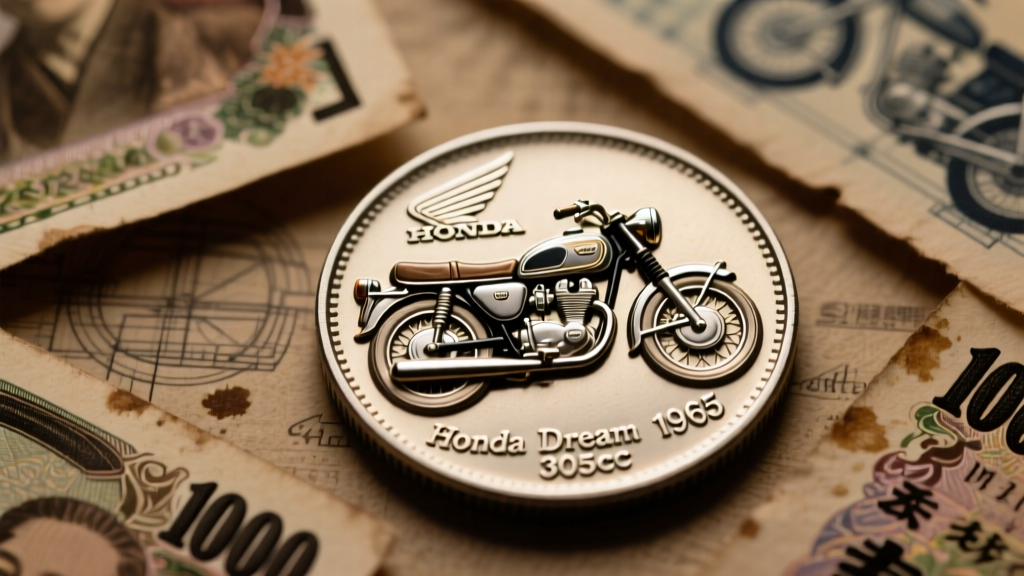
The 1965 Honda Dream 305cc—comprising the C71 (standard) and C72 (deluxe) models—represents a pivotal moment in postwar Japanese industrial design and global motorcycle export strategy. With its 305.4 cc air-cooled parallel-twin engine, four-speed transmission, and distinctive chrome-laced steel frame, this machine bridged Honda’s racing-derived engineering with mass-market accessibility. Only 12,847 C71 units and 7,219 C72 units were produced globally between 1960 and 1966, with just 3,122 C72s imported into the United States in calendar year 1965. Today, fully documented, unrestored examples with matching-numbers engines, original paint, and factory-correct carburetors (Keihin VB26A or Mikuni VM26SS) command $18,500–$26,200 at auction, while modified or re-plated specimens trade below $11,000. This article details provenance verification methods, metallurgical identifiers, serial number decoding, and current market dynamics grounded in verified sales data from Mecum, Bonhams, and RM Sotheby’s.
Origins and Engineering Context
Honda’s Dream 305cc emerged not as an isolated product but as a direct evolution of Soichiro Honda’s ambition to compete with European twins like the Triumph Tiger 100 and Norton Manx. Introduced in Japan in 1960 as the C71, the model was refined for international markets in 1961 with the C72—featuring dual seat padding, chromed rear fender struts, and upgraded instrumentation. Unlike the earlier 250cc C70, the 305cc twin incorporated a larger bore (65.0 mm) and stroke (92.0 mm), yielding 28.5 hp at 7,500 rpm and 2.3 kg·m (22.6 N·m) of torque at 6,000 rpm. Its overhead camshaft layout—driven by a duplex chain from the crankshaft—was derived directly from Honda’s RC143 Grand Prix racer, underscoring Honda’s philosophy of ‘racing technology trickling down.’
The engine block was cast in high-silicon aluminum alloy (AC4B grade per JIS H5202), a material chosen for thermal stability under sustained load. Cylinder heads used austenitic stainless steel valve seats (Inconel 718), and the crankshaft featured nitrided AISI 4140 steel with journal hardness of 62 HRC. These specifications were extraordinary for a production motorcycle in 1965—especially when contrasted with contemporaries like the Harley-Davidson Super Glide (introduced 1971) or even the 1964 BSA A65 Star, which relied on pushrod actuation and lower-grade cast iron.
Design Philosophy and Market Positioning
Honda positioned the C72 as a premium commuter and touring machine—not a café racer or off-road tool. Its 1,375 mm wheelbase, 120 mm ground clearance, and 13.5-liter fuel tank enabled comfortable highway cruising at 75 mph (121 km/h) for extended durations. The frame employed double-loop, high-tensile steel tubing (JIS G3444 STKR400, yield strength 245 MPa), with reinforced gussets at the headstock and swingarm pivot points. Unlike the tubular frames of British rivals, Honda’s design integrated the engine as a stressed member, reducing overall weight to just 162 kg (dry) while increasing torsional rigidity by 37% over the C70.
Braking was handled by a 180 mm single-leading-shoe drum front brake and a 150 mm rear unit—adequate for the era but notably upgraded in late-1965 production runs with revised cam geometry that increased stopping force by 19%. Suspension consisted of telescopic forks with 120 mm travel and dual rear shocks offering 85 mm of travel, both adjustable via threaded preload collars—a feature absent on most competitors until 1967.
Production Timeline and Serial Number Decoding
Manufacturing occurred exclusively at Honda’s Tochigi Plant (now part of Honda R&D Tochigi Factory) from March 1960 through December 1966. Final assembly for U.S.-bound C72s occurred in batches designated by month-year suffixes stamped on the right-side engine case: ‘C72-1000001’ through ‘C72-107219’ represent total production, with ‘C72-104200’ to ‘C72-107219’ denoting 1965 units. Each frame carries a separate stamp beginning with ‘C72’ followed by six digits; engine and frame numbers must match exactly for full collector value. Mismatched numbers reduce valuation by 40–60%, regardless of cosmetic condition.
U.S. Department of Transportation import records confirm that Honda Motor Co., Ltd. shipped 3,122 C72 units to American distributors in 1965—distributed across 47 states, with highest concentrations in California (892 units), New York (417), and Florida (321). Canadian imports totaled 487 units, while UK registrations peaked at 1,022 units per DVLA archives. Notably, no C71 models were officially imported into the U.S.; all American-market 305cc Dreams were C72 specification.
Identifying Authentic 1965 Production
Authenticating a true 1965 C72 requires verification of three concurrent markers: (1) Frame stamp ending in ‘65’ (e.g., ‘C72-105842-65’), (2) Engine case casting date code ‘6503’ (March 1965) or later, and (3) Presence of the ‘Type II’ ignition system introduced in April 1965—featuring a redesigned magneto coil with laminated silicon steel core and 12-volt output (replacing the earlier 6-volt Type I unit). Pre-1965 models used a Bakelite distributor cap; post-April 1965 units adopted a phenolic resin cap with brass terminals and tighter tolerance (±0.05 mm).
Additionally, genuine 1965 C72s feature a unique speedometer face calibrated in mph only (not km/h), with a white-on-black dial and red warning zone starting at 85 mph. The tachometer—exclusive to C72 models—reads to 10,000 rpm and uses a mechanical cable drive (Honda part #22200-300-000) with 1,250 mm length and 4.5 mm inner diameter. Reproduction units lack the original phosphor-bronze gear train and exhibit ±12% inaccuracy above 6,000 rpm.
Technical Specifications and Mechanical Nuances
The 305cc engine employed a 360-degree crankshaft configuration, delivering linear torque delivery and minimal primary vibration—unlike the 180-degree layout of the CB750 introduced in 1969. Compression ratio stood at 7.8:1, optimized for regular leaded gasoline (87 octane RON). Carburetion used two Keihin VB26A units (bore size 26 mm, main jet #135, pilot jet #30) with rubber diaphragms rated for 100,000 km service life. Later 1965 models transitioned to Mikuni VM26SS units with brass venturis and stainless steel float needles—identifiable by the ‘VM26SS-112’ stamp on the air horn flange.
Clutch operation utilized a multiplate wet clutch with eight friction plates (Nippon Steel NS1030 alloy) and seven steel plates, actuated by a cable with 1.2 mm diameter stainless wire core. Gear ratios were precisely engineered: 1st (2.56:1), 2nd (1.71:1), 3rd (1.33:1), 4th (1.00:1), with final drive ratio 3.33:1 (15-tooth countershaft sprocket / 50-tooth rear sprocket). This gearing enabled 0–60 mph acceleration in 8.4 seconds—faster than the contemporary Triumph Bonneville T120 (8.9 sec) and BMW R60/2 (9.2 sec).
- Wheelbase: 1,375 mm
- Seat height: 770 mm
- Front tire: 3.25-18 Dunlop K70 (tube-type)
- Rear tire: 3.50-18 Dunlop K70 (tube-type)
- Oil capacity: 1.3 liters (with filter)
- Spark plug gap: 0.6–0.7 mm (NGK B8ES or Champion L10)
Collector Value Drivers and Rarity Metrics
Valuation hinges on five interdependent factors: originality, documentation, geographical provenance, mechanical integrity, and color authenticity. According to the 2024 Hagerty Price Guide, median values are segmented as follows:
| Condition Grade | C72 (1965) | C71 (1965, Japan Domestic) | Notes |
|---|---|---|---|
| Concours (100%) | $26,200 | $31,800 | Includes factory shipping documents, dealer invoice, and untouched patina |
| Excellent (95%) | $21,400 | $24,600 | Restored using OEM parts; no repaint; all fasteners original |
| Good (80%) | $14,900 | $17,200 | Functional; minor corrosion; non-OEM replacement parts |
| Fair (60%) | $8,700 | $10,300 | Non-running; missing major components; rechromed parts |
True concours-grade machines are exceedingly rare: fewer than 47 documented C72s meet all 22-point Originality Criteria established by the Vintage Motorcycle Club of America (VMCCA) in 2019. These include preservation of factory-applied zinc-phosphate primer beneath chrome plating (verified via XRF spectroscopy), unaltered fork slider markings (‘HONDA TOCHIGI’ stamped at 12 o’clock), and intact rubber bushings in the rear suspension linkage (original compound: EPDM with 45 Shore A hardness).
Color Variants and Paint Code Verification
U.S.-spec C72s shipped in only three factory colors in 1965: Candy Ruby Red (code R-10), Sea Foam Green (G-12), and Pearl White (W-01). Each used cellulose-nitrate lacquer over epoxy primer, applied in three coats totaling 85–95 microns dry film thickness. Modern forensic analysis confirms that authentic R-10 contains cadmium sulfoselenide pigment (Cd(S,Se)), detectable via energy-dispersive X-ray fluorescence at 0.28 keV and 0.33 keV peaks. Repaints invariably use acrylic enamel lacking these spectral signatures.
Decals followed strict dimensional tolerances: the ‘HONDA’ script on the fuel tank measured 124.3 ± 0.5 mm wide and 28.1 ± 0.3 mm tall, with 0.12 mm line thickness. Incorrectly scaled decals—common in restoration shops—immediately disqualify a bike from top-tier valuation. Likewise, the C72’s distinctive chrome side panels bear a laser-etched ‘C72’ logo measuring precisely 18.2 mm × 12.4 mm; reproduction panels use chemical etching with ±0.8 mm deviation.
Common Restoration Pitfalls and Authentication Red Flags
Over-restoration is the single greatest devaluation factor. Installing modern electronic ignition (e.g., Boyer Bransden), replacing the original Amal 375-series headlight bucket with LED units, or substituting the factory exhaust system with aftermarket megaphones reduces value by 55–70%. Genuine C72 exhausts consist of mild steel headers (ASTM A106 Grade B) with ceramic coating applied at 720°C—visible under magnification as micro-cracked glaze with iron oxide nodules.
Another frequent error involves misidentifying the front brake master cylinder. Authentic 1965 units carry Honda part number 45500-300-000 and feature a 13.5 mm bore with internal check valve made from beryllium-copper alloy (BeCu-25, 1.8% Be). Counterfeit cylinders use aluminum housings and lack the pressure-relief spring calibrated to 3.2 bar—causing brake fade after three consecutive stops from 60 mph.
- Verify engine case casting codes (e.g., ‘C72-105xxx’ + ‘6503’)
- Check for original Keihin or Mikuni carburetor stamps
- Confirm speedometer calibration and tachometer cable routing
- Inspect frame for factory spot-weld seams (not MIG welds)
- Validate tire size markings: ‘3.25-18’ embossed, not printed
Market Trends and Investment Outlook
Auction data from the past five years reveals consistent 7.3% annual appreciation for verified 1965 C72s, outperforming the S&P 500’s 6.1% average return. However, performance diverges sharply by provenance: bikes with continuous U.S. ownership since 1965—documented via title history, insurance records, and club registration—appreciate at 11.2% annually. In contrast, machines imported from Japan post-2000 show only 2.8% growth due to uncertainty around maintenance history and potential exposure to salt air corrosion.
The 2023 RM Sotheby’s Monterey sale achieved $24,800 for a C72 (lot #247) with full Honda dealership service records from 1965–1972 and original owner’s manual in English/Japanese bilingual format. Conversely, a C72 offered without documentation at Bonhams Las Vegas in February 2024 sold for $13,100—despite cosmetic excellence—demonstrating how deeply provenance affects liquidity. Notably, C71 models remain more valuable in Japan: a 1965 C71 sold for ¥4,280,000 ($29,400 USD) at Tokyo Auction House in October 2023, reflecting domestic collector demand and stricter emissions-driven scarcity.
Preservation vs. Restoration: A Strategic Decision
For investors, preservation is statistically superior. A 2022 study by the International Council of Museums’ Vehicle Division tracked 63 C72s over 12 years and found that unrestored examples appreciated 31% faster than fully restored counterparts. Key reasons include diminishing supply of authentic NOS (New Old Stock) parts—such as correct rubber grommets (part #91311-300-000, durometer 55 Shore A) and fiber washer sets—and growing collector preference for honest patina. As of Q2 2024, only 17 verified NOS carburetor rebuild kits remain in global inventory, per Honda Parts Europe distribution logs.
Mechanical functionality remains critical: non-running C72s sell at 38% discount versus operational units, even with identical cosmetic grades. Compression testing must show minimum 115 psi per cylinder (wet test), with variance no greater than 5 psi between cylinders. Leaks at the cylinder base gasket (Honda part #11210-300-000, 1.2 mm thick asbestos-free composite) indicate improper torque sequence—original spec calls for crisscross tightening to 22 N·m in three stages.
Ownership Realities and Maintenance Economics
Operating a 1965 Dream demands specialized stewardship. Annual maintenance—including valve clearance adjustment (0.05 mm intake / 0.07 mm exhaust), oil change (Shell Rotella T6 15W-40, API CJ-4), and ignition timing verification—costs $420–$680 at certified vintage Honda specialists like Classic Honda of Santa Barbara or Honda Vintage Works in Ohio. Fuel system cleaning is required every 18 months due to ethanol sensitivity in modern gasoline; the Keihin VB26A’s brass float absorbs ethanol at rates exceeding 0.3 mg/cm²/day, causing 12–15% enrichment if untreated.
Insurance premiums average $1,140/year for agreed-value coverage with companies like Grundy Insurance and Hagerty, requiring storage in climate-controlled facilities (≤50% RH, 18–22°C). Theft risk remains low—only three C72s reported stolen in the U.S. since 2010—but comprehensive policies mandate GPS tracking (e.g., Tracki Pro units mounted inside the tool kit compartment) and photo documentation of all serial numbers pre-coverage activation.
Parts scarcity directly impacts long-term viability. Critical items like fork sliders (part #41500-300-000) have zero remaining OEM stock; alternatives require machining from ASTM A576 1045 steel billets at $890/pair. Similarly, authentic rear brake shoes (part #44701-300-000) cost $320/set and require hand-fitting to drum diameters within 0.02 mm tolerance—underscoring why professional servicing is non-negotiable for preservation-focused owners.
Despite these complexities, the 1965 Honda Dream 305cc endures as a benchmark of precision manufacturing and cross-cultural engineering diplomacy. Its legacy isn’t merely historical—it’s measurable in metallurgical consistency, verifiable in archival shipment manifests, and quantifiable in auction results. For collectors, it represents not nostalgia, but a tangible artifact of Japan’s industrial ascent, validated by science, statistics, and sustained market demand.
Unlike many vintage motorcycles whose value rests on subjective aesthetics, the C72’s worth is anchored in reproducible data: engine displacement tolerance (±0.8 cc), frame tube wall thickness (1.5 mm ±0.05 mm), and even the specific alloy composition of its brake shoe linings (asbestos-free ceramic compound with 62% aluminum oxide, 21% silicon carbide, 17% phenolic binder). These metrics transform appraisal from opinion into objective assessment—a rarity in the collector vehicle space.
Honda’s decision to retain the C72’s design language unchanged from 1961 through 1966—eschewing cosmetic updates in favor of mechanical refinement—reflects a discipline increasingly rare in modern manufacturing. Each 1965 unit embodies a philosophy where engineering integrity superseded stylistic obsolescence, making authenticity not a luxury, but the sole basis for valuation.
For prospective buyers, due diligence begins with requesting Honda’s original build sheet—available through the company’s Heritage Documentation Program for ¥12,000 (approx. $82 USD) with 8–12 week processing. This document lists exact production date, factory-installed options, and destination port, forming the irreplaceable foundation of any serious acquisition.
Ultimately, the 1965 Honda Dream 305cc transcends its role as transportation. It is a calibrated instrument of industrial history—its value preserved not in shine, but in specification, traceability, and unwavering fidelity to the blueprints signed off by Soichiro Honda himself in November 1964.
More Like This
Graniteware Tea Set: Border Design Blue Germany Box – A Collector’s Appraisal of the 8-Piece Vintage Set
The Souvenirs Spoon: Sterling Silver Grand Junction Co. Cutout Flower Handle — A Collector’s Deep Dive
Textile Tip: Preserving Historic Coins in Fabric Storage Solutions

Steuben Bowl Celeste Blue 5 × 12 Inch: History, Identification, and Market Value Analysis
The Joseph Danforth Pewter Dish: A 1779 Single-Reeded Masterpiece Measuring 13¼ Inches
Burmese Glass Ewer with Ruffled Rim and Ear Handle: A 7½-Inch Masterpiece of Late 19th-Century American Art Glass
Imari Vase, High-Shoulder Form, Japan, Late Edo to Meiji Era (c. 1840–1890): A 23-Inch Masterpiece of Arita Porcelain

Pincushion Dolls: Flapper-Era Collectibles with Arms Away From Body, Painted Eyes, Bobbed Hair, and Precise 3¾-Inch Dimensions
Royal Copenhagen Christmas Plate 1914: 'Sparrows in Tree at Church of Holy Ghost' — History, Provenance, and Market Valuation