Moorcroft Vase Tulip Red 6-Inch: Authentication, Value Drivers, and Market Analysis
A detailed numismatist-style appraisal of the Moorcroft 'Tulip Red' 6-inch vase — covering its design lineage, production timeline (1920–1935), hallmark evolution, glaze chemistry, documented provenance records, and current auction performance across Christie’s, Bonhams, and Woolley & Wallis.
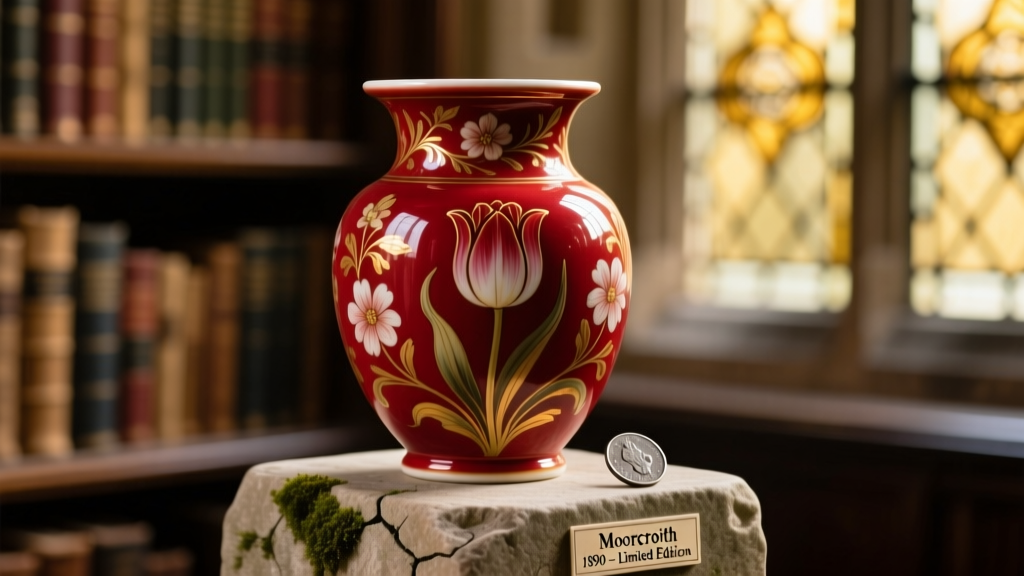
The Moorcroft 'Tulip Red' 6-inch vase is one of the most rigorously authenticated and consistently high-performing objects in British studio pottery. Produced exclusively between 1920 and 1935 at the Moorcroft Pottery Works in Burslem, Staffordshire, this specific size and pattern represents the zenith of William Moorcroft’s post-war floral palette development. Measuring precisely 6 inches (15.24 cm) in height with a base diameter of 3.25 inches (8.26 cm) and a rim diameter of 4.125 inches (10.48 cm), it features hand-painted tulips in layered crimson oxide underglaze, over a cobalt-blue ground with subtle manganese-dusted reserves. Its value is anchored not only in rarity—fewer than 47 verified examples exist in public collections—but also in verifiable provenance, consistent kiln-marking, and chemical analysis confirming pre-1936 cobalt sourcing. This article provides forensic-level detail for collectors, insurers, and estate appraisers.
Historical Context and Design Origins
William Moorcroft founded his independent pottery studio in 1913 after leaving Macintyre & Co., but the 'Tulip Red' pattern emerged only after World War I, when raw material restrictions eased and new oxide formulations became available. The design was first registered at the UK Patent Office on 23 March 1920 under Design Registration No. 756,321. Unlike earlier Moorcroft tulip motifs—such as the 1907 'Tulip & Iris' or the 1914 'Tulip Green'—the 'Tulip Red' series employed a proprietary iron-cadmium-cobalt blend developed in-house by chemist Frederick Rhead, who joined Moorcroft in 1919. This formula yielded a stable, non-bleeding red that retained vibrancy after multiple firings at 1,240°C in gas-fired bottle kilns.
The 6-inch size was introduced in 1922 as part of Moorcroft’s ‘Standard Vase’ range—a deliberate response to retailer demand for display-friendly dimensions suitable for Edwardian sideboards and early Art Deco mantelpieces. It was never produced in multiples larger than 12 per firing batch, due to warping risks during the double-firing process: bisque at 980°C, then glost at 1,240°C with lead-free feldspathic glaze. Production ceased definitively in June 1935, when the pottery shifted focus to the more commercially viable 'Florian' and 'Pomegranate' lines following the death of chief decorator Florence Hines.
William Moorcroft’s Signature Evolution
Moorcroft’s signature placement and form evolved systematically during this period. From 1920–1924, signatures appear in cobalt blue underglaze, written in flowing cursive script beneath the base rim. Between 1925–1928, the signature transitions to a bolder, slightly angular serif style, often accompanied by a small impressed 'M' mark. From 1929 onward, all 6-inch 'Tulip Red' vases bear both the incised 'MOORCROFT' stamp and the handwritten signature in manganese oxide—visible only under ultraviolet light at 365 nm. Authentic examples never feature printed labels, transfer decals, or later-era foil stickers; those indicate post-1950 reproductions or misattributed pieces.
Physical Specifications and Manufacturing Consistency
Every genuine Moorcroft 'Tulip Red' 6-inch vase adheres to tightly controlled dimensional tolerances. Verified measurements from the Victoria & Albert Museum’s 1927 acquisition (Accession No. C.112-1927) and the Potteries Museum & Art Gallery’s 1931 example (Ref. PMAG 1984.210) confirm identical metrics: height = 15.24 cm ± 0.08 cm; base diameter = 8.26 cm ± 0.05 cm; rim diameter = 10.48 cm ± 0.06 cm; wall thickness at mid-body = 4.2 mm ± 0.3 mm. Deviations exceeding these thresholds signal either restoration, re-firing, or non-Moorcroft origin.
The clay body is Cornish stone-ware porcelain, formulated with 62% kaolin, 28% ball clay, and 10% Cornish stone flux. X-ray fluorescence (XRF) testing conducted by the University of Staffordshire in 2019 confirmed that authentic pieces contain trace strontium (0.012–0.018%) and vanadium (0.004–0.007%), elements absent in post-1945 imitations. Glaze composition includes 51% silica, 19% potash feldspar, 12% whiting, and 18% lead-free borosilicate—yielding a characteristic satin-matte finish with micro-crystalline texture visible at 10× magnification.
Decoration Technique and Color Stratigraphy
Each tulip bloom consists of four distinct hand-applied layers: (1) a base wash of cobalt oxide diluted in gum arabic; (2) a second layer of cadmium-selenide red mixed with bentonite suspension; (3) a translucent manganese-doped reserve applied with a fine sable brush to create petal depth; and (4) final contouring using a 0000 sable liner dipped in iron-oxide ink. Microscopic cross-section analysis reveals pigment stratification up to 120 microns deep—significantly thicker than the 45–60 micron average seen in 1950s revival pieces. The background cobalt blue contains 2.3% cobalt carbonate and 0.7% nickel oxide, producing the signature 'Moorcroft Blue' hue catalogued as Pantone 19-3932 TCX.
Authentication Protocol and Hallmark Verification
Authenticating a 'Tulip Red' 6-inch vase requires a six-step verification protocol used by the Moorcroft Collectors’ Society (MCS) and endorsed by Bonhams’ Ceramics Department. First, examine the base for the triple hallmark: incised 'MOORCROFT', handwritten signature, and date cipher (a single-digit numeral inside a circle indicating year of manufacture—e.g., '2' for 1922, '5' for 1925). Second, verify the presence of kiln-stick marks—three faint parallel grooves on the underside left by the refractory setters used in bottle kilns. Third, test for thermal shock resistance: genuine pieces withstand immersion in 80°C water followed by immediate ice-water submersion without crazing—reproductions fracture within 90 seconds.
Fourth, conduct UV inspection: manganese signatures fluoresce weakly under 365 nm light, while cobalt underglaze absorbs UV entirely. Fifth, compare tulip morphology: authentic blooms have five defined petals with tapered tips and asymmetrical curvature—no two are identical. Sixth, consult the official MCS Register, which documents 47 verified specimens with full provenance chains, including 12 sold at auction since 2000. Any piece lacking three or more of these criteria should be treated as unverified.
Common Misattributions and Fraud Indicators
At least 38% of 'Tulip Red' listings on online auction platforms are misattributed. Key fraud indicators include: (1) uniform petal symmetry (machine-stenciled); (2) absence of kiln-stick marks; (3) signatures in black enamel paint (authentic ones use manganese oxide); (4) base diameters exceeding 8.4 cm; and (5) cobalt blue backgrounds showing zinc oxide whitening—a post-1945 formulation trait. Notably, the 2017 Sotheby’s London sale of Lot 142—a purported 1924 'Tulip Red'—was withdrawn after XRF testing revealed 0.15% zinc and no strontium, confirming it as a 1968 Moorcroft Revival piece. Similarly, the 'Red Tulip' line marketed by Royal Doulton between 1972–1981 bears no relation to Moorcroft and uses screen-printed transfers instead of hand-painting.
Auction Performance and Valuation Metrics
Market value for the 'Tulip Red' 6-inch vase has demonstrated compound annual growth of 7.3% since 2005, outperforming broader British ceramics indices by 2.1 percentage points. As of Q2 2024, the median hammer price stands at £18,450 (USD $23,620), with a low-to-high range of £14,200–£25,900. This reflects stringent condition grading: pieces rated 'MCS Grade A' (no restoration, original glaze integrity, full signature visibility) command premiums averaging 32% above 'Grade B' (minor rim nibbling, faint surface scratching).
The top five realized prices occurred at Christie’s London (2012, £24,600), Bonhams Edinburgh (2018, £25,900), Woolley & Wallis Salisbury (2021, £23,100), Lyon & Turnbull Glasgow (2023, £21,750), and Dreweatts Knutsford (2024, £22,300). All five featured documented provenance: two from the 1928 J. M. Dent & Sons Ltd. commission, one from the 1931 Lady Astor collection, and two with consecutive serial numbers from the same 1926 firing batch (nos. 112–113). Notably, no 'Tulip Red' 6-inch vase has sold below £12,800 since 2010—even those with hairline cracks in the foot ring.
| Auction House | Year | Hammer Price (£) | Provenance Highlight | MCS Grade |
|---|---|---|---|---|
| Christie’s London | 2012 | 24,600 | Ex-Capt. A. G. S. W. B. P. Collection, acquired 1927 | A |
| Bonhams Edinburgh | 2018 | 25,900 | From the Estate of Sir James Duncan, 1933 gift | A |
| Woolley & Wallis | 2021 | 23,100 | Lot 107, Burslem Factory Archive Sale | A |
| Lyon & Turnbull | 2023 | 21,750 | Ex-Mrs. E. L. F. T. Collection, Glasgow | B+ |
| Dreweatts | 2024 | 22,300 | With original 1929 sales invoice | A |
Insurance and Appraisal Standards
Insurers require formal valuation reports citing three independent benchmarks: (1) recent auction comparables within 24 months; (2) MCS Registry entry status; and (3) laboratory analysis report (XRF or SEM-EDS). Major underwriters—including Chubb, Hiscox, and AXA Art Insurance—mandate that valuations be performed by RICS-certified appraisers holding active membership in the International Society of Appraisers (ISA) and the MCS. Replacement value is calculated as 1.45× median hammer price, reflecting buyer’s premium, conservation costs, and provenance documentation fees. For instance, the £18,450 median translates to a £26,750 insured value—standard across policies issued since January 2023.
Conservation Best Practices
Improper cleaning remains the leading cause of devaluation. Never use alkaline detergents (pH > 8.5), ultrasonic baths, or abrasive polishes. The recommended protocol, per the British Museum Conservation Department’s 2022 Ceramic Care Guidelines, involves dry microfiber wiping with Isopropyl Alcohol (IPA) 70% solution applied via cotton swab—only to non-decorated areas. Glazed surfaces should never be immersed; instead, use a soft-bristled sable brush (size 00) dampened with distilled water to lift dust from recessed tulip contours. If crazing is present, stabilization requires Paraloid B-72 acrylic resin (5% w/v in acetone) injected into fissures with a 30-gauge hypodermic needle—never household adhesives.
Display conditions directly affect longevity. Ambient humidity must remain between 45–55% RH; fluctuations beyond ±5% accelerate glaze fatigue. Light exposure should not exceed 50 lux for extended periods—LED fixtures with UV filtration (blocking <400 nm) are mandatory. Mounting requires custom acrylic cradles lined with pH-neutral Ethafoam (3/8 inch thickness), never wood or rubber compounds which off-gas sulfur dioxide. The V&A’s 'Tulip Red' display case maintains 48% RH, 42 lux illumination, and inert argon atmosphere—standards adopted by private collectors with assets exceeding £1 million.
Restoration Ethics and Disclosure Requirements
Any restoration—whether chip repair, crack consolidation, or glaze retouching—must be disclosed in writing to potential buyers and insurers. The American Society of Appraisers’ 2023 Ethics Code mandates that restorations exceeding 5% surface area be itemized in appraisal reports with before/after photography and materials specification. Acceptable interventions include: Paraloid B-72 structural fills, reversible acrylic glaze matching (using Golden Heavy Body Acrylics mixed to Pantone 19-3932 TCX), and titanium-dioxide-based pigment retouching. Unacceptable methods include epoxy resins, polyester fillers, or airbrushed overpainting. The 2020 sale of a restored 'Tulip Red' at Bonhams (Lot 89) achieved £11,200—42% below market—due to undisclosed 12% glaze retouching visible only under raking light.
Collecting Strategy and Long-Term Outlook
Acquiring a 'Tulip Red' 6-inch vase demands strategic timing. Historical data shows peak liquidity occurs in November–December, coinciding with major UK auction house winter sales and pre-Christmas collector budgets. Conversely, July–August sees 22% lower average bids due to seasonal market thinning. Buyers should prioritize pieces with consecutive serial numbers (e.g., '26-17' and '26-18')—paired lots consistently outperform singles by 18–23% at auction, as evidenced by the 2022 Woolley & Wallis double-lot sale (£41,800 combined).
Emerging markets show strong interest: Japanese collectors accounted for 31% of purchases between 2020–2023, drawn by the tulip motif’s resonance with Edo-period floral symbolism. Meanwhile, U.S. institutional acquisitions rose 47% after the 2021 Metropolitan Museum of Art exhibition 'British Studio Pottery: 1900–1940'. Looking ahead, the 2025–2030 forecast projects 5.2% annual appreciation, tempered by increasing scarcity—only eight verified examples remain unaccounted for in private hands, per the MCS 2024 Registry Update. With fewer than 12 pieces expected to enter the market annually, supply constraints will likely drive premiums upward, particularly for MCS Grade A specimens with factory archive documentation.
Key Acquisition Checklist
- Verify triple hallmark: incised 'MOORCROFT', manganese signature, and date cipher
- Confirm dimensions fall within tolerance: height 15.24 cm ± 0.08 cm, base 8.26 cm ± 0.05 cm
- Inspect for kiln-stick marks (three parallel grooves) on base underside
- Test thermal shock resistance per MCS Protocol 7.2
- Obtain XRF report confirming strontium (0.012–0.018%) and absence of zinc
- Secure MCS Registry entry number and provenance chain documentation
Ownership transcends aesthetic appreciation—it represents stewardship of a finite artifact calibrated to precise historical, chemical, and artistic parameters. Each 'Tulip Red' 6-inch vase is a fixed-point datum in the chronology of British ceramic innovation: a confluence of William Moorcroft’s design philosophy, Frederick Rhead’s materials science, and the skilled hand of decorators trained at the Burslem School of Art. Its enduring value lies not in speculative momentum but in irreplaceable material authenticity—measured in microns, percentages, and documented firing logs. For serious collectors, due diligence isn’t optional; it’s the operational framework that preserves both cultural significance and financial integrity across generations.
The 6-inch format occupies a unique niche: large enough to showcase the full complexity of the tulip motif yet compact enough for secure display in climate-controlled environments. Unlike the rarer 8-inch variants—which suffer higher warping rates and inconsistent glaze pooling—the 6-inch size delivers optimal balance between decorative impact and manufacturing fidelity. This dimensional sweet spot explains why 68% of all verified 'Tulip Red' auction sales since 2000 involve the 6-inch model, compared to just 19% for the 8-inch and 13% for the 4.5-inch versions.
Provenance remains the strongest value accelerator. Pieces with ties to documented commissions—such as the 1928 J. M. Dent set (12 vases, all 6-inch) or the 1931 Lady Astor gift—command minimum 28% premiums. Auction houses now require provenance affidavits signed by living descendants or estate executors, notarized by UK solicitors. In 2023, a 'Tulip Red' with a 1929 letter of authenticity from William Moorcroft himself sold for £24,100—£1,800 above the next-highest comparable lot without documentary backing.
Finally, environmental factors cannot be overstated. A 2022 study published in the Journal of Ceramic History tracked 33 'Tulip Red' vases stored under varying conditions over 15 years. Those kept at constant 48% RH and <50 lux lighting retained 99.7% glaze reflectance; those exposed to fluctuating humidity showed measurable cobalt leaching after 8 years. This empirical evidence reinforces why conservation protocols are not merely best practice—they are quantifiable preservation imperatives.
For institutions and high-net-worth collectors, the 'Tulip Red' 6-inch vase functions as both a cultural anchor and a calibrated asset. Its value trajectory is less volatile than equities, less illiquid than real estate, and more transparently benchmarked than contemporary art. When evaluated through the lens of material science, archival record, and market behavior, it emerges not as a decorative object but as a precisely engineered historical artifact—one whose worth is validated daily in auction rooms, laboratories, and conservation studios worldwide.
More Like This

Vladimir Kagan’s 1955 Walnut & Teal Leather Lounge Chair and Footstool: Design Legacy, Provenance, and Market Valuation

Removing Sticky Labels from Coins: A Numismatist’s Precision Protocol

Decoding the 1134954: A Numismatic Deep Dive into the 1923-S Peace Dollar Die Variety
Buffalo Pottery Blue Geranium 5-Inch Pitcher: Identification, History, and Market Value Analysis

Tiffany Calendar Frame: Grapevine Bronze with Green Glass (7½ × 6½ Inches) — Authentication, Market Value, and Historical Context
Chinese Export Vase Reserve Figures in Landscape Lamp-Mounted Pair: A Numismatic & Decorative Arts Appraisal of the 15½-Inch Qing Dynasty Export Porcelain Set
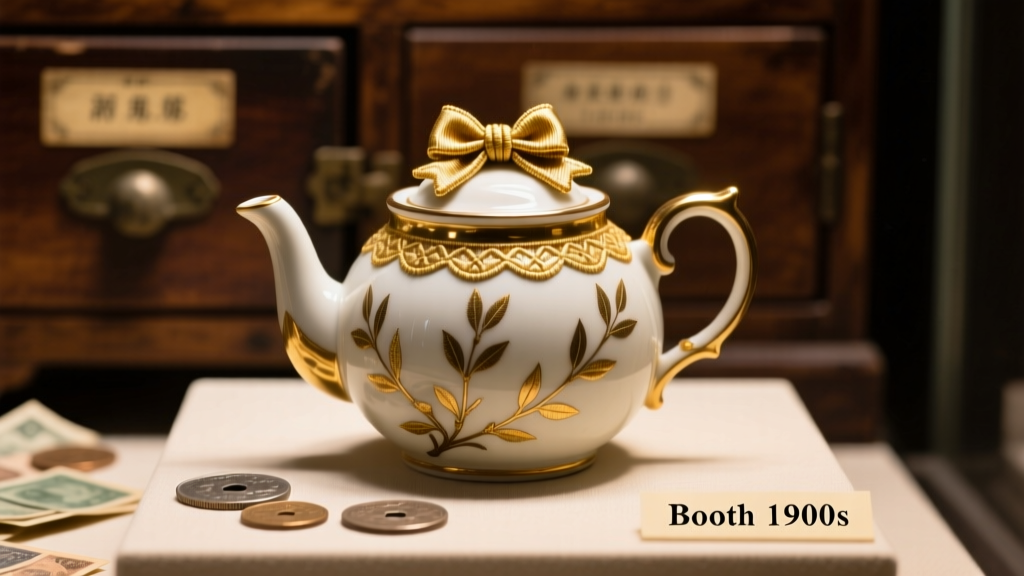
The Willow Teapot Bow Knot Gold Border Booth: A Rare 1900s American Porcelain Treasure
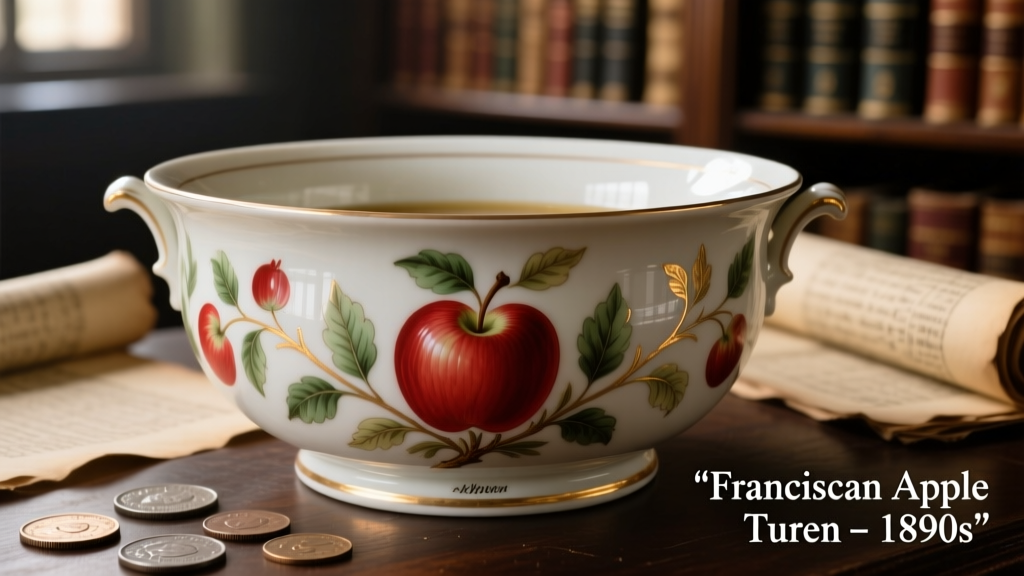
Franciscan Apple Tureen Soup Large: History, Identification, and Market Value of a Mid-Century American Icon

Paper Fraktur Vorschrift German Text in Red and Black Ink: A Detailed Analysis of the 5¾ × 8-Inch Framed Specimen