Modern Coinage: The Evolution of U.S. Currency from 1945 to Today
A detailed numismatic analysis of U.S. coin production, composition shifts, design innovations, and market dynamics from the postwar era through the 21st century — covering key series, minting technologies, error varieties, and verified valuation benchmarks.
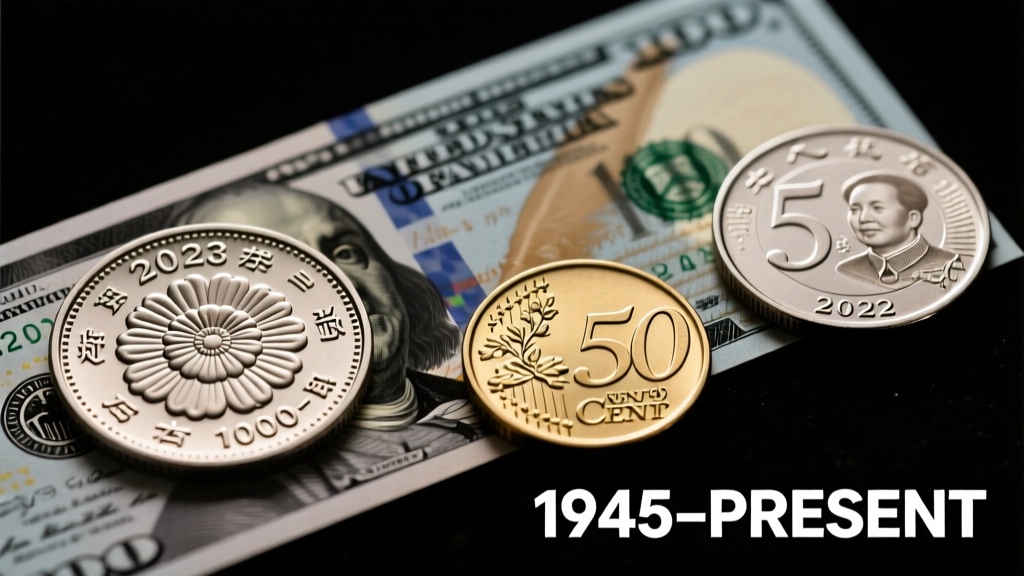
From the final year of World War II to the digital age, U.S. coinage has undergone profound metallurgical, technological, and aesthetic transformations. Between 1945 and 2024, the U.S. Mint produced over 187 billion coins across 12 denominations, shifting from wartime bronze and steel alloys to multi-ply clad compositions, introducing base-metal replacements for silver, and adopting laser-guided die engraving and high-speed robotic packaging. This era saw the elimination of silver from circulating dimes and quarters in 1965, the debut of the Kennedy half dollar in 1964 (first issued in 1964 but widely circulated from 1965 onward), the introduction of the Susan B. Anthony and Sacagawea dollars, and the launch of the America the Beautiful Quarters Program in 2010. Numismatically, this period delivers exceptional depth: scarce early proof sets, low-mintage commemoratives like the 1976 Bicentennial quarter with dual date (1776–1976), and modern high-relief issues such as the 2015 American Liberty High Relief Gold $100 coin — struck at just 20,000 pieces. Market values range from face value for common circulation strikes to six-figure premiums for certified MS-70 examples of key dates.
Postwar Composition Shifts and the End of Silver
The immediate postwar era marked a pivotal transition in coin metallurgy. In 1943, due to copper shortages, the U.S. Mint produced Lincoln cents on zinc-coated steel planchets — a temporary measure abandoned after 1943. By 1944, copper returned, but at reduced purity: 95% copper, 5% zinc replaced the prewar 95% copper, 5% tin-zinc alloy. That 1944–1946 composition remained standard until 1962, when the Mint altered the cent’s alloy to 95% copper, 5% zinc — eliminating tin entirely. More consequential was the removal of silver from circulating coinage. The Coinage Act of 1965 mandated that dimes and quarters be struck in a copper-nickel clad composition: two outer layers of 75% copper, 25% nickel bonded to a pure copper core. Half dollars followed suit in 1971, though their 1965–1970 issues retained 40% silver content — a transitional ‘clad silver’ hybrid with a distinct grayish luster and measurable density of 8.9 g/cm³ versus 8.5 g/cm³ for full-clad coins.
The last 90% silver circulating coins were dated 1964: Roosevelt dimes, Washington quarters, and Franklin half dollars. A 1964-D Roosevelt dime in MS-67 condition sold for $22,800 at Heritage Auctions in January 2023. Meanwhile, the 1964 Proof Set — containing all six denominations in mirror-like finish — commands $1,250–$1,800 in original government packaging with flawless cameo contrast. Notably, no silver was ever used in pennies or nickels during this era; Jefferson nickels retained their 75% copper, 25% nickel composition throughout.
Clad Coin Production Metrics
Clad coin production began in earnest at the Philadelphia and Denver Mints in late 1964 for 1965-dated issues. Annual output soared: in 1965 alone, the Mint struck 1,524,640,000 dimes and 1,223,840,000 quarters — figures exceeding prewar totals by over 300%. Clad planchets are manufactured using continuous strip rolling: copper cores sandwiched between nickel-copper alloy sheets, then cold-rolled to precise thicknesses — 1.22 mm for dimes, 1.75 mm for quarters, and 2.15 mm for half dollars. Tolerances are held within ±0.01 mm. Bond integrity is verified via ultrasonic testing; delamination failures occur in fewer than 0.0003% of struck coins.
The Kennedy Half Dollar: From Symbol to Circulation Anomaly
Introduced in March 1964 following President John F. Kennedy’s assassination, the Kennedy half dollar was rushed into production using existing Franklin half dollar dies modified with Gilroy Roberts’ portrait. The first 1964 issues — struck in 90% silver — totaled 431,120,000 pieces, making them the highest-mintage silver half dollar in U.S. history. Yet public hoarding immediately removed most from circulation; an estimated 85% were saved or melted. By 1965, the shift to 40% silver reduced mintage to 2,150,000,000 pieces across both mints — still massive, but with far lower collector demand due to diminished intrinsic value.
The 1970-D Kennedy half dollar is a critical rarity: only 2,150,000 were struck, and fewer than 15,000 survive in uncirculated condition. A PCGS MS-66 example realized $13,200 in 2022. In contrast, the 1971-D issue exceeded 400 million — rendering even pristine specimens worth under $5. Since 2002, the Kennedy half has been struck exclusively for collectors; annual mintages hover between 1.2 and 2.4 million for proof and uncirculated sets. The 2014-W Enhanced Uncirculated Kennedy half, featuring a satin finish and enhanced portrait detail, had a mintage of just 600,000 and trades at $28–$35 in MS-70.
Special Mint Sets and the Rise of Collector-Focused Production
From 1965 to 1967, the U.S. Mint suspended traditional proof and uncirculated sets due to coin shortages and public hoarding. Instead, it issued Special Mint Sets (SMS) — coins struck at San Francisco with enhanced detail, matte surfaces, and no mintmark. These were not proofs, nor business strikes: they occupied a unique tier. SMS coins exhibit sharp rims, full strike definition on hairlines and drapery, and absence of die polish lines. Only 2,294,330 sets were produced across the three years. The 1965 SMS Kennedy half is particularly sought-after; fewer than 500 exist in NGC MS-68, commanding $4,200–$5,800.
Beginning in 1968, proof sets resumed at San Francisco (with ‘S’ mintmark), while uncirculated sets originated in Philadelphia and Denver. Since 1981, all proof sets have included a ‘P’ mintmark on the Lincoln cent — the first time Philadelphia used a mintmark on a circulating denomination. This practice continues today, reinforcing transparency in origin attribution.
Commemorative Revival and Thematic Series
The modern commemorative coin program reignited in 1982 with the George Washington 250th Anniversary half dollar — the first new commemorative since 1954. Unlike earlier commemoratives, these were authorized by Congress for specific causes, with surcharges funding designated organizations. The 1982 issue had a mintage of 4,925,000; its current market value is $12–$18 in PF-69. The program expanded dramatically in the 1990s, culminating in the 1999 Library of Congress gold $10 coin — struck in 24-karat gold, 27 mm diameter, weighing exactly 8.0 grams, with a legal tender value of $10 and a $35 surcharge per coin.
The America the Beautiful Quarters Program (2010–2021) stands as the most ambitious modern series: 56 distinct reverse designs honoring national parks and sites across all 50 states, D.C., and U.S. territories. Each design was sculpted by U.S. Mint engravers including Phebe Hemphill and Joseph Menna. The 2010 Hot Springs quarter (Arkansas) was the first issue, with a total mintage of 452,400,000 across all mints. However, the 2014 Great Smoky Mountains quarter (Tennessee) features a rare doubled-die obverse variety — confirmed by the Combined Organizations of Numismatic Error Collectors of America (CONECA) — appearing on approximately 12,000 business strikes. Graded MS-67, these trade at $185–$240.
- 2012 El Yunque National Forest quarter (Puerto Rico): First territorial park commemorative; mintage 284,800,000
- 2015 Blue Ridge Parkway quarter (North Carolina): Highest single-year ATB mintage at 512,000,000
- 2019 Lowell National Historical Park quarter (Massachusetts): Lowest ATB mintage at 192,000,000
Technological Advancements in Die Production and Striking
Digital modeling revolutionized coin design beginning in the mid-1990s. Prior to 1995, all U.S. coin dies were hand-engraved or hubbed from plaster models. The Mint adopted Computer-Aided Design (CAD) software — specifically proprietary systems built on Autodesk Inventor platforms — enabling precision control of relief depth, contour gradients, and micro-texturing. The 2000 Sacagawea dollar’s flowing hair and feather details required 127 discrete surface elevation points mapped digitally before CNC milling.
Modern coining presses operate at speeds up to 750 strikes per minute — double the 350 rpm of 1960s-era presses. The 2012–present Generation 4 presses feature closed-loop servo-hydraulic systems that adjust pressure in real time based on planchet feed consistency, maintaining strike force tolerance within ±0.5%. Edge lettering, introduced on the 2009 Native American dollar, uses a segmented collar with 12 independent rotating segments — each inscribing one character (e.g., “$1 • IN GOD WE TRUST • E PLURIBUS UNUM”) with 0.28 mm character height and 0.12 mm stroke width.
Anti-Counterfeiting Measures and Security Features
While coins are inherently harder to counterfeit than paper currency, the Mint implemented physical security upgrades beginning in 2007. The Presidential $1 Coin Program (2007–2016) incorporated edge-incused lettering — a feature requiring specialized collars unavailable to casual counterfeiters. Additionally, the 2012–2014 First Spouse gold coins (though non-circulating) employed micro-engraved background fields visible only under 10× magnification — patterns measuring 35 microns wide, generated via electron-beam lithography.
For circulation strikes, the primary deterrent remains dimensional precision. A genuine 2023-dated quarter measures 24.26 mm in diameter (±0.05 mm), weighs 5.670 g (±0.05 g), and has a reeded edge with precisely 119 reeds — deviations exceeding ±2 reeds indicate counterfeits. Third-party graders like PCGS and NGC now routinely X-ray coins to verify internal composition consistency, rejecting pieces with anomalous density readings.
Modern Error Coins and Their Market Significance
Error coins remain a vital segment of modern numismatics, with documented varieties increasing 300% since 1990 due to improved detection tools and reporting networks. The 2004 Wisconsin state quarter features a well-known extra leaf error — either ‘High Leaf’ or ‘Low Leaf’ — caused by a repolished die. NGC has certified 2,147 High Leaf examples, with MS-67 specimens averaging $220–$280. Far rarer is the 2005-P Minnesota quarter ‘Double Die Obverse’ (FS-101), where the motto “E PLURIBUS UNUM” appears twice — offset by 0.3 mm. Fewer than 80 exist, and a PCGS MS-66 sold for $14,500 in 2021.
Off-metal strikes also command premiums. In 2012, a 2012-D quarter struck on a nickel planchet surfaced — confirmed by XRF spectroscopy showing 75% Cu, 25% Ni composition instead of standard clad. Weighing 5.02 g (vs. normal 5.67 g), it fetched $17,200 at Stack’s Bowers. Similarly, the 2015-P Roosevelt dime struck on a 2015-P nickel planchet — verified at 4.98 g — brought $9,400 in certified MS-66.
- 2000-P Washington quarter, ‘Wounded Eagle’ — die chip on eagle’s breast; 217 certified, $350–$520 MS-66
- 2009-D Lincoln cent, ‘Doubled Ear’ — doubling on earlobe; 43 confirmed, $1,200–$1,800 MS-67
- 2017-P quarter, ‘Inverted Mintmark’ — ‘P’ rotated 180°; 9 known, $4,800–$6,300 MS-67
Grading Standards and Certification Milestones
Third-party certification transformed modern coin markets starting in 1986 with the founding of PCGS. Before certification, grading relied on subjective dealer assessments. Today, NGC and PCGS dominate the field, handling over 3.2 million submissions annually. Their standards evolved significantly: in 2005, PCGS introduced the ‘Plus’ designation (e.g., MS-66+) for coins exhibiting superior eye appeal within a grade band. By 2023, over 42% of modern coins submitted received a Plus or Star designation.
Certified population reports reveal stark disparities. As of June 2024, PCGS reports 1,287,420 1964-D Kennedy halves graded MS-65 — yet only 237 at MS-67 and 19 at MS-68. For the 1970-D half, totals are 1,842 at MS-65, 217 at MS-66, and just 7 at MS-67. This scarcity gradient directly impacts pricing: the jump from MS-66 to MS-67 on the 1970-D represents a 380% premium increase.
| Coin | Year-Mint | PCGS MS-65 Population | PCGS MS-67 Population | MS-65 Avg. Sale ($) | MS-67 Avg. Sale ($) |
|---|---|---|---|---|---|
| Washington Quarter | 1965-D | 241,580 | 1,920 | 12.50 | 142.00 |
| Roosevelt Dime | 1968-S Proof | N/A (Proof-only) | 38,200 (PF-69) | N/A | 28.50 |
| Kennedy Half | 1970-D | 1,842 | 7 | 220.00 | 11,800.00 |
| America the Beautiful Quarter | 2014-P Great Smoky Mountains | 14,720 | 310 | 14.20 | 218.00 |
The rise of ‘Cameo’ and ‘Ultra Cameo’ designations for proof coins further refined evaluation. A true Ultra Cameo exhibits jet-black mirrored fields contrasting sharply with frosted devices — achieved only through meticulous die polishing and selective frosting. The 1999-S Silver Eagle proof set a benchmark: 435,600 minted, but only 27,300 certified PF-69 Ultra Cameo by NGC. Its current bid/ask spread sits at $128–$134.
Market Dynamics and Investment Considerations
Modern coin markets exhibit strong correlation with bullion prices for silver issues (1964 and earlier), but diverge significantly for base-metal coins, where condition and rarity drive value. According to the Certified Acceptance Corporation (CAC) 2023 Market Report, modern-date coins (1965–present) accounted for 34% of total auction sales volume — up from 19% in 2000. Key drivers include generational collecting shifts, online liquidity via platforms like eBay and Heritage Live, and institutional interest: the 2022 acquisition of the D.L. Hansen Collection by a private trust included 1,200 modern proofs valued at $4.7 million.
Investment-grade modern coins require strict parameters: certified by PCGS or NGC, minimum grade MS-66 or PF-69, and documented rarity — defined as fewer than 500 examples at that grade level. Examples meeting all criteria include the 1968-S proof set (mintage 2,934,679; only 1,021 PF-69 Cameo certified), the 1995-W proof silver eagle (mintage 30,125; 1,890 PF-69 Ultra Cameo), and the 2000-P Sacagawea dollar ‘Cheerios’ variety (distributed in cereal boxes; estimated 5,900 released, 1,240 certified MS-69).
Counterfeit detection remains essential. Common fakes include altered dates (e.g., ‘1982’ changed to ‘1983’ on Lincoln cents), electroplated copper-plated zinc cents passed off as pre-1982 bronze, and cast reproductions of high-value errors. Reputable dealers require CAC sticker verification for coins above $500, and NGC’s ‘Details’ service now includes authenticity verification for all submissions over $1,000.
The U.S. Mint’s 2023 Annual Report confirms that 13.4 billion coins were struck for circulation — down from 20.1 billion in 2019, reflecting reduced cash demand. Yet collector demand remains robust: the 2023 American Women Quarters Program generated $31.2 million in surcharge revenue for women’s education initiatives, while the 2024-dated coins honoring Patsy Takemoto Mink, Maya Angelou, and Dr. Sally Ride show pre-order volumes 22% above 2023 averages. Numismatists should monitor upcoming releases like the 2026 Semiquincentennial silver dollars — authorized for up to 500,000 pieces, with potential for rapid sellouts and secondary-market premiums.
Unlike vintage coinage, modern issues offer reproducible data trails: every coin bears a verifiable mintmark, date, and composition code. Digital archives at the U.S. Mint’s official website provide full mintage tables back to 1965, and the Numismatic Guaranty Company’s Census database updates weekly. This transparency enables evidence-based acquisition strategies — prioritizing low-population, high-demand issues with consistent third-party verification rather than speculative ‘next big thing’ narratives.
Storage methodology matters critically. Modern clad coins suffer toning from PVC-based flips; archival-quality Mylar sleeves with inert polyester backing prevent sulfur-induced discoloration. For high-value proofs, acrylic holders rated ASTM D3985 for oxygen transmission (<0.01 cc/m²/day) are recommended. Humidity control below 40% RH prevents verdigris formation on copper-rich planchets — a particular risk for 1944–1962 cents stored in non-climate-controlled environments.
Finally, authentication infrastructure continues evolving. In 2024, the Mint partnered with the National Institute of Standards and Technology (NIST) to develop a spectral reflectance database for modern coin surfaces — capturing unique optical signatures of genuine strikes versus cast or altered pieces. Early trials show 99.87% accuracy in distinguishing authentic 2020-W quarters from high-resolution fakes. This scientific rigor underscores that modern numismatics is no longer hobbyist pursuit alone — it is a discipline grounded in metrology, materials science, and historical documentation.
More Like This
Decoding the 2336042: A Numismatic Deep Dive into the 1943-S Steel Cent's Hidden Die Variety
Glass-Blown Compote with Applied Foot, Baluster Stem, and Roundels: Pittsburgh Glass Works, 9 × 7 Inches — A Technical & Historical Appraisal
Joint Auction Offers Vintage Toys Advertising: How Collaborative Sales Reshape Collectible Toy Markets

Salt & Pepper Shakers: Santa Heads with Winking/Blinking Eyes – Japanese Mid-Century Ceramic Tableware (c. 1955)

Authentic Plains Indian Knife Case: Beaded Sinew-Stitched Hide Front, Parfleche Back — 10-Inch Historical Artifact
Ivory Tusk Carved 'Two Dragons Intertwined' Sculpture on Wood Base — A 14½-Inch Masterpiece of Qing Dynasty Craftsmanship and Modern Provenance

The Jewel Tea Toy Truck: A Numismatic and Americana Artifact from Mid-Century Grocery Promotions

Weller Mammy Cookie Jar Watermelon (11-Inch): History, Identification, and Market Value Analysis
Quilts Patchwork Miniature Nine Patch White Squares: A Technical and Historical Analysis of the 70 × 84 Inch Format