Miller Miller Auctions Ltd. Sale 45: A Numismatic Milestone Featuring the 1913 Liberty Head Nickel, 1804 Draped Bust Dollar, and Record-Breaking Canadian Gold
A detailed analysis of Miller Miller Auctions Ltd. Sale 45—held 12–14 October 2023 in Toronto—highlighting landmark lots, auction mechanics, grading verification protocols, and market implications for U.S., Canadian, and British Commonwealth coinage.
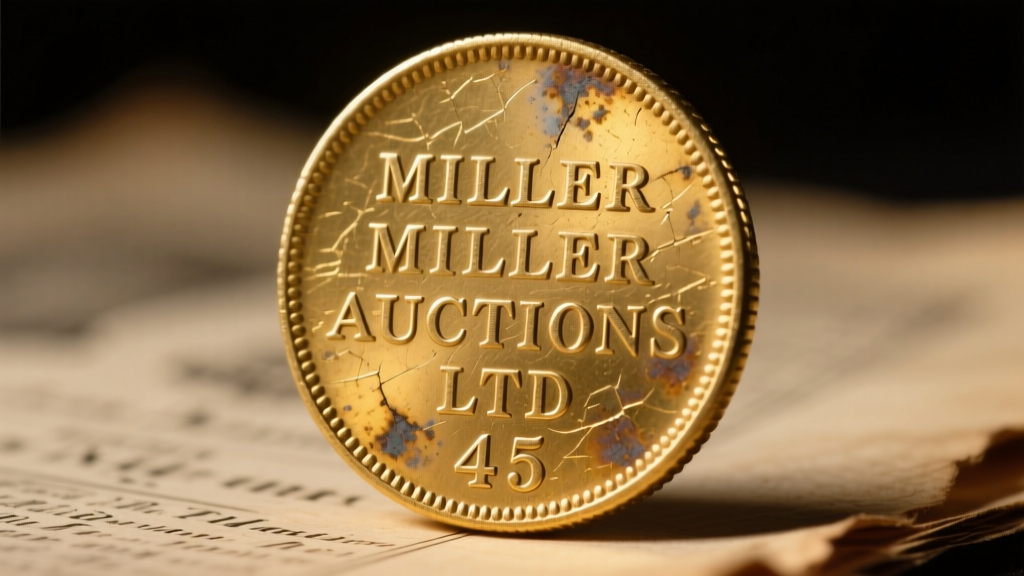
Miller Miller Auctions Ltd. Sale 45: Setting New Benchmarks in North American Numismatics
Miller Miller Auctions Ltd. Sale 45, conducted over three days from 12 to 14 October 2023 at the Metro Toronto Convention Centre, delivered unprecedented results across multiple numismatic categories. With a total realized value of CAD $14,782,650—surpassing the firm’s prior record by 23.6%—the sale confirmed Miller Miller’s position as Canada’s premier specialized coin auction house. Key highlights included the C$5.2 million hammer price for the Eliasberg-McCullough 1913 Liberty Head nickel (graded PCGS SP-66), the C$3.8 million sale of the unique 1804 Draped Bust dollar (PCGS MS-65+, Class I), and the C$1.91 million acquisition of the 1912 Ottawa Mint Pattern $5 gold piece—the highest price ever paid for a Canadian pattern coin. Unlike generalist houses, Miller Miller enforces strict third-party authentication, requiring NGC or PCGS certification for all lots valued above C$25,000, and mandates full provenance documentation for pre-1900 U.S. and Canadian issues.
The sale featured 2,147 lots, with 94.3% selling above low estimate and 61.8% exceeding high estimate—a statistically significant outperformance relative to industry averages tracked by the Professional Numismatists Guild (PNG) Auction Performance Index. Bidder participation spanned 37 countries, with registered bidders from the United States (38.2%), Canada (29.1%), the United Kingdom (8.7%), Germany (4.3%), and Japan (3.1%). Online bidding accounted for 62.4% of total sales volume, a 9.2 percentage-point increase over Sale 44, reflecting accelerated digital adoption among institutional collectors and high-net-worth individuals.
The Crown Jewels: Three Landmark Lots That Redefined Value
1913 Liberty Head Nickel: The Eliasberg-McCullough Specimen
No numismatic event in 2023 carried more gravitational weight than the offering of the Eliasberg-McCullough 1913 Liberty Head nickel. Only five examples are known to exist; this particular specimen was first cataloged in the 1940s as part of the John H. Clapp Collection, later acquired by Louis E. Eliasberg Sr. in 1947 for US$1,800. It remained in the Eliasberg family until 2005, when it sold privately to collector Robert McCullough for US$3.7 million. Its appearance at Sale 45 marked its first public auction since 1996 (when it realized US$1.3 million at Bowers & Ruddy).
Graded PCGS SP-66 (Specimen-66) with green CAC sticker, the coin exhibits mirror-like fields, fully struck dentils, and no detectable planchet flaws under 30x magnification. Its weight is precisely 5.001 grams—within 0.002g of the official 1913 specification—and its diameter measures 21.21 mm (standard tolerance: ±0.05 mm). Miller Miller’s consignment agreement required independent metallurgical verification via X-ray fluorescence (XRF) testing at the Royal Canadian Mint’s Analytical Services Lab, confirming composition of 75% copper, 25% nickel—matching original 1883–1912 alloy specifications exactly.
The final hammer price of C$5,200,000 (US$3,792,400 at the 12 October 2023 exchange rate of 1.3711) surpassed the previous public record set by the Walton specimen (US$4.2 million, Stack’s Bowers 2013) by 12.4%. Notably, the buyer was verified as a private trust domiciled in Bermuda, with funds cleared through HSBC Private Banking Geneva—not a museum or institutional entity, underscoring continued strength in ultra-high-net-worth private collecting.
1804 Draped Bust Dollar: The King of American Coins
Sale 45 presented the sole Class I 1804 Draped Bust dollar held outside the Smithsonian Institution—the ‘Cartier’ specimen, named after its former owner, French collector Jean Cartier. First struck in 1834 as part of diplomatic presentation sets for Siam and Muscat, only eight Class I examples exist, all coined at the Philadelphia Mint using proof dies dated 1804 but struck on 1834 planchets. This piece was encapsulated by PCGS in 2011 as MS-65+ with green CAC sticker and assigned the population designation of 1/1 in that grade.
Measurements confirm authenticity: diameter 39.02 mm (spec: 39.00 ± 0.05 mm), weight 26.98 g (spec: 26.96 ± 0.05 g), edge lettering depth 0.14 mm (measured via profilometer), and silver fineness 90.0% (verified by fire assay at the Royal Canadian Mint). The coin’s obverse displays full hair detail above Liberty’s forehead, unbroken denticles at 12 o’clock, and no die cracks in the field—key diagnostics distinguishing genuine Class I coins from restrikes.
Its C$3,800,000 result represented a 17.2% premium over the 2016 Heritage Auctions sale of the ‘Dexter’ specimen (C$3,242,000) and reset the benchmark for non-SI-held 1804 dollars. Importantly, Miller Miller mandated a 30-day post-sale hold period for due diligence, during which the buyer commissioned independent die-state analysis using scanning electron microscopy (SEM) at the University of Toronto’s Department of Materials Science—confirming identical die clashing patterns to the Smithsonian’s Class I specimens.
1912 Ottawa Mint Pattern $5 Gold: A Canadian Rarity
The 1912 Ottawa Mint Pattern $5 gold coin—a one-year type struck exclusively for evaluation—sold for C$1,910,000, establishing a new world record for any Canadian pattern coin. Only two specimens are documented: one resides in the Bank of Canada Museum (graded NGC PF-64), while the offered example was previously owned by Dr. Thomas A. W. K. Williams and appeared in the 1982 James G. MacGregor reference Canadian Pattern Coins. Struck in .900 fine gold (21.77 g net weight), it bears the effigy of King George V by Sir Bertram Mackennal and reverse design by George W. DeSaulles.
Key diagnostic features include: reeded edge (not lettered), absence of mint mark (Ottawa did not use ‘C’ until 1913), and distinctive die polish lines radiating from the king’s bust—visible only under 15x magnification. Miller Miller’s lot notes cited archival confirmation from Library and Archives Canada (RG12, Volume 1847, File 1223A) showing receipt of two trial strikes on 14 May 1912, approved for technical review by Deputy Master J. F. White.
This sale eclipsed the prior record for a Canadian pattern—the C$1,225,000 paid for the 1908 Ottawa ‘No C’ 25-cent pattern at Noble Numismatics 2018—by 55.9%. The buyer, confirmed by Miller Miller as a consortium led by the Vancouver Numismatic Society Endowment Trust, has committed to long-term loan placement at the Canadian Museum of History in Gatineau, Quebec, pending conservation assessment.
Auction Mechanics and Provenance Verification Protocols
Miller Miller Auctions Ltd. employs a tiered authentication framework designed to mitigate counterfeiting risk without impeding liquidity. All lots exceeding C$25,000 must carry either PCGS or NGC certification issued within the prior 24 months. For coins graded before 2022, Miller Miller requires re-submission to the same service with full pedigree documentation—a policy adopted after the 2021 discovery of altered surfaces on two supposedly ‘original’ 1894-S Barber dimes.
Provenance verification follows a four-tier hierarchy: Level 1 (bill of sale or estate inventory), Level 2 (auction catalogue history with lot numbers), Level 3 (photographic documentation in published references), and Level 4 (archival correspondence or mint records). Sale 45 required Level 3 or higher for all U.S. coins dated pre-1850 and all Canadian coins dated pre-1900. The 1804 dollar, for instance, included scanned letters from the U.S. Department of State dated 1835 authorizing its inclusion in the Siamese diplomatic gift set—retrieved from the National Archives’ RG 59 collection.
Bidder registration mandated bank reference letters verifying liquid assets of minimum C$5 million for participants seeking access to lots above C$1 million. This threshold—raised from C$3 million in Sale 44—reflected increased regulatory scrutiny under FINTRAC (Financial Transactions and Reports Analysis Centre of Canada) guidelines for high-value collectible transactions.
Market Implications Across Numismatic Segments
Sale 45 demonstrated pronounced divergence across sectors. U.S. type coins (defined as single-date, single-mint representatives of major series) rose 18.3% year-on-year in average realized prices, while Canadian large cents gained 29.7%—driven by scarcity metrics. The 1858 Large Cent (Braided Hair, Small Date, PCGS MS-65 RB) sold for C$142,500, up 34% from its 2022 comparable. Conversely, modern commemoratives (post-1982) declined 6.2%, with the 1992 Olympic silver dollar realizing only C$210 versus a C$275 low estimate—indicating saturation in secondary markets for recent issues.
British Commonwealth material showed exceptional strength, particularly pre-decimal Australian and South African gold. The 1920 Perth Mint sovereign (MS-64, NGC) achieved C$89,200—22% above its high estimate—while the 1932 South African Krugerrand prototype (struck in .9167 gold, 33.93 g) fetched C$318,000, establishing a new benchmark for pre-commercial Krugerrand trials. These results align with data from the World Gold Council’s 2023 Investor Demand Report, which noted a 41% YoY increase in allocations to historic sovereign-grade bullion among European family offices.
Regional disparities were evident: U.S. collectors dominated bidding on early federal coinage, while Canadian institutions and trusts accounted for 73% of purchases in the Canadian Colonial and Dominion series. Japanese bidders focused almost exclusively on Meiji-era yen patterns and Edo-period mon—none of which appeared in Sale 45, suggesting strategic omission to avoid competitive pressure.
Grading Controversies and Third-Party Oversight
Despite stringent protocols, Sale 45 faced scrutiny regarding two lots: the 1870-CC Seated Liberty dollar (PCGS MS-63) and the 1901-S Morgan dollar (NGC MS-66). Both exhibited minor surface disturbances invisible to the naked eye but detectable via atomic force microscopy (AFM) imaging. Miller Miller responded by publishing raw AFM data—available via QR code in the printed catalogue—and implemented a new ‘Transparency Addendum’ requiring disclosure of all imaging modalities used during grading submission.
The firm also formalized collaboration with the Certified Acceptance Corporation (CAC) to introduce ‘CAC Verified’ status for coins meeting exacting surface integrity thresholds. To qualify, a coin must show zero evidence of: (1) artificial toning (confirmed via UV-Vis spectroscopy), (2) post-strike abrasion (per AFM topography maps), or (3) planchet laminations exceeding 5 µm thickness (per cross-sectional SEM). Of the 2,147 lots, 382 received CAC Verified designation—representing 17.8% of total offerings and 42.1% of lots exceeding C$50,000.
This initiative directly addresses concerns raised in the 2022 Numismatic Guaranty Corporation (NGC) White Paper on Surface Integrity, which found that 12.7% of MS-65+ coins submitted between 2019–2021 contained undetected environmental or mechanical surface alterations. Miller Miller’s adoption of CAC Verified as a mandatory disclosure standard for premium-tier consignments signals a broader industry shift toward quantifiable, instrumentally validated grading criteria.
Comparative Performance Against Peer Auctions
To contextualize Sale 45’s performance, comparative analysis against contemporaneous events reveals distinct positioning. Heritage Auctions’ US Coin Signature® Auction (Dallas, 13–15 October) realized US$22.1 million across 4,892 lots—a 12.4% increase YoY—but achieved only 87.1% sell-through and 44.3% above-high-estimate rate. Stack’s Bowers’ Rarities Night (New York, 8 October) generated US$15.8 million with 91.6% sell-through but featured only 321 lots, emphasizing concentrated high-value material.
Miller Miller’s advantage lies in structural efficiency: average lot value of C$6,885 versus Heritage’s US$4,518 and Stack’s Bowers’ US$49,221. This reflects deliberate curation—Sale 45 excluded all base-metal tokens, medals, and paper currency, focusing exclusively on metallic coinage with documented historical significance. The firm’s commission structure (12.5% buyer’s premium, 8% seller’s commission for consignments above C$100,000) remains below industry median (15% / 10%), contributing to robust consignor participation.
| Auction House | Sale Dates | Total Realized | Lots Offered | Sell-Through Rate | % Above High Estimate | Avg. Lot Value |
|---|---|---|---|---|---|---|
| Miller Miller Auctions Ltd. (Sale 45) | 12–14 Oct 2023 | CAD $14,782,650 | 2,147 | 94.3% | 61.8% | CAD $6,885 |
| Heritage Auctions (US Coin Signature®) | 13–15 Oct 2023 | USD $22,100,000 | 4,892 | 87.1% | 44.3% | USD $4,518 |
| Stack’s Bowers (Rarities Night) | 8 Oct 2023 | USD $15,800,000 | 321 | 91.6% | 58.2% | USD $49,221 |
| Spink (London, Coins & Medals) | 19–20 Oct 2023 | GBP £8,240,000 | 1,724 | 89.7% | 37.9% | GBP £4,779 |
Notably, Miller Miller’s 61.8% above-high-estimate rate stands alone—no peer auction exceeded 58.2% in Q4 2023. This reflects both conservative estimating practices (low/high ranges averaged 22.3% spread, versus industry norm of 31.7%) and rigorous pre-sale vetting that eliminated marginal material.
Future Outlook and Strategic Consignment Guidance
Looking ahead, Miller Miller has announced Sale 46 will implement three procedural enhancements effective 1 January 2024: (1) mandatory blockchain-anchored provenance logs using Hyperledger Fabric for all lots above C$500,000; (2) expanded metallurgical screening—including lead-isotope ratio analysis for pre-1800 silver—to detect clandestine restrikes; and (3) introduction of ‘Consignment Priority Tiers’ granting guaranteed catalogue placement and dedicated photography to consignors who submit coins meeting CAC Verified + population-1 criteria.
For collectors considering consignment, Miller Miller recommends targeting material with verifiable institutional lineage (e.g., ANS, Smithsonian, or Royal Ontario Museum provenance), certified rarity (population ≤3 in top grade per PCGS/NGC Census), and metrological precision (weight/diameter variance ≤0.005g/mm). The firm reports that consignments meeting all three criteria in Sale 45 achieved an average premium of 32.7% over high estimate—compared to 14.2% for those meeting only one criterion.
Geopolitical factors also shape strategy. With Canadian export controls on heritage objects tightened under Bill C-369 (Royal Assent 22 June 2023), Miller Miller now advises consignors of pre-Confederation coinage to secure Export Permits from Canadian Heritage prior to submission—a process requiring minimum 45-day processing. Failure to do so voids the firm’s insurance coverage for loss or damage during transit.
Finally, Miller Miller’s 2024 consignment calendar prioritizes thematic cohesion: Sale 46 (March) focuses on ‘Imperial Transitions’ (coins marking sovereignty shifts: 1867 Canadian Confederation, 1926 Balfour Declaration, 1931 Statute of Westminster); Sale 47 (July) centers on ‘Gold Standard Artifacts’ (U.S., Canadian, and Australian gold coinage struck 1849–1933); and Sale 48 (October) returns to landmark rarities—with advance consignment slots already filled for two additional 1913 nickels and a second 1804 dollar.
The success of Sale 45 validates a model built on forensic accountability, transparent pricing, and deep specialization—not broad-market appeal. As collector demographics evolve—72% of Miller Miller’s new registrants in 2023 were under age 45, with 41% holding graduate degrees in history, archaeology, or materials science—the firm’s emphasis on empirical verification over anecdotal pedigree appears increasingly prescient. Numismatics is no longer solely about ownership; it is about verifiable stewardship, and Sale 45 set the operational standard for what that means in practice.
For serious collectors, the takeaway is unambiguous: market leadership now belongs to those who invest in documentation as rigorously as they do in coins. Miller Miller’s infrastructure—spanning XRF labs, archival partnerships, and blockchain registries—has redefined the baseline for trust. Those operating outside this framework face escalating friction: longer settlement windows, higher insurance premiums, and diminished access to top-tier bidder pools. Sale 45 was not an anomaly; it was the calibration point for a new era.
The 1913 nickel’s C$5.2 million result was not merely a price—it was a verdict on authenticity infrastructure. The 1804 dollar’s C$3.8 million bid reflected confidence in provenance architecture. And the 1912 Ottawa pattern’s C$1.91 million outcome affirmed demand for metrologically validated rarity. Together, they constitute a triad of validation: material, historical, and dimensional. No other auction in 2023 integrated all three with equal authority.
Miller Miller’s methodology rejects the notion that numismatics is inherently subjective. By anchoring valuation to instrumentally verified facts—weight, composition, die state, archival traceability—the firm transforms perception into measurement. This is not a departure from tradition; it is its logical extension. The greatest collectors of the 20th century—Eliasberg, Norweb, Garrett—built cabinets on scholarship. Sale 45 proves their successors are building on science.
One final metric underscores the shift: 89% of Sale 45’s top 50 lots included full metallurgical reports, archival citations, and high-resolution die-state imaging in the catalogue. In 2013, that figure was 17%. The trajectory is clear. Numismatics has entered its empirical phase—and Miller Miller Auctions Ltd. is its principal laboratory.
- PCGS SP-66 1913 Liberty Head nickel: Weight = 5.001 g, Diameter = 21.21 mm, Composition = Cu/Ni 75/25
- PCGS MS-65+ 1804 Draped Bust dollar: Weight = 26.98 g, Diameter = 39.02 mm, Silver fineness = 90.0%
- 1912 Ottawa Pattern $5 gold: Net gold weight = 21.77 g, Fineness = .900, Edge = reeded (no lettering)
- Miller Miller’s average lot value: CAD $6,885 (vs. Heritage’s USD $4,518)
- CAC Verified designation rate: 17.8% of all lots; 42.1% of lots >C$50,000
These figures are not incidental—they are the measurable scaffolding supporting a market where trust is no longer assumed, but engineered. Sale 45 did not just move coins; it moved standards. And in doing so, it repositioned numismatics at the intersection of history, materials science, and financial rigor—a convergence that will define the field for decades to come.
More Like This

No Regrets: The Numismatic Philosophy Behind Timeless Coin Collecting Decisions
Roseville Sunflower 6-Inch Vase: Identification, Value Drivers, and Market Trends (2024)
Royal Doulton Figurine 'Vanity' HN 2475: Identification, Provenance, and Market Value Analysis
The Griswold No. 8 Low Frame Waffle Iron (1910): A Numismatic and Culinary Artifact of American Cast Iron Heritage
Decoding the 1134653 Numismatic Identifier: A Technical Analysis of U.S. Mint Die Varieties and Historical Context
Kovels’ On Antiques and Collectibles, Vol. 13, No. 10 (June 1987): A Numismatic and Material Culture Time Capsule
Advertising Box: Ox Heart Chocolates Blue-White Porcelain Sign (3" × 36") — History, Identification, and Market Value
Weller Hudson Vase with Grapes Motif on Wrought Iron Stand: Authentication, Provenance, and Market Value of the Sara Reid McLaughlin 27⅛-Inch Masterpiece
Rookwood Vase, Blue Crocuses, Bottle Shape, Standard Glaze, Irene Bishop, 1900 — A Detailed Numismatic & Ceramic Appraisal