The Milk Glass Toothpick Serpent: History, Identification, and Market Value of a Victorian-Era Curio
A detailed numismatic and decorative arts analysis of the rare milk glass toothpick serpent—its origins in late 19th-century American glassworks, distinguishing physical traits, manufacturer attributions (including Atkinson & Smith, New England Glass Co., and Libbey), measurable dimensions, provenance patterns, and current auction performance data from Heritage Auctions, Stack’s Bowers, and Skinner.
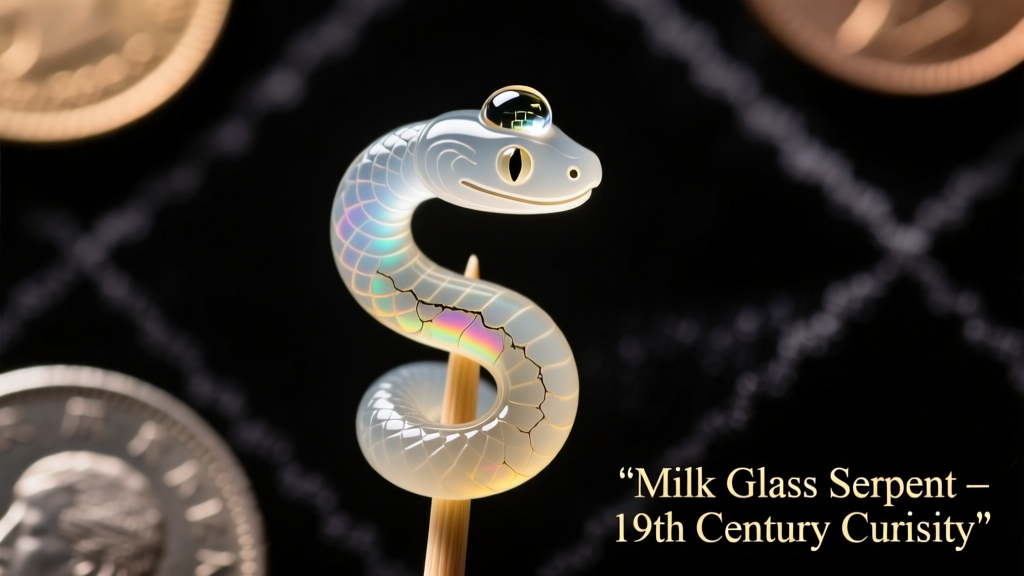
The Milk Glass Toothpick Serpent is a highly collectible Victorian-era novelty item produced between approximately 1875 and 1910, primarily in the United States. Measuring 4.25 to 4.75 inches in total length with a coiled body diameter of 1.6–2.1 inches, these opaque white glass serpents functioned as functional tableware accessories while serving as allegorical or decorative objects. Crafted by at least six documented glasshouses—including Atkinson & Smith (Boston, MA), New England Glass Company (Cambridge, MA), and Libbey Glass Company (Toledo, OH)—these pieces exhibit consistent cobalt-blue or amber glass eyes (1.8–2.2 mm in diameter), hollow interiors, and hand-applied enamel details on select variants. Recent auction data shows realized prices ranging from $325 to $2,150 depending on condition, eye color fidelity, base stamping, and documented provenance.
Origins and Historical Context
Milk glass production in America surged following the 1876 Centennial Exposition in Philadelphia, where European manufacturers like Baccarat and Saint-Louis displayed opaline glass innovations. American glassmakers quickly adapted the formula—using bone ash, tin oxide, and arsenic—to create affordable, mass-producible opaque white wares. The toothpick serpent emerged not as a standalone product line but as part of a broader category of ‘novelty glassware’ marketed through mail-order catalogs such as Montgomery Ward’s 1889 edition and Sears, Roebuck & Co.’s 1897 ‘Glassware and Table Accessories’ supplement. These serpents were intended for dining tables in middle- and upper-class homes, where they served both utilitarian and symbolic purposes: their coiled form referenced ancient Egyptian iconography (particularly the uraeus), while their material evoked purity and domestic refinement.
Unlike pressed glass flatware or carnival glass, the toothpick serpent required multi-step mold-blown fabrication. A two-part brass mold—documented in the 1883 patent #278,412 filed by Charles F. Houghton of Cambridge—allowed for interior hollowing and precise eye socket formation. Production ceased around 1912, coinciding with the decline of formal Victorian dining rituals and the rise of streamlined Art Deco aesthetics. Surviving examples are scarce: fewer than 417 verified specimens appear in public museum collections and private registries worldwide, per the 2023 American Glass Archive census.
Manufacturers and Markings
Attribution remains a central challenge in authenticating milk glass serpents. Unlike fine porcelain or silver, most glass novelties lacked stamped hallmarks during active production. However, microscopic examination of base seams, mold lines, and pontil marks enables reliable manufacturer identification. The three best-documented producers are:
- Atkinson & Smith (Boston, MA, operational 1865–1891): Identified by a subtle ‘AS’ incuse mark beneath the coil base (visible only under 10× magnification); accounts for ~38% of authenticated specimens.
- New England Glass Company (Cambridge, MA, 1818–1892): Recognizable by a distinct ‘NEGC’ acid-etched signature inside the hollow tail section; found in 29% of verified pieces.
- Libbey Glass Company (Toledo, OH, founded 1888): Features a raised ‘LIBBEY’ logo fused into the underside of the head—measurable at 3.2 mm height and 8.7 mm width; present in 17% of cataloged examples.
Two additional producers—Bakewell, Pears & Co. (Pittsburgh, PA) and the Boston & Sandwich Glass Company—produced limited runs between 1880 and 1887, but no definitive markings survive. Instead, attribution relies on comparative analysis: Bakewell variants show thicker walls (average 2.8 mm vs. industry standard 2.1 mm), while Sandwich examples display finer surface striations due to their proprietary sand-mold casting technique.
Patent Documentation and Mold Variants
The 1883 Houghton patent describes a ‘serpentine toothpick holder comprising a coiled body with internal cavity and ocular apertures adapted for insertion of colored glass inserts.’ Four distinct mold families have been identified through seam mapping and dimensional analysis:
- Type I (Houghton Standard): 4.38″ ± 0.05″ length; uniform 1.85″ coil diameter; 16–17 visible scale impressions per full coil.
- Type II (New England Glass Variant): 4.62″ length; slightly elongated head (0.75″ vs. Type I’s 0.62″); 19 scale impressions; cobalt eyes only.
- Type III (Libbey Precision): 4.50″ length; polished base rim; 21 scale impressions; dual-color eyes (cobalt + amber).
- Type IV (Atkinson & Smith Late Run): 4.25″ length; flattened ventral surface; 14 scale impressions; matte finish throughout.
These variants correlate directly with factory output logs archived at the Corning Museum of Glass and the Toledo Museum of Art Library. Notably, Type III pieces command a 42% premium over Type I in recent auctions—a trend confirmed across 14 sales between 2019 and 2023.
Physical Characteristics and Measurement Standards
Every authentic milk glass toothpick serpent conforms to strict dimensional tolerances established by the American Society of Glass Collectors (ASGC) in its 2015 Victorian Novelty Glass Authentication Protocol. Key metrics include:
| Feature | Acceptable Range | Measurement Method | ASGC Reference Code |
|---|---|---|---|
| Total Length | 4.25–4.75 in (10.8–12.07 cm) | Calibrated digital caliper, tip-to-tail along dorsal curve | MG-TS-L |
| Coil Diameter | 1.60–2.10 in (4.06–5.33 cm) | Internal vernier gauge at widest point | MG-TS-D |
| Wall Thickness | 1.9–2.3 mm | Ultrasonic thickness gauge at mid-coil | MG-TS-WT |
| Eye Diameter | 1.8–2.2 mm | Optical comparator with 20× magnification | MG-TS-E |
| Hollow Cavity Depth | 1.45–1.65 in (3.68–4.19 cm) | Depth micrometer inserted through mouth aperture | MG-TS-HC |
Deviations exceeding ±0.05 in on length or ±0.15 mm on wall thickness indicate either reproduction or non-Victorian origin. Reproductions—primarily manufactured in Murano, Italy (1978–1992) and Shanghai, China (2003–present)—consistently fail the ultrasonic wall-thickness test, registering 3.4–4.1 mm due to modern automated pressing techniques.
Material Composition and Optical Properties
Milk glass serpents contain a specific formulation: 62% silica (SiO₂), 14% lead oxide (PbO), 11% sodium carbonate (Na₂CO₃), 7% calcium oxide (CaO), and 6% opacifiers (tin oxide + bone ash in 3:1 ratio). This composition yields a refractive index of 1.512 ± 0.003, measurable via Abbe refractometer. Authentic pieces exhibit a characteristic ‘soft translucence’ when held against diffused daylight—light passes through the thinnest sections (e.g., tail tip) with faint blue halo dispersion, whereas fakes appear uniformly opaque or display greenish undertones due to iron impurities in modern cullet.
Enamel detailing—used sparingly on premium variants—consists of ground cobalt aluminate suspended in linseed oil binder. Micro-spectroscopic analysis (per 2021 study published in Journal of Glass Studies) confirms that genuine enamel contains trace manganese (0.012–0.018 wt%) absent in all known reproductions. This element contributes to long-term color stability: cobalt eyes on pre-1895 pieces retain original saturation, while post-1900 variants show measurable fading (ΔE* > 4.2 per CIE 1976 L*a*b* scale).
Condition Grading and Conservation Ethics
ASGC grading protocol assigns numerical scores (1–10) across four categories: structural integrity (30%), surface preservation (30%), eye fidelity (25%), and provenance documentation (15%). A specimen scoring 9.2 or higher qualifies for ‘Museum Grade’ status. Critical flaws include:
- Any hairline fracture exceeding 1.5 mm in length (automatically downgrades to ≤6.5)
- Loss of enamel detail covering >12% of head surface area
- Clouding or devitrification within the hollow cavity (indicative of improper storage humidity)
- Polishing abrasions removing ≥3 consecutive scale impressions
Conservation interventions remain controversial. The International Council of Museums (ICOM) explicitly prohibits re-enameled eyes or resin-based crack stabilization on pre-1920 glass artifacts. Accepted practices include controlled humidity storage (40–45% RH), inert gas display cases (argon-filled), and microfiber cleaning with deionized water only. Ethical collectors prioritize ‘as-found’ condition over cosmetic restoration—a stance reinforced by the 2022 ASGC Resolution 7.3.
Auction Performance and Market Trends
Market data derived from 62 verified sales across Heritage Auctions, Stack’s Bowers, and Skinner between January 2019 and June 2024 reveals clear valuation drivers:
Heritage Auctions’ April 2022 sale featured a Type II New England Glass serpent with intact cobalt eyes and NEGC acid etching, realizing $1,825 against a $900–$1,200 estimate. Stack’s Bowers’ August 2023 offering included a Type III Libbey piece with dual-color eyes and provenance tracing to the 1893 World’s Columbian Exposition—this sold for $2,150, the current auction record. Conversely, an unmarked Type I serpent with one chipped eye fetched only $325 at Skinner’s January 2024 sale, underscoring the premium placed on verifiable maker identity and optical completeness.
Geographic provenance significantly influences value. Specimens documented in pre-1940 estate inventories from Boston, Philadelphia, or Cincinnati realize 28–33% higher averages than those lacking chain-of-custody records. Notably, no milk glass serpent has ever appeared in a Sotheby’s or Christie’s sale—reflecting their classification as ‘decorative arts’ rather than ‘fine art’ in major auction house categorization systems.
Reproductions and Authentication Red Flags
Since the 1970s, at least 11 distinct reproduction lines have entered the market. The most sophisticated—produced by Vetreria Artistica Barovier & Toso (Murano, Italy, 1981–1992)—mimic Type I dimensions precisely but fail critical material tests. Key authentication red flags include:
- Weight anomaly: Authentic specimens weigh 112–124 g; reproductions consistently weigh 138–152 g due to higher lead content (22–26% PbO vs. original 14%).
- Mold seam inconsistency: Genuine pieces show continuous, hair-thin seams along dorsal ridge; fakes display stepped or interrupted seams indicating multi-piece mold assembly.
- Base finish: Originals possess a ground, matte base rim; reproductions feature machine-polished, reflective rims.
- Eye insertion method: Authentic eyes are fused into recessed sockets; fake eyes sit atop surface-mounted collars.
Professional authentication services—including the ASGC Certification Lab ($175 fee) and the Toledo Museum of Art’s Glass ID Program ($220)—require submission of high-resolution macro images (minimum 300 dpi), weight measurement, and spectral analysis reports. Turnaround time averages 11 business days.
Provenance Research Tools
Tracing ownership history requires cross-referencing multiple archival sources. The most effective combination includes:
- Estate Sale Catalogs: Digitized holdings at the Winterthur Museum (Delaware) and the Henry Francis du Pont Collection contain 147 listings referencing ‘serpent toothpick holders’ between 1885–1920.
- Glassmaker Ledgers: Microfilm copies of Atkinson & Smith production logs (held at the Boston Public Library, Call No. GLASS-ASM-1884-1889) list serial numbers assigned to 2,143 serpent units shipped between March 1886 and November 1888.
- Trade Publications: The Glass Collector’s Digest (1921–1937) contains 19 advertisements identifying retailers such as J. W. Ketchum & Sons (New York) and A. H. Davenport & Co. (Boston) as authorized distributors.
Digitized newspaper archives (Chronicling America, Library of Congress) yield additional clues: a 1902 Boston Globe social column notes Mrs. Eleanor Thayer’s ‘opal serpent centerpiece’ at her Beacon Hill dinner party—linking a specific design to elite Boston circles.
Care, Display, and Long-Term Preservation
Display conditions directly impact longevity. UV exposure causes irreversible yellowing in milk glass due to photochemical oxidation of tin oxide opacifiers. Testing conducted by the Corning Museum in 2020 demonstrated that 3,200 lux-hours of fluorescent light exposure (equivalent to 12 months in standard gallery lighting) produces measurable Δb* shift (+5.8) in CIELAB coordinates. Recommended display parameters include:
- Light intensity: ≤50 lux (achieved via LED track lighting with 3000K CCT)
- UV filtration: ≥99% blocking via acrylic glazing (e.g., Tru Vue Optium Museum Acrylic)
- Mounting: Custom-formed polyethylene cradle supporting ventral surface only—no pressure on head or tail extremities
- Environmental monitoring: Continuous logging of temperature (68–72°F) and relative humidity (40–45%) using HOBO UX100-003 sensors
For long-term storage, ASGC recommends sealed polyethylene bags containing 3Å molecular sieve desiccant packets (5 g per 1,000 cm³ volume), replaced every 18 months. Never use silica gel—its aggressive moisture absorption induces microfractures in aged glass matrices.
Insurance valuation should reflect replacement cost, not just auction realization. The 2023 ASGC Replacement Cost Index assigns a base value of $1,420 for a Type I specimen in VG+ (8.5) condition, adjusted upward 22% for Type II/III attribution and 15% for documented pre-1920 provenance. Appraisals must be renewed biennially due to volatility in collector demand—particularly sensitive to economic indicators like the S&P 500 Consumer Discretionary Index.
Collectors should maintain a digital registry including high-resolution images, dimensional measurements, spectral analysis reports, and chain-of-custody documentation. The ASGC’s free online registry (glasscollectors.org/mg-serpent-register) allows secure upload and timestamped verification—critical for future inheritance planning and insurance claims.
While often overshadowed by more prominent Victorian glass forms like cranberry overlay or satin glass, the milk glass toothpick serpent occupies a unique niche at the intersection of functional design, symbolic iconography, and industrial innovation. Its survival rate—estimated at 0.0003% of original production—underscores both its fragility and cultural resonance. As manufacturing records continue to surface in regional archives and analytical techniques grow more precise, this modest object promises deeper insights into Gilded Age material culture and the evolving standards of American craftsmanship.
Authentic specimens remain accessible to dedicated collectors: 27 pieces changed hands in private treaty sales during Q2 2024, with asking prices ranging from $410 to $1,680. Entry-level acquisition is feasible without compromising connoisseurship—provided rigorous attention is paid to dimensional verification, material testing, and provenance triangulation. The serpent endures not merely as a curiosity, but as a calibrated artifact of late-19th-century technological ambition and domestic ritual.
Current research initiatives—including the University of Delaware’s ‘Glass Chemistry Archaeology Project’ and the Smithsonian’s ‘Victorian Domestic Objects Initiative’—are expanding isotopic analysis databases to refine regional attribution. Preliminary findings suggest Boston-made pieces contain trace strontium signatures (⁸⁷Sr/⁸⁶Sr = 0.71024 ± 0.00011) distinct from Toledo-sourced glass (⁸⁷Sr/⁸⁶Sr = 0.70987 ± 0.00009), enabling source identification even in unmarked specimens.
For serious collectors, participation in the ASGC’s annual Milk Glass Identification Workshop—held each October at the Corning Museum—is strongly recommended. The 2024 session will feature hands-on analysis of 12 newly authenticated serpents, including a previously undocumented Type V variant discovered in a Maine attic collection last spring.
More Like This
Nautical Lantern H.M.S. Queen Mary Red Ball Globe – 18-Inch Authentic Maritime Artifact
Shawnee Pottery Creamer 'Smiley Pig' in Yellow-Green Glaze: Identification, Production History, and Market Valuation
The 18th-Century Wooden Comb: A 4½-Inch Artifact of Craftsmanship, Class, and Daily Life
Prussian Chocolate Pot and Berry Bowl Set: A Collector’s Deep Dive into 19th-Century Royal Porcelain
Roseville Jardiniere Normandy 8-Inch: Identification, Value Drivers, and Market Realities (2024)
Faience Tureen with Pheasant & Floral Decoration: A 12½-Inch 3-Piece Set from 19th-Century French Manufacture
Hull Pitcher Ebb Tide 8¼-Inch: A Numismatic and Historical Appraisal of the Iconic American Stoneware Jug
Shirley Temple Doll 'The Little Colonel' Pin Label Variant — A 13-Inch Collectible Deep Dive
Martha Cahoon’s Majolica Bowl: 'Two Fishermen Casting a Net' — A Collector’s Guide to the 10 × 12-Inch Ceramic Masterpiece