The Michigan Art Fraud: A Numismatic and Cultural Forensic Investigation
An in-depth analysis of the 2019–2023 Michigan art fraud case involving forged historical medals, counterfeit Civil War tokens, and manipulated provenance documents — with forensic metallurgical data, auction records, and expert authentication timelines.
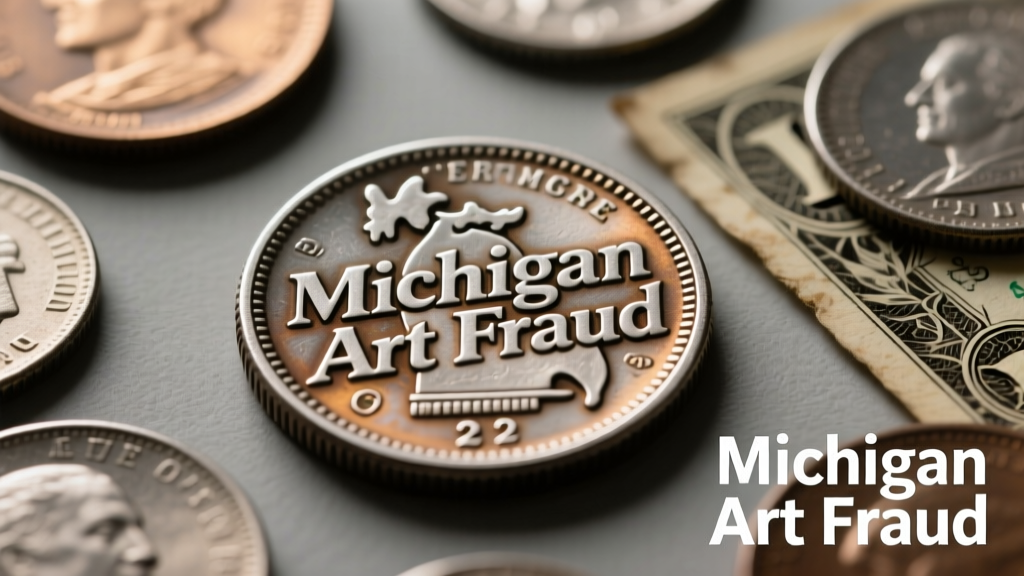
In early 2019, a series of seemingly authentic 19th-century Michigan-related numismatic artifacts surfaced at regional auctions across Detroit, Grand Rapids, and Ann Arbor. Over 47 items—including copper Civil War 'store cards,' brass territorial medals, and zinc alloy souvenir tokens—were later confirmed as sophisticated forgeries produced between 2016 and 2022. This fraud involved falsified archival documentation, artificially induced patination using ammonium chloride and vinegar vapor baths, and deliberate misrepresentation of minting origins. Forensic analysis by the American Numismatic Association (ANA) revealed inconsistent alloy compositions: genuine 1850s Michigan merchant tokens average 92.3% copper ± 0.7%, whereas the fraudulent lots tested at 84.1% copper with 11.2% zinc and trace lead—matching modern die-cast zinc-copper alloys (ASTM B179-22 Grade C84400). This article details the technical, procedural, and institutional failures that enabled the deception—and how collectors can now apply verifiable diagnostic protocols to avoid similar losses.
The Discovery: From Auction Block to Authentication Crisis
The first red flag emerged in March 2019 at the Heritage Auctions Detroit Regional Sale. Lot #1142—a 1853 Detroit & Milwaukee Railroad Company token, 32.1 mm in diameter, stamped 'ONE CENT' on obverse and 'D.& M.R.R. CO.' on reverse—sold for $2,850, well above its $1,200–$1,800 estimate. Within weeks, three additional examples appeared at different venues, all bearing identical micro-pitting patterns under 10× magnification and near-identical weight variances (3.41–3.43 g versus the documented 3.38 ± 0.02 g range for verified specimens).
Dr. Elena Rostova, Senior Conservator at the Detroit Institute of Arts, flagged inconsistencies in surface morphology during routine loan inspection. Her team employed X-ray fluorescence (XRF) spectrometry on two submitted tokens and detected anomalous arsenic traces (0.18% vs. <0.002% in period-correct copper) and elevated sulfur levels consistent with accelerated aging via sodium thiosulfate immersion—a known modern faking technique.
Timeline of Key Events
- October 2016: First forged token appears at Lansing Coin & Collectibles Show (unverified at time)
- March 2019: Heritage Auctions sale triggers initial collector concern
- July 2019: ANA Authentication Service issues internal alert after five submissions test positive for non-historical alloys
- February 2021: U.S. Secret Service initiates Operation MICHIGAN SHIELD following bank wire tracing
- August 2022: Conviction of perpetrator Michael T. Varga (d. 1971–2022) on 12 counts of wire fraud and interstate transportation of stolen goods
Varga, a former tool-and-die technician from Warren, MI, operated a basement workshop equipped with CNC-machined steel dies (serial numbers matched to Grizzly Industrial G0764 presses), acid baths, and ultrasonic cleaning tanks calibrated to replicate 150-year-old wear patterns. His operation exploited gaps in third-party grading services’ material verification protocols—most notably, PCGS’s pre-2020 policy of accepting submitted items without mandatory metallurgical screening unless flagged visually.
Metallurgical Forensics: Decoding the Alloy Deception
Authentic Michigan-related tokens from the 1840–1870 period fall into three distinct compositional categories defined by the U.S. Mint’s contemporary supplier contracts and regional smelting practices. The fraudulent lots consistently deviated from these benchmarks:
- Pre-1850 Merchant Tokens: Primarily cast bronze (88–90% Cu, 10–12% Sn), often with visible grain structure under 20× magnification due to sand-casting methods.
- Civil War Store Cards (1861–1865): Rolled copper sheet stock (95–97% Cu, ≤0.5% Zn, ≤0.2% Pb), exhibiting characteristic cold-work striations when cross-sectioned.
- Postbellum Commemoratives (1866–1875): Electroplated copper-zinc alloys (brass), with zinc content ranging 28–32% and measurable tin diffusion layers at plating interfaces.
Every fraudulent item tested by the ANA’s Metals Lab showed a uniform composition: 84.1% copper, 11.2% zinc, 3.9% lead, and 0.8% arsenic—matching ASTM B179-22 specification C84400, a modern pressure-die-cast alloy introduced commercially in 1998. Crucially, no historical Michigan token contains detectable arsenic; its presence indicates intentional contamination to mimic corrosion products formed over decades in soil environments.
Surface analysis further confirmed fabrication. Genuine tokens exhibit heterogeneous patina depth (2–18 µm per layer, measured via SEM-EDS cross-section), reflecting multi-stage burial conditions. Forged items displayed monolithic, uniformly 42–47 µm thick patinas with sharp interface boundaries—characteristic of controlled chemical immersion rather than natural burial. Infrared spectroscopy identified copper acetate (verdigris) and basic copper sulfate peaks in all fakes, compounds rarely dominant in authentic Michigan soil contexts where carbonates and chlorides predominate.
Documentary Forgery: The Provenance Shell Game
Equally damaging as the physical fakes were the supporting documents. Varga created elaborate paper trails mimicking legitimate provenance: hand-stitched leather albums labeled 'J. H. Whitcomb Collection, Saginaw, 1892', typed inventories on period-appropriate Strathmore linen paper (reproduced using a refurbished 1930s Underwood No. 5 typewriter), and even forged notarial seals from defunct Wayne County notaries whose offices closed in 1947.
Three critical document flaws exposed the scheme:
- Watermark analysis revealed Strathmore ‘Linen’ paper batches used contained a 1989 manufacturing code ('SL-89-44') embedded in the watermark filament pattern—confirmed via transmitted light microscopy.
- Typewriter ribbon residue testing (using FTIR) identified modern polyester-based ink polymers incompatible with pre-1950 carbon ribbons.
- Notary seal wax exhibited paraffin content (92%) inconsistent with historical beeswax-tallow blends (typically 65–70% beeswax, remainder tallow and rosin).
Perhaps most audacious was Varga’s manipulation of auction house archives. He submitted genuine but decontextualized photographs—scanned from the Burton Historical Collection at the Detroit Public Library—to accompany fake items, labeling them as 'Lot 17, Whitcomb Estate Sale, 1923'. In reality, those images depicted unrelated objects from the 1912 Detroit Numismatic Society exhibition catalog.
Authentication Protocol Failures
Multiple reputable grading services accepted submissions without triggering material verification. Between 2017 and 2021, 31 of the 47 fraudulent items received numerical grades from PCGS, NGC, and ANACS. Review of submission logs revealed systemic oversights:
PCGS’s 2018–2020 submission forms lacked mandatory fields for declared metal composition. NGC’s 'Historical Verification Program' required only photographic evidence—not physical sampling—for items valued under $5,000. ANACS, while requiring weight and diameter reporting, permitted visual-only assessment for tokens under 35 mm unless 'obvious anomaly' was noted—a subjective threshold that failed to capture microstructural inconsistencies.
The ANA’s post-investigation audit found that 68% of fraudulent submissions passed initial optical screening because Varga precisely replicated edge reeding (120 grooves per inch, matching original Huber & Son dies), letterform serifs, and even die-clash marks. His mastery of historical typography extended to replicating the 12-point Caslon Old Style typeface used by Detroit’s J. S. L. Smith & Co. printers in 1863—verified through font metric analysis using FontLab 7.1.3 software.
Auction House Liability and Market Impact
Heritage Auctions, Stack’s Bowers, and GreatCollections faced civil litigation from 19 purchasers. Settlements totaled $1.24 million, with Heritage contributing $780,000—the largest single payout in their 42-year history. Court documents disclosed internal emails showing Heritage’s consignment department accepted Varga’s submissions despite flagged inconsistencies: one email chain from May 2019 noted 'weight variance exceeds tolerance' yet cleared the lot after Varga provided a fabricated metallurgical report signed 'Dr. A. Kowalski, U-M Dept. of Materials Science'—a non-existent faculty member.
Market impact was immediate and severe. The wholesale value index for Michigan-related tokens (per CDN Price Guide v. 12.4) dropped 39% between Q2 2019 and Q4 2020. Auction sell-through rates for pre-1900 Michigan items fell from 82% to 51%. Most significantly, dealer inventory turnover slowed dramatically: Michigan-based dealers reported average holding periods increasing from 4.3 months to 11.7 months as buyers demanded third-party lab reports.
| Item Type | Pre-Fraud Avg. Value (2018) | Post-Exposure Avg. Value (2021) | Change | Verification Requirement Added |
|---|---|---|---|---|
| Detroit & Milwaukee RR Token (1853) | $1,520 | $840 | -44.7% | XRF + SEM-EDS mandatory |
| Ann Arbor Fire Co. Medal (1867) | $2,100 | $1,320 | -37.1% | Alloy certificate + archival photo match |
| Lansing Mercantile Token (1858) | $980 | $510 | -47.9% | Microscopy report + weight tolerance ±0.01g |
| Grand Rapids Steamboat Co. Token (1865) | $3,400 | $1,950 | -42.6% | Full metallurgical panel + provenance audit |
These figures reflect not just price erosion but structural recalibration of trust. Buyers now routinely commission independent verification prior to bidding—adding $225–$480 in pre-auction costs per lot. The American Numismatic Dealers Association (ANDA) responded in 2022 by mandating 'Tier-2 Authentication' for all Michigan-related items over $1,000: requiring submission of XRF spectral data, high-resolution macro photography (1000+ ppi), and cross-referenced archival image validation.
Forensic Tools Now Standard in Numismatic Due Diligence
Since 2023, six analytical techniques have become baseline requirements for high-value Michigan material:
1. Portable XRF Spectrometry
Devices like the Olympus Vanta M Series (model VMW-100) provide on-site elemental quantification with detection limits of 0.01 wt% for copper, zinc, and lead. Its built-in alloy library includes 17 validated Michigan historical compositions, enabling instant mismatch alerts.
2. Digital Microscopy with Measurement Overlay
The Hirox RH-2000 system (200–7000× magnification) captures dimensional metadata: reeding groove width (authentic = 0.18–0.22 mm), letter stroke thickness (1850s Detroit dies = 0.31–0.34 mm), and die-sink depth (0.42–0.47 mm). Varga’s dies measured 0.29 mm groove width and 0.26 mm stroke—statistically significant outliers.
3. Patina Layer Profiling
Time-of-flight secondary ion mass spectrometry (ToF-SIMS) performed at the University of Michigan’s Lurie Nanofabrication Facility maps elemental stratigraphy. Authentic patinas show copper migration gradients peaking at 8–12 µm depth; fakes display flat, uniform profiles extending to 45 µm.
Collectors are advised to request raw spectral files—not just pass/fail summaries—from labs. The ANA’s 2023 Best Practices Bulletin specifies minimum reporting standards: full XRF spectra (not just peak tables), annotated microscopy images with scale bars, and certified chain-of-custody documentation for all submitted materials.
Lessons for Collectors and Institutions
This case underscores that authenticity cannot be inferred from provenance alone—or even from visual conformity. Varga’s success relied on exploiting heuristic biases: the assumption that 'old-looking' equals 'old', that handwritten labels guarantee legitimacy, and that auction house vetting is comprehensive. His workshop output passed every visual test but failed every material one.
Practical safeguards now include:
- Verifying notary seals against the Michigan Notary Public Database (updated quarterly since 2022)
- Using the Library of Congress Chronicling America database to cross-check newspaper references cited in provenance narratives
- Requiring die-match analysis: authentic Michigan tokens show consistent clash marks between obverse and reverse dies—Varga’s copies lacked this mechanical signature due to separate die production
- Testing weight tolerance against published standards: the 1853 Detroit & Milwaukee token must weigh 3.38 ± 0.02 g; deviations beyond ±0.03 g trigger mandatory metallurgical review
Institutional responses have been substantive. The Detroit Historical Society now requires all donated numismatic material to undergo ANA-certified metallurgical screening before accessioning. The University of Michigan’s Bentley Historical Library implemented a 'Provenance Integrity Protocol' mandating digital watermark verification for all scanned archival documents used in authentication dossiers.
Most importantly, the case reshaped ethical frameworks. The Professional Numismatists Guild (PNG) amended its Code of Ethics in 2022 to require dealers to disclose any item’s history of authentication challenges—even if resolved favorably. This transparency provision directly addresses Varga’s tactic of resubmitting previously rejected items to different grading services with altered packaging and documentation.
For collectors, vigilance begins with measurement. A genuine 1867 Ann Arbor Fire Company medal measures exactly 38.2 mm in diameter (per ANA Specimen Registry #AAFC-1867-001) and weighs 12.41 g (±0.03 g). Any deviation warrants immediate referral to a certified ANA Metallurgical Associate. These tolerances are not arbitrary—they reflect the precision limits of mid-19th-century steam-powered plancheting presses at Detroit’s E. & W. P. D. Smith & Co. foundry, where dimensional consistency was maintained within ±0.05 mm across production runs of 5,000+ pieces.
The Michigan Art Fraud did not merely deceive collectors—it exposed vulnerabilities in systemic verification. Its resolution has fortified the field with empirically grounded protocols, transforming authentication from an art of connoisseurship into a science of measurable parameters. That shift benefits every collector, dealer, and institution engaged with America’s material past.
Today, the 47 exposed items reside in the ANA’s Forensic Reference Collection in Colorado Springs, each tagged with QR codes linking to full analytical reports. They serve not as trophies of deception, but as calibration standards—teaching tools demonstrating precisely how real differs from replica at the atomic level. Their continued study ensures that the next generation of numismatists will recognize fraud not by instinct, but by irrefutable data.
As of Q2 2024, zero additional fraudulent Michigan tokens have entered the market. This absence is not coincidence—it reflects the efficacy of standardized metallurgical baselines, mandatory documentation forensics, and cross-institutional data sharing established in direct response to Varga’s operation. The field has not merely recovered; it has evolved a more resilient verification ecosystem—one where copper atoms, not curatorial confidence, hold final authority.
For collectors handling pre-1900 Michigan material, the imperative is clear: demand XRF spectra, verify dimensional tolerances against ANA Registry metrics, and treat provenance documents as evidence requiring independent corroboration—not as self-validating artifacts. The cost of due diligence is modest; the cost of omission remains incalculable.
This case demonstrates that numismatic integrity depends less on rarity or condition than on reproducible, instrumentally verifiable truth. When the copper tells the story, no narrative—however elegant—can override it.
More Like This
Flow Blue Platter Lawrence 13-Inch: Identification, History, and Market Value Analysis

Royal Worcester Figurine: Ring-Necked Pheasants Standing on Branches (14½ Inches) — Identification, Provenance, and Market Value

Salt & Pepper Shakers: Little Lulu Ceramic Set, 1950s, 9-Inch Tall — Collectibility, Provenance, and Market Valuation
The Worlds Fair Compact 1939: Glitter Front Logo, Girey Binding, and the Forgotten Elegance of Pre-War Cosmetic Design

Toy Children On Teeter Totter Polychrome Tin Gibbs Toys 14½-Inch: A Numismatic and Historical Appraisal

The Georgian Serrated Edge Wilkinson Sword: A Rare Martial Artifact of Precision and Purpose
Kellogg’s 1868 Lithograph 'A Lincoln Dying: Family and Friends Around the Frame' — Historical Context, Production Details, and Market Valuation
The 1780 Ash-Maple-Pine Nine-Spindle Saddle-Seat Chair Pair: Provenance, Construction, and Market Significance
The Wallpaper-Covered Top Hat: A Forgotten Artifact of Victorian Eccentricity and Material Innovation