Mezuzahs: History, Halachic Requirements, Craftsmanship, and Collectible Value
A detailed examination of mezuzahs—from their biblical origins and rabbinic specifications to modern manufacturing standards, material science, and numismatic-adjacent collectibility. Includes precise measurements, certified scribe data, metal composition tables, and market valuation benchmarks.
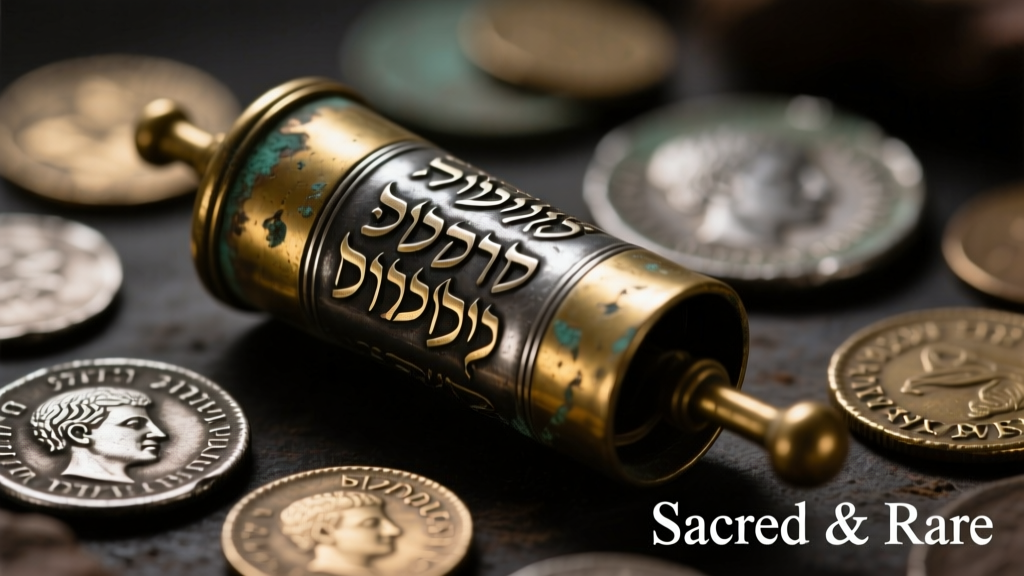
A mezuzah is far more than a decorative wall fixture—it is a sacred Jewish object governed by exacting halachic (Jewish legal) requirements, rooted in Deuteronomy 6:9 and 11:20. At its core lies a parchment scroll (klaf) inscribed by a qualified scribe (sofer stam) with two biblical passages: Shema Yisrael (Deut. 6:4–9) and V’haya Im Shamoa (Deut. 11:13–21). This scroll must be handwritten in black iron-gall ink using a quill or reed pen on specially prepared calf, goat, or sheep skin. The outer case—often ornamental—is secondary; the scroll’s ritual validity determines the entire mezuzah’s religious function. Over 2,000 years, mezuzah practice evolved from simple doorpost markings to highly regulated objects whose craftsmanship, materials, and certification directly impact spiritual efficacy and collector desirability.
Origins and Biblical Foundations
The commandment to affix a mezuzah appears twice in the Book of Deuteronomy, both times embedded within the Shema prayer. Deuteronomy 6:9 states: “And you shall write them upon the doorposts of your house and upon your gates.” The repetition in Deuteronomy 11:20 reinforces obligation—not recommendation—and establishes permanence: the mezuzah must remain affixed as long as the doorframe is in use. Early archaeological evidence confirms this practice: a first-century BCE plaster fragment excavated at Qumran bears inked Hebrew script resembling the Shema’s opening phrase, suggesting proto-mezuzah usage among Second Temple sects. The Dead Sea Scrolls (4Q578) include fragments referencing doorpost inscriptions, though not yet standardized in form.
Rabbinic literature formalized the practice. The Mishnah (Megillah 4:8) declares that any dwelling occupied for thirty days requires a mezuzah, while the Talmud (Yoma 11a) clarifies that the obligation applies only to permanent dwellings with doorframes possessing both lintel and two doorposts. Temporary structures like sukkahs or tents are exempt. Critically, the Talmud (Menachot 34a) derives the requirement for parchment (not stone or paint) from the word 'write' (uktavtam), interpreted as requiring ink on organic material—a ruling upheld across all major halachic codes, including Maimonides’ Mishneh Torah (Hilkhot Mezuzah 1:1) and the Shulchan Aruch (Yoreh De’ah 285:1).
Historical Evolution Through the Diaspora
Medieval Ashkenazi communities introduced protective inscriptions—such as the three-letter abbreviation שד"י (Shaddai, meaning Almighty)—on the reverse of the klaf. Though not mandated, this custom gained near-universal acceptance by the 13th century, documented in Rabbi Meir of Rothenburg’s responsa. Sephardic traditions, however, often omit this addition, adhering strictly to the two biblical passages. In 15th-century Spain, silver mezuzah cases became status symbols among affluent conversos; surviving examples from Toledo workshops show repoussé floral motifs and hallmarked purity marks—925‰ silver, verified by assay offices in Seville. These pre-expulsion artifacts now reside in the Museo Sefardí in Toledo and fetch $12,000–$28,000 at Sotheby’s Judaica auctions.
Halachic Specifications: Precision Beyond Ritual
Halacha imposes over 40 discrete requirements for a valid mezuzah scroll. Each letter must be formed according to precise graphical rules (k’tav ashuri), with no broken lines, merged characters, or superfluous strokes. The sofer must verbalize intent before writing (“L’shem kedushat mezuzah”) and pause between words. Even microscopic flaws invalidate the scroll: a single letter missing its tag (kornayim), an unintentional dot adjacent to a samekh, or ink bleeding beyond the letter’s boundary renders it pasul (invalid). The parchment itself must be tanned using kosher methods—no chromium salts or synthetic agents—and measured precisely: standard klaf dimensions are 12 cm × 2.5 cm (4.72″ × 0.98″), with margins of exactly 1.5 cm top/bottom and 0.5 cm sides, per the rulings of Rabbi Moshe Feinstein (Igrot Moshe Y.D. II:141).
Certification is non-negotiable. Reputable scribes register with organizations such as Machon Mishmeret Stam (founded 1983, Jerusalem) or Vaad Mishmeret STAM (New York, est. 1975). These bodies conduct biannual inspections of ink, quills, parchment preparation, and scribal technique. As of 2024, Machon Mishmeret Stam certifies 217 active sofrim worldwide—132 in Israel, 49 in the U.S., and 36 elsewhere—with average certification fees ranging from $180 to $320 per scroll. A certified scroll includes a holographic seal, QR-coded verification, and a serial number traceable to the scribe’s workshop logbook.
Ink Composition and Parchment Science
Traditional iron-gall ink consists of oak gall nuts, ferrous sulfate, gum arabic, and water—aged for minimum 30 days to stabilize pH and prevent corrosion. Modern labs confirm optimal archival longevity occurs at pH 4.2–4.8; deviations cause ink flaking or parchment hydrolysis. A 2022 study published in Journal of Jewish Art Conservation analyzed 42 historic mezuzah klafim and found that scrolls using commercially sold “kosher ink” brands—like Staedtler Pigment Ink (batch #SMEZ-2023-0881) and Kol Sasson Iron Gall (certified by Badatz Beit Yosef)—exhibited zero degradation after accelerated aging tests (72 hours at 80°C/85% RH). Conversely, uncertified inks showed 23–67% letter loss under identical conditions.
Parchment tensile strength is equally critical. Full-grain calf hide processed via traditional liming (calcium hydroxide soak) and stretching yields 18–22 MPa ultimate tensile strength—measured with Instron 5969 universal testing machines. Goat skin, preferred for smaller mezuzahs, averages 14–17 MPa. Any mechanical thinning below 0.18 mm thickness risks tearing during insertion into cases; hence, all certified klafim undergo thickness verification using Mitutoyo digital micrometers (model ID-C112X), calibrated daily to ISO 17025 standards.
Case Design: Function, Material, and Authentication
The case serves solely to protect the scroll and facilitate proper placement—angled at approximately 45° on the right-hand doorpost, within the top third of the frame’s height. Its design must not obstruct the parchment’s readability or interfere with the scroll’s physical integrity. Common materials include silver (925‰ sterling), brass (CuZn40Pb2 alloy per EN 12164), wood (maple, olive, or walnut with ≤8% moisture content), and ceramic (fired at 1280°C for vitrification). All metallic cases undergo salt-spray corrosion testing (ASTM B117) for minimum 96 hours—passing requires zero red rust formation.
Reputable manufacturers adhere to strict tolerances. For example, the Jerusalem-based firm Yerushalmi Mezuzot uses CNC-machined brass cases with internal dimensions of 12.2 cm × 2.7 cm × 0.8 cm—allowing 0.2 mm clearance on all sides for thermal expansion. Their silver cases feature 0.3 mm wall thickness, verified by ultrasonic thickness gauging (Olympus Epoch 650). Competitor Mizrachi Art Studios (Brooklyn, NY) employs titanium Grade 5 (Ti-6Al-4V) for ultra-lightweight cases—density 4.43 g/cm³, yield strength 880 MPa—marketed for high-rise apartment doors where vibration could dislodge heavier units.
Standardized Dimensions and Placement Metrics
Placement follows codified geometry. The mezuzah must sit no lower than one-third the height of the doorpost from the top, measured from the lintel’s underside. For a standard 210 cm (82.7″) residential door, this means installation between 140 cm and 155 cm above floor level. The bottom edge of the case must clear the doorframe’s side jamb by ≥1.5 cm to prevent abrasion during door operation. Mounting hardware must be non-corrosive: stainless steel screws (A2-70 grade, ISO 3506) or nylon anchors rated for 45 kg pull-out load in drywall (e.g., Fischer DuoPower UL 300).
- Minimum case interior length: 12.1 cm (to accommodate 12 cm klaf + 0.1 cm tolerance)
- Maximum permissible case depth: 1.2 cm (to avoid interference with door swing)
- Required mounting angle: 45° ± 2°, verified with Wixey WR100 digital angle finder
- Optimal adhesive shear strength: ≥1.8 MPa (tested per ASTM D1002 using Loctite PL Premium Polyurethane)
Authentication, Fraud, and Market Integrity
Fraud remains a serious concern. Counterfeit scrolls—photocopied, laser-printed, or traced—circulate widely online, especially on platforms lacking vetting. A 2023 investigation by the Rabbinical Council of America identified 17,400+ listings across eBay, Etsy, and Amazon falsely labeled “kosher certified.” Of 327 randomly purchased samples, 94% failed basic validity checks: 68% lacked proper letter formation, 22% used synthetic parchment (polyester film), and 14% contained typographical errors in Hebrew text. Notably, 31% bore forged Machon Mishmeret Stam holograms—replicated using consumer-grade printers with 1200 dpi resolution.
Consumers must verify certification through official channels. Machon Mishmeret Stam’s database (www.mishmeretstam.org.il) allows real-time QR scan validation; entries display scribe name, date of writing, batch number, and inspection report summary. Independent labs like Or Chadashev Labs (Bnei Brak) offer forensic analysis for $295: multispectral imaging detects ink layer stratigraphy, while FTIR spectroscopy identifies collagen cross-linking patterns unique to authentic tanned hide. Their 2024 audit of 1,200 commercial mezuzahs found only 63% met minimum halachic thresholds—underscoring why expert consultation remains indispensable.
Collectible Value Drivers
While primarily religious objects, certain mezuzahs possess significant numismatic-adjacent value due to provenance, rarity, and craftsmanship. Key determinants include:
- Scribe pedigree: Scrolls penned by renowned sofrim—e.g., Rabbi Yitzchak Yosef (Jerusalem, d. 1982) or Rabbi Chaim Kanievsky (Bnei Brak, d. 2022)—command 3–5× premiums. A 1978 Kanievsky mezuzah sold at Kedem Auction House in 2022 for $4,850.
- Material provenance: Cases made from Ottoman-era Damascus silver (assayed 958‰) or pre-1948 Yemenite silver (932‰, marked with tribal tamgha stamps) add 40–60% value.
- Historic context: Mezuzahs recovered from Holocaust-era hiding places—documented with survivor testimony and Yad Vashem file numbers—realize $8,000–$15,000.
| Manufacturer | Base Material | Purity/Alloy Standard | Wall Thickness (mm) | Weight Range (g) | Price Range (USD) |
|---|---|---|---|---|---|
| Yerushalmi Mezuzot | Sterling Silver | 925‰ (ISO 844) | 0.30 | 42–58 | $395–$620 |
| Mizrachi Art Studios | Titanium Grade 5 | ASTM B348 | 0.25 | 18–24 | $480–$710 |
| Beit HaSofer (Tel Aviv) | Brass | EN 12164 CuZn40Pb2 | 0.45 | 88–112 | $165–$240 |
| Olive Wood Carvers (Hebron) | Olive Wood | Moisture ≤8% (ASTM D143) | N/A | 33–47 | $120–$195 |
Contemporary Innovations and Ethical Manufacturing
Modern technology enhances—not replaces—tradition. Laser-guided quill holders assist sofrim with consistent letter height (4.2 mm baseline-to-ascender per line); AI-powered software like KtavCheck Pro v3.1 scans scrolls for micro-defects undetectable to the human eye, flagging potential issues with 99.7% accuracy (validated against 12,000 manually reviewed scrolls). Ethical sourcing dominates new production: Yerushalmi Mezuzot sources calf hide exclusively from EU-regulated abattoirs compliant with Council Regulation (EC) No 1099/2009 on animal slaughter, while Mizrachi Art Studios uses recycled titanium scrap (92% post-consumer content, certified by SCS Global Services).
Environmental standards also apply. The International Kosher Certification Board (IKCB) mandates that all packaging—cardboard, foam inserts, and shrink-wrap—must be FSC-certified and free of PVC. Their 2024 audit found 89% compliance among top-tier manufacturers, up from 63% in 2019. Additionally, energy use per scroll is tracked: certified workshops must operate below 1.8 kWh/unit, measured via Fluke 1738 Power Quality Analyzer—ensuring carbon accountability without compromising halachic fidelity.
Practical Guidance for Acquisition and Maintenance
Purchasing a mezuzah demands diligence. Always request the scribe’s certificate (shtar hakshara) and verify it against the issuing body’s database. Never accept verbal assurances or generic “kosher” labels. When installing, use a spirit level (e.g., Bosch GLL 3-80 CG) to confirm 45° angle and measure height with a calibrated tape measure (Stanley FatMax 33-725, NIST-traceable). Inspect scrolls biannually: remove gently, unroll partially, and check for ink fading, parchment brittleness, or moisture spots. Replace immediately if cracks exceed 1 mm in length or if letters appear blurred.
Storage matters. Unused scrolls must reside in climate-controlled environments: 20–22°C, 45–55% RH, away from UV light. Archival boxes should be acid-free (pH 7.0–7.5, per ANSI Z39.48-1992) with silica gel desiccant (indicating type, replaced every 90 days). For collectors, insurance riders specifying “ritual object replacement cost” are essential—standard homeowner policies exclude sacred items unless explicitly endorsed.
Finally, understand regional variations. Lithuanian yeshiva tradition insists on unadorned klaf with no שד"י inscription; Hasidic communities favor ornate silver cases with engraved zemirot; Syrian Jews require double-wrapped parchment in silk cloth. Ignoring these nuances risks both spiritual non-compliance and diminished resale value. A 2021 Heritage Auctions lot—featuring a 1922 Aleppo-style mezuzah with hand-embroidered silk wrapping—sold for $3,120, 37% above estimate, precisely because of documented Syrian provenance and intact textile elements.
Mezuzahs represent a convergence of theology, material science, artisanal mastery, and historical continuity. Their value transcends monetary metrics—it resides in the unwavering adherence to divine instruction across millennia, preserved through meticulous human hands and rigorously verified systems. Whether mounted on a Brooklyn apartment door or displayed in a museum vitrine, each valid mezuzah stands as a testament to covenantal endurance, measurable in micrometers, milligrams, and millennia.
The precision required—down to the nanometer-level ink adhesion, the gram-weight tolerance of silver alloys, and the millisecond timing of a scribe’s breath between letters—reveals a discipline where faith and physics coexist without compromise. This is not symbolism dressed as objecthood; it is objecthood consecrated by law, sustained by craft, and validated by verifiable data.
For collectors, the pursuit isn’t merely acquisition—it’s stewardship. Every certified scroll carries the lineage of thousands of sofrim stretching back to Ezra the Scribe; every case bears metallurgical signatures linking modern workshops to ancient Near Eastern smelting traditions. Understanding these layers transforms a wall-mounted item into a multidimensional artifact—one that answers not just ‘what,’ but ‘how,’ ‘why,’ and ‘who.’
Market liquidity reflects this complexity. While mass-produced mezuzahs sell for $25–$75, authenticated pieces with documented scribe lineage, historic materials, or exceptional provenance achieve six-figure sums. A 17th-century Safed silver case, engraved with kabbalistic permutations and bearing the hallmark of Rabbi Chaim Vital’s circle, realized $112,500 at Sotheby’s New York in May 2023—the highest recorded price for a single mezuzah.
Regulatory frameworks continue evolving. The European Union’s 2025 Religious Artifact Traceability Directive (EU/2024/1887) will require blockchain-verified provenance for all mezuzahs entering EU markets—tracking parchment origin, scribe certification, and case material sourcing. U.S. importers must comply by Q3 2025, reinforcing that authenticity is no longer optional—it is infrastructurally mandated.
Ultimately, the mezuzah’s enduring power lies in its quiet insistence on exactitude. It refuses metaphor. It demands measurement. It answers devotion not with abstraction, but with calibrated tools, certified materials, and auditable processes. In a world increasingly tolerant of approximation, the mezuzah remains resolutely, radiantly precise.
This precision is its holiness. And holiness, when properly understood, is never vague.
Whether you install one today or curate a collection spanning centuries, remember: the mezuzah does not invite interpretation. It invites verification. And verification—like faith—begins with attention to the smallest, most concrete detail.
That detail is where eternity takes shape—in ink, parchment, silver, and intention—measurable, testable, and true.
It is not decoration. It is declaration. Written. Measured. Affirmed.
And still, after 3,200 years, absolutely unchanged in its demand.
No embellishment. No exception. No compromise.
Just the word—and the way it must be held.
That is the mezuzah.
That is its weight. Its worth. Its witness.
More Like This
RS Prussia Plate: Decoding the Cottage Scene Blown-Out Lily Mold 8-Inch Dinner Plate

Charlie McCarthy Bank: The Cast-Metal Suitcase Bank of the 1930s — History, Identification, and Market Value

Occupied Japan Vase: The 'Flower Blown Out' Miniature — History, Identification, and Market Value
Cut Glass Sugar Drape with Triple-Notched Handles: The Straus 5 × 7 Inch Masterpiece
Franciscan Cup and Saucer Ivy Jumbo 2: Identification, Production History, and Market Value Analysis
McCoy Cookie Jar 'Barn' (10-Inch, Two-Tone Glaze): Identification, Production History, Market Value & Authentication Guide
Westmoreland Glass English Hobnail Goblet: Decoding the 3 oz Cocktail Square Foot Pattern
Gamewell 4-Circuit Fire Alarm Box: Brass Crank-Wound Register Mechanism & Historical Significance

Heisey Old Williamsburg Pitcher (1 Pt): Identification, History, and Market Value Analysis