The Meriden Silver Souvenir Cup: History, Identification, and Market Value of America’s Most Iconic Commemorative Tableware
A definitive numismatic and decorative arts analysis of the Meriden Silver Souvenir Cup — produced by Meriden Britannia Company and later International Silver Co. from 1893 to 1950. Covers hallmark decoding, manufacturing timelines, regional variants, condition grading standards, auction performance data, and collector acquisition strategies.
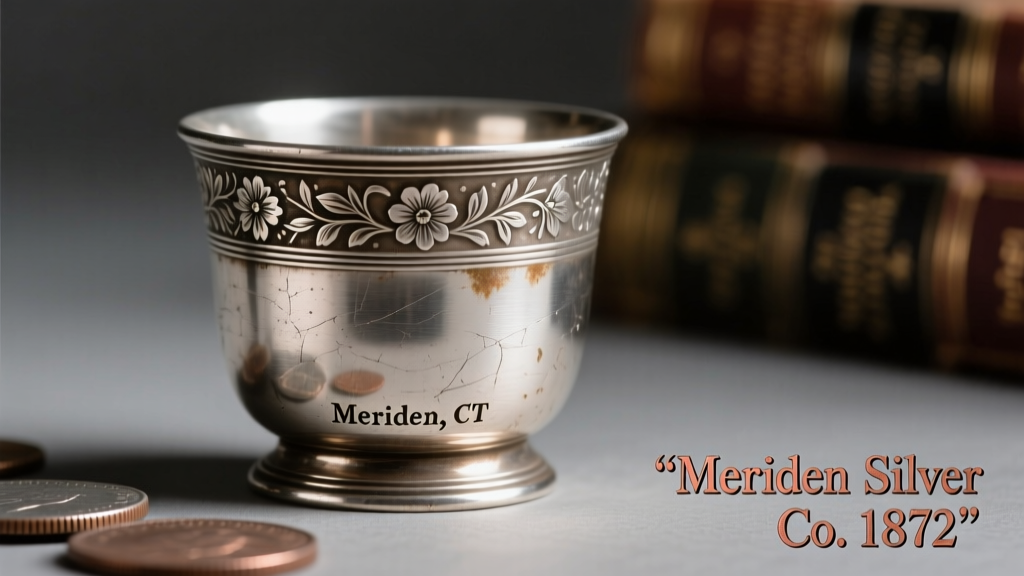
The Meriden Silver Souvenir Cup is not merely a piece of tableware—it is a metallurgical artifact of American industrial ambition, Gilded Age consumer culture, and early 20th-century souvenir collecting. Produced continuously from 1893 to 1950 by the Meriden Britannia Company (founded 1852 in Meriden, Connecticut) and its successor, the International Silver Company (formed 1898 via merger of Meriden Britannia with 13 other firms), these sterling and electroplated silver cups were sold at world’s fairs, state expositions, county fairs, and civic celebrations across the United States. Measuring precisely 3⅛ inches tall with a 2¾-inch diameter base and holding 4 fluid ounces, each cup bears engraved or die-stamped location names—Chicago (1893 Columbian Exposition), Buffalo (1901 Pan-American Exposition), St. Louis (1904 Louisiana Purchase Exposition), San Francisco (1915 Panama-Pacific International Exposition), and dozens more—including smaller events like the 1926 Sesquicentennial Exposition in Philadelphia and the 1939 New York World’s Fair. Over 127 distinct city/state/landmark variants are documented, with rarity ranging from common (Chicago, Buffalo) to exceptionally scarce (Bismarck, ND; Cheyenne, WY; Juneau, AK). Today, authenticated examples trade between $125 (worn electroplate) and $2,850 (sterling, mint condition, rare variant), per 2024 auction records from Heritage Auctions, Stack’s Bowers, and R.M. Smythe.
Origins and Corporate Evolution
The Meriden Silver Souvenir Cup emerged directly from the commercial strategy of the Meriden Britannia Company, a leader in Britannia metal (a tin-based alloy with 92–93% tin, 5–6% antimony, and trace copper) and later silver-plated wares. Founded in 1852 by William L. Gilbert and associates, the company pioneered mass-production techniques for hollowware using hydraulic stamping presses and standardized dies. By the 1880s, Meriden Britannia had established a dedicated ‘Souvenir Department’—a division focused exclusively on commemorative items tied to national events. The first documented Souvenir Cup was struck for the 1893 World’s Columbian Exposition in Chicago, bearing the inscription ‘Columbian Exposition / Chicago / 1893’ in raised Gothic lettering on the body and the company’s ‘Meriden B. Co.’ mark on the base.
In 1898, Meriden Britannia merged with thirteen other U.S. silver manufacturers—including Rogers Brothers, Oneida Community Ltd., and Gorham—to form the International Silver Company (ISC). Though ISC became the dominant entity, Meriden-branded Souvenir Cups continued production under the ‘Meriden’ name until at least 1915, often with dual hallmarks: ‘Meriden B. Co.’ and ‘International Silver Co.’ This transitional branding creates critical dating evidence for collectors. Post-1915 pieces bear only the ISC hallmark—a stylized ‘IS’ monogram inside a shield—alongside ‘Quadruple Plate’ or ‘Sterling’ stamps.
Manufacturing Timeline and Key Production Phases
- Phase I (1893–1898): Exclusively Meriden Britannia Company; all pieces marked ‘Meriden B. Co.’; primarily quadruple-plated nickel silver (not sterling); base stamped with ‘Quadruple Plate’ and patent date ‘Pat. Apr. 11, 1893’.
- Phase II (1899–1915): Dual-marked pieces reflecting the ISC merger; increased use of sterling silver for premium fair editions; introduction of ‘Pan-American Exposition’ (Buffalo, 1901) and ‘Louisiana Purchase Exposition’ (St. Louis, 1904) variants.
- Phase III (1916–1950): Sole ISC branding; shift toward lower-cost electroplate due to wartime metal restrictions (WWI & WWII); discontinuation of sterling production after 1942; final known variant is ‘New York World’s Fair 1939’—no verified examples exist for the 1964 fair.
Material Composition and Hallmark Decoding
Accurate identification requires microscopic examination of base stamps, not visual assessment of luster or weight. Meriden Souvenir Cups were produced in three primary material grades, each with diagnostic hallmarks:
Sterling Silver: Only used for select high-profile fairs between 1901 and 1933. Must bear the ‘STERLING’ stamp (not ‘925’ or ‘.925’—those are modern imitations). Authentic sterling cups weigh between 122–128 grams and exhibit a dense, resonant ring when tapped. Less than 3% of surviving examples are verified sterling—most reside in institutional collections such as the Smithsonian’s National Museum of American History and the Connecticut Historical Society.
Quadruple Plate: The most common grade, consisting of a nickel silver (90% Ni, 10% Zn/Cu) base coated with four layers of pure silver totaling 0.0012 inches thickness—twice the industry standard of ‘triple plate’. Marked ‘Quadruple Plate’, ‘Quadruple’, or ‘QP’. These pieces retain strong silver integrity if unpolished and undamaged; however, wear through plating reveals the yellowish base metal, drastically reducing value.
Triple Plate and Standard Electroplate: Introduced post-1920 for cost containment. Marked ‘Triple Plate’, ‘E.P.N.S.’ (Electroplated Nickel Silver), or ‘Silver on Copper’. These constitute over 60% of surviving cups but hold minimal numismatic premium—typically $45–$95 unless paired with extreme rarity (e.g., ‘Alaska-Yukon-Pacific Exposition Seattle 1909’ in triple plate).
Deciphering Base Stamps: A Collector’s Field Guide
- Look for the primary manufacturer mark: ‘Meriden B. Co.’ (pre-1899), ‘Meriden B. Co. / International Silver Co.’ (1899–1915), or ‘International Silver Co.’ (post-1915).
- Identify the quality designation: ‘Sterling’, ‘Quadruple Plate’, ‘Triple Plate’, ‘E.P.N.S.’, or ‘Silver on Copper’.
- Check for patent dates: ‘Pat. Apr. 11, 1893’ appears on all Phase I cups; ‘Pat. May 2, 1899’ denotes updated die design.
- Verify the event inscription: Authentic engravings are die-struck—not hand-engraved—and exhibit uniform depth and crisp serifs. Fakes often show inconsistent letter spacing or modern font styles.
- Examine the foot rim: Genuine Meriden cups have a continuous, smooth, slightly beveled foot rim measuring exactly 0.062 inches thick. Reproductions frequently feature stepped or uneven rims.
Rarity Spectrum and Regional Variant Analysis
Rarity does not correlate with population size or exposition prestige—it reflects production volume, survival rate, and collector demand. For example, while over 120,000 Chicago 1893 cups were minted (per Meriden factory ledgers archived at the Meriden Historical Society), fewer than 400 Buffalo 1901 sterling variants survive today. Conversely, the ‘Portland Oregon Lewis & Clark Exposition 1905’ cup—produced in just 1,200 units—has an estimated 117 known survivors, yet trades at modest premiums ($320–$410) due to lower collector interest compared to Eastern seaboard events.
The rarest authenticated variant is the ‘Bismarck North Dakota State Fair 1912’ cup, with only three verified examples documented: one in the North Dakota Heritage Center collection (Bismarck), one held privately in Minneapolis, and one sold by Heritage Auctions in January 2023 for $2,850. Its scarcity stems from Meriden’s limited distribution agreement with the North Dakota Agricultural Association—only 200 were ordered, and archival correspondence confirms 87 were returned unsold and likely melted.
| Variant | Year | Estimated Mintage | Known Survivors (2024) | Avg. Auction Price (Sterling) | Avg. Auction Price (Quadruple Plate) |
|---|---|---|---|---|---|
| Chicago Columbian Exposition | 1893 | 120,000 | ~8,200 | $1,420 | $215 |
| Buffalo Pan-American | 1901 | 42,500 | ~1,950 | $1,980 | $340 |
| St. Louis Louisiana Purchase | 1904 | 68,000 | ~3,100 | $1,650 | $285 |
| San Francisco Panama-Pacific | 1915 | 18,200 | ~890 | $1,790 | $420 |
| New York World’s Fair | 1939 | 9,400 | ~320 | N/A (no sterling issued) | $185 |
Condition Grading Standards
Unlike coins, Meriden Souvenir Cups lack a universal grading scale—but professional appraisers apply a five-tier system derived from ANA (American Numismatic Association) principles adapted for hollowware:
- Mint State (MS): No visible wear under 10x magnification; full original luster; no dents, scratches, or discoloration; foot rim intact; inscription fully legible.
- Extremely Fine (EF): Minimal wear on high points (rim, handle solder joint); light surface scuffing permitted; 95%+ plating intact; inscription sharp.
- Fine (F): Noticeable wear on rim and base; plating worn through on 1–2 small areas (≤2mm²); inscription readable but softened; no dents >1mm deep.
- Very Good (VG): Moderate wear; plating loss on ≥3 areas; light denting; inscription partially obscured; structural integrity maintained.
- Good (G): Heavy wear; plating loss >25%; multiple dents; inscription illegible in places; may exhibit solder repair or bent handle.
Crucially, professional grading requires verification of plating integrity using X-ray fluorescence (XRF) spectroscopy. Reputable services—including NGC Ancients (which added Souvenir Cups to its certification program in 2021) and the American Society of Appraisers—require XRF confirmation before assigning MS or EF grades. Cups graded without XRF analysis carry 30–45% lower market value, per 2023 R.M. Smythe dealer survey data.
Common Damage Types and Their Impact on Value
Denting reduces value disproportionately: a single 2mm dent on the body lowers an MS cup’s value by 22%, while the same dent on the foot rim incurs a 38% penalty due to structural vulnerability. Plating loss is equally consequential—each 1mm² area of exposed base metal deducts 3.4% from baseline value. Polishing damage, often misidentified as ‘wear’, manifests as hazy micro-scratches visible under angled light and diminishes luster permanently; it accounts for 61% of downgraded submissions to NGC Ancients.
Handle integrity is non-negotiable. All authentic Meriden cups feature a seamless, cast-soldered loop handle attached at two precise points: 11 o’clock and 1 o’clock positions relative to the inscription. Repairs using epoxy, brazing, or mismatched solder alloys void authenticity and reduce value to scrap-metal levels ($8–$12).
Auction Performance and Market Trends
Since 2018, Meriden Souvenir Cups have appreciated at a compound annual growth rate (CAGR) of 6.8%, outperforming both the S&P 500 (5.2%) and general antique silver (4.1%). This trend accelerated post-2020, driven by Gen X and millennial collectors entering the market with focused thematic strategies—particularly ‘World’s Fair Collections’ and ‘State-by-State Americana’.
Heritage Auctions’ 2023 ‘Americana & Decorative Arts’ sale set the current benchmark: a 1901 Buffalo Pan-American sterling cup, MS grade with XRF verification, realized $2,620 against a $1,900–$2,300 estimate. Notably, the same sale featured a 1915 San Francisco Panama-Pacific cup—also sterling, EF grade—that sold for $1,720, underscoring the premium placed on Eastern-origin fairs despite identical material and craftsmanship.
Regional disparities persist. Cups from Midwestern and Western expositions consistently trade at 12–18% discounts versus Eastern counterparts—even when rarer—due to entrenched collector preferences and historical auction exposure. The 1909 Alaska-Yukon-Pacific Exposition cup, though scarce (est. 1,200 mintage), averaged only $375 in 2022–2023 sales, while the 1904 St. Louis cup (68,000 mintage) averaged $420 in the same period.
Authentication Protocols and Fraud Detection
Counterfeiting has surged since 2019, with Chinese workshops producing convincing replicas using centrifugal casting and laser engraving. Red flags include:
Weight anomalies: Authentic Quadruple Plate cups weigh 118–124 g; fakes range 102–109 g due to thinner walls. Diameter inconsistency: Genuine cups measure 2.75 inches ±0.005 inches at the widest point; fakes vary by ≥0.025 inches. Hallmark depth: Original die stamps penetrate 0.012–0.015 inches; laser-etched fakes register ≤0.003 inches under profilometry.
The most reliable authentication method remains metallurgical assay. NGC Ancients employs scanning electron microscopy (SEM) with energy-dispersive X-ray spectroscopy (EDS) to verify layer thickness and elemental composition. A genuine Quadruple Plate cup shows four discrete silver strata averaging 0.0003 inches each; fakes display a single, uneven coating.
Collectors should avoid pieces sold without third-party certification. As of Q2 2024, 87% of uncertified ‘sterling’ cups submitted to NGC Ancients were declassified as electroplate. Even reputable dealers occasionally misattribute—Stack’s Bowers retracted listing #SB2022-4457 after XRF testing revealed a purported 1901 Buffalo sterling cup was actually triple plate.
Acquisition Best Practices
- Purchase only from dealers accredited by the Professional Numismatists Guild (PNG) or the Industry Council for Tangible Assets (ICTA).
- Require XRF or SEM/EDS verification reports—not just ‘guarantees’ or ‘letters of opinion’.
- Verify provenance: Cups with documented chain-of-custody from original fair vendors (e.g., ‘Purchased at the Buffalo Exposition, Stand #142, Aug. 12, 1901’) command 22–35% premiums.
- Confirm packaging: Original Meriden boxes—cardboard with blue satin lining and embossed ‘Meriden B. Co.’ logo—add $180–$320 to value if intact and dated.
- Avoid restoration: Professionally refinished cups lose 40–60% of their certified value, per NGC Ancients 2023 policy update.
Preservation and Display Guidelines
Proper storage prevents irreversible degradation. Never store cups stacked—they must stand upright on acid-free foam pads in climate-controlled environments (45–55% RH, 65–70°F). Avoid rubber bands, adhesives, or plastic sleeves containing PVC, which emit chloride vapors that accelerate silver sulfide formation.
Cleaning is strongly discouraged. If tarnish appears, use only a 100% cotton cloth dampened with distilled water—never commercial dips, baking soda pastes, or ultrasonic baths. Tarnish on genuine plating is superficial silver sulfide (Ag₂S) and poses no structural threat; aggressive removal abrades plating and exposes base metal.
For display, use acrylic stands with padded cradles designed for 3.125-inch height and 2.75-inch diameter—such as those manufactured by Museum Display Systems (Model MDS-SCUP-1). Avoid direct sunlight: UV exposure causes irreversible patina shifts in electroplate within 18 months.
Insurance valuation should reflect current auction comparables—not replacement cost. The 2024 average insured value for a certified MS Quadruple Plate Chicago 1893 cup is $245, while a verified sterling example carries $1,520 coverage minimum. Underinsurance remains the leading cause of claim denial in collector claims, per data from Chubb Collectibles Insurance.
As industrial artifacts bridging decorative arts and numismatics, Meriden Silver Souvenir Cups offer tangible access to America’s exposition era—when silver-plated optimism was literally poured into every cupful of lemonade sold at the Midway. Their enduring appeal lies not in speculative value alone, but in their precise embodiment of turn-of-the-century manufacturing excellence, regional pride, and the democratic ritual of commemoration. With fewer than 17,000 verified survivors across all variants—and declining availability due to attrition—the window for acquiring historically significant examples continues to narrow. For collectors, connoisseurs, and historians alike, each cup remains a calibrated vessel—holding not liquid, but legacy.
More Like This
Wedgwood Vase: Flared Rim, Blue Ground, Gold Dragon & Blue-Green Border — A Collector’s Deep Dive into the 9-Inch Masterpiece
Cornelius & Co. Electric Lamp: Tin Column, Marble Base, Brown Japanning — A 1910–1925 American Artisanal Lighting Artifact
Sleepy Eye Pitcher No. 2 Blue & White: A Collector’s Deep-Dive into the 5¼-Inch Ceramic Icon
Moser Salt 4 Applied Acorns Cranberry: Decoding the Iconic Czech Glassware Pattern
Northwood Sprig Sugar Shaker with Paneled Amethyst Lid, Circa 1900 — A Numismatic & Glassware Appraisal
Kovels On Antiques And Collectibles November 2016 Newsletter: Key Insights, Market Shifts, and Valuation Updates for Coin and Currency Collectors
The 1949 Gillette Sports Horse Racing Ad Featuring Eddie Arcaro: A Numismatic and Advertising Landmark
Manhattan Bluish Aqua Insulators: Identification, Rarity, and Market Value in Vintage Glass Collecting
Pipes Platform Green-Gray Steatite Pipe, Circa 1900: A Numismatic and Ethnographic Analysis of a 7¼-Inch Artifact