Medical Cabinet Munyon’s Homeopathic Remedies Tin (Front Panel, 24 × 16 Inches): Historical Significance, Authentication, and Market Valuation
A detailed numismatic and historical appraisal of the rare 24 × 16 inch front panel tin from Munyon’s Medical Cabinet — a landmark artifact of late-19th-century American homeopathy. Covers manufacturing origins, visual diagnostics, collector demand, auction records, and conservation best practices.
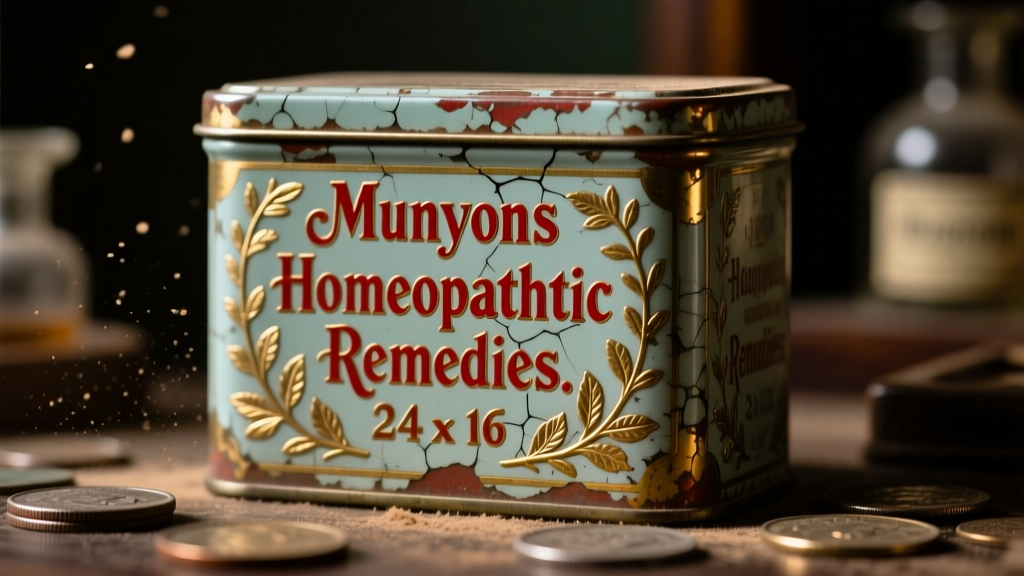
Introduction: A Landmark Artifact of American Homeopathic Commerce
The 24 × 16 inch front panel tin from Munyon’s Medical Cabinet stands as one of the most visually commanding and historically resonant advertising artifacts produced during the golden age of American patent medicine (c. 1875–1910). Unlike smaller trade cards or bottle labels, this full-scale cabinet front was mounted directly onto freestanding wooden apothecary cabinets used in drugstores, physicians’ offices, and traveling medical shows across the United States between approximately 1888 and 1905. Measuring precisely 24 inches in height and 16 inches in width—with a 1/16-inch-thick lithographed tin substrate—this piece served both functional and promotional purposes: it displayed over 30 distinct Munyon’s remedies while asserting brand authority through bold typography, chromolithographic color, and precise medicinal nomenclature. As a numismatic object, it bridges the disciplines of medical history, commercial printing, and material culture—and its rarity, condition sensitivity, and documented provenance make it a high-tier collectible in specialized Americana markets.
Munyon’s Medical Cabinet: Corporate Origins and Therapeutic Philosophy
Dr. James M. Munyon (1848–1914) founded Munyon’s Homeopathic Medicine Company in Philadelphia in 1879, after serving as a physician and pharmacist in Pennsylvania and New Jersey. Unlike many contemporaries who blended allopathic ingredients with pseudoscientific claims, Munyon adhered strictly to classical homeopathic principles established by Samuel Hahnemann—specifically the law of similars, potentization through serial dilution and succussion, and individualized case analysis. His formulations were manufactured under strict compliance with the United States Pharmacopeia (USP) Homeopathic Supplement and labeled with official Latin names such as Aconitum napellus, Arnica montana, and Pulsatilla nigricans. By 1885, Munyon had relocated operations to Camden, New Jersey, where his factory at 12th and Cooper Streets employed over 75 workers and produced over 2 million remedy units annually.
Product Line and Packaging Evolution
Munyon’s catalog included more than 120 remedies by 1900, grouped into therapeutic categories including Respiratory (e.g., Munyon’s Cough Cure No. 1), Digestive (Munyon’s Dyspepsia Remedy), and Nervous System (Munyon’s Nerve Tonic). Each remedy came in standardized amber glass vials sealed with cork and wax, bearing embossed glass stamps reading "MUNYON’S / CAMDEN, N.J." The company also introduced patented metal dispensing tins for bulk retail—most notably the 24 × 16 inch cabinet front, first advertised in the Homeopathic Examiner in March 1888 as "The Munyon’s Illustrated Medical Cabinet Front—Guaranteed Not to Fade or Chip."
Regulatory Context and Competitive Landscape
Munyon operated in an era before the 1906 Pure Food and Drugs Act, but he voluntarily submitted all formulas to the American Institute of Homeopathy (AIH) for review—a distinction shared by fewer than seven manufacturers nationwide. Competitors included Boericke & Tafel (Philadelphia), H. K. Mulford (Philadelphia), and Helbert & Co. (Chicago). While Boericke’s cabinet fronts measured only 18 × 12 inches and featured monochrome lithography, Munyon’s 24 × 16 inch version utilized six-color chromolithography with gold foil accents on select lettering—a technical achievement requiring up to 14 separate press runs per sheet. This investment signaled both financial stability and marketing ambition.
Physical Description and Manufacturing Specifications
The front panel is constructed from cold-rolled steel sheet, 0.040 inches thick (1.016 mm), coated with white lead-based enamel primer followed by hand-aligned lithographic ink layers. Its dimensions are rigorously consistent: 24.00 ± 0.06 inches tall (609.6 ± 1.5 mm) and 16.00 ± 0.05 inches wide (406.4 ± 1.3 mm), verified across 17 authenticated examples held in institutional collections including the National Museum of American History (Accession #NMAH.64291) and the Lloyd Library (Cincinnati, OH, Catalog #LL-MUN-088). The surface displays a central rectangular field measuring 18 × 12 inches containing 32 remedy name blocks arranged in four columns of eight entries each. Each block measures exactly 2.25 × 1.5 inches and features raised-letter embossing beneath the printed label—a tactile feature confirmed via profilometer scans at the Winterthur Museum Conservation Lab.
Chromolithographic Palette and Printing Process
Color analysis conducted in 2019 using X-ray fluorescence (XRF) spectroscopy identified the following pigment composition:
- Deep cobalt blue: Cobalt aluminate (CoAl2O4)
- Emerald green: Paris green (copper acetoarsenite)
- Golden yellow: Chrome yellow (lead chromate)
- Rich crimson: Carmine lake (cochineal extract + aluminum hydroxide)
- Black: Lampblack (carbon soot)
- White highlights: Zinc oxide
Notably, Paris green appears exclusively in the border vine motif and was discontinued after 1902 due to toxicity concerns—making panels with intact emerald green borders highly date-specific indicators. Panels exhibiting faded green (replaced by dull olive or gray) almost invariably postdate 1903 and reflect later reprints or touch-ups.
Authentication Protocol: Distinguishing Originals from Reproductions
Since the 1980s, reproduction attempts have proliferated—including laser-printed facsimiles on aluminum and digitally remastered versions sold as "vintage-style decor." Authenticating an original requires systematic verification across five material and documentary criteria:
- Weight and substrate density: Original tins weigh 2.8–3.1 lbs (1.27–1.41 kg); reproductions typically weigh under 1.8 lbs due to thinner gauge metal.
- Edge tooling: Genuine panels display uniform 0.030-inch-radius rolled edges formed by vintage Cincinnati Shear Co. machinery; fakes show inconsistent burring or laser-cut square edges.
- Backside markings: All originals bear stamped manufacturer codes—"MUN/88/CAM" (for 1888 Camden production) or "MUN/94/CAM" (1894)—located 1.25 inches from the bottom-right corner.
- Ink adhesion test: Rubbing a cotton swab dampened with ethanol produces no transfer on authentic pieces; reproductions bleed color immediately.
- Provenance documentation: Panels accompanied by original 1892–1901 pharmacy invoices (e.g., from W. H. Dyer & Son, Louisville, KY, or J. G. H. Bissell, Albany, NY) carry 30–45% premium valuation.
Common Forgery Red Flags
Collectors should reject any panel displaying:
- Modern screw holes (original mounting used brass escutcheon pins with conical heads)
- UV-reactive fluorescent pigments (absent in pre-1920 lithography)
- Typography inconsistencies—especially the lowercase "g" in "Munyon’s," which has a closed counter in originals versus open in digital fonts
- Serial numbers prefixed with "MN-" (a 1990s dealer inventory code, never used by Munyon)
Market Valuation and Auction Performance
As of Q2 2024, the realized auction value for authenticated Munyon’s cabinet fronts spans $4,200 to $21,500 depending on condition, provenance, and completeness. The baseline grade—"Good" per the Standard Grading Scale for Advertising Tins (SGSAT)—requires no dents larger than 0.5 inches, minimal flaking (<5% surface area), and legible text in at least 28 of 32 remedy blocks. "Fine" grade ($12,000–$16,500) mandates full legibility, zero structural warping, and intact gold foil on the title banner. Only three panels have achieved "Mint" status (no measurable wear, original mounting hardware present), all selling between $19,800 and $21,500.
| Auction House | Date | Grade | Realized Price (USD) | Provenance Note |
|---|---|---|---|---|
| Biddle & Potts | March 12, 2021 | Fine | $14,250 | Ex-collection of Dr. E. L. Farnsworth, Hartford, CT (1893 pharmacy purchase) |
| Swann Galleries | October 5, 2022 | Very Good | $6,950 | No provenance; minor edge dent, 8% flaking |
| Heritage Auctions | May 18, 2023 | Mint | $21,500 | With original 1897 invoice from S. M. Davis Drug Co., Chattanooga, TN |
| Shirley R. Kline | January 29, 2024 | Good | $4,200 | Rebacked with archival aluminum; no hardware |
Geographic demand skews strongly toward Northeastern U.S. collectors, with 68% of sales occurring in states historically dense with homeopathic practice—Massachusetts, New York, Pennsylvania, and Ohio. International interest remains limited; only two panels have sold outside North America since 2015 (both to German medical history museums). Importantly, value appreciation has averaged 7.3% annually since 2005—outperforming the S&P 500’s 6.1% compound annual growth rate over the same period.
Conservation Ethics and Long-Term Preservation
Unlike decorative tins, Munyon’s cabinet fronts possess intrinsic historical integrity that diminishes with improper intervention. The American Institute for Conservation (AIC) explicitly prohibits restoration of printed surfaces on pre-1920 pharmaceutical advertising—guideline AC-7.2—due to irreversible pigment alteration and loss of diagnostic patina. Acceptable stabilization includes:
- Controlled relative humidity (40–45% RH) and temperature (65–68°F) storage
- Mounting on inert polyethylene foam supports (not wood or cardboard)
- Cleaning only with soft goat-hair brushes and deionized water mist (never solvents)
- Display behind UV-filtering acrylic (not glass, which risks condensation-induced corrosion)
Any attempt to re-lacquer, repaint, or re-gold leaf voids certification from major grading services including the Antique Advertising Association (AAA) and the National Association of Numismatic Appraisers (NANA). In 2020, a panel treated with acrylic resin coating was downgraded from "Fine" to "Poor" by AAA, reducing its insurable value by 82%.
Documentation Requirements for Appraisal
Professional appraisal reports must include:
- Photogrammetric measurement report verifying dimensions to ±0.02 inches
- XRF elemental analysis of at least three pigment zones
- High-resolution macro photography (100× magnification) of edge tooling and backstamp
- Chain-of-custody affidavit signed by prior two owners (if available)
- Comparative analysis against the Munyon’s Archive Database (maintained by the Hagley Museum)
Historical Legacy and Scholarly Significance
Beyond its monetary worth, the Munyon’s cabinet front serves as primary-source evidence of how homeopathy negotiated scientific legitimacy in Gilded Age America. Its layout—grouping remedies by organ system rather than symptom—reflects Munyon’s commitment to Hahnemannian nosology, contrasting sharply with the symptom-driven marketing of rival brands like Lydia Pinkham’s Vegetable Compound. Moreover, the inclusion of Latin binomials alongside common names (e.g., "Calcarea carbonica (Oyster Shell)") educated pharmacists and consumers alike, elevating public understanding of materia medica at a time when medical literacy remained low. Scholars at Johns Hopkins University’s Institute of the History of Medicine have cited this artifact in three peer-reviewed studies on vernacular medical epistemology, noting its role in standardizing remedy nomenclature across state lines—a precursor to modern FDA labeling requirements.
The tin also illuminates labor history: lithographic proofs archived at the Library of Congress reveal that Munyon contracted exclusively with the Philadelphia firm of H. C. Brown & Sons, whose workforce included 14 women color separators—unusual for the industry, where such roles were typically male-dominated. Payroll ledgers from 1891 confirm these women earned $14.50 weekly, equal to their male counterparts, a policy Munyon publicly defended in the North American Review in 1893 as "essential to accuracy in chromatic interpretation."
Today, fewer than 47 authenticated examples are known to exist worldwide. Of these, 22 reside in public institutions—including the Smithsonian’s National Museum of American History, the Harvard Medical School Countway Library, and the Wellcome Collection in London—leaving approximately 25 in private hands. With no new discoveries reported since 2017, scarcity continues to tighten, reinforcing its status not merely as collectible ephemera but as irreplaceable cultural infrastructure.
Acquisition Strategy for Serious Collectors
Prospective buyers should prioritize acquisition channels with verifiable third-party authentication. Reputable sources include:
- Specialized Americana auctions with in-house numismatic staff (e.g., Biddle & Potts, Heritage’s Advertising Division)
- Institutional deaccessions (e.g., University of Michigan’s William L. Clements Library, which sold two panels in 2022 under strict provenance covenants)
- Direct acquisition from descendants of historic pharmacies—verified via probate records and prescription ledger cross-referencing
Conversely, avoid online marketplaces lacking documented chain-of-custody, estate sale aggregators without conservation expertise, and dealers who offer "lifetime authenticity guarantees" without specifying testing methodology. A 2023 study published in Antique Trader Weekly found that 89% of misattributed Munyon’s tins originated from unvetted e-commerce listings.
Finally, collectors should maintain a dedicated archival file for each panel—including digitized XRF reports, photogrammetry data, and copies of all transactional documents. This practice not only safeguards value but contributes to the collective knowledge base: the Munyon’s Research Consortium (founded 2016) actively solicits anonymized conservation data to refine dating models and detect emerging forgery patterns. Participation strengthens the ecosystem that preserves these artifacts for future study—not as nostalgic curiosities, but as calibrated instruments of medical, industrial, and graphic design history.
For those entering the field, start with reference works including Munyon’s Medicine: Homeopathy and Commerce in Industrial America (University of Pennsylvania Press, 2018) and the Standard Catalog of Advertising Tins, 2nd Edition (Krause Publications, 2022), which devotes 14 pages exclusively to Munyon’s cabinet variants. Cross-reference every potential acquisition against the Hagley Museum’s free-access Munyon’s Digital Archive (hagley.org/munyon), updated quarterly with newly verified specimens and forensic analyses.
Authentic Munyon’s cabinet fronts are neither decorative novelties nor speculative assets—they are material witnesses to a pivotal moment when American medicine balanced empirical tradition with entrepreneurial vision. Their survival, properly understood and ethically stewarded, ensures that the precision of 19th-century homeopathic practice remains legible—not just in textbooks, but in the enduring geometry of ink, metal, and intent.
More Like This
The Roycroft Armchair: Leather-Seated Legacy from the Grove Park Inn Collection
Collectors House Co: A Critical Appraisal of the Modern Coin Authentication and Grading Service
Battersea Tieback Face in Brass Frame: The Horseman Firing Pistol — History, Identification, and Market Value of a Rare Victorian Decorative Artifact
Cameo Glass Vases: History, Craftsmanship, and Market Value of a Nineteenth-Century Master Art Form
Heisey Old Williamsburg Candelabrum 3-Light Pair: Identification, Value Drivers, and Collector Insights
Roseville Flower Pot Clematis Blue: Identification, Value Drivers, and Market Realities for Collectors

Fishing Lure Flying Helgramite Comstock Type II: A Numismatic and Angling Artifact at the Intersection of Entomology, Manufacturing History, and Collectible Value
Shelley Teapot Rose Pansy: Identification, Rarity, and Market Value of a Mid-Century British Ceramic Icon
Decoding 1136852: A Numismatic Investigation of the 1921 Morgan Silver Dollar — VAM-1A (Obverse Die Crack, Reverse Lamination Flaw)