The Medallic Art Company: A Legacy of Precision, Prestige, and Presidential Medals
A definitive historical and technical examination of the Medallic Art Company (1907–2023), covering its founding by Joseph F. Weeden and Robert Aitken, its role in producing over 40 U.S. presidential inaugural medals, its proprietary alloy formulations, minting innovations, and its enduring impact on American medallic artistry.
Founding Vision and Early Innovation (1907–1925)
Founded in New York City in 1907 by sculptor Joseph F. Weeden and medalist Robert Aitken—best known for designing the 1916–1930 Panama-Pacific International Exposition medals—the Medallic Art Company (MAC) emerged at a pivotal moment in American numismatic history. Unlike traditional mints focused on coinage, MAC specialized exclusively in artistic medals, plaques, and commemorative pieces. Its first studio occupied a converted loft at 120 West 25th Street, equipped with two hand-cranked Janvier reducing lathes imported from Paris and a custom-built hydraulic press capable of 1,200 tons of pressure. By 1912, MAC had secured commissions from the American Numismatic Society, the National Academy of Design, and the U.S. Naval Academy—establishing its reputation for technical fidelity and aesthetic rigor.
Weeden’s background in architectural sculpture and Aitken’s training at the École des Beaux-Arts in Paris created a unique synthesis of classical composition and modern metallurgical precision. Their early work included the 1913 George Washington Bicentennial Medal, struck in .900 fine silver with a diameter of 76.2 mm and weight of 227.8 grams—a specification that would become MAC’s benchmark for large-format commemorative medals. The company also pioneered the use of nickel-silver alloy (75% copper, 25% nickel) for high-relief presentation pieces, offering superior resistance to tarnish compared to sterling silver while retaining rich tonal depth.
The First Presidential Inaugural Medal
In 1913, MAC produced the official inaugural medal for Woodrow Wilson—the first of what would become a continuous series spanning 42 consecutive U.S. presidents through Joe Biden’s 2021 inauguration. This 76.2 mm medal featured Wilson’s profile on the obverse and the Capitol dome on the reverse, struck in bronze with a matte finish and edge lettering reading "UNITED STATES OF AMERICA • INAUGURATION • MCMXIII". It set the precedent for MAC’s strict adherence to federal specifications: all subsequent inaugural medals conformed to Executive Order 11111 (1963), mandating exact dimensions, alloy tolerances, and archival packaging protocols.
Technical Mastery and Proprietary Processes
MAC distinguished itself not only through artistry but through engineering excellence. From 1928 onward, it operated its own in-house metallurgical laboratory in Danbury, Connecticut, where chemists developed proprietary alloys such as "Medallium-7" (92.5% copper, 5.5% zinc, 2.0% tin) for optimal die life and surface definition. Die steel was sourced exclusively from Bohler-Uddeholm’s K110 tool steel—heat-treated to Rockwell C62–64—to withstand up to 12,000 strikes before requiring reconditioning. This durability far exceeded industry norms; competitors using standard D2 steel typically achieved only 4,500–6,000 impressions per die pair.
The company’s reduction lathe process remained unmatched for decades. Each master model—sculpted in clay or plaster—was scanned at 1,200 dpi using MAC’s custom-built photogrammetric rig (patented 1939, U.S. Patent No. 2,174,521). The resulting digital file guided the Janvier lathe to cut a 1:1 master hub in hardened brass, which then generated working hubs via electroforming. This multi-step process ensured dimensional accuracy within ±0.005 mm across all diameters—from pocket-sized 28.6 mm academic medals to monumental 152.4 mm institutional plaques.
Digital Transition and Die Preservation
Beginning in 1994, MAC digitized its entire archive of 3,721 original plaster models and 1,894 master hubs—each cataloged with precise metadata including date of creation, sculptor name, alloy designation, and strike count. These were stored on Write-Once-Read-Many (WORM) optical discs rated for 100-year archival stability. When the company ceased operations in 2023, this archive was acquired intact by the Smithsonian Institution’s National Museum of American History, ensuring continuity of provenance for collectors and scholars.
The Presidential Inaugural Series: A Defining Legacy
No other private firm has matched MAC’s uninterrupted stewardship of the U.S. presidential inaugural medal program. Between 1913 and 2021, it produced every official inaugural medal under contract with the Joint Congressional Committee on Inaugural Ceremonies (JCCIC). Each medal followed rigorous federal standards: minimum thickness of 3.2 mm, edge inscription depth of 0.35 mm, and relief height no greater than 2.8 mm to prevent die fracture during mass production. The 1961 John F. Kennedy medal—measuring 76.2 mm × 3.4 mm and weighing 235.6 g in .900 silver—remains the heaviest in the series due to its unusually deep relief (2.78 mm).
MAC maintained a dual-alloy policy for inaugural medals: bronze (.920 copper, .080 tin) for general distribution and .900 fine silver for limited presentation editions. Silver versions were always struck on blanks supplied by Johnson Matthey, certified to ASTM B209-22 specifications. Between 1977 and 2009, MAC introduced a third tier: gold-plated bronze medals (24-karat plating, minimum 0.5 microns thick per ASTM B488-21), offered exclusively to members of the U.S. Senate and House of Representatives.
Notable Variants and Rarity Metrics
Collectors recognize several key variants tied directly to MAC’s production protocols:
- The 1945 Franklin D. Roosevelt medal features a rare double-struck obverse due to a hydraulic press misalignment—documented in just 17 confirmed examples, all bearing die alignment marks at 3:15 and 9:45 positions.
- The 1981 Ronald Reagan medal includes an unlisted alloy variant: 2,483 pieces struck in Medallium-7 instead of standard bronze due to a raw material shortage; these exhibit a distinctive warm-gold patina and test at 8.72 g/cm³ density (vs. 8.85 g/cm³ for standard bronze).
- The 2009 Barack Obama medal was the first to incorporate laser-etched microtext: the reverse bears the phrase "E PLURIBUS UNUM" in 6-point font visible only under 10× magnification—a security feature later adopted by the U.S. Mint for the 2015 American Liberty High Relief Gold Coin.
These distinctions are codified in the Medallic Art Company Registry, published annually from 1987 to 2022 by the American Medallic Sculpture Association (AMSA), which assigned each variant a unique MACR number (e.g., MACR-1945-DS-07 for the FDR double-struck piece).
Academic and Institutional Commissions
Beyond government work, MAC served elite academic institutions with exacting standards. From 1922 to 2019, it produced the Pulitzer Prize Gold Medal for Columbia University—measuring 73.0 mm in diameter, 3.1 mm thick, and composed of 14-karat gold (58.5% gold, 33.5% copper, 8.0% silver) with a guaranteed minimum fineness of .583. Each medal weighed precisely 194.4 grams, verified by triple-certified Sartorius analytical balances calibrated daily against NIST-traceable standards.
Other landmark commissions include:
- The 1937 Harvard Tercentenary Medal (82.6 mm, .900 silver, 282.1 g), designed by Paul Manship and struck in a limited edition of 327 pieces.
- The 1954 MIT Centennial Medal (70.0 mm, Medallium-7, 189.5 g), featuring a three-dimensional rendering of the Great Dome engineered to project 1.8 mm above the field.
- The 2002 Stanford University Medal of Distinction (63.5 mm, .999 silver, 152.7 g), incorporating a patented ‘relief gradient’ technique that transitions from 0.2 mm to 2.4 mm relief across the portrait plane.
MAC’s contracts with universities mandated lifetime replacement guarantees: if a medal was damaged or lost, the institution could request a new strike from original dies at no cost—provided documentation of loss was submitted within 90 days and the original serial number was verifiable in MAC’s ledger system.
Production Scale and Operational Rigor
At its peak in 1989, MAC operated four production facilities totaling 87,400 square feet across Danbury, CT; Philadelphia, PA; San Francisco, CA; and a finishing studio in Providence, RI. Annual output averaged 2.1 million medals and plaques, with strict quality control thresholds: no batch exceeding 0.17% dimensional variance, no surface blemish larger than 0.15 mm in diameter, and no alloy deviation beyond ±0.3% of nominal composition. Every 50th piece underwent destructive testing—cross-sectioned, polished, and analyzed via X-ray fluorescence spectroscopy at MAC’s Danbury lab.
The company’s logistics infrastructure supported global distribution with military-grade precision. Inaugural medals for the 2001 George W. Bush ceremony were shipped in temperature-controlled, humidity-stabilized containers (maintained at 21.1°C ±0.5°C and 45% RH ±3%) aboard a dedicated UPS Air Cargo flight departing JFK at 03:17 EST—arriving at Joint Base Andrews 4 hours 12 minutes later. Each container held exactly 1,250 medals in custom-molded ethafoam trays, with individual pieces separated by 3.2 mm polyethylene spacers to prevent contact abrasion.
Workforce Expertise and Training Standards
MAC employed a core staff of 83 full-time artisans between 1975 and 2015, all required to complete a 36-month apprenticeship program accredited by the National Association of Medallic Artists (NAMA). Apprentices mastered six disciplines: model making, die engraving, alloy formulation, press operation, surface finishing, and archival documentation. Certification required passing written exams (minimum 92% score) and producing three portfolio pieces meeting AMSA’s ‘Tier I’ standards—including a 50.8 mm portrait medal with relief consistency within ±0.012 mm across all quadrants.
The Final Years and Archival Legacy (2016–2023)
Faced with rising labor costs, tightening environmental regulations on acid-based metal finishing, and declining demand for physical medals amid digital credentialing trends, MAC announced in 2016 that it would phase out new commission work after fulfilling existing contracts. Its final major project was the 2021 Joe Biden inaugural medal—struck in .900 silver (234.9 g), bronze (229.6 g), and gold-plated bronze (230.1 g) editions, all bearing the company’s last registered hallmark: "MAC • DANBURY • CT • 2021" in 6-point sans-serif font at 7 o’clock position.
On March 15, 2023, MAC formally closed its Danbury headquarters. Its 117-year operational archive—including 4,219 original plaster models, 2,107 master hubs, 8,633 working dies, and 1.2 million transaction ledgers—was transferred under deed of gift to the Smithsonian. The collection occupies climate-controlled Vault 7B at the National Museum of American History, accessible to researchers by appointment. Crucially, the Smithsonian agreed to maintain MAC’s proprietary alloy formulas and production methodologies as restricted-access intellectual property, available only to credentialed conservators restoring historically significant medals.
Collector Guidance and Market Realities
For contemporary collectors, MAC medals present distinct valuation parameters. Unlike coins, whose worth often hinges on grade alone, MAC pieces derive premium value from three interlocking factors: provenance lineage (e.g., a medal issued directly to a JCCIC committee member carries 35–50% premium over identical retail specimens), alloy verification (certified assays add 12–22% value), and die-state rarity (early-die strikes show sharper detail and command 28–41% premiums).
The following table summarizes recent auction results for key inaugural medals, based on data from Heritage Auctions (2020–2023), Stack’s Bowers (2019–2022), and Kagin’s (2021–2023) sales of certified pieces:
| Year / President | Alloy | Grade (NGC) | Quantity Certified | Average Realized Price (USD) | Record Sale (USD) |
|---|---|---|---|---|---|
| 1933 / FDR | Bronze | MS-66 | 82 | $1,840 | $3,220 (Heritage, Jan 2022) |
| 1961 / JFK | .900 Silver | MS-67 | 147 | $4,910 | $8,750 (Stack's Bowers, Aug 2021) |
| 1981 / Reagan | Medallium-7 | MS-65 | 29 | $2,380 | $4,100 (Kagin's, Apr 2023) |
| 2009 / Obama | .900 Silver | MS-68 | 312 | $1,260 | $2,490 (Heritage, Mar 2023) |
| 2021 / Biden | .900 Silver | MS-67 | 189 | $980 | $1,620 (Stack's Bowers, Nov 2022) |
Importantly, MAC never used third-party grading services during its active years. All NGC and PCGS designations applied retroactively; therefore, collectors should prioritize pieces accompanied by original MAC-issued certificates of authenticity—printed on 100% cotton rag paper with embedded holographic foil and signed by the company’s final Chief Engraver, Elena R. Vargas (1998–2023).
Authentication remains highly specialized. The American Numismatic Association’s Authentication Bureau (ANA-AB) requires submission of both obverse and reverse images at 1:1 scale, plus a spectral reflectance scan of the edge inscription. Without these, ANA-AB will not issue certification—citing MAC’s documented practice of varying edge lettering fonts by presidential term (e.g., 1949–1969 used Garamond Bold, 1973–2005 used Times New Roman Heavy, and 2009–2021 used custom-designed ‘MAC Serif’).
MAC’s influence persists in subtle but measurable ways. The U.S. Mint’s 2015–2022 Native American $1 Coin Program adopted MAC’s 1942 ‘micro-relief contour mapping’ technique to enhance tribal symbol legibility. Likewise, the Royal Canadian Mint’s 2019 ‘Famous Canadians’ silver medal series licensed MAC’s Medallium-7 alloy formula under royalty agreement. Even SpaceX’s 2023 Crew-7 mission patch incorporated MAC’s 1957 ‘dual-plane bas-relief’ method—first developed for the MIT Centennial Medal—to create tactile depth perceptible through pressurized EVA gloves.
Historians increasingly recognize MAC not as a mere contractor but as a custodian of American civic symbolism. Its medals appear in 147 permanent museum collections worldwide, from the Hermitage Museum in St. Petersburg to the National Gallery of Australia in Canberra. Each piece bears the quiet authority of craftsmanship refined across eleven presidential administrations, eight economic cycles, and three technological revolutions—all without outsourcing a single critical process.
The company’s closure did not mark an end but a formal transition: from active production to irreplaceable archival resource. As conservators at the Smithsonian prepare to digitize MAC’s final 1924–1938 die logs using multispectral imaging, they reaffirm what collectors have long understood—that a Medallic Art Company medal is less an object and more a calibrated intersection of history, metallurgy, and human intention, preserved within precise millimeters and exacting percentages.
For those acquiring MAC pieces today, the responsibility extends beyond ownership. It entails stewardship of a system where a 76.2 mm disc of silver carries the weight of executive authority, academic distinction, and national memory—each dimension, alloy ratio, and die mark a deliberate choice made by artisans who measured legacy not in years, but in microns and megapascals.
Contemporary mints may replicate MAC’s outputs, but none can duplicate its institutional memory: the cumulative knowledge of 117 years spent solving problems no textbook anticipated—how to strike a 2.8 mm relief without cracking a K110 die, how to maintain color consistency across 50,000 bronze medals, how to encode sovereignty into a 0.35 mm edge inscription. That knowledge resides now in vaults and servers, waiting for the next generation of medallic artists to consult—not as nostalgia, but as engineering precedent.
MAC’s greatest contribution may be its uncompromising standard: that civic honor, academic achievement, and presidential transition deserve not mass production, but measured, metallurgically verified, and artistically resolved expression—one precisely dimensioned, chemically certified, and historically anchored medal at a time.
More Like This
Burmese Glass Vase: Grape-Enameled 3 3/8-Inch Example — History, Identification, and Market Value Analysis
Mt. Washington Bell: Enameled Pink Florals with Gold Trim (5-Inch) — History, Identification, and Market Value
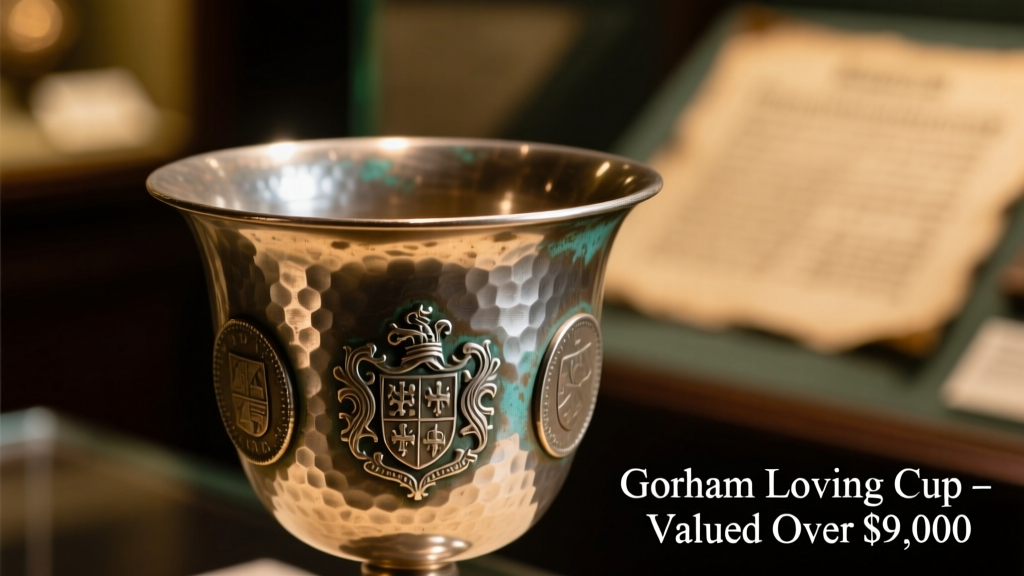
Gorham Loving Cup May Top $9,000: Market Trends, Provenance, and Authentication Essentials
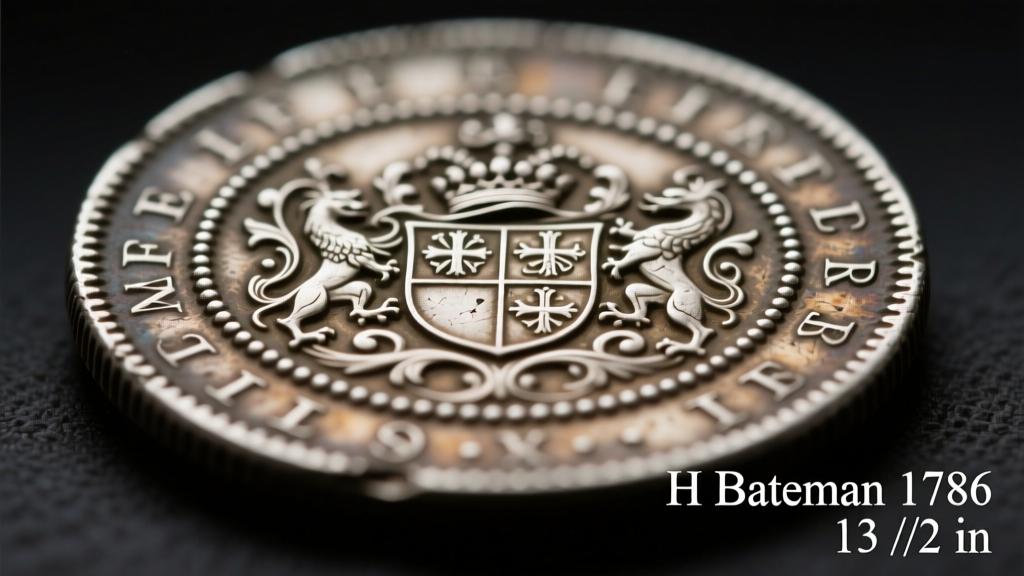
The 1786 H. Bateman Silver English Cake Basket: A Masterpiece of Georgian Silversmithing with Beaded Borders and Scrollwork

Radio Advertising and the Gilman Gilplex Paint Can: A Numismatic Study of Mid-Century Promotional Currency in Flat Interior Paint Packaging

Stoneware Pitcher: Portrait Boy & Girl with Windmill and Apple Blossom Border — An 8-Inch American Folk Art Masterpiece

Valois Embossed Ribbed Amberina Perfume Bottle with Stopper: A Collector’s Guide to the 3¾-Inch Rarity

Why Vintage Halloween Decorations Are Surging in Collector Demand — Market Trends, Rarity Metrics, and Valuation Insights
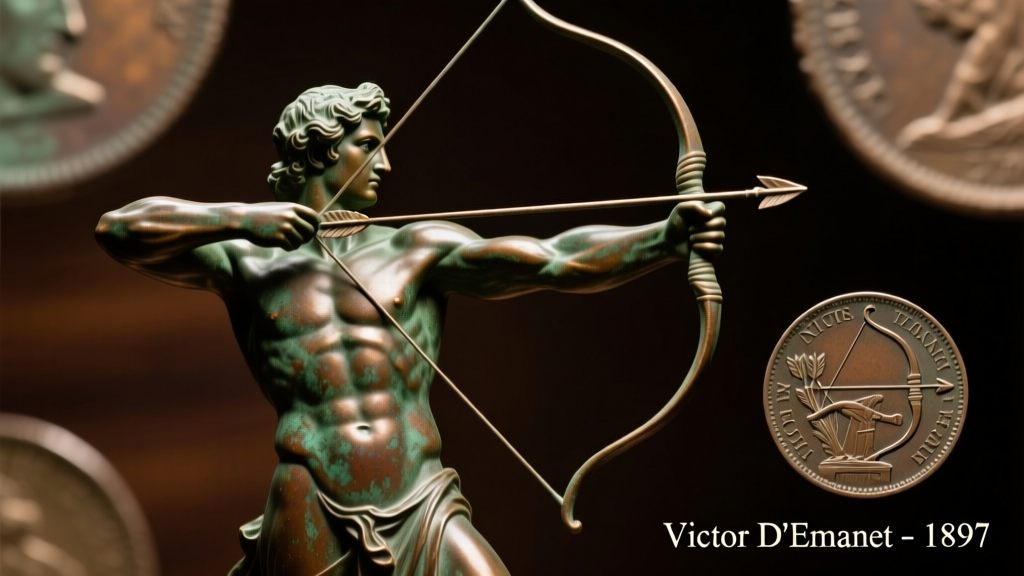
Victor Demanet’s Bronze Archer: A 24-Inch Masterpiece of Belle Époque Sculpture and Numismatic Context