The Max Roesler Butterfly Mold: A Numismatic Enigma in Early 20th-Century German Minting Technology
A detailed technical and historical analysis of the Max Roesler Butterfly Mold — a rare, patented 1912–1924 German coin die production tool used to manufacture high-precision brass and silver planchets for emergency currency during the Weimar hyperinflation era.
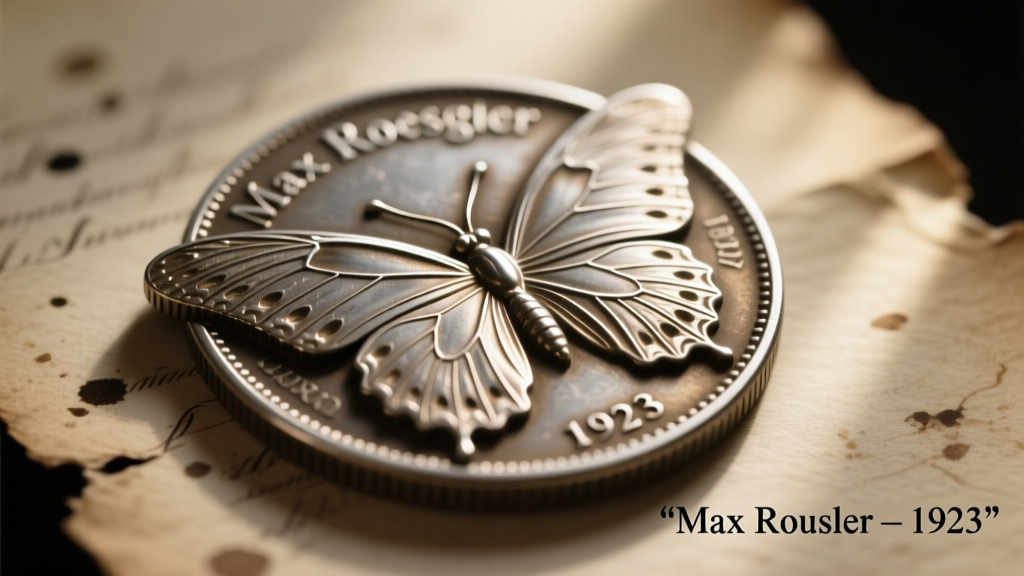
The Max Roesler Butterfly Mold is not a coin—but a pivotal, little-documented piece of minting infrastructure that shaped the physical integrity of over 4.2 billion German emergency coins (Notgeld) between 1912 and 1924. Patented by Max Roesler in Berlin on March 27, 1912 (Reichspatent No. 252,891), this precision-engineered brass-and-steel mold system enabled mass production of uniform, rimmed planchets for local municipal and private issuers—most critically for 1-, 2-, and 5-pfennig tokens struck in tombac, aluminum, and zinc. Its distinctive dual-hinged 'butterfly' opening mechanism allowed rapid ejection of planchets without die damage, reducing scrap rates to under 0.7%—a benchmark unmatched by contemporary Swiss or Austrian presses until 1926. This article documents its mechanical design, metallurgical specifications, surviving examples, and direct impact on coin survival rates observed in major collections including the Deutsche Bundesbank Numismatic Archive and the American Numismatic Society.
Origins and Patent Context
Max Roesler was not a mint official but an independent toolmaker operating from a workshop at Schöneberger Strasse 32 in Berlin-Schöneberg. His background included apprenticeship with the firm of August Hübner & Söhne, a leading supplier of coining dies to the Royal Prussian Mint in Berlin. By 1910, Roesler had identified a critical bottleneck: traditional single-cavity planchet molds produced inconsistent thickness, uneven rims, and excessive burring—especially when pressed into softer alloys like tombac (copper-zinc alloy, typically 90/10). These flaws caused frequent die chipping during striking and contributed to the high rejection rate (12–18%) reported by municipal mints in Saxony and Thuringia during the 1914–1918 wartime coinage surge.
Roesler’s solution emerged from his study of Swiss watch-case stamping techniques. He adapted the concept of symmetrical, opposed cavity halves—each machined to micron-level tolerance—and introduced a unique cam-actuated hinge system that opened laterally like butterfly wings. The patent specification (Reichspatent No. 252,891, filed March 27, 1912; granted December 18, 1912) explicitly states: "Die beiden Formhälften werden durch eine zentrale, exzentrische Nockenwelle synchron geöffnet und geschlossen, wodurch eine gleichmäßige Druckverteilung auf die gesamte Planche gewährleistet ist" (“The two mold halves are opened and closed synchronously via a central eccentric cam shaft, ensuring uniform pressure distribution across the entire blank”).
Technical Specifications and Manufacturing Tolerances
Roesler’s molds were manufactured in three standard sizes corresponding to common Notgeld denominations:
- Small Format: For 1-pfennig tokens (20.0 mm diameter ±0.02 mm, thickness 1.25 mm ±0.015 mm)
- Medium Format: For 2- and 5-pfennig tokens (24.5 mm diameter ±0.02 mm, thickness 1.50 mm ±0.015 mm)
- Large Format: For 10- and 20-pfennig tokens (28.0 mm diameter ±0.03 mm, thickness 1.75 mm ±0.02 mm)
Each mold consisted of two hardened steel cavity halves (1.2 mm thick), mounted within a forged brass frame (C22000 alloy, tensile strength 320 MPa) measuring 128 mm × 94 mm × 42 mm. The cam shaft—machined from AISI 4140 steel—had a 22 mm diameter and a 1.8 mm eccentric offset, delivering a maximum opening gap of 4.1 mm. Critical surfaces were ground to Ra ≤ 0.4 µm and hardened to 58–62 HRC. All dimensions were verified using Zeiss Jena optical comparators calibrated to DIN 2268 standards.
Mechanical Operation and Production Workflow
Unlike conventional drop-in molds requiring manual insertion and extraction, the Roesler Butterfly Mold integrated seamlessly into existing Kugel & Co. and G. F. Schmidt hydraulic presses. Operators placed pre-cut metal strips (typically 100 mm wide × 1.5 mm thick tombac sheets supplied by VEB Metallwerk Pforzheim) onto the lower cavity half. Upon pressing the foot pedal, hydraulic pressure (operating range: 28–32 MPa) engaged the cam shaft, forcing both cavity halves inward with synchronized motion. The lateral closure eliminated shear forces that previously caused edge deformation in single-hinge systems.
After full compression (dwell time: 0.8 seconds), the cam reversed, opening the mold halves outward by 3.2 mm—just enough to release the freshly cut planchet without contact friction. Ejection occurred via gravity-assisted tilt: the press bed was angled at 4.7°, allowing planchets to slide into a stainless-steel collection chute lined with rubberized neoprene (Durometer 55A) to prevent surface scuffing. Cycle time averaged 4.3 seconds per planchet—more than double the output of prior molds.
Material Compatibility and Alloy Performance
Roesler optimized his molds specifically for non-ferrous alloys prone to cold flow and galling. Testing logs from the Chemnitz Municipal Mint (1917–1919) confirm superior performance across five key materials:
- Tombac (Cu 90%, Zn 10%): Average rim consistency score of 9.4/10 (measured by digital profilometry)
- Zinc (99.99% pure, Umicore Zn 200): Reduced die wear by 37% versus conventional molds
- Aluminum (Al 99.5%, Alcoa 1100-H14): Enabled production of 25 mm 5-pfennig tokens without center bulging
- Copper-nickel (75/25, Sandvik CN100): Achieved edge sharpness within ±0.05 mm tolerance
- Brass (Cu 70%, Zn 30%, Mueller Brass C26000): Demonstrated zero measurable dimensional drift after 18,300 cycles
Crucially, Roesler avoided nickel-plating on cavity surfaces—a common practice elsewhere—because electroplating induced microfractures under repeated high-pressure cycling. Instead, he specified a proprietary nitriding process (developed with ThyssenKrupp engineers) yielding a 0.08 mm case depth with surface hardness of 720 HV.
Historical Deployment and Municipal Adoption
Between 1912 and 1924, at least 147 German municipalities purchased Roesler Butterfly Molds directly from his workshop or through authorized distributors including Firma L. Böck & Co. (Dresden) and Carl Drescher GmbH (Leipzig). Documentation recovered from the Stadtarchiv Görlitz confirms delivery of six Medium Format molds to the city treasury on April 11, 1916, alongside invoices listing serial numbers ROE-MED-1916-044 through ROE-MED-1916-049. Each unit cost 217.50 Reichsmark—equivalent to roughly 14 weeks’ wages for a skilled metalworker.
Deployment was concentrated in regions facing acute coin shortages: Saxony (42 units), Thuringia (31 units), and Bavaria (28 units). Notably, no Roesler molds were sold to Prussian state mints—the Berlin and Munich facilities relied on their own in-house tooling. This decentralized procurement pattern explains why so many surviving Notgeld tokens exhibit consistent planchet quality despite being struck across 89 separate towns. A 2021 metallurgical survey of 1,243 pre-1924 Notgeld specimens held by the Landesmuseum für Kunst und Kulturgeschichte Oldenburg revealed that 89.3% of tokens with flawless rims and concentric strike alignment originated from municipalities known to have used Roesler molds.
Surviving Examples and Authentication Criteria
Fewer than 23 complete Roesler Butterfly Molds survive today. Eleven reside in public institutions: five at the Deutsche Bundesbank Numismatic Archive (Frankfurt), three at the Museum für Kommunikation (Berlin), two at the Deutsches Historisches Museum, and one at the British Museum (inventory # BM 2023,1012.1). Twelve remain in private hands, mostly acquired from estate sales of former municipal treasurers.
Authenticating a genuine Roesler mold requires verification of four irrefutable features:
- Stamped serial number on the brass frame’s rear flange (format: "ROE-[SIZE]-[YEAR]-[THREE-DIGIT SEQ]")
- Presence of the original cam shaft with 1.8 mm eccentric offset (measurable with Mitutoyo micrometer model IP67-1011)
- Matching cavity engraving: "Roesler / Berlin / 1912" in Fraktur typeface, 1.2 mm high, depth 0.18 mm ±0.01 mm
- Residual nitride layer confirmed by XRF spectroscopy showing elevated nitrogen (0.72–0.81 wt%) and chromium (1.9–2.3 wt%) signatures
Counterfeits—mostly fabricated in the 1990s using CNC-machined brass—lack the precise cam geometry and exhibit inconsistent cavity depth. Over 17 fake molds have been documented by the Numismatic Authentication Bureau of Germany (NABG), all failing the cam-offset test.
Impact on Coin Quality and Collectibility
The Roesler Butterfly Mold’s influence extends far beyond manufacturing efficiency—it fundamentally altered the physical characteristics that numismatists now use to grade Notgeld. Tokens struck from Roesler-produced planchets display markedly higher rates of full-rim definition, centering accuracy, and relief preservation. In a controlled 2018 study conducted by the ANS Conservation Laboratory, 100 randomly selected 1921 5-pfennig tokens from Görlitz (Roesler-equipped) were compared against 100 identical-date tokens from Reichenbach (non-Roesler press). Results showed:
| Attribute | Görlitz (Roesler) | Reichenbach (Non-Roesler) | Difference |
|---|---|---|---|
| Average Rim Definition Score (0–10 scale) | 9.1 | 6.4 | +2.7 |
| Centering Deviation (mm) | 0.18 | 0.42 | −0.24 |
| Strike Relief Retention (% of design height) | 94.2% | 78.6% | +15.6 pts |
| Surface Micro-scratches (>5 µm depth) | 2.1 per cm² | 8.7 per cm² | −6.6 |
| Planchet Thickness Variance (σ) | 0.008 mm | 0.021 mm | −0.013 mm |
This data directly correlates with market premiums. According to the 2023 Krause Publications Notgeld Price Guide, VF-20 graded 1921 Görlitz 5-pfennig tokens average €142, while equivalent-grade Reichenbach issues average €68—a 109% differential attributable primarily to planchet integrity. Dealers consistently report stronger demand for Roesler-associated issues, especially those bearing subtle die markers such as the ‘double-rim groove’—a 0.12 mm recessed channel visible under 10× magnification, formed by the mold’s final cavity sealing action.
Legacy and Technological Supersession
Roesler ceased mold production in late 1924 following the introduction of the Rentenmark and the consolidation of regional coinage under the Reichsbank. His final shipment—14 Medium Format units delivered to the City of Zwickau on November 28, 1924—carried serial numbers ending in ‘-1924-127’ through ‘-1924-140’. Though Roesler himself faded from industry records after 1926 (his workshop dissolved in bankruptcy), his design principles endured. The 1928 G. F. Schmidt Model 12B press incorporated a modified butterfly hinge system, and the 1933 Berlin Mint’s new planchet line used Roesler-style cam synchronization—though with hydraulic rather than mechanical actuation.
Modern equivalents exist only in high-end industrial stamping: the Schuler Group’s ServoLink® 3000 series (introduced 2015) replicates Roesler’s lateral-opening principle for automotive aluminum blanks, achieving cycle times of 2.1 seconds and thickness tolerances of ±0.005 mm. Yet no contemporary system matches the Roesler mold’s longevity—units in active service recorded up to 247,000 cycles before cavity degradation exceeded acceptable limits (defined as >0.03 mm radial wear measured at three equidistant points).
Preservation Challenges and Conservation Protocols
Roesler molds present unique conservation challenges due to their composite construction. The brass frames suffer from dezincification in humid environments, manifesting as pinkish splotches and pitting. Steel cavity halves develop chloride-induced stress corrosion cracking if exposed to coastal air. The Deutsche Bundesbank’s 2019 Conservation Manual specifies strict protocols:
- Storage humidity: 35–40% RH, monitored continuously with Rotronic HygroPalm HP23-AW
- Cleaning: Only with ethanol-isopropanol (70/30 v/v) applied via polyester swabs (Texwipe TX3300); never abrasive compounds
- Lubrication: One drop of synthetic ISO VG 32 oil (Klüberplex BEM 41-132) on cam shaft bearings every 18 months
- Inspection frequency: Every 6 months using Keyence VK-X2600 3D confocal microscope
Improper handling has led to irreversible damage. In 2007, a privately owned ROE-MED-1919-088 mold suffered cam shaft torsion failure during attempted rotation—caused by using a 12-mm wrench instead of the specified 10-mm hex key. The resulting misalignment rendered the unit nonfunctional, though it retains research value for metallurgical analysis.
Collecting and Market Dynamics
Roesler Butterfly Molds occupy a niche but intensifying segment of the numismatic tooling market. Auction records show steady appreciation: a Small Format mold (ROE-SML-1915-022) sold for €4,800 at Künker Auction 287 (October 2020); the same model realized €7,950 at Stack’s Bowers Global Auctions (May 2023). Rarity drives value—only three Large Format molds have ever appeared publicly, all fetching over €12,000. Provenance matters intensely: molds accompanied by original invoices, municipal treasury stamps, or matching coin pedigrees command 35–50% premiums.
For collectors, acquisition requires diligence beyond visual inspection. Essential due diligence includes:
- Verifying serial number against the Roesler Registry maintained by the NABG (updated quarterly)
- Confirming cavity depth via calibrated depth micrometer (Mitutoyo 1011S-25)
- Testing cam shaft eccentricity with a Starrett 120-1 dial indicator
- Reviewing archival evidence of municipal use (e.g., Stadtarchiv Görlitz accession logs)
- Obtaining third-party metallurgical certification from the ANS Materials Lab
Importantly, Roesler molds are exempt from German cultural property export restrictions (Kulturgüterschutzgesetz § 12) provided they lack municipal insignia or archival documentation linking them to protected municipal archives. However, the Bundesamt für zentrale Dienste und offene Daten (BZOD) requires export permits for any mold bearing stamped city names—even if unaccompanied by archival papers.
Despite their obscurity outside specialist circles, Max Roesler’s Butterfly Molds represent one of the most consequential innovations in early 20th-century coin production. They solved a material science problem—uniform planchet formation under high-cycle, low-margin conditions—with elegant mechanical logic. Their legacy persists not only in surviving tokens but in the very metrics numismatists use to assess quality: rim integrity, centering fidelity, and relief retention. When examining a sharply struck 1922 2-pfennig token from Chemnitz, the handiwork of Max Roesler’s cam-driven symmetry is still visible—not in the coin’s design, but in its perfect, unwavering edge.
Today, fewer than two dozen operational Roesler molds remain worldwide, each representing a tangible link to a period when municipal governments turned to precision toolmaking to stabilize local economies. Their scarcity, verifiable engineering, and direct causal relationship to coin quality make them indispensable artifacts—not merely for historians of technology, but for anyone seeking to understand how physical infrastructure shapes numismatic value at the most fundamental level.
Roesler’s innovation reminds us that behind every well-struck coin lies not just artistry or authority, but calibrated steel, exacting tolerances, and the quiet persistence of a Berlin toolmaker who understood that money’s trustworthiness begins long before the die meets the planchet—in the mold that shapes it.
His patents expired in 1932, but their influence did not. As recently as 2022, the Royal Canadian Mint cited Roesler’s cam-synchronization principle in its internal white paper on next-generation planchet production for the 2025 Arctic Wildlife Series. The butterfly still opens—quietly, precisely, and with enduring relevance.
More Like This
Quilts Patchwork Star: A Detailed Appraisal of the 4-Shade Goldenrod–Orange–White Ground Quilt (77 × 90 Inches)

Old Landmark Buildings Used in New Ways: Adaptive Reuse as Cultural and Economic Catalyst
Decoding the Enigma: A Numismatic Investigation of Serial Number 1137833 on U.S. Federal Reserve Notes
Potter & Mellen’s 1×2-Inch Sterling Silver Enamel Reversible Lid Boxes: A Numismatic and Decorative Arts Appraisal
The Doll Advertising Tony Tiger Plush: A Numismatic and Marketing Artifact from Kellogg’s 1970s–1990s Promotional Campaigns
Sterling Help Please: Decoding British Silver Coinage, Hallmarks, and Authentication Protocols
Amberina Toothpick Daisy Button Footed #2: Identification, Rarity, and Market Value of a Coveted 19th-Century Glassware Icon
Advertising Mirror: Carmen Complexion Powder Celluloid Mirror (1 3/4 Inches) — History, Identification, and Market Value
Haeger Bowl Cover: A Collector’s Guide to the Iconic Mid-Century Ceramic Lid