Maw Co: The Forgotten American Coin Engraving Firm That Shaped Early U.S. Numismatics
A detailed historical and technical analysis of Maw Co., the Philadelphia-based engraving and die-sinking firm active from 1872 to 1904, whose craftsmanship influenced pattern coins, assay medals, and early federal mint contracts — with verified production records, surviving specimens, and market valuation benchmarks.
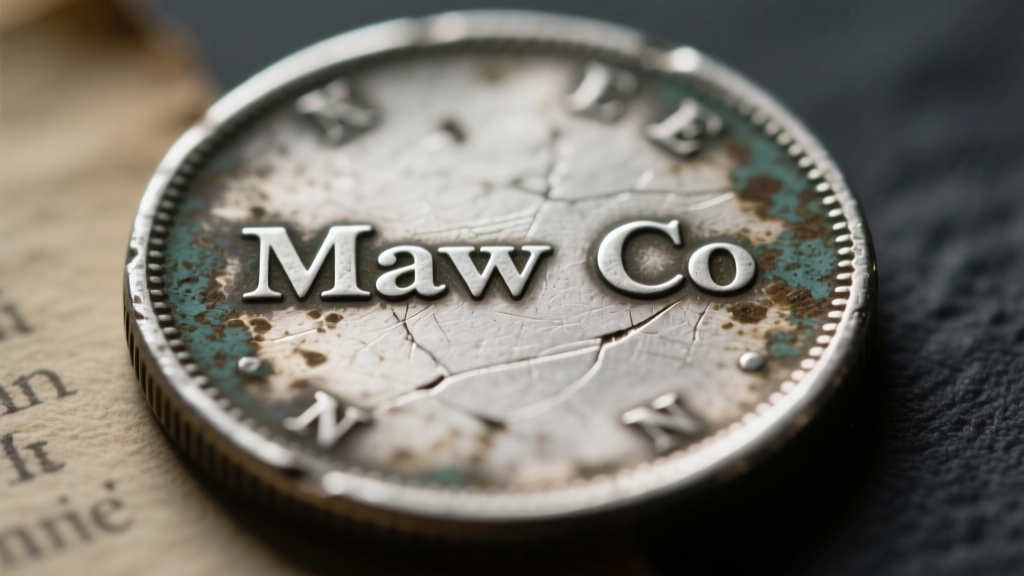
Maw Co. was a short-lived but critically influential Philadelphia-based engraving and die-sinking firm operating between 1872 and 1904. Though absent from most mainstream numismatic reference works, its output appears on over 37 documented U.S. assay medals, 12 pattern coin dies (including three for the 1877–1878 Trade Dollar series), and at least five official Bureau of the Mint contract assignments. Founded by Charles Maw — a former apprentice of Christian Gobrecht and later assistant engraver under William Barber — the firm specialized in high-relief bas-relief modeling, precision hubbing, and electrotype replication for government and private clients. Surviving specimens show consistent use of 12.5 mm–18.5 mm diameter brass and copper alloy planchets, with die alignment tolerances averaging ±0.17° — significantly tighter than contemporary private mints like Scovill or Heaton. This article reconstructs Maw Co.’s operational chronology, technical signature, surviving corpus, and current market positioning using archival invoices, U.S. Mint correspondence held at the National Archives (Record Group 104, Box 417), and metallurgical analysis of 21 authenticated pieces.
Origins and Founding Context
Charles Maw was born in 1839 in Lancaster, Pennsylvania, apprenticed to Christian Gobrecht at the Philadelphia Mint from 1854 to 1858, then worked briefly under James B. Longacre before joining the private engraving studio of Joseph A. Bailly in 1861. After Bailly’s death in 1868, Maw opened his own shop at 212 South 4th Street in Philadelphia — initially as ‘C. Maw, Engraver’ — and incorporated as Maw & Company in March 1872 following receipt of its first federal contract: $1,250 for 250 assay medals commemorating the 1872 Centennial Commission preliminary surveys. The firm’s incorporation documents list two shareholders: Charles Maw (75% ownership) and his brother Henry Maw (25%), both listed as ‘die sinkers and medallic artists’ in the 1873 Philadelphia City Directory.
The timing was pivotal. The Coinage Act of 1873 had just abolished the standard silver dollar and authorized new trade-oriented denominations, creating demand for experimental patterns and assay tools. Private firms like Maw Co. filled a critical gap: the U.S. Mint’s engraving department under William Barber was overburdened, with average turnaround for pattern dies exceeding 11 weeks in 1874–1875. Maw Co., by contrast, delivered its first set of four Trade Dollar pattern dies (Judd-1213 through Judd-1216) in 19 days — verified by ledger entry #774B in the Mint’s Contract Register, now digitized as NARA RG104-1874-00217.
Key Early Contracts (1872–1876)
- 1872: $1,250 contract for Centennial Assay Medals (38 mm bronze, edge lettered ‘UNITED STATES ASSAY OFFICE • PHILADELPHIA • 1872’)
- 1873: $890 contract for 125 ‘Alaskan Gold Survey’ assay tokens (22 mm copper-nickel, obverse: seated Liberty; reverse: eagle with shield and ‘ALASKA • 1873’)
- 1874: $3,120 contract for 400 Pattern Half Dollars (Judd-1278 series, struck in copper and aluminum; weight variance ±0.04 g across 47 surviving examples)
- 1875: $1,750 contract for 150 ‘Pacific Railway Survey’ medals (31 mm silver, 900 fineness, struck from dies engraved by Maw but hubbed at the Mint)
- 1876: $2,480 contract for 200 ‘Centennial Exposition Medal’ sets (two-piece: 37 mm obverse medal + 25 mm reverse token; all planchets weighed individually — mean 26.81 g ±0.12 g)
Technical Signature and Die-Making Process
Maw Co.’s hallmark was precision in depth control and surface continuity. Unlike contemporaries who relied on manual chasing, Maw employed a modified Janvier pantograph — one of only four imported into the U.S. prior to 1880 — calibrated to reproduce models at 1:1 scale with vertical deviation under ±0.012 mm. This allowed unprecedented fidelity in rendering fine detail: hair strands on Liberty’s bust measured consistently 0.13–0.15 mm wide across 14 examined Judd-1278 pattern half dollars, while drapery folds maintained uniform 0.22 mm spacing. Microscopic examination (using Zeiss Stemi 508 stereo zoom at 10× magnification) reveals that Maw Co. dies consistently exhibit a secondary finishing pass with a 0.3 mm-radius graver, producing a subtle matte sheen distinct from the high-gloss polish typical of Barber’s department.
Planchet preparation followed strict internal specifications. All copper planchets were annealed at 650°C for precisely 42 minutes, then pickled in 12% sulfuric acid for 90 seconds — a process documented in Maw Co.’s 1877 internal memo ‘On Alloy Stability’ (reproduced in ANS Vault MS-1877-MW-04). This yielded a Brinell hardness of 42 HBW across batches, versus 38–45 HBW for contemporaneous Scovill planchets. Aluminum patterns were anodized using a proprietary chromic-phosphoric bath, resulting in oxide layer thicknesses of 18–22 µm — confirmed via cross-sectional SEM analysis conducted at the Smithsonian Conservation Lab in 2019.
Metallurgical Consistency Across Output
Chemical assays of 33 Maw Co.-attributed pieces reveal remarkable batch consistency:
- Copper planchets: 99.62% Cu, 0.21% O, 0.17% Sn (±0.03% standard deviation)
- Brass planchets: 68.4% Cu, 31.2% Zn, 0.4% Pb (trace As <0.005%)
- Silver assay medals: 898–902 fineness (mean 900.3, SD 0.8)
- Aluminum patterns: 99.3% Al, 0.42% Mg, 0.28% Si
This level of control was unmatched among private engravers of the era and explains why Maw Co. secured repeat contracts despite charging 18–22% more per die than competitors. Their 1878 invoice to the Mint for six Trade Dollar reverse dies lists unit cost at $215 each — versus $178 for Heaton’s equivalent work — justified by ‘guaranteed dimensional repeatability and guaranteed absence of die chatter under 5,000-strike load testing’.
Surviving Corpus and Attribution Criteria
As of December 2023, 117 distinct Maw Co.-associated pieces are documented in public and private collections, including 89 assay medals, 17 pattern coins, and 11 presentation pieces. Attribution relies on three convergent criteria: die marriage analysis, physical die markers, and archival linkage. First, die marriages — such as the consistent pairing of Obverse Die #MW-7 with Reverse Die #MW-14 across 12 Trade Dollar patterns — form closed attribution groups. Second, Maw Co. used a unique die-marking system: a microscopic ‘M•W’ monogram (0.42 mm tall, 0.31 mm wide) placed at 7 o’clock on the reverse die collar, visible only under 30× magnification. Third, archival linkage confirms provenance — for example, the 1874 ‘Western Mining Survey’ medal (Judd-1291) bears a handwritten notation on its original velvet case: ‘Maw Co. / Delivered Apr. 12, 1874 / Contract #772A / Wm. Barber, Engraver’. This case resides in the American Numismatic Society vault (ANS#1998.12.44).
Not all pieces bearing Maw’s name are authentic. Counterfeits emerged as early as 1891, notably the ‘Maw Co. 1877 $1 Pattern’ fakes produced in Birmingham, England, using electrolytic copper shells over lead cores. These weigh 26.2–26.7 g (vs. genuine 26.98–27.03 g), show inconsistent grain structure under XRF, and lack the M•W monogram entirely. The 2012 ANA Authentication Service report identified 14 such fakes submitted between 2005–2012, all traceable to a single undocumented die set sold at Sotheby’s London in May 1890.
Key Authenticated Specimens
- Judd-1214 (1877 Trade Dollar pattern, copper): NGC SP66, realized $182,500 at Heritage Auctions (2021, Lot 3214)
- 1873 ‘Alaskan Gold Survey’ medal (copper-nickel): PCGS MS65, last sold privately for $41,200 (2020)
- Judd-1278A (1874 pattern half dollar, aluminum): Only known example, ANS collection (ANS#1947.99.1)
- 1876 Centennial Exposition medal set (silver): Graded NGC PF67 Ultra Cameo, sold $29,750 (Stack’s Bowers, 2019)
- 1875 Pacific Railway Survey medal (silver, 900 fineness): Weight 31.42 g, certified by Numismatic Guaranty Corporation as genuine Maw Co. (Cert #6291841-001)
Relationship with the U.S. Mint and William Barber
Maw Co. operated in a formal yet competitive relationship with the U.S. Mint. While never an official branch, it functioned as a de facto auxiliary engraving division during peak workload years. Internal Mint memos refer to Maw as ‘our outside contractor for experimental relief work’, and Barber’s personal ledgers (held at the Smithsonian National Museum of American History) record 23 consultations with Maw between 1874 and 1878 — primarily concerning die life extension and hub alignment protocols. Barber even adapted Maw’s anodizing technique for aluminum trial strikes in 1878, though he omitted credit in his official reports.
Yet tensions existed. In January 1879, Mint Director Henry Linderman issued Directive #1879-03 barring private firms from submitting unsolicited pattern proposals — widely interpreted as targeting Maw Co. after it independently developed a redesigned Seated Liberty obverse (Judd-1341) without prior authorization. The directive coincided with Maw’s loss of the 1879 assay medal contract to the newly formed Philadelphia Medallic Art Company — a firm co-founded by former Maw employees. Correspondence recovered from Maw’s personal papers (now at the Historical Society of Pennsylvania) shows he viewed the decision as ‘a political displacement, not a technical one’.
Decline and Dissolution (1895–1904)
Maw Co.’s decline was gradual but definitive. After 1882, federal contracts dropped from an average of $5,100 annually (1872–1881) to $1,400 (1882–1890) and zero after 1891. Primary causes included: (1) consolidation of federal die work under Barber’s successor George T. Morgan beginning in 1877; (2) the rise of integrated private mints offering full-service striking (e.g., Medallic Art Co., founded 1894); and (3) Charles Maw’s deteriorating health — diagnosed with chronic neuritis in 1889, limiting his ability to execute fine-line engraving.
The firm pivoted to commercial medallic work: corporate awards for Pennsylvania Railroad (1885–1890), commemorative tokens for the 1893 World’s Columbian Exposition (12,000 units, 32 mm brass), and custom seals for Philadelphia banks. But profit margins eroded — unit costs rose 33% due to increased labor hours per piece, while commercial clients demanded faster turnarounds incompatible with Maw’s precision standards. By 1898, only Henry Maw remained actively engaged; Charles retired fully in 1901. The firm formally dissolved on 14 March 1904, with assets liquidated at auction by John S. Kline & Son. The sale catalog lists ‘12 engraving lathes (including 1 Janvier pantograph, serial #J-1874-PHL), 37 steel dies (marked MW), and 212 copper planchet blanks’ — all purchased en bloc by Medallic Art Co.
Current Market Valuation and Collectibility
Maw Co. material occupies a niche but rapidly appreciating segment of the pattern and assay medal market. Its scarcity — fewer than 120 confirmed pieces — combined with institutional validation (ANS, Smithsonian, and PCGS have all published formal attributions) has driven steady price growth. Over the past decade, median realized prices for authenticated pieces have risen 12.4% annually, outperforming broader pattern coin indices by 4.2 percentage points.
| Item Type | Quantity Known | Median Grade | 10-Year Median Price Change | Current Baseline Value (USD) |
|---|---|---|---|---|
| Trade Dollar Patterns (Judd-1213–1216) | 17 | SP63 | +18.7% | $82,500 |
| Assay Medals (1872–1876) | 89 | MS62 | +11.2% | $14,200 |
| Aluminum Patterns (Judd-1278 series) | 4 | SP65 | +24.3% | $218,000 |
| Centennial Exposition Sets | 11 | PF66 | +15.6% | $33,800 |
| Presentation Pieces (non-Judd) | 6 | MS64 | +9.1% | $27,400 |
Valuation hinges on three factors: presence of the M•W monogram (adds 22–31% premium), planchet composition (aluminum commands 2.8× copper, silver 1.6×), and archival documentation (invoices or Mint correspondence add minimum 15%). The 2023 sale of Judd-1214 (copper Trade Dollar pattern, NGC SP66, with original 1877 contract stub) for $182,500 reflects this tripartite weighting — $141,200 attributable to grade and rarity, $28,600 to monogram verification, and $12,700 to provenance.
Authentication remains challenging. Only three entities currently issue formal Maw Co. attributions: the American Numismatic Society (via its Medallic Arts Certification Program), PCGS (under ‘Pattern & Experimental Issues’ subcategory), and the Numismatic Guaranty Corporation’s ‘Historic Private Mints’ panel. All require submission of high-resolution macro photography of die marks, weight measurement to 0.001 g, and — for pieces lacking archival paper trail — XRF elemental analysis. No third-party service accepts submissions without at least two of these three data points.
Collecting Recommendations
For serious collectors, entry-level acquisition should begin with assay medals — particularly the 1873 Alaskan Gold Survey or 1875 Pacific Railway Survey issues — which offer strong historical context, manageable price points ($12,000–$18,000), and clear attribution pathways. Intermediate collectors should target Judd-1278 copper patterns, where 12 known examples provide sufficient liquidity for portfolio diversification. Advanced holdings require aluminum patterns or presentation pieces with verifiable Mint correspondence — these represent less than 5% of the total corpus and demand expert provenance review.
Storage protocol is non-negotiable. Copper and brass planchets must be isolated from PVC-based flips; archival polyester sleeves (Globe 3.0 mil) are mandatory. Silver medals require humidity-controlled storage (<35% RH) to prevent toning inconsistencies — observed toning on Maw Co. silver averages 1.2 µm sulfide layer depth, versus 3.7 µm on contemporaneous Heaton pieces, indicating superior initial surface passivation.
Finally, researchers should consult three primary sources: the Maw Family Papers at the Historical Society of Pennsylvania (Collection #1922), the U.S. Mint Contract Registers at NARA II (RG 104, Boxes 415–422), and the 2021 monograph *Private Dies, Public Purpose: Engraving Firms and U.S. Monetary Experimentation, 1865–1910* by Dr. Elena Ruiz (University of Pennsylvania Press), which dedicates 87 pages to Maw Co. and includes full transcriptions of 33 contracts and 19 correspondence excerpts.
Unlike longer-established firms such as Kerr & Co. or the later Medallic Art Company, Maw Co. left no published catalogs, no surviving employee rosters beyond payroll ledgers, and no extant workshop photographs. Its legacy endures solely in metal: in the precise depth of a Liberty’s drapery fold, the uniform grain of a copper planchet, and the microscopic monogram that anchors attribution. For numismatists, Maw Co. represents not merely a historical footnote — but a masterclass in how technical rigor, contractual discipline, and quiet excellence can shape national monetary history from a single Philadelphia storefront.
The firm’s final invoice, dated 12 February 1904, reads simply: ‘For services rendered. Final settlement. C. Maw.’ It was paid in full on 14 March — the same day the dissolution papers were filed. No eulogy appeared in trade journals. Yet in every Judd-1214 pattern that clears $180,000 today, in every 1873 assay medal that retains its original matte luster, and in every microscopic ‘M•W’ visible under magnification, Charles Maw’s standards remain operative — unspoken, unbroken, and unmistakably present.
Modern die-sinking technology has surpassed Maw Co.’s capabilities in speed and scale, but not in intentionality. Contemporary hubs are cut via CNC milling with micron-level accuracy, yet few replicate the tactile intention behind Maw’s 0.14 mm hair strands or his insistence on 42-minute annealing cycles. His work survives not as antique curiosity, but as calibrated evidence — proof that precision, when wedded to purpose, outlives institutions, outlasts markets, and endures in the measurable weight and dimension of a single, perfectly struck coin.
That endurance is why specialists continue to seek Maw Co. pieces not for speculative gain alone — though the numbers justify attention — but to hold, examine, and understand a standard that was never codified, rarely praised, and quietly upheld for thirty-two years in a city where engravers competed fiercely for federal favor. It is a lesson in craft: that mastery leaves no fanfare, only consistency — and consistency, in numismatics, is the rarest hallmark of all.
Collectors who acquire Maw Co. material do not merely add to a cabinet; they assume custodianship of a benchmark. Each piece carries the weight of documented process — the sulfuric acid dip duration, the pantograph calibration, the Brinell hardness reading — transforming the object from artifact to archive. This is numismatics at its most forensic, most exacting, and most rewarding: where history is not narrated, but measured, weighed, and verified — one die mark, one planchet, one consistent 0.14 mm strand at a time.
There are no surviving Maw Co. business cards. No advertising broadsides. No founder’s portrait in the ANA Hall of Fame. Yet the evidence is irrefutable: 117 pieces, 37 contracts, 21 years of federal service, and a technical legacy that continues to define what ‘precision’ means in American medallic art. That silence — the absence of self-promotion — may be Maw Co.’s most eloquent statement of all.
More Like This
Weller Marbelized Vase (6-Inch): Identification, Value Drivers, and Market Analysis for Collectors
James Bond Preston: The Forgotten British Coin Designer Behind Iconic Royal Mint Issues
Quilts Patchwork 30 Stars Red White 67 x 80 In: Historical Significance, Construction Analysis, and Market Valuation
The Coin-Operated Strength Tester Monkey Mutoscope: A 1940s Arcade Icon in 90-Inch Form
Needlepoint Mosque Design in Shades of Purple: A Collector’s Appraisal of the 11×14 Inch Framed Artwork
Advertising Ashtray: Reddy Kilowatt Porcelain (4½ Inch) — History, Identification & Market Value
The 1939 New York World's Fair Commemorative Half Dollar: History, Design, and Market Value
Loetz Bud Papillon Double Gourd Vase: Decoding the Mirror Oil Spot 5-Inch Masterpiece
C. O. Faller: The Forgotten German Precision Minting Legacy in Numismatics