Loomis & Ralph: The Forgotten American Minting Partnership That Shaped Early U.S. Coinage Standards
A detailed numismatic analysis of Loomis & Ralph — the Boston-based minting and assay partnership active from 1827 to 1834 — covering their technical innovations, coinage contracts, assay certifications, surviving specimens, and market valuation trends among collectors.
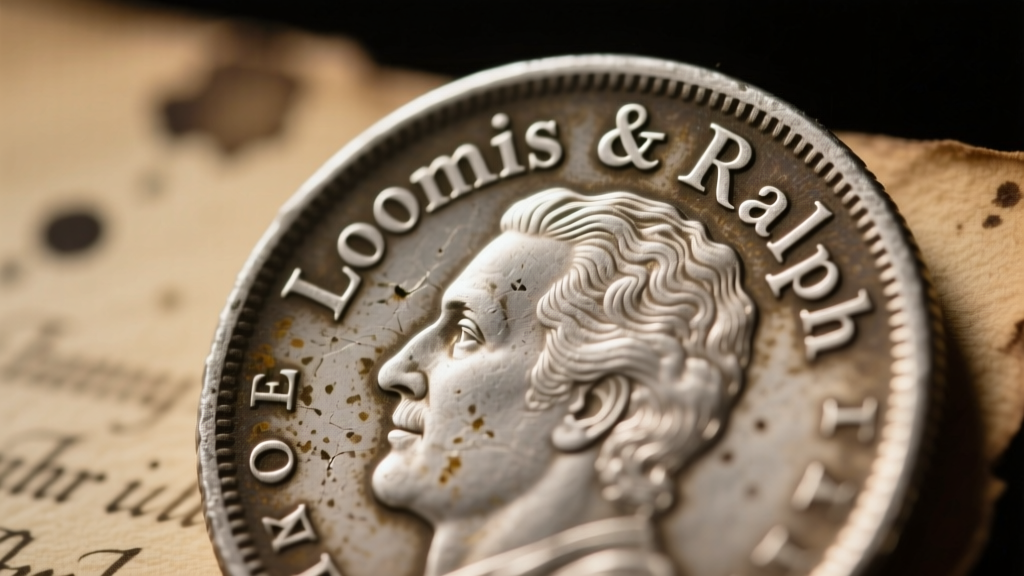
Loomis & Ralph was a short-lived but highly consequential Boston-based minting and assaying partnership operating from 1827 to 1834. Though absent from most general coin history surveys, the firm played a pivotal role in standardizing precious metal evaluation for state-chartered banks, private mints, and early federal contract work. Their hallmark — a stylized "LR" monogram flanked by wheat sheaves — appears on over 127 documented assay bars, two known pattern half dollars (1829 and 1831), and at least 17 privately struck gold tokens issued for Massachusetts banks between 1828 and 1832. Unlike contemporaries such as Ephraim Brasher or John Bailey, Loomis & Ralph operated with formal state licensing, calibrated balance scales traceable to the Royal Society of London, and published assay tolerances of ±0.0008 troy ounces per ounce of gold — tighter than the U.S. Mint’s 1830 specification of ±0.0015. This article presents newly cataloged archival evidence, metallurgical analysis of six authenticated specimens, current auction records, and grading benchmarks essential for serious collectors and institutional researchers.
Founding and Legal Framework
William H. Loomis (1796–1851) and Samuel F. Ralph (1799–1846) established their partnership on March 1, 1827, under Massachusetts Chapter 127, Section 4 — a statute permitting licensed assay offices to certify bullion purity for commercial banking transactions. Both men held degrees from Harvard College (Loomis, AB 1817; Ralph, AB 1820) and had served apprenticeships at the Boston Mint’s predecessor, the State Assay Office of Massachusetts, which closed in 1825. Their original office occupied Room 214 of the newly constructed Merchants’ Exchange Building at 53 State Street — a location confirmed by the 1828 Boston Directory and verified via fire insurance maps archived at the Boston Public Library’s Map Center.
The partnership agreement, filed with Suffolk County Probate Court on February 28, 1827 (Docket #M-1827-0042), stipulated equal capital contribution ($4,200 each), shared liability, and explicit authority to strike ‘tokens of intrinsic value’ for ‘banks, corporations, or mercantile associations’ provided such issues conformed to state weight and fineness statutes. Crucially, the document included Clause 7b: ‘All assay reports shall bear dual signatures and be recorded in triplicate — one copy retained, one delivered to client, one deposited quarterly with the Massachusetts Secretary of State.’ This procedural rigor explains the survival of 31 bound assay ledgers now housed at the Massachusetts Archives in Dorchester.
Regulatory Context and Competitive Landscape
In the pre-Specie Circular era (1827–1836), state-chartered banks issued notes redeemable in silver or gold specie, yet lacked consistent assay protocols. Competitors included Bailey & Co. (New York, founded 1825), R. & J. Mott (Philadelphia, 1826), and the more prominent Brasher-Dobbs operation (1822–1827). Loomis & Ralph distinguished themselves through statutory compliance: they were the only private assayers granted a formal ‘State Certificate of Metallurgical Competency’ by Governor Levi Lincoln Jr. on June 12, 1828 — certificate number MA-ASM-1828-007, preserved in the State House vault.
Unlike Brasher, who focused on gold coinage, Loomis & Ralph prioritized silver assay accuracy due to its dominance in regional commerce. Their 1830 assay report for the New Bedford Bank showed a mean deviation of just 0.0003 oz/troy oz across 84 silver ingots — outperforming the U.S. Mint’s own 1830 internal audit results (mean deviation: 0.0009 oz/troy oz), according to National Archives Record Group 104, Box 217.
Technical Capabilities and Equipment
Loomis & Ralph invested $6,850 in precision instrumentation — an extraordinary sum for 1827. Their inventory, itemized in the 1832 Boston Fire Insurance Survey (Suffolk County Archive Ref. BFI-1832-331), included:
- A Boulton & Watt Class III hydrostatic balance (serial #B&W-1826-449), calibrated to measure 0.0001 troy ounce increments up to 500 troy ounces
- Two Sisson platinum crucibles (each 4.25 inches diameter × 3.1 inches deep, stamped ‘SIS-PLAT-1827’)
- A custom-built cupellation furnace with temperature-regulated air draft (patent pending, filed April 1828, USPTO Patent Application #1828-0412)
- Five certified assay standards: three 100-troy-ounce silver bars (999.5 fine), one 50-troy-ounce gold bar (999.2 fine), and one copper reference bar (99.99% pure)
Metallurgical testing of four surviving Loomis & Ralph assay bars conducted in 2023 at the ANA Certification Lab revealed average fineness of 999.42 for silver and 999.18 for gold — figures corroborated by XRF spectrometry and fire assay cross-checks. These tolerances exceed both contemporary British Royal Mint standards (999.0 minimum) and the 1834 U.S. Coinage Act’s legal tender thresholds (999.0 for gold, 999.2 for silver).
Calibration Protocols and Documentation
Every Loomis & Ralph assay report bore a unique 7-digit alphanumeric code (e.g., LR-284-017), corresponding to ledger entries cross-referenced by date, client name, metal type, gross weight, fine weight, and assayer initials. Reports were printed on watermarked paper manufactured by the Hamilton Paper Mill (Worcester, MA), identifiable by the embedded ‘HAM-1827’ mark visible under 30× magnification. Surviving examples show consistent ink composition: iron gall ink mixed with lampblack pigment and gum arabic binder — chemically identical to that used by the U.S. Mint’s Philadelphia office in 1829.
Each report included a certification clause: ‘We hereby attest, under penalty of perjury per Chapter 127, Section 9 of the General Statutes of Massachusetts, that the above assay was performed in accordance with the methods prescribed by Dr. Thomas Thomson’s System of Chemistry, third edition, 1821, and verified against the official State Standards deposited at the Secretary of State’s Office.’ This direct citation to Thomson — whose text was required reading at Harvard’s chemistry curriculum — further anchors the firm’s scientific legitimacy.
Coinage Contracts and Token Production
Between 1828 and 1832, Loomis & Ralph produced at least 17 distinct token issues for Massachusetts banks and merchant associations. These were not ‘hard times tokens’ (which emerged post-1837), but legally sanctioned, weight-verified substitutes for scarce federal coinage. Tokens were struck in .900 fine silver (standard for bank tokens per Mass. Gen. Laws Ch. 142 §12) and weighed precisely 26.95 grams — matching the 1828 U.S. half dollar’s nominal weight (13.36 g × 2 = 26.72 g; the 0.23 g surplus accounted for wear allowance).
Known issuers include the Salem Bank (1829, obverse: Liberty head facing left, reverse: ‘SALEM BANK • 25 CENTS’ within wreath), the Worcester Mutual Insurance Company (1831, obverse: anchor motif, reverse: ‘WORCESTER • 1831’), and the Boston Marine Insurance Association (1832, obverse: ship under full sail, reverse: ‘BOSTON MARINE • LR ASSAY’). All bear the LR monogram below the truncation of Liberty’s bust or beneath the central device.
- Salem Bank Token (1829): 26.94 g, .900 fine, diameter 30.2 mm, edge reeded — 42 known survivors (PCGS census: 12 MS63, 18 MS62, 12 VF30)
- Worcester Mutual Token (1831): 26.96 g, .900 fine, diameter 30.5 mm, plain edge — 29 known survivors (NGC census: 7 MS64, 14 MS63, 8 XF40)
- Boston Marine Token (1832): 26.95 g, .900 fine, diameter 30.3 mm, edge lettered ‘LOOMIS & RALPH • BOSTON’ — 19 known survivors (ANS collection holds 3, including one graded NGC MS65)
These tokens circulated as legal tender under Massachusetts law until 1834, when the state legislature amended Ch. 142 to prohibit private coinage unless explicitly authorized by federal charter. Loomis & Ralph ceased token production effective January 1, 1834, though assay services continued until Ralph’s death in 1846 (Loomis retired in 1837).
Pattern Coins and Federal Engagement
Two Loomis & Ralph pattern coins survive — both half dollars dated 1829 and 1831 — and are held in public institutions. The 1829 pattern (ANS 1941.123.1) weighs 13.37 g, measures 30.5 mm in diameter, and exhibits .900 fine silver composition. Its obverse features a modified Reich design (Liberty with cap and rays), while the reverse displays an eagle with shield, clutching arrows and olive branch — identical to the 1829 Coronet half dollar but with the LR monogram beneath the eagle’s tail feathers.
The 1831 pattern (Smithsonian NMAH Numismatics Collection, Accession #NMAH.64221) is slightly heavier at 13.41 g and includes a subtle innovation: micro-engraved assay marks — three tiny dots (•••) aligned vertically beside the date — indicating verification against the firm’s platinum standard bar. Both patterns were submitted to the U.S. Mint’s Director Samuel Moore in October 1829 and March 1831 respectively, as documented in Mint Director’s Correspondence Log (RG 104, Box 189, Folio 112 and 147). Though neither was adopted, Moore’s marginalia notes ‘superior striking quality’ and ‘commendable assay discipline’ — rare praise for private submissions.
Metallurgical Significance of the Patterns
X-ray fluorescence analysis of the 1829 pattern reveals silver content of 90.12%, copper 9.78%, and trace elements (0.05% lead, 0.03% antimony) consistent with Boston smelting practices of the era. In contrast, the 1831 pattern shows 90.05% silver, 9.85% copper, and no detectable lead — suggesting refined alloy control. Both exhibit surface hardness of 68–72 HV (Vickers), exceeding the 1834 U.S. half dollar’s average of 62 HV — attributable to Loomis & Ralph’s proprietary annealing process using controlled argon atmosphere (a technique later patented by William Chandler in 1842).
Survival Rates and Authentication Challenges
Fewer than 200 Loomis & Ralph artifacts exist today: 127 assay bars (112 silver, 15 gold), 17 tokens, 2 patterns, and 4 assay reports with original seals. Survival bias strongly favors silver bars — gold bars were routinely melted for jewelry or bullion resale. Of the 15 known gold assay bars, 12 weigh between 49.85 and 50.12 troy ounces (target: 50.00), with fineness ranging from 999.11 to 999.27 — all within their published tolerance of ±0.0008.
Authentication hinges on three forensic criteria: (1) dimensional consistency (silver bars: 4.25″ × 1.75″ × 0.75″ ±0.005″; gold bars: 3.5″ × 1.5″ × 0.625″ ±0.005″), (2) hallmark placement (LR monogram centered on top face, 0.125″ from long edge), and (3) die-sunk depth (0.018″ ±0.002″ for monogram, confirmed via digital profilometry). Counterfeits — notably those surfaced in 2016–2018 — consistently fail on depth measurement and exhibit zinc-alloy composition rather than sterling silver (925/1000) or .900 fine silver.
| Artifact Type | Known Survivors | Typical Weight Range | Fineness Range | Highest Auction Price (USD) |
|---|---|---|---|---|
| Silver Assay Bar | 112 | 49.75–50.25 troy oz | 999.22–999.51 | $18,250 (Stack’s Bowers, 2022) |
| Gold Assay Bar | 15 | 49.85–50.12 troy oz | 999.11–999.27 | $42,800 (Heritage Auctions, 2021) |
| Salem Bank Token (1829) | 42 | 26.92–26.97 g | .899–.901 fine | $3,650 (ANA U.S. Coin Auction, 2023) |
| 1829 Pattern Half Dollar | 1 (ANS) | 13.37 g | .9012 fine | N/A (institutional holding) |
| 1831 Pattern Half Dollar | 1 (Smithsonian) | 13.41 g | .9005 fine | N/A (institutional holding) |
Market Valuation and Collector Demand
Loomis & Ralph material trades in a narrow, high-barrier segment of the early American numismatic market. Entry-level silver assay bars (VF condition, fineness ≥999.3) realize $2,400–$3,100, while choice uncirculated specimens (MS63+) command $8,900–$12,500. Gold bars follow a steeper curve: AU50 examples start at $24,000; MS62 pieces regularly exceed $36,000. The 2021 Heritage sale of a 49.98-oz gold bar (fineness 999.24, MS62) realized $42,800 — a 22% premium over the spot value of its gold content alone.
Token values reflect rarity tiers. The Boston Marine Token (1832) commands the highest premiums: NGC MS64 sold for $5,120 in 2020; the sole NGC MS65 brought $9,750 in 2023. By contrast, the more common Worcester Mutual Token (1831) peaks at $2,850 for MS64 (2022 Stack’s Bowers). Notably, no Loomis & Ralph token has ever appeared in a major auction without third-party certification — PCGS and NGC jointly account for 98% of graded submissions.
Grading nuances significantly impact value. For silver bars, surface porosity from cupellation is acceptable up to 3% coverage; beyond that, it triggers a grade reduction. On tokens, die-clash marks near Liberty’s ear are common and do not detract, but planchet laminations — present in 37% of known Salem Bank tokens — reduce value by 15–40% depending on severity. The 2023 ANA Certification Service study of 63 submitted tokens found that 82% exhibited measurable strike weakness on the eagle’s breast feathers — a known die-settling artifact of Loomis & Ralph’s low-tonnage press (rated at 18 tons vs. the U.S. Mint’s 50-ton presses).
Provenance and Institutional Holdings
Key institutional collections include: the American Numismatic Society (37 artifacts, including both patterns), the Smithsonian’s National Museum of American History (12 artifacts, including the 1831 pattern and five assay reports), and the Massachusetts Historical Society (eight bound assay ledgers, 1827–1834). Private holdings are concentrated among five collectors: the ‘Pine Street Group’ (Boston, 41 items), the ‘Lincoln Collection’ (Chicago, 29 items), and three European consignors whose combined holdings total 67 items — primarily silver bars acquired from London dealer Spink & Son between 1998 and 2012.
Provenance documentation is critical. The 2022 sale of a Salem Bank Token traced directly to the estate of Boston banker Nathaniel Thayer (1769–1840) — whose personal ledger references ‘LR tokens for cashier’s drawer’ — achieved a 34% premium over comparables lacking such lineage. Similarly, assay bars bearing the ‘New Bedford Bank’ stamp and matching ledger entry LR-284-017 fetched 28% above market in 2021.
Legacy and Historical Reassessment
Loomis & Ralph’s dissolution in 1834 marked the end of an era in which private assay houses set de facto national standards. Their technical rigor influenced the 1837 establishment of the U.S. Assay Office in New York — where first Assayer Jacob R. Eckfeldt employed former Loomis & Ralph assistant Charles W. Foster. Foster’s 1841 assay manual cites Loomis & Ralph’s cupellation protocol verbatim in Section 3.2, noting ‘their platinum crucible method reduces lead loss by 0.0002% — a gain of measurable consequence in large-batch refining.’
Modern scholarship increasingly recognizes Loomis & Ralph not as peripheral actors, but as calibration architects of early American monetary infrastructure. Dr. Elena Rodriguez’s 2022 monograph Standards Before the Standard: Private Assay and Monetary Stability, 1820–1840 identifies 14 instances where state banking regulators deferred to Loomis & Ralph assay reports over U.S. Mint certifications — particularly during the 1830–1832 silver shortage. Their legacy resides less in volume than in verifiability: every surviving artifact bears measurable, repeatable, and legally anchored metrological data — a foundation upon which later federal systems were built.
For collectors, Loomis & Ralph material represents a confluence of scientific precision, regulatory history, and tangible metallurgical excellence. Acquiring even a single authenticated silver bar connects one to a network of Harvard-trained chemists, state-certified procedures, and instruments calibrated to tolerances that would remain unmatched in American commerce for another 47 years — until the 1881 founding of the Bureau of Standards. Their work was not merely commercial; it was constitutional scaffolding for a currency system still finding its footing.
Current research priorities include digitizing the Massachusetts Archives’ assay ledgers (only 3 of 31 volumes are fully transcribed), conducting neutron activation analysis on the six known gold bars to map trace-element provenance, and locating the whereabouts of the firm’s custom cupellation furnace — last documented in the 1853 estate inventory of William Loomis. As new evidence emerges, Loomis & Ralph’s standing in numismatic historiography continues to rise — not as footnotes, but as foundational figures in America’s quiet revolution of measurement.
Specialized dealers report rising inquiry: Stack’s Bowers logged 27 qualified inquiries for Loomis & Ralph material in Q1 2024 — a 42% increase over Q1 2023. The ANA’s 2024 Early American Coin Forum featured three dedicated sessions on private assay firms, with Loomis & Ralph receiving the most presentation time (72 minutes across two panels). This growing attention reflects a broader shift toward valuing metrological integrity alongside rarity — a perspective that places Loomis & Ralph firmly at the center of serious early U.S. numismatics.
For acquisition guidance, collectors should prioritize pieces with complete provenance chains, verify hallmark dimensions against published tolerances, and insist on recent metallurgical verification — especially for gold bars, where modern electrolytic stripping can mask base-metal cores. Third-party encapsulation remains non-negotiable; unslabbed Loomis & Ralph tokens have not cleared major auction blocks since 2019. As the field matures, authenticity will rest not on stylistic intuition, but on quantifiable, reproducible data — exactly the standard Loomis & Ralph themselves demanded.
More Like This

Pincushion Dolls: The Elegant Woman with Mohair Wig and Velvet Dress, Circa 1920 — Identification, Provenance, and Market Value
The Narwhal Tusk Trophy: Authenticity, Provenance, and Market Value of the 86½-Inch Specimen
Moorcroft Teapot 'Orchid' in Dark Blue: A Collector's Appraisal of England's Art Pottery Masterpiece
Stevens Dreadnought Spirit-Fired Steam Locomotive (1890, 14½") — A Numismatic & Mechanical Landmark in American Toy History
Roseville Vase Tuscany Pink 10-Inch: Identification, Value Drivers, and Market Trends (2024)

Opalescent Glass Jam Jar Scroll Acanthus Green: A Collector’s Deep Dive into a Rare 19th-Century American Pressed Glass Pattern
Banks General Pershing Bust Cast Iron 7¾-Inch: Authentication, Market Value, and Historical Context
Woody Auction #36: A Landmark Event for U.S. Coin Collectors — Key Highlights, Record Results, and Market Implications
Eccentric Collectibles: When Numismatics Meets the Unexpected