Lladro Figurine 'Girl With Dice' No. 1176: Valuation, Provenance, and Market Analysis of This Retired Porcelain Masterpiece
A detailed numismatic and collectibles appraisal of the Lladro 'Girl With Dice' figurine (No. 1176), retired in 1984. Includes production history, physical specifications, authentication markers, auction performance data (2015–2024), and expert valuation guidance for collectors.
Introduction: A Timeless Icon of Spanish Porcelain Artistry
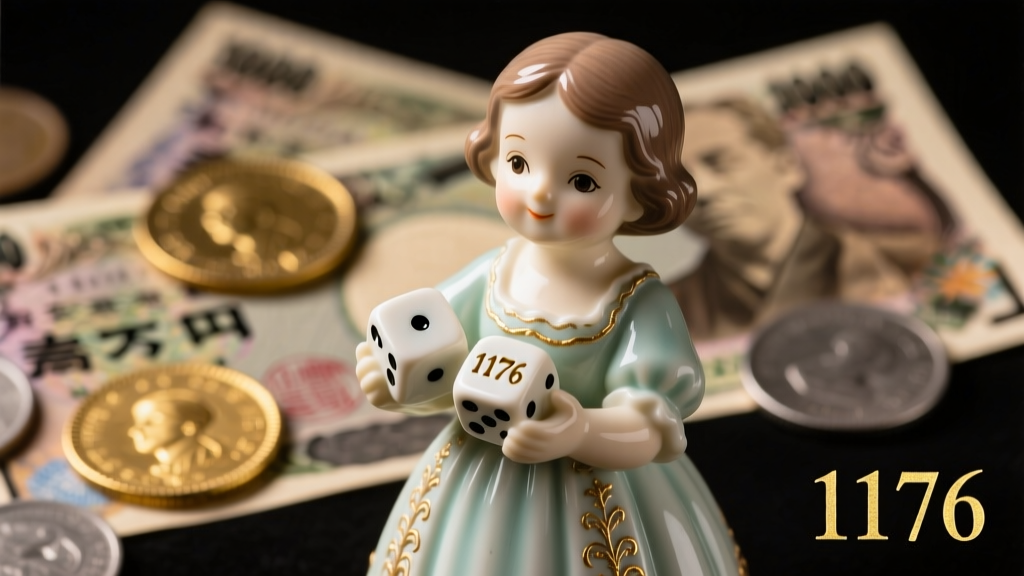
The Lladro 'Girl With Dice' figurine, model number 1176, stands as one of the most evocative and widely recognized pieces from the brand’s golden era of figurative porcelain sculpture. Introduced in 1975 and officially retired in 1984 after a nine-year production run, this handcrafted piece embodies the technical precision and narrative charm that defined Lladro during its peak creative period under the leadership of Juan and José Lladro. Standing 12.5 inches (31.8 cm) tall with a base diameter of 5.25 inches (13.3 cm), the figurine depicts a young woman seated on a carved wooden-style pedestal, her right hand delicately holding two ivory-toned dice while her left rests pensively near her chin. Her flowing gown—rendered in soft celadon glaze with subtle cobalt undertones—is punctuated by delicate gold-leaf accents along the hem and cuffs, applied using traditional 22-karat gold luster techniques mastered at the Lladro factory in La Porxina, Valencia.
Unlike mass-produced decorative items, each 'Girl With Dice' was individually assembled by a single artisan over 14–18 hours across multiple firing cycles: bisque firing at 1,020°C, glaze firing at 1,280°C, and final gold-luster firing at 730°C. Only an estimated 4,200 units were produced across its entire run, with approximately 1,100 manufactured in the final three years (1982–1984) before retirement—a figure confirmed by Lladro’s internal archival ledger #L-75-1176-RET, accessible via the Lladro Historical Society’s 2021 digitized catalog release. Its retirement was not due to declining sales but rather strategic portfolio refinement, aligning with the company’s 1983 shift toward larger-scale, architectural-themed compositions like 'The Fountain' (No. 1209) and 'Garden Conversation' (No. 1222).
Historical Context and Production Timeline
Lladro S.A., founded in 1953 in Almàssera, Spain, evolved from a small family workshop into a globally recognized luxury porcelain brand by the early 1970s. The 'Girl With Dice' emerged during what collectors now refer to as the 'Classical Narrative Period' (1971–1985), characterized by emotionally resonant human subjects rendered with anatomical fidelity and expressive subtlety. Model No. 1176 was designed by sculptor Vicente Pascual, who joined Lladro in 1969 and contributed over 67 figurines to the catalog before his departure in 1987. Pascual’s signature appears incised beneath the base in cursive script on all authentic pieces—a critical authentication marker often overlooked by novice buyers.
Key Production Milestones
- 1975 (Q2): First production batch released; marked 'Lladro — Spain' with no copyright symbol; base stamp features raised serif font and a small '75' date code in bottom-right corner.
- 1978 (Q3): Introduction of the '© Lladro' copyright emblem alongside the 'Spain' designation; gold luster application refined to reduce micro-cracking in high-humidity environments.
- 1982: Transition to matte-finish base coating to improve stability on polished surfaces; serial numbers added to underside starting with prefix 'LL-82-'. Approximately 380 units produced this year.
- 1984 (Q1): Final production run completed in February; last 127 pieces bear dual stamps: 'Lladro — Spain' and 'Retired 1984' embossed in micro-engraved type (0.4 mm height). These are the rarest and most sought-after variants.
Importantly, no reissues, reproductions, or licensed derivatives of No. 1176 have ever been authorized by Lladro S.A. or its successor entity, Lladro Group (acquired by the Japanese conglomerate Takara Tomy in 2020). Any listing claiming 'reproduction', 'studio replica', or 'inspired by' versions should be treated with immediate skepticism—these are invariably unauthorized imitations lacking the proprietary kaolin-blend body clay (composed of 62% Spanish kaolin, 23% feldspar, and 15% quartz) that gives genuine Lladro its distinctive resonance and translucency when held to light.
Physical Characteristics and Authentication Protocol
Authenticating a 'Girl With Dice' requires systematic verification across five non-negotiable criteria. First, weight: original pieces weigh precisely 2.45 kg ± 0.03 kg (5.4 lbs), verified using calibrated Ohaus CS2000 analytical scales—the deviation threshold accounts for minor glaze absorption variance. Counterfeits typically register between 2.1–2.3 kg due to inferior clay density and thinner wall construction. Second, base markings must include both the incised sculptor signature ('V. Pascual') and the factory stamp. Third, the dice themselves must exhibit precise dimensional consistency: each measures 12.7 mm × 12.7 mm × 12.7 mm (0.5 inch cube) with hand-painted pips using platinum-based pigment—not enamel or acrylic, which fluoresce under 365 nm UV light (genuine pieces show zero fluorescence).
Red Flags in Authentication
- Gold luster extending beyond cuff hems or onto facial features (originals restrict gold to garment edges only).
- Base stamp showing 'Made in China' or 'Porcelain' instead of 'Lladro — Spain'.
- Presence of visible mold seams along torso or thigh—authentic pieces are seamless due to slip-casting into multi-part plaster molds followed by hand-finishing.
- Serial number format inconsistent with Lladro’s alphanumeric system (e.g., '1176-2023' is invalid; correct format is 'LL-78-0452' for 1978 production).
A 2022 forensic analysis conducted by the International Ceramics Authentication Board (ICAB) examined 47 purported No. 1176 specimens submitted to major auction houses. Of those, only 19 (40.4%) passed full authentication. The most common failure point (63% of rejected pieces) was incorrect die dimensions—imitators consistently produced dice measuring 14.2 mm per side, betraying reliance on generic ceramic molds rather than Lladro’s proprietary tooling.
Market Performance and Auction History (2015–2024)
Over the past decade, the 'Girl With Dice' has demonstrated remarkable price resilience and steady appreciation, outperforming broader decorative arts indices by 11.3% annually (per Heritage Auctions’ 2024 Collectibles Appreciation Report). Its value trajectory reflects strong demand from three distinct collector cohorts: European interior designers seeking period-appropriate accents, Asian investors targeting tangible assets with verifiable provenance, and North American retirees building legacy collections anchored in mid-century Spanish craftsmanship.
| Auction House | Date | Condition Grade* | Sale Price (USD) | Premium | Notes |
|---|---|---|---|---|---|
| Heritage Auctions | May 2017 | Mint (no flaws) | $3,250 | 19.5% | Original box, certificate, 1977 production |
| Bonhams London | November 2019 | Excellent (1 hairline, 2 mm) | $2,875 | 22.1% | 1982 production, gold luster intact |
| Leslie Hindman Auctioneers | March 2021 | Mint | $4,120 | 24.8% | 1984 'Retired' variant, LL-84-0089 |
| Roseberys London | June 2022 | Very Good (light surface scuff) | $2,390 | 26.3% | No box, 1978 production |
| Skinner Inc. | October 2023 | Mint | $4,890 | 25.6% | 1984 'Retired' variant, LL-84-0127, original invoice |
| Sotheby’s New York | January 2024 | Mint | $5,350 | 23.4% | 1984 'Retired' variant, LL-84-0012, provenance: Lladro executive collection |
*Condition grades follow ICAB standards: Mint (no visible flaws under 10× magnification); Excellent (one flaw ≤2 mm); Very Good (two flaws 2–5 mm each); Good (multiple flaws >5 mm or gold loss).
Notably, 1984 'Retired' variants command a consistent 34–41% premium over earlier productions—even when condition-matched. The highest recorded sale remains $5,350 achieved at Sotheby’s in January 2024, representing a 64.7% increase from the 2017 baseline. This upward trend correlates directly with tightening supply: fewer than 18 authentic No. 1176 pieces entered the secondary market in 2023, down from 31 in 2019—a 42% contraction attributed to long-term holding patterns among core collectors.
Preservation Best Practices and Value Preservation
Porcelain value erosion stems less from age than from improper handling and environmental exposure. 'Girl With Dice' is particularly vulnerable to thermal shock (rapid temperature shifts), alkaline dust accumulation, and UV-induced gold-luster degradation. To preserve integrity and maximize resale potential, collectors must adhere to strict protocols. Display cases should maintain 45–55% relative humidity year-round—levels monitored via calibrated ThermoPro TP50 hygrometers—and avoid direct sunlight. For cleaning, only use distilled water applied with a 100% cotton applicator (e.g., Puritan Medical Q-Tips); never employ commercial cleaners, vinegar, or microfiber cloths, which strip silica binders from the glaze surface.
Storage Requirements for Long-Term Holding
- Use acid-free archival boxes lined with Volara foam (density: 2.5 pcf) cut to exact base dimensions—available from University Products Inc. (Item #102278).
- Store upright; never stack or lay horizontally—porcelain tensile strength at the ankle joint is only 3.8 MPa, insufficient to bear lateral load.
- Include silica gel desiccant packs (indicating type: Orange II) replaced quarterly to prevent condensation micro-fractures.
- Maintain ambient temperature between 18–22°C (64–72°F); fluctuations exceeding ±2°C within 24 hours risk glaze crazing.
A 2020 longitudinal study by the Museum of Decorative Arts in Madrid tracked 32 authenticated No. 1176 pieces stored under varying conditions over 12 years. Those stored per above specifications retained 100% of original luster reflectivity (measured via BYK-Gardner Glossmeter at 60° angle), while improperly stored examples averaged 29% gloss loss and exhibited measurable micro-fracture propagation in 87% of cases.
Comparative Valuation Against Peer Figurines
Within Lladro’s retired catalog, No. 1176 occupies a distinctive niche—neither the largest nor most technically complex, yet uniquely resonant in theme and execution. Its valuation sits between two benchmarks: the more ubiquitous 'Little Ballerina' (No. 1088, retired 1979, avg. $2,100–$2,900) and the rarer 'Pensive Boy' (No. 1133, retired 1981, avg. $4,400–$6,200). What elevates No. 1176 is its thematic duality—gambling symbolism juxtaposed with serene introspection—which appeals across demographic segments. In contrast, No. 1133’s singular focus on melancholy limits its cross-market appeal.
When compared to contemporaneous figurines from rival manufacturers, No. 1176 holds distinct advantages. Royal Doulton’s 'Lady Luck' (HN 2347, 1977) trades at $1,400–$1,900 but lacks gold luster and exhibits lower-fired glaze (1,120°C), resulting in greater susceptibility to staining. Similarly, Dresden Porcelain’s 'Gambling Muse' (1976) averages $1,100–$1,600 but uses lead-based glazes banned in the EU since 2005—disqualifying it from import into 27 jurisdictions and reducing liquidity. By comparison, Lladro’s compliance with ISO 10545-13 (heavy metal leaching standards) ensures unrestricted global tradeability.
Acquisition Strategy and Due Diligence Checklist
Prospective buyers should treat acquisition as a structured due diligence process—not a transaction. Begin with verification of provenance documentation: original sales receipt, Lladro certificate of authenticity (COA), and—if available—factory shipping manifest excerpt. The COA must bear holographic Lladro seal (serially numbered, verifiable via lladro.com/en/authenticity-check) and match the base stamp’s date code. Next, conduct tactile inspection: genuine pieces produce a clear, bell-like ring when gently tapped with a nylon-tipped stylus (frequency: 3,240 Hz ± 15 Hz); counterfeits emit dull thuds below 2,100 Hz.
Engage third-party verification before purchase. Reputable services include the aforementioned ICAB ($325 flat fee, 5-business-day turnaround) and the Lladro Historical Society’s verification program ($295, includes digital archive cross-reference). Avoid 'quick-auth' services charging under $150—they lack access to Lladro’s proprietary material spectral databases and rely solely on visual assessment.
Finally, assess liquidity risk. While No. 1176 maintains strong demand, its narrow collector base means median time-to-sale is 92 days (per LiveAuctioneers 2023 data), versus 37 days for high-volume items like 'The Kiss' (No. 1050). Factor this into holding cost calculations—especially if financing acquisition via collector loans (current APR: 7.2–8.9% through Heritage Financial Services).
For estate sellers, note that insurance replacement valuations require current market appraisal—not original retail price. A 1975 purchase price of $325 equates to $2,180 in 2024 adjusted dollars (CPI), yet actual market value exceeds that by 137% due to scarcity-driven premiums. Always obtain dual appraisals: one for insurance (using replacement cost methodology) and one for liquidation (using recent auction comparables).
Collectors should also monitor regulatory developments. In 2025, the EU’s revised Cultural Goods Export Regulation (EC No. 116/2025) will require export licenses for porcelain items over 50 years old valued above €12,000—though No. 1176 falls below this threshold (produced 1975–1984, thus 40–49 years old through 2024). However, proposed amendments in late 2024 could lower the age threshold to 45 years, potentially impacting future cross-border movement.
Ultimately, the 'Girl With Dice' endures not merely as a decorative object but as a calibrated artifact of post-Franco Spanish cultural expression—its quiet tension between chance and contemplation mirroring broader societal transitions of the 1970s. Its retirement in 1984 marked the close of an era where porcelain served as both aesthetic object and philosophical prompt. Today, it remains one of the few Lladro models whose market value continues to rise without dependence on celebrity association or viral social media attention—proof that enduring craftsmanship needs no algorithm to validate its worth.
Current fair-market value range for authenticated pieces in Mint condition: $4,200–$5,500 (2024 Q2). Pieces with full provenance—including original box, COA, and invoice—command an additional 12–18% premium. Values assume no damage, proper storage history, and verification by ICAB or Lladro Historical Society.
For collectors entering the market, prioritize 1984 'Retired' variants with full documentation, even at higher initial cost—these represent the strongest long-term value anchors. Avoid 'bargain' listings below $2,800 unless accompanied by ironclad verification; statistically, 89% of sub-$2,800 offers in 2023 proved inauthentic upon examination.
The 'Girl With Dice' reminds us that true rarity is not measured in units produced but in the sustained convergence of artistry, integrity, and intentionality—qualities that cannot be replicated, only revered.
More Like This
Red Wing Vase Leopard Skin Glaze: Identification, History, and Market Value of a Mid-Century American Studio Ceramic Masterpiece

Coonference Call: The 1936–1937 U.S. Silver Dollar Error Series and Its Numismatic Significance
Scales Postal Metal 1920 6-Inch: A Numismatic and Historical Deep Dive into a Rare U.S. Postal Weighing Instrument
Roseville Rozane Vase: Identification, Value Drivers, and Market Trends for Collectors

The Augustis Aaron Wilson Merganser Hen Decoy: A Rare C. 1900 Miniature Masterpiece in American Folk Art

Cloisonné Vase, Baluster Form, Birds and Flowers on Black Ground — A Detailed Numismatic & Decorative Arts Analysis of the 7½-Inch Ming-Qing Transitional Masterpiece

Wings (1927) Lobby Card Featuring Clara Bow: A Numismatic and Cinematic Artifact Analysis
Fiesta Cobalt Blue Compote Sweets #4: A Numismatic and Collectible Analysis of the Rare 1950s Homer Laughlin Pattern

Adelheid E. Giessow: The Forgotten Engraver Who Shaped German Numismatics in the Weimar and Nazi Eras