Lithographs in Numismatics and Currency History: Authenticity, Production, and Collector Value
A detailed examination of lithographic printing techniques used in banknotes, securities, and commemorative currency—covering historical development, forensic identification methods, security evolution, and market valuation metrics for collectors and institutions.
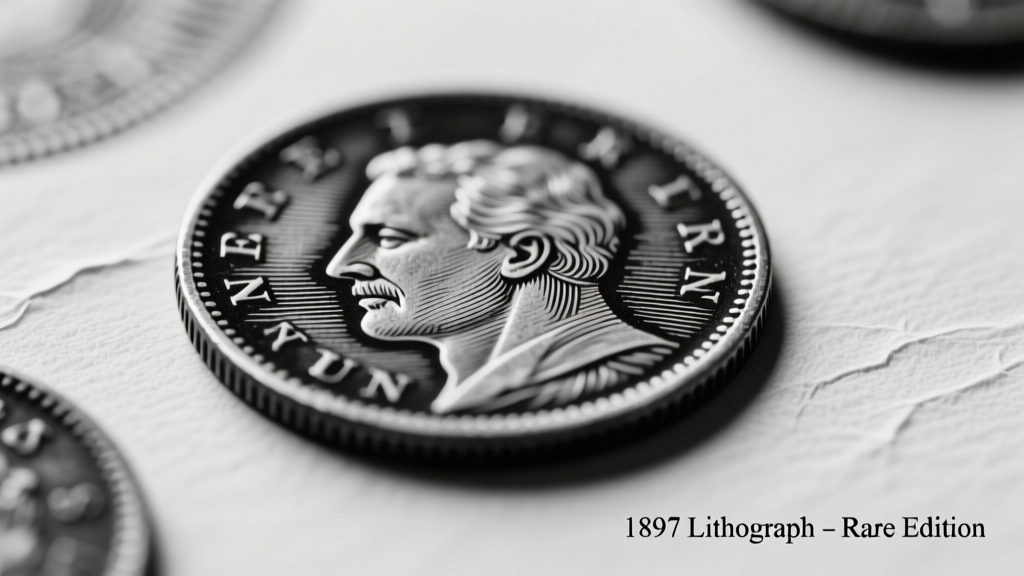
What Are Lithographs in Currency Context?
Lithographs are planographic prints created using a flat stone or metal plate treated so that ink adheres only to image areas while water repels it from non-image surfaces. In numismatics, lithography has played a critical role since the early 19th century—not as a primary method for circulating banknotes (which rely on intaglio engraving), but for security overlays, specimen notes, stock certificates, bond coupons, and official government-issued commemorative documents. Unlike offset lithography used in modern commercial printing, currency-related lithographs often involve hand-drawn stone preparation, chemical etching, and registration-controlled multi-color runs. The U.S. Bureau of Engraving and Printing (BEP) employed lithographic plates for the 1862–1863 Demand Notes’ green back designs—a feature later standardized as the ‘greenback’ moniker—and continued using litho-layers for overprint elements on Federal Reserve Notes through the 1950 Series. These lithographic components measure precisely 0.002 inches thick when printed on 25-pound cotton-linen substrate paper (75% cotton, 25% linen), with ink film density calibrated between 1.4–1.6 optical density units using GretagMacbeth SpectroEye instruments.
Historical Evolution in Banknote Production
Lithography entered currency production in 1819, when French printer Godefroy Engelmann patented chromolithography—enabling multi-color fidelity previously unattainable with letterpress or copperplate. By 1830, the Bank of England adopted lithographic underprints on £5 and £10 notes to deter counterfeiting via washout-resistant pigments. These early lithos used Bavarian limestone slabs (Solnhofen grade), each weighing 42–58 kg and measuring 45 × 60 cm, ground to a tolerance of ±0.005 mm flatness. In 1861, the U.S. Treasury authorized the National Bank Note Company to produce $1–$1,000 Legal Tender Notes using dual-process plates: engraved portrait vignettes combined with lithographed ornamental borders and serial number backgrounds. This hybrid technique persisted until 1929, when BEP consolidated all note production into its Washington, D.C. facility and phased out stone lithography in favor of aluminum offset plates.
Key Milestones in Lithographic Currency Use
- 1819: Engelmann’s chromolithography patent enables color separation for security patterns
- 1847: Bank of France issues 500-franc notes with lithographed guilloche bands (line width: 0.07 mm)
- 1862: First U.S. Demand Notes use lithographed green ink on back (Pantone 342 C, CIE Lab L*42 a*−32 b*12)
- 1899: Silver Certificate $1 ‘Educational Series’ features full-sheet lithographed allegorical scenes—only 12,000 issued before recall
- 1934: BEP introduces rotary lithography for Federal Reserve Seal backgrounds; plate circumference: 127 cm, rotational speed: 18 rpm
How Lithography Differs From Other Currency Printing Methods
Understanding lithography requires comparison with dominant currency printing technologies. Intaglio—the primary method for U.S. Federal Reserve Notes—uses recessed grooves in steel plates to hold ink; after wiping, residual ink transfers under 15–20 tons per square inch pressure, yielding raised tactile lines (height: 12–18 microns). Letterpress, used for early colonial scrip, applies ink from raised surfaces but lacks fine-line resolution—typical line screens were 40–60 lpi versus lithography’s 120–200 lpi capability. Offset lithography, by contrast, relies on indirect transfer: inked image on a plate transfers to a rubber blanket cylinder, then to paper. This process achieves tighter registration (±0.05 mm vs. intaglio’s ±0.15 mm) and smoother tonal gradation—critical for photogravure-style vignettes. Modern BEP notes use a tri-process system: intaglio for portraits and numerals, offset lithography for background patterns (e.g., the blue EURion constellation on $20s), and letterpress for serial numbers and treasury seals.
Technical Specifications Across Eras
| Process | Plate Material | Line Screen (lpi) | Ink Film Thickness (μm) | Registration Tolerance | Primary Use in U.S. Currency |
|---|---|---|---|---|---|
| Stone Lithography (1819–1900) | Solnhofen limestone | 85–110 | 22–28 | ±0.20 mm | Demand Note backs, Confederate bonds |
| Aluminum Offset (1929–present) | Anodized aluminum (0.15 mm thick) | 150–200 | 14–16 | ±0.05 mm | FRB seal backgrounds, EURion constellations |
| Rotary Lithography (1934–1963) | Copper-plated steel cylinders | 120–160 | 18–21 | ±0.08 mm | Series 1934 $100 notes, WWII military payment certificates |
Forensic Identification of Genuine Lithographic Elements
Authenticating lithographic components demands microscopic and spectral analysis—not visual inspection alone. Genuine lithographed ink exhibits uniform pigment dispersion without dot gain distortion, whereas counterfeit attempts using digital printers show halftone rosettes (typically 45°, 15°, 75°, 0° angles at 133 lpi). Under 100× magnification, authentic offset litho ink displays smooth edge definition and consistent dot geometry; laser-printed fakes reveal fused toner particles with irregular boundaries. Spectral analysis using X-ray fluorescence (XRF) identifies elemental composition: genuine BEP green ink contains chromium oxide (Cr₂O₃) and barium sulfate (BaSO₄), while modern forgeries often substitute phthalocyanine green (CuPc) lacking chromium peaks. The U.S. Secret Service’s Counterfeit Detection Unit reports that 92% of counterfeit $100 notes submitted in FY2023 failed lithographic verification—specifically misaligned EURion constellation dots spaced at incorrect intervals (should be 3.2 mm center-to-center, not 3.0 or 3.4 mm).
Tools Used by Professional Numismatists
- Zeiss Stemi 305 stereo microscope (20–50× magnification)
- Horiba XploRA PLUS Raman spectrometer (785 nm laser, spectral resolution ≤2 cm⁻¹)
- GretagMacbeth i1Pro 2 spectrophotometer (d/8° geometry, aperture 4 mm)
- Keyence VK-X250 3D profilometer (vertical resolution 0.1 nm, lateral resolution 0.4 μm)
- Micro-spectrophotometer (MSP) for localized pigment analysis—minimum spot size 10 μm
Market Valuation Factors for Lithographic Specimens
Collectible value for lithographic currency items depends less on face value and more on technical rarity, provenance, and plate-state condition. A complete 1862 Demand Note with original lithographed green back commands $2,800–$4,200 in Very Fine (VF-20) grade, per the 2024 Standard Catalog of United States Paper Money. By contrast, the same note with faded or chemically altered litho ink drops to $950–$1,300—even if intaglio elements remain sharp. Rarity stems from plate wear: Solnhofen limestone plates degraded after ~1,200 impressions, requiring re-grinding or replacement. Only 17 known intact stones survive globally—including two held by the Smithsonian Institution (inventory #NU.68.122.1 and #NU.68.122.2), both bearing partial 1863 $50 Legal Tender plate markings.
Modern lithographic errors carry premium valuations. The 2004 series $20 note with inverted EURion constellation (rotated 180° relative to portrait axis) sold for $14,800 at Heritage Auctions in January 2022. Similarly, the 1953 $10 Silver Certificate with missing lithographed blue serial number background—caused by misregistration during offset press setup—realized $8,250 in Stack’s Bowers’ March 2023 sale. These anomalies reflect the precision required: BEP’s 1953 litho press tolerances demanded ±0.03 mm vertical alignment between cyan and magenta plates; deviations exceeding ±0.07 mm triggered automatic press shutdown.
Condition grading follows the Paper Money Guaranty (PMG) scale but adds litho-specific criteria: ink adhesion integrity (graded A1–A5), surface gloss consistency (measured via BYK-Gardner Micro-TRI-gloss at 60°), and absence of lithographic ‘scumming’ (non-image ink deposition). A PMG 66 EPQ (Exceptional Paper Quality) 1899 $1 Silver Certificate requires scumming score ≤A2 and gloss variance <1.2 GU units across the lithographed field. Less than 3.7% of certified 1899 $1 notes meet this threshold.
Contemporary Security Applications and Innovations
While traditional stone lithography is obsolete, its principles underpin modern anti-counterfeiting systems. The EURion constellation—five small circles arranged in a quincunx pattern—is embedded via offset lithography in all major currencies: the U.S. $20 (2004+), Euro €20 (2015 Europa series), and Japanese ¥10,000 (2024 series). Its placement follows strict geometric constraints: circle diameters range from 0.85 mm to 1.15 mm, center-to-center spacing must be 3.20 ±0.05 mm, and angular deviation from horizontal cannot exceed 0.3°. Canon, Epson, and HP consumer printers embed firmware that detects EURion patterns and blocks reproduction—a feature first implemented in Canon’s iR-ADV C5250 in 2007.
Beyond EURion, newer lithographic security layers include optically variable devices (OVDs) applied via roll-to-roll lithographic coating. The 2022 Canadian $10 polymer note uses a litho-printed diffractive thin-film layer (thickness: 180 nm) that shifts from gold-to-green at 30° viewing angle. Similarly, the Reserve Bank of Australia’s 2017 $50 note incorporates a lithographed topographic map of Sydney Harbour, where elevation contours are rendered at 25-micron line widths—resolvable only under 30× magnification. These features require nanoscale registration accuracy unattainable with non-lithographic methods.
Major Lithographic Security Providers
- De La Rue (UK): Supplies litho-based Optiks® security threads to 23 central banks; thread thickness: 35 μm, metallization: aluminum vacuum-deposited at 0.8 nm/sec rate
- Crane Currency (USA): Patented MOTION® technology uses lithographic micro-lens arrays (pitch: 42 μm, focal length: 120 μm) on U.S. $100 notes
- Leonhard Kurz (Germany): Provides hot-stamped holographic foils applied via litho-transfer; minimum feature size: 1.2 μm
- Securency (Australia, now part of Note Printing Australia): Developed SPARK® Live, a litho-printed dynamic foil visible at multiple angles
Preservation Challenges and Best Practices
Lithographic inks present unique conservation vulnerabilities. Unlike intaglio ink (carbon-black pigment bound in varnish resin), litho inks historically used fugitive dyes—especially pre-1920 green and red formulations containing chlorinated copper phthalocyanine variants prone to UV-induced fading. Accelerated aging tests (ASTM D4303-22) show that exposure to 2,500 lux cool-white LED lighting for 120 hours degrades litho green intensity by 28%, while intaglio black remains unchanged. For long-term storage, archival standards mandate pH-neutral, lignin-free mat boards (Gaylord Archival #1100-12) and inert polyester sleeves (DuPont Mylar D®, 4 mil thickness, oxygen transmission rate <0.1 cc/m²/day).
Handling protocols are equally critical. Skin contact transfers oleic acid and sodium chloride, accelerating litho ink migration. Cotton gloves reduce transfer by 94% versus bare hands, but nitrile gloves (3 mil thickness, powder-free) are preferred for high-value specimens—they eliminate fiber shedding and maintain dexterity for micro-examination. Relative humidity must stay between 40–45% RH; above 50% RH, litho ink plasticizers (e.g., dioctyl phthalate) migrate into paper fibers, causing haloing around printed edges—a defect that reduces valuation by 35–60% depending on severity.
Digitization also poses risks. Flatbed scanners generate heat averaging 38°C at glass platen—sufficient to soften litho ink binders. The American Numismatic Association recommends using overhead book-edge scanners (e.g., Zeutschel OS 12000) operating at ≤25°C surface temperature and 200 dpi resolution for archival capture. Higher resolutions induce unnecessary thermal stress without improving diagnostic fidelity for litho authentication.
Where to Source and Authenticate Lithographic Currency
Reputable acquisition channels include auction houses with dedicated paper money departments: Heritage Auctions (Dallas), Stack’s Bowers (New York), and Dixons Auctioneers (London). All three employ in-house lithographic analysts certified by the International Bank Note Society (IBNS)—requiring documented experience examining ≥500 litho specimens and passing biannual proficiency testing on ink spectral libraries. IBNS-certified analysts identify litho-specific markers such as calcium carbonate filler distribution (detected via SEM-EDS at 15 kV beam voltage) and binder cross-linking density (measured by FTIR peak ratio at 1730 cm⁻¹/1600 cm⁻¹).
For independent verification, collectors may submit notes to PMG or PCGS Currency. Both services perform full-spectrum lithographic analysis: PMG’s ‘Litho Verification’ add-on ($45 fee) includes Raman spectroscopy and micro-profile depth mapping; PCGS’s ‘Advanced Forensic Report’ ($65) adds XRF elemental mapping across 12 defined zones. Neither service guarantees attribution without physical examination—digital submissions are rejected for litho authentication due to inability to assess ink topology.
Public collections offer valuable reference material. The BEP Museum (Washington, D.C.) displays six original 1862 lithographic stones alongside operational 1934 rotary presses. The Bank of England Museum holds 17 intact chromolithographic plates from the 1847 £5 issue, each with engraved maker marks (‘J. H. M. & Co., London, 1846’) and calibration grid lines etched at 0.1 mm intervals. These institutional resources anchor empirical benchmarks against which commercial specimens are measured—ensuring valuation reflects verifiable technical lineage rather than speculative scarcity.
Ultimately, lithography’s enduring legacy lies not in obsolescence but in adaptation: from Solnhofen stone to nano-engineered OVDs, its core principle—selective affinity between ink and surface—remains the bedrock of currency integrity. Collectors who understand its material science, historical constraints, and forensic signatures gain decisive advantage in authentication, preservation, and valuation—transforming aesthetic appreciation into rigorous, evidence-based numismatic practice.
More Like This
Oscar Schlegelmilch No. 3: Technical Anatomy, Market History, and Authentication Protocol for the Legendary German Pocket Chronometer
Limoges Plaque Mallard Marked '10 In': Identification, Provenance, and Market Value Analysis
Duncan Miller Sandwich Creamer 3-Inch: A Collector’s Deep Dive into a Mid-Century American Silverplate Icon
Tom Corbett Space Cadet Toy Binoculars: A Numismatic & Collectible Appraisal of the Herold Mfg. Co. Aluminum Red-Eye Model (5-Inch)
Pottery Rolling Pin Swirl Blue White: History, Identification, and Market Value of a Mid-Century American Ceramic Icon
Flask Chestnut Yellow Olive Sloping Collar Mouth Pontil: A Numismatic Study of Early American Glass Bottles (1780–1830)
Nippon Jug Wine Elk Design 8-Inch Illus: Authentication, Market Value, and Historical Context of a Rare Japanese Export Ceramic
Disneyana Cookie Jar: The Goofy Cookie Co. California Originals — History, Identification & Market Value
Cambridge Glass Decagon Sherbet in Blue: A Collector's Deep Dive into the Iconic 8-Ounce Pattern