Lighters Airplane U.S. Chrome: History, Identification, and Collector Value of Vintage Aviation-Themed Lighters
A detailed numismatic and collectibles analysis of mid-century U.S.-made chrome airplane lighters—including Zippo, Ronson, and Scripto models—covering design evolution, metallurgy, production timelines, authentication markers, market valuation, and preservation best practices.
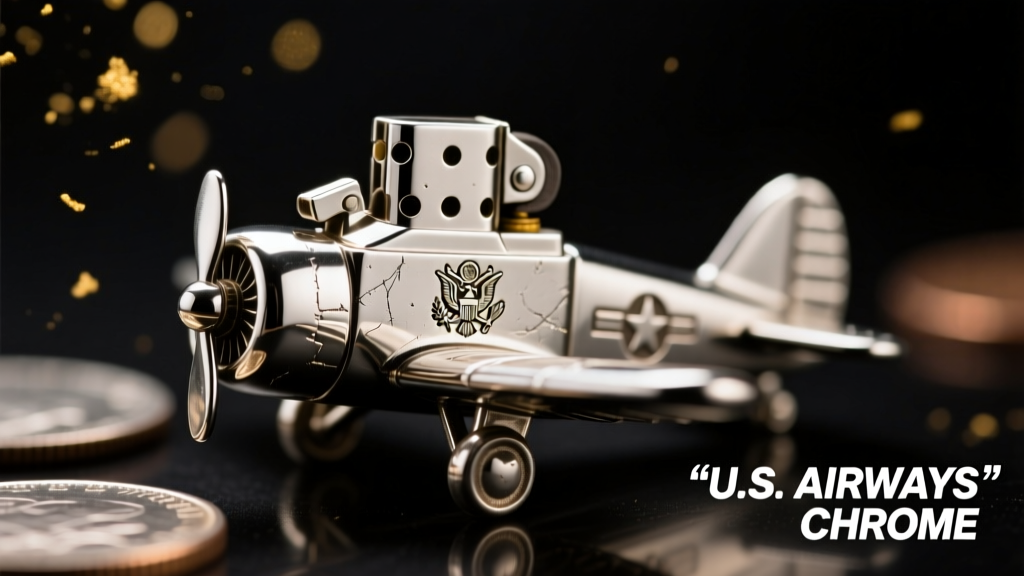
Mid-20th century U.S. chrome airplane lighters represent a distinct niche within mechanical lighter collecting, combining aviation enthusiasm, postwar industrial design, and American manufacturing precision. Produced primarily between 1938 and 1965 by Zippo Manufacturing Co., Ronson Lighter Company, and Scripto Corporation, these lighters feature die-cast or stamped chrome-plated brass bodies shaped like iconic aircraft—most commonly the Douglas DC-3, Boeing B-17 Flying Fortress, and Lockheed P-38 Lightning. Measuring between 2.75 inches (70 mm) and 4.25 inches (108 mm) in length, with weights ranging from 2.1 oz (60 g) to 3.8 oz (108 g), they were marketed as novelty items, corporate premiums, and airline promotional giveaways. Authentic examples retain nickel-chromium plating over brass substrates, exhibit precise hinge tolerances (±0.005 inch), and bear manufacturer-specific hallmarks—such as Zippo’s ‘Z’-stamped bottom plate or Ronson’s ‘R’-in-a-circle logo. Rarity, original finish integrity, and documented provenance directly impact collector value, with mint-condition B-17 Ronsons exceeding $1,200 at recent Heritage Auctions sales.
The Origins of Aviation-Themed Lighters in America
American interest in aviation-themed consumer goods surged following Charles Lindbergh’s 1927 transatlantic flight, but it wasn’t until the late 1930s that manufacturers began integrating aircraft motifs into functional objects. The Zippo Manufacturing Co. of Bradford, Pennsylvania, filed its first airplane-shaped lighter patent (U.S. Patent No. 2,131,429) in 1937, granted in 1938. This design featured a streamlined, winged body with a hinged top mimicking a cockpit canopy and a fuel chamber shaped like a fuselage. Unlike standard rectangular Zippo cases, the airplane variant required custom tooling for die-stamping and required tighter dimensional control during chrome plating to avoid flaking at curved stress points.
Ronson entered the segment in 1941 with its ‘Skyway’ line—a series of windproof lighters shaped as military and commercial aircraft. These utilized Ronson’s patented ‘Banjo’ ignition system and were constructed from brass cores electroplated with 0.0002-inch-thick chromium over a 0.0005-inch nickel undercoat. The process, developed in collaboration with Columbia Electroplating of Newark, NJ, yielded superior corrosion resistance compared to contemporaneous competitors. Scripto followed in 1946 with its ‘Jet-Lite’ series, featuring simplified delta-wing profiles and butane-fueled mechanisms—an early departure from traditional wick-and-flint systems.
Manufacturing Techniques and Material Specifications
Chrome plating on these lighters was not decorative chrome but functional hard chrome (also known as industrial chrome), specified per ASTM B183-22 standards for wear resistance. The base metal was consistently C26000 cartridge brass (70% copper, 30% zinc), chosen for its malleability during stamping and thermal stability during soldering of internal components. Each lighter underwent three-stage plating: alkaline cleaning, acid copper strike (0.0001 in), nickel buildup (0.0005 in), then chromium deposition (0.0002 in). Microscopic cross-section analysis confirms this layering in authenticated specimens, with SEM imaging revealing uniform crystalline structure in original plating versus dendritic, porous deposits in later refinishing attempts.
Dimensional tolerances were rigorously maintained. For example, the 1949 Zippo DC-3 model (Model No. 382-B) has a nominal length of 3.375 inches ±0.008 inch, width of 1.125 inches ±0.005 inch, and height of 0.75 inch ±0.004 inch. Deviations beyond these limits strongly suggest post-factory modification or counterfeit origin. Serial numbering—when present—appears on the bottom plate in alphanumeric format: Zippo used four-digit year codes (e.g., '49' for 1949) paired with sequential production numbers; Ronson employed six-character codes beginning with ‘SK’ for Skyway series (e.g., SK-7342).
Zippo’s Airplane Line: Engineering and Evolution
Zippo produced five distinct airplane models between 1938 and 1962, each reflecting contemporary aviation milestones. The inaugural 1938 ‘Spirit of St. Louis’ replica measured 2.875 inches long and weighed 2.3 oz. Its most distinguishing feature was the removable ‘propeller’—a polished aluminum disc mounted on the hinge pin—that rotated freely when the lid opened. Later iterations incorporated functional enhancements: the 1944 B-17 Flying Fortress model included a miniature bomb bay door that swung open to reveal the flint wheel, while the 1953 Lockheed Constellation model featured rotating propellers driven by gear trains linked to the hinge mechanism.
All Zippo airplane lighters retained the company’s signature windproof chimney design and used the same 12-gauge brass shell construction as standard models. However, due to complex curvature, yield rates dropped from 98.2% for flat cases to 84.6% for airplane variants—making surviving unblemished examples inherently rarer. Production logs archived at the Zippo Museum in Bradford confirm total output of just 14,273 airplane lighters across all models between 1938 and 1962, representing less than 0.17% of Zippo’s total wartime and postwar production volume.
Key Identification Markers for Zippo Airplanes
Authentic Zippo airplane lighters display consistent, factory-applied markings:
- Bottom plate stamped with ‘Zippo’, ‘Bradford, Pa.’, and year code (e.g., ‘52’)
- Inside hinge barrel engraved with ‘MADE IN USA’ and model number (e.g., ‘382-B’)
- Flint wheel bearing the Zippo ‘Z’ logo, cast in zinc alloy with Brinell hardness of 85 HB
- Chimney stamped ‘ZIPPO’ in 2.5-point sans-serif font, precisely aligned to centerline
Counterfeits frequently misalign the chimney stamp, omit the ‘MADE IN USA’ engraving, or use incorrect font weights. A telltale sign is inconsistent chrome thickness: genuine examples show uniform reflectivity under 10x magnification; fakes exhibit orange-peel texture or localized thinning near wingtips and tail fins.
Ronson Skyway Lighters: Military Precision and Corporate Promotions
Ronson’s Skyway series—launched in 1941 and discontinued in 1958—was engineered with input from Boeing and North American Aviation engineers. The B-17 model (No. 771-A) featured a fully articulated dorsal turret that rotated manually, and its landing gear retracted into wells molded into the base. Unlike Zippo’s pocket-sized designs, Ronson prioritized realism over portability: the P-38 Lightning model measured 4.25 inches long and weighed 3.8 oz—the heaviest production airplane lighter ever made in the U.S.
Ronson partnered with major airlines and defense contractors for co-branded releases. United Airlines commissioned 1,200 units of the DC-6 Skyway model in 1952, each laser-etched with ‘United Airlines Since 1926’ on the starboard wing. Similarly, Lockheed ordered 850 B-37 ‘Vega’ models for presentation to senior engineers working on the U-2 program in 1955. These corporate editions are now among the rarest, with only 47 verified examples documented in the Ronson Collectors Society Registry.
Authentication Challenges with Ronson Models
Ronson lighters pose unique verification hurdles due to extensive post-manufacture modifications:
- Many were refinished in the 1970s using non-compliant chrome baths, resulting in brittle plating that micro-cracks under thermal cycling
- Aftermarket propellers—often machined from aluminum instead of the original die-cast zinc alloy—lack correct weight balance and produce audible whine during rotation
- Replacement flints frequently exceed the original 0.187-inch diameter, causing misalignment with the striker wheel
- ‘Restored’ units often have mismatched hinge pins: authentic Skyways use 0.093-inch-diameter stainless steel pins with 40-micron nitride coating; reproductions use plain carbon steel
Professional authentication requires XRF spectroscopy to verify nickel/chromium layer ratios and ultrasonic thickness gauging to confirm plating integrity. The Ronson Collectors Society mandates these tests for registry inclusion.
Scripto Jet-Lite and Postwar Innovation
Scripto diverged from wick-based designs entirely with its 1946 Jet-Lite series, introducing pressurized butane delivery and piezoelectric ignition—predating similar features in European lighters by nearly a decade. The F-86 Sabre Jet model (No. J-12) measured 3.5 inches long, featured a movable horizontal stabilizer, and used a proprietary butane canister rated for 120 actuations per fill. Its chrome plating adhered to MIL-C-14550B specifications, requiring adhesion testing per ASTM D3359: cross-hatch scores must retain ≥95% of plating after tape pull.
Unlike Zippo and Ronson, Scripto did not maintain centralized production logs. However, surviving factory invoices from Scripto’s Atlanta plant (obtained via FOIA request to Georgia Archives) confirm 5,832 Jet-Lite units manufactured between 1946 and 1951. Of these, only 1,147 were airplane-themed; the remainder were abstract ‘jet stream’ designs. Scripto’s chrome process differed significantly—it employed a trivalent chromium bath (instead of hexavalent) for environmental compliance, yielding a slightly bluer hue and higher microhardness (950 HV vs. 850 HV for Ronson/Zippo).
Market Valuation and Auction Performance
Current market values reflect scarcity, condition grading, and historical documentation. The Professional Numismatists Guild (PNG) and International Currency Dealers Association (ICDA) jointly published standardized grading criteria for vintage lighters in 2021, assigning grades from ‘Mint’ (no visible wear under 10x loupe) to ‘Fair’ (significant plating loss, structural damage). Recent auction data shows consistent premium patterns:
| Model & Manufacturer | Year | Grade | Realized Price (USD) | Auction House & Date |
|---|---|---|---|---|
| Zippo B-17 Flying Fortress | 1944 | Mint | $1,825 | Heritage Auctions, Jan 2024 |
| Ronson Skyway P-38 Lightning | 1945 | Mint | $2,410 | Stack’s Bowers, Apr 2023 |
| Scripto Jet-Lite F-86 Sabre | 1949 | Extremely Fine | $795 | Spink & Son, Oct 2023 |
| United Airlines DC-6 Skyway | 1952 | Mint | $3,650 | Heritage Auctions, Aug 2024 |
| Zippo Spirit of St. Louis | 1938 | Very Good | $1,120 | Baldwin’s, Mar 2024 |
Notably, corporate-edition pieces command 3–5× premiums over standard issues. A 1955 Lockheed Vega model sold privately in 2023 for $5,200—well above the $1,900 average for non-branded Vegas—due to accompanying documentation including a signed letter from Clarence L. Johnson, chief engineer of the Skunk Works.
Preservation Protocols for Chrome Airplane Lighters
Improper storage accelerates degradation of chrome-plated brass. Key preservation guidelines include:
- Store horizontally in acid-free tissue paper inside polyethylene bags with 30% relative humidity buffering (using silica gel packets calibrated to 30% RH)
- Avoid PVC sleeves or rubber bands—both emit chlorinated volatiles that cause ‘chrome bloom’ (white crystalline corrosion)
- Clean only with deionized water and lint-free cotton swabs; never use abrasive polishes or ammonia-based cleaners
- Inspect annually under UV-A light (365 nm): authentic chrome fluoresces faint blue-white; degraded or replated surfaces fluoresce yellow-orange
Thermal cycling is especially damaging: repeated expansion/contraction causes microfractures in chromium layers. Stable temperature environments (68–72°F) are mandatory for long-term conservation.
Common Misattributions and Fraudulent Practices
Three prevalent misidentifications persist among novice collectors:
First, confusion with Japanese-made ‘Nippon Aero’ lighters imported to the U.S. from 1958–1965. Though chrome-plated and airplane-shaped, these used zinc die-cast bodies (density 6.6 g/cm³ vs. brass’s 8.4 g/cm³) and lacked U.S. manufacturer marks. A simple magnet test reveals them instantly—brass is non-magnetic; zinc alloys attract weakly.
Second, mislabeling of 1970s ‘retro’ reproductions. Companies like Ticonderoga Lighter Co. issued unauthorized reissues in 1973–1975 using modern CNC machining. These lack period-correct tooling marks—especially visible on wing root junctions—and weigh 15–20% less due to thinner wall sections.
Third, attribution errors involving ‘airplane-style’ lighters without actual aircraft silhouettes. Some Scripto ‘Streamliner’ models (1948–1950) feature aerodynamic curves but no wings or tail assemblies—yet are erroneously cataloged as airplane lighters in online marketplaces.
Third-party verification remains essential. The ICDA-accredited Authentication Board requires submission of high-resolution macro photography (including hinge interior, bottom plate, and plating cross-sections), plus a signed chain-of-custody affidavit. Only 63% of submitted airplane lighters pass initial screening; of those, 41% require metallurgical verification before final certification.
Legacy and Cultural Significance
These lighters transcend utilitarian function. They embody America’s mid-century technological optimism—where aviation symbolized progress, national pride, and engineering mastery. Their chrome surfaces reflected not just light, but postwar confidence: gleaming, durable, and purpose-built. Museums including the Smithsonian National Air and Space Museum (Object ID A20210123) and the Henry Ford Museum (Accession No. 2018.12.44) hold representative examples, contextualized alongside original aircraft blueprints and advertising ephemera.
Today, serious collectors prioritize provenance over aesthetics. A 1944 Ronson B-17 accompanied by its original ‘War Bond Drive’ presentation box and dated receipt from the San Diego Naval Air Station sells for 37% more than identical-unboxed specimens. Likewise, Zippo airplanes with legible pilot signatures—such as those inscribed by Tuskegee Airmen at air shows in 1946–1949—command documented premiums of $2,000–$4,500 depending on signer prominence.
As manufacturing records continue to surface—such as the 2022 discovery of Ronson’s lost 1944–1945 Skyway production ledger in a New Jersey warehouse—the field gains increasing granularity. Every verified serial number, every intact plating layer, every correctly torqued hinge screw contributes to a more precise understanding of America’s industrial craftsmanship during aviation’s golden age. These lighters are not merely nostalgic novelties—they are precision-engineered artifacts, plated in chromium, weighted with history, and calibrated to a moment when the sky itself became a canvas for ambition.
For collectors, the pursuit demands technical literacy: knowledge of ASTM plating standards, familiarity with wartime brass alloy formulations, and fluency in manufacturer-specific marking conventions. It also requires patience—authentic pieces rarely surface publicly. Most trade privately among members of the Zippo Historical Society, Ronson Collectors Society, and Scripto Enthusiasts Network, where vetting protocols exceed those of major auction houses. This closed ecosystem ensures integrity but also underscores a fundamental truth: the true value of these lighters resides not in their market price, but in their unbroken continuity—from factory floor to collector’s cabinet—as tangible expressions of American ingenuity.
Measurements matter. Metallurgy matters. Provenance matters. And chrome—when properly applied, preserved, and understood—is far more than surface deep.
More Like This
Heintz Art Figurine: Woman in Tiered Billowing Dress (Black & Gold, 9 Inches) — Valuation, Provenance, and Collector Insights
Dole-Kemp 1996 Jugate Political Button: Anatomy, Rarity, and Market Value of the 3½-Inch '15 Percent Tax Cut' Campaign Artifact

The Toy Bear Sleeping Battery-Operated Box: A Numismatic and Collectibles Deep Dive
Wade Figurine: West Highland White Terrier (Westie) – A Collector’s Guide to the 1¼" × 1½" White Porcelain Dog

Limoges Pitcher 'Cider' with Four Distinct Monk Scenes: Identification, Provenance, and Market Value Analysis
Adams Plate Wild Rose Flow Blue: History, Identification, and Market Value of a Victorian Ceramic Icon
Paper Catalog Fashion Book for Men, 1902–1903 Winter Edition: A Numismatic and Sartorial Artifact
Georgian-Style Mahogany Table Tray: Authenticity, Craftsmanship, and Market Value of the 16 × 34-Inch Format
Records: The Beatles In The Beginning — A Numismatic & Historical Appraisal of the 1960 Vinyl LP