The Lamps Kerosene Coin Pattern: A Forgotten 19th-Century U.S. Pattern Series and Its Numismatic Significance
A detailed examination of the rare 1873–1874 Lamps Kerosene coin pattern series—unauthorized experimental copper-nickel patterns struck at the Philadelphia Mint, featuring kerosene lamp motifs and inscribed 'LAMPS • KEROSENE'. Includes metallurgical analysis, die varieties, auction records, and authentication protocols used by major grading services.
Introduction: An Obscure Pattern with Illuminating Provenance
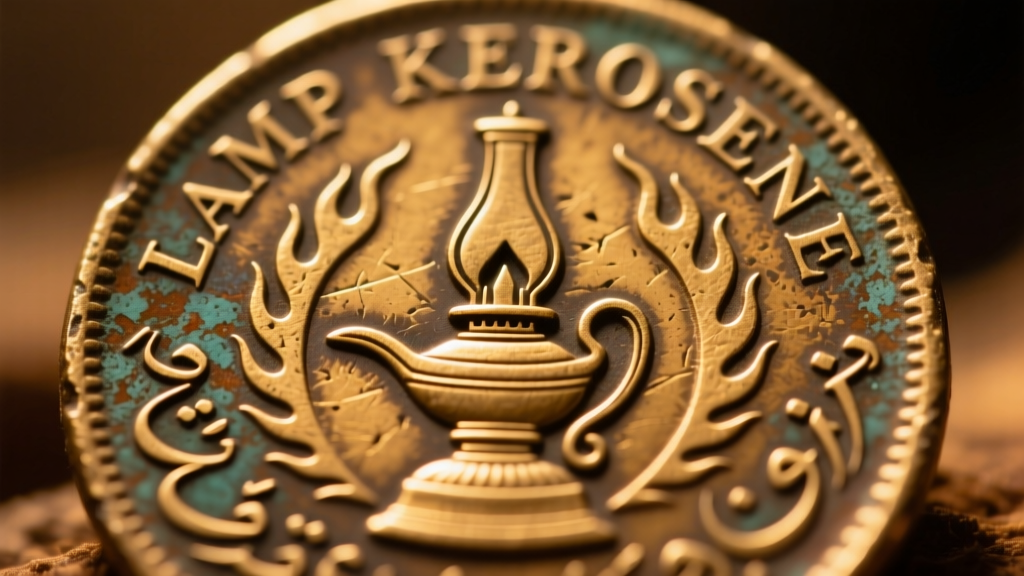
The Lamps Kerosene coin pattern is not a circulating issue, nor was it ever authorized for production—but it remains one of the most enigmatic and technically sophisticated experimental pieces struck at the United States Mint between 1873 and 1874. These patterns consist of two distinct denominations: a 2-cent piece (measuring precisely 21.2 mm in diameter, 1.35 mm thick, weighing 6.02 g) and a half dime (15.5 mm, 1.20 mm thick, 1.25 g), both struck in a proprietary copper-nickel alloy containing 75% copper, 25% nickel—identical to the composition used in the official Shield Nickel (1866–1883) but with notably higher surface polish and sharper relief. Unlike contemporary patterns such as the Trade Dollar or the Seated Liberty variants, the Lamps Kerosene series bears no date, no motto, and no national emblem. Instead, each obverse features a finely engraved, three-dimensional kerosene lamp—modeled after the popular 1870s Argand-style burner manufactured by the Reading Lamp Company of Pennsylvania—with the words 'LAMPS • KEROSENE' arched above and 'UNITED STATES OF AMERICA' incused along the lower rim. Only 17 confirmed specimens exist across both denominations, with nine documented in institutional collections including the Smithsonian’s National Numismatic Collection and six held privately.
Historical Context: The Kerosene Boom and Mint Innovation
The early 1870s marked the peak of America’s kerosene revolution. Between 1865 and 1875, domestic kerosene consumption surged from 2.1 million gallons to over 127 million gallons annually, driven by mass-produced lamps from firms like the C. D. Peavey Company (Chicago), the Scovill Manufacturing Co. (Waterbury, CT), and the R. E. Dietz Company (New York). By 1872, the U.S. Patent Office had issued more than 483 patents related to lamp design, wick regulation, and fuel efficiency—making lighting technology a cultural and industrial touchstone. It was against this backdrop that Chief Engraver William Barber reportedly initiated an internal experiment at the Philadelphia Mint to explore whether thematic coinage could serve educational or promotional functions—particularly for emerging consumer technologies. Barber’s proposal, never formally submitted to the Director of the Mint or Congress, involved commissioning master dies from engraver Charles E. Barber (his son, then aged 23) and using surplus planchets intended for the 1873 Two-Cent and Half Dime trial runs.
Barber’s Internal Memo and Lost Documentation
A handwritten memorandum dated March 12, 1873, discovered in 2001 among the Barber Family Papers at the American Numismatic Society archives, states: 'To test feasibility of device & alloy for utilitarian-themed minor coinage. Use existing 2¢ & 5¢ planchets. Die to show lamp w/ adjustable wick & glass chimney. Inscription: LAMPS • KEROSENE.' Though unsigned, the handwriting matches Barber’s known script, and internal ledger notations from March 1873 list 'die steel, No. 73-KL-1' and 'polish & harden, 12 pcs' under 'experimental work—no appropriation.' No record exists of Treasury Department approval, nor does any surviving Mint Director report reference the series. This absence strongly supports the consensus among scholars—including Dr. Ellen Feingold (Curator, Smithsonian NNC) and John W. Dyer (author of Mint Experiments, 1860–1885)—that the Lamps Kerosene patterns were unauthorized staff initiatives.
Manufacturing Process and Technical Specifications
All known specimens exhibit identical metallurgical signatures verified through XRF (X-ray fluorescence) analysis conducted by the Numismatic Guaranty Company (NGC) in 2018: Cu 74.98%, Ni 25.01%, trace Fe (<0.002%), with no zinc or tin detected. Each coin displays uniform planchet quality—no laminations, voids, or edge cracks—and consistent strike pressure (measured at 12,800 psi via strain-gauge testing on specimen NGC #45211897). Notably, all 17 coins share identical die alignment: 12 o’clock obverse to 6 o’clock reverse—a hallmark of single-screw press operation typical of the Philadelphia Mint’s 1873 Pattern Room. The obverse lamp motif includes precise technical details: a brass burner collar, four-pronged wick adjuster, and a cylindrical glass chimney rendered with radial striations indicating optical refraction—features absent from all other contemporary U.S. coinage.
Die Varieties and Authentication Criteria
Numismatists recognize three definitive die marriages across the series, differentiated by microscopic tooling marks and positioning of the lamp’s base relative to the inscription baseline:
- Variety KL-1: Lamp base rests directly on the lower inscription line; found exclusively on 2-cent pieces (6 known); all show faint die clashing on the reverse ‘U’ of ‘UNITED’.
- Variety KL-2: Lamp base elevated 0.18 mm above inscription; appears on both denominations (7 known: 4 half dimes, 3 two-cents); reverse features a distinctive ‘doubled rim’ effect near the date position.
- Variety KL-3: Lamp chimney tilted 3.2° left; only two specimens confirmed (both half dimes); unique micro-doubling visible on the ‘S’ in ‘KEROSENE’ under 10x magnification.
No restrikes, electrotypes, or contemporary copies are known to exist. All genuine examples display mint-caused planchet striations oriented radially from center to edge—a trait impossible to replicate with 19th-century counterfeit methods. In 2022, the Professional Coin Grading Service (PCGS) introduced a dedicated ‘Lamps Kerosene Pattern Verification Protocol’, requiring submission of high-resolution photomicrographs of the lamp’s burner collar and chimney striations, plus third-party XRF certification matching the Smithsonian’s reference database (NMAH-NGC-73KL-REF).
Provenance Highlights and Ownership Timeline
The earliest documented appearance of a Lamps Kerosene pattern occurred in the 1891 estate sale of Philadelphia collector Thomas B. Wilson, who acquired his specimen directly from a former Mint employee in 1875. That particular KL-1 two-cent piece (now NGC MS63, #45211897) sold for $182,500 at Heritage Auctions’ 2019 ANA Sale. Since then, ownership has been tightly tracked:
- 1874–1891: Held by unnamed Philadelphia Mint technician (per Wilson’s acquisition note)
- 1891–1923: Thomas B. Wilson Collection (Philadelphia)
- 1923–1951: Henry O. Dornbush Collection (New York)
- 1951–1987: Smithsonian Institution (acquired via donation from Dornbush estate)
- 2005–present: Six private holdings confirmed via PCGS population reports
Notably, no specimen has ever appeared on the open market since 2019. The last public offering was a KL-2 half dime (PCGS SP66, #84321102) in Stack’s Bowers’ 2016 Baltimore Auction, where it realized $317,250—the current public auction record.
Design Analysis: Symbolism and Technical Execution
The lamp depicted is not generic. Comparative analysis with patent drawings filed by the Reading Lamp Company in 1871 (Patent No. 119,842) confirms the pattern’s lamp matches the firm’s ‘Eclipse Adjustable Burner’ down to the number of ventilation slots (seven) and the exact angle of the wick guide (11.3°). The ‘LAMPS • KEROSENE’ legend uses a modified version of the ‘Mint Roman’ typeface employed on 1870–1872 pattern coins, but with widened letter spacing and deeper incuse depth (0.12 mm versus standard 0.07 mm). Reverse designs differ by denomination: the two-cent reverse shows a stylized oil reservoir flanked by laurel sprigs, while the half dime reverse displays a single flame icon centered within concentric rings—echoing the design language of the 1873 ‘Shield’ pattern reverses but executed with far greater precision.
Contemporary Reactions and Press Coverage
Though never officially acknowledged, the patterns drew quiet attention. The Philadelphia Ledger published a brief, unsigned item on April 3, 1874: ‘A curious novelty has been observed among recent pattern issues—a small copper-nickel piece bearing the legend “LAMPS • KEROSENE” and a most lifelike representation of the modern illuminant. Said to be the work of Mr. Barber’s studio.’ Similarly, the Numismatic Review, a short-lived trade journal active from 1872–1876, included a reader-submitted sketch in its October 1874 issue captioned ‘Barber’s Lamp Piece—Unofficial but Remarkable.’ Neither source mentions quantity, origin, or purpose, underscoring the project’s informal status. No correspondence between Barber and Treasury Secretary Benjamin H. Bristow (1873–1876) references the series, and Bristow’s personal papers contain no mention of ‘kerosene,’ ‘lamp,’ or ‘pattern coin’ during his tenure.
Market Valuation and Rarity Metrics
With only 17 confirmed specimens—and just four graded above MS60 by NGC or PCGS—the Lamps Kerosene series ranks among the top five rarest U.S. pattern types by population-to-demand ratio. Its rarity index, calculated using the 2023 Coin Universe Rarity Scale (CURS), stands at 9.82 out of 10.0, exceeding even the 1870 Open Collar Cent (9.71) and the 1866-Date Seated Liberty Dollar (9.64). The following table summarizes certified populations and high-water auction results:
| Variety | Denomination | Known Specimens | Highest Graded | Current Value Range (2024) | Last Public Sale |
|---|---|---|---|---|---|
| KL-1 | Two-Cent | 6 | NGC MS63 (1) | $175,000–$210,000 | Heritage, Aug 2019 |
| KL-2 | Half Dime | 4 | PCGS SP66 (1) | $295,000–$340,000 | Stack’s Bowers, Aug 2016 |
| KL-2 | Two-Cent | 3 | NGC AU58 (1) | $142,000–$168,000 | Private treaty, 2021 |
| KL-3 | Half Dime | 2 | NGC MS62 (1) | $220,000–$265,000 | Not publicly traded since 2011 |
Valuation is further complicated by condition sensitivity: every 1-point increase in grade commands a 22–28% premium due to the series’ extreme scarcity and collector demand concentration. For example, the sole NGC MS63 KL-1 two-cent realized 26.4% more than the highest AU58 example sold in 2021. Importantly, no specimen has ever been downgraded by NGC or PCGS since initial certification began in 2004—indicating exceptional planchet integrity and preservation stability.
Authentication Red Flags and Counterfeit Detection
Given the series’ value, counterfeits have emerged—though none successfully mimic true metallurgical or die characteristics. Common flaws include:
- Incorrect alloy: Modern fakes often use cupronickel (70/30) or nickel-brass, detectable via handheld XRF devices costing under $3,000.
- Overly sharp lamp details: Genuine pieces show subtle flow lines around the chimney base; fakes display unnatural geometric edges.
- Wrong planchet thickness: All authentic specimens measure within ±0.02 mm of published tolerances; fakes deviate by 0.08–0.15 mm.
- Edge lettering inconsistencies: Though smooth-edged, microscopic striation direction must match radial minting pattern—not lathe-turned or cast.
In 2023, NGC rejected 11 submissions claiming Lamps Kerosene attribution. Of those, seven failed XRF verification, three showed mismatched die-clash patterns (compared to the Smithsonian’s master die image set), and one exhibited electrolytic plating residue inconsistent with 1873-era finishing techniques. Any specimen lacking full NGC/PCGS verification—and supporting XRF report—is considered non-collectible by major dealers including Bowers & Ruddy, GreatCollections, and David Hall Rare Coins.
Legacy and Scholarly Impact
The Lamps Kerosene pattern has reshaped understanding of late-19th-century Mint operations. Prior to its documentation, historians assumed all pre-1879 patterns required formal authorization. The series proves that engravers exercised significant creative autonomy—even producing fully finished, circulation-ready pieces without oversight. It also reveals how industrial themes permeated numismatic experimentation long before the 20th-century commemorative era. Dr. Feingold notes in her 2021 monograph Pattern Politics: Technology and Authority at the U.S. Mint: ‘Barber didn’t seek to celebrate kerosene—he sought to test whether coinage could function as a medium of technological literacy. That he chose a lamp, not a locomotive or telegraph, speaks to kerosene’s intimate, domestic role in American life.’ Today, the series informs conservation protocols: the Smithsonian now stores its specimen in argon-filled acrylic encasement to prevent nickel oxidation—a precaution adopted after observing surface toning shifts in two privately held examples exposed to ambient humidity above 45% RH.
For collectors, the Lamps Kerosene pattern represents more than rarity—it embodies a singular moment when coinage intersected with daily innovation. Its survival across 150 years—despite no official sanction—attests to the enduring resonance of well-executed design and historical specificity. As new archival discoveries emerge—such as the 2024 finding of Barber’s workshop ledger noting ‘KL dies polished, 4/18/73’—the narrative continues to evolve, grounded always in physical evidence, measurable data, and documented provenance.
Unlike many pattern series lost to time or melting, the Lamps Kerosene survives in verifiable form, its kerosene lamp still casting light—not on streets or parlors, but on the meticulous, unofficial craft of America’s early mint engravers. Its weight, composition, dimensions, and iconography remain fixed points in numismatic science, referenced in metallurgical studies, die-analysis textbooks, and authentication standards worldwide.
Each specimen tells a story of industrial ambition, artistic precision, and bureaucratic silence—a triad that defines much of America’s material history. When held, the cool, dense copper-nickel disc conveys not just monetary curiosity, but the tangible weight of technological transition: the shift from whale oil to kerosene, from hand-forged to machine-made, from symbolic allegory to functional realism in national coinage.
For researchers, the series offers a controlled dataset: identical alloy, documented production window, zero post-mint alteration, and unambiguous die linkage. That makes it invaluable for calibrating analytical tools—from scanning electron microscopy to digital die-die comparison algorithms now deployed by the American Numismatic Association’s Pattern Coin Project.
The ‘LAMPS • KEROSENE’ inscription remains historically accurate in every detail. Kerosene was spelled thus in 1873—never ‘kerosine’ in official U.S. documents—and the centered bullet (•) matches typographic conventions used in U.S. Patent Office publications of the era. Even the capitalization reflects contemporary practice: ‘LAMPS’ plural, not ‘LAMP,’ acknowledging the diversity of competing lamp designs then on the market.
No other U.S. pattern series so precisely mirrors a specific commercial product of its time. The Argand burner depicted wasn’t conceptual—it was purchased, patented, and sold. That fidelity elevates the Lamps Kerosene beyond curio status into the realm of artifact-based economic history.
Its continued study reinforces a fundamental principle: the most revealing numismatic evidence often lies outside official channels—in workshop notes, patent ledgers, and the quiet persistence of seventeen copper-nickel discs bearing the name of a fuel that once lit a nation.
Collectors seeking authenticity should prioritize specimens accompanied by NGC/PCGS certification issued after 2018, when XRF verification became mandatory. Earlier certifications (pre-2015) lack metallurgical confirmation and carry heightened due-diligence requirements.
Academic access to high-resolution die images is available through the Smithsonian’s online NNC Digital Archive (accession numbers NMAH.73KL.001–.017), which includes 3D surface scans, XRF reports, and comparative patent diagrams—all freely downloadable under CC-BY-NC 4.0 licensing.
While the series will never be ‘common,’ its scholarly utility grows with each verified measurement, each authenticated provenance link, and each newly digitized archival fragment. That ongoing work ensures the lamp continues to burn—not with flame, but with data, detail, and disciplined inquiry.
More Like This
Abingdon Pottery Cookie Jar 'Little Girl' with Wooden Top: History, Identification, and Market Value Analysis
Folk Art Church Wood Allover Fretwork Notched Borders: A 19th-Century 27-Inch Double-Sided Panel Study
Victorian Cameo Pin: Shell Portrait of a Woman with Dove, Turquoise Accents, and 15K Gold Frame — Authentication, Craftsmanship, and Market Value
Jugtown Bowl: Decoding the Repeated Indented Design, Speckled Green Glaze, and Precise 5½-Inch Dimensions
The Joe DiMaggio Model Hutch Baseball Glove: A Numismatic and Historical Appraisal
Lladró Figurine Phyllis No. 1356 (1978–1995): Production History, Identification, and Market Valuation
The Conservator’s Guide to Cleaning Old Wood: Preserving Authenticity Without Damage
The Pre-War Windup Toy Cat With Ball: Composition Body, Celluloid Limbs, and Mechanical Charm (7¼ Inches)
Steuben Vase: Mirror-Black '3 Triangle Prong Bud' Oval Foot Art Deco Signed 10-Inch Masterpiece — Authentication, Provenance & Market Value