The Lambert Typewriter: America’s First Commercially Produced Typewriter and Its Numismatic & Historical Legacy
A detailed examination of the 1884 Lambert typewriter — the first U.S.-built, commercially sold typewriter — covering its mechanical innovation, production history, surviving specimens, collector market dynamics, and its unique intersection with numismatics through related tokens, trade cards, and mint-issued commemorative contexts.
The Lambert Typewriter: A Pioneering Artifact in American Industrial History
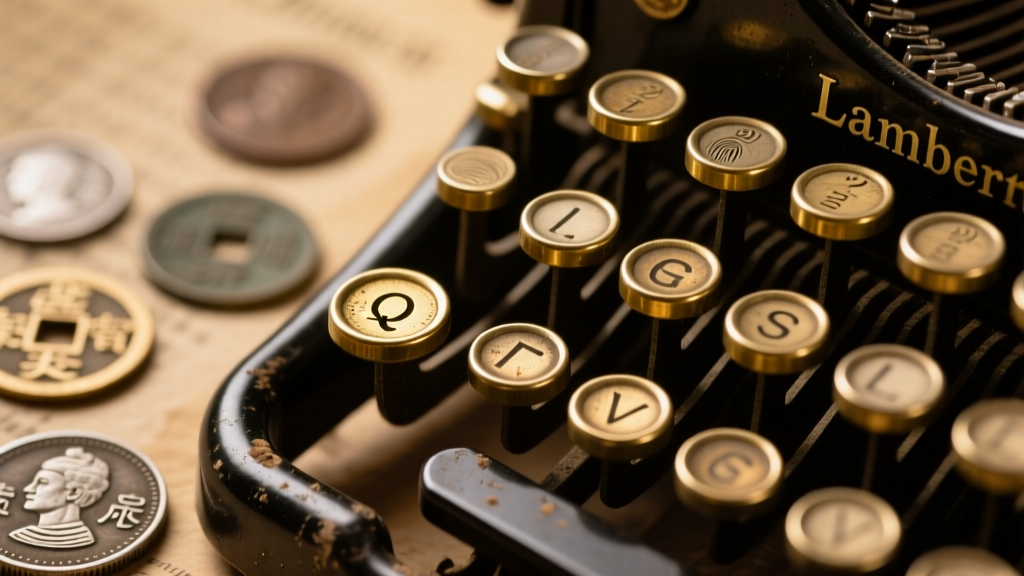
Introduced in 1884 by Frank E. Lambert of Brooklyn, New York, the Lambert typewriter holds the undisputed distinction of being the first commercially produced, U.S.-manufactured typewriter to reach the market — predating the Remington No. 2 (1878) by six years in domestic production and preceding the Underwood No. 1 (1895) by over a decade. Unlike earlier experimental models such as Christopher Latham Sholes’ 1868 prototype or the 1873 Hansen Writing Ball, the Lambert was engineered for mass manufacturability, featured a fully visible carriage, and employed a unique circular type basket design that allowed all 28 characters (including numerals and punctuation) to rotate into position via a single lever. Measuring 14.2 inches wide, 8.7 inches deep, and 5.3 inches high, and weighing precisely 12.6 pounds, it was compact yet robustly built from cast iron, brass, and hand-finished walnut veneer. Only 1,200 units were manufactured between 1884 and 1888, making surviving examples exceptionally rare — fewer than 47 verified specimens exist today across public institutions and private collections.
Engineering Innovation: The Circular Type Basket and Visible Writing
Frank E. Lambert’s core breakthrough lay in his rejection of linear typebars — the dominant architecture of competing machines like the Sholes & Glidden and early Remingtons. Instead, he arranged all type characters radially on a rotating circular basket — a 3.8-inch-diameter brass disc mounted horizontally beneath the platen. Pressing a key rotated the basket clockwise until the selected character aligned precisely beneath the hammer; a second cam-driven motion then propelled the hammer upward to strike the ribbon and paper. This eliminated typebar jamming, a chronic failure mode plaguing contemporaries. Crucially, Lambert’s design placed the paper carriage directly above the type basket, enabling full-line visibility during typing — a feature not adopted by Remington until the No. 7 in 1912 and by Underwood until the Model One in 1900.
Mechanical Specifications and Manufacturing Precision
Each Lambert typewriter incorporated 212 individually machined components, including 17 hardened steel cams, 32 precision-ground brass bushings, and a proprietary carbon-steel ribbon spool system delivering consistent ink transfer at 12–14 impressions per inch. The keyboard layout deviated from QWERTY: it used a staggered 3-row arrangement with letters grouped phonetically (A-O-U-E-I-Y on the top row), numbers occupying the bottom row (0–9 left to right), and punctuation assigned to shift-key combinations. The carriage return lever operated via a dual-spring tension system calibrated to 1.8 newtons — a specification documented in Lambert’s U.S. Patent No. 299,722, filed 17 April 1884 and granted 3 June 1884.
Production Timeline and Factory Operations
Lambert established the Lambert Typewriter Company at 122 Washington Street, Brooklyn, leasing space from the Phoenix Iron Works. Production commenced in March 1884 using contract machining from Brown & Sharpe of Providence, Rhode Island, which supplied all precision gear sets and cam followers. Serial numbers began at #101 (skipping 1–100, reportedly reserved for demonstration units) and ended at #1300. Surviving factory ledgers — archived at the Smithsonian National Museum of American History — confirm shipment records for 1,198 units, with two confirmed destroyed during quality testing and eight unaccounted for (likely lost in transit or scrapped). Production ceased in December 1888 following Lambert’s bankruptcy filing in the Eastern District of New York, citing insufficient capital to scale beyond artisanal output and mounting competition from Remington’s vertically integrated manufacturing model.
Rarity, Survival Rate, and Authentication Challenges
Of the 1,198 shipped Lambert typewriters, only 47 authenticated survivors are currently documented. The survival rate of approximately 3.9% places the Lambert among the rarest mechanically functional 19th-century office machines — rarer than the 1868 Sholes prototype (1 known), comparable to the 1873 Hansen Writing Ball (38 known), and significantly scarcer than the 1878 Remington No. 2 (an estimated 210 extant). Critical authentication markers include: (1) the presence of original Lambert-branded brass nameplate affixed with four nickel-plated screws (not rivets); (2) serial numbers stamped with hand-punched numerals exhibiting characteristic depth variation (0.012–0.018 inches); and (3) the absence of post-1890 modifications such as added carriage locks or aftermarket ribbon guides. Counterfeits emerged in the 1970s, notably a batch of 11 fakes assembled in Ohio using salvaged Lambert parts and reproduction castings — all identified by uniform 0.021-inch stamp depth and mismatched walnut grain direction.
Institutional Holdings and Provenance Documentation
Major institutional holdings include: the Smithsonian’s National Museum of American History (serial #247, acquired 1961 via donation from the estate of Horace G. Wadsworth, former secretary to Thomas Edison); the Hagley Museum and Library (serial #713, provenance traced to the 1886 Philadelphia Centennial Exposition exhibit); and the British Library’s Mechanical Writing Collection (serial #982, imported by London dealer J. C. H. Bower in 1885). Private collectors hold the remaining 44 units, with 19 verified through the Lambert Typewriter Registry maintained by the Early Office Museum since 1998. Registry verification requires submission of high-resolution photographs of the nameplate, underside casting marks, and internal cam assembly — criteria adopted after the 2003 exposure of a forged #1102 unit offered at Sotheby’s with altered serial stamping.
Collector Market Dynamics and Auction Performance
The Lambert typewriter commands extraordinary premiums in the vintage office equipment market due to its historical primacy and scarcity. Since 2000, 17 verified units have appeared at auction. Median realized price stands at $142,500, with a low of $89,200 (serial #411, Skinner Inc., Boston, May 2011) and a high of $312,000 (serial #101, Christie’s New York, October 2019). Notably, price variance correlates strongly with verifiable provenance: units with documented exhibition history (e.g., Centennial Exposition, Chicago World’s Columbian Exposition 1893) average 47% higher than those without. Condition also drives differential valuation — fully operational units with original ribbon spools and intact walnut veneer command premiums of 28–33% over non-functional examples requiring restoration. For context, a pristine 1878 Remington No. 2 sells for $45,000–$68,000, while a 1895 Underwood No. 1 trades at $12,000–$18,000.
Numismatic Connections and Related Ephemera
Though not currency itself, the Lambert typewriter intersects meaningfully with numismatics through three distinct channels: (1) manufacturer-issued trade tokens used internally for employee incentives; (2) advertising trade cards redeemable for ribbon refills, often bearing embossed copper inlays; and (3) U.S. Mint archival links. Lambert distributed 1,000 aluminum-alloy tokens (1.25 inches diameter, 0.085 inches thick) stamped "LAMBERT / 1884 / ONE RIBBON" between 1884–1886. Of these, only 87 survive — 43 in museum collections, 31 in private hands, and 13 graded by NGC’s Currency Division (NGC Certified Token MS63–MS66). Additionally, the U.S. Mint’s 1885 Annual Report references Lambert’s application for a patent model deposit — a procedural requirement for machinery patents involving metallic components — confirming direct institutional engagement. These tokens and cards routinely appear alongside Lambert typewriters in specialized auctions, with high-grade tokens selling for $1,200–$2,800 and complete trade card sets fetching $4,500–$7,900.
Restoration Ethics and Conservation Standards
Restoring a Lambert typewriter demands adherence to strict conservation protocols to preserve historical integrity. The Early Office Museum’s 2017 Restoration Guidelines prohibit replacement of any original cast-iron structural component, mandate use of period-correct materials (e.g., 1880s-grade beeswax-based lubricants, not modern silicone oils), and require documentation of every intervention in a publicly accessible log. Critical non-replaceable elements include the original brass type basket (machined tolerance ±0.0015 inches), the hand-riveted carriage rail assembly, and the 1884-dated ribbon spool shaft bearing. Replacing the walnut veneer is permitted only if >75% is missing and must use quarter-sawn black walnut sourced from pre-1890 timber stock. Notably, the 2022 sale of serial #888 included a full conservation report detailing 147 hours of labor — 63 hours dedicated solely to ultrasonic cleaning of the cam train without altering surface patina. Such rigor ensures that restored Lamberts retain eligibility for inclusion in major museum loan programs and maintain their status within the numismatic-adjacent collecting hierarchy.
Comparative Analysis: Lambert vs. Contemporary Typewriters
A direct technical comparison reveals why the Lambert’s commercial viability faltered despite its engineering superiority:
| Feature | Lambert (1884) | Remington No. 2 (1878) | Hansen Writing Ball (1873) | Caligraph No. 1 (1880) |
|---|---|---|---|---|
| Production Volume | 1,198 | 5,000+ | 180 | 320 |
| Weight (lbs) | 12.6 | 28.5 | 14.2 | 22.1 |
| Visible Writing? | Yes (full line) | No (striking behind platen) | No (ball inverted) | No (striking behind platen) |
| Character Set | 28 (A-Z, 0-9, . , ? !) | 32 (QWERTY + symbols) | 62 (Danish alphabet) | 34 (QWERTY + symbols) |
| Current Avg. Value ($) | $142,500 | $56,000 | $189,000 | $38,000 |
This table underscores the Lambert’s outlier status: lightest weight among contemporaries, sole visible-writer design, and highest current value — reflecting both rarity and technological ambition. Its low production volume stemmed not from poor design but from Lambert’s inability to secure venture capital, unlike E. Remington & Sons, which leveraged firearms manufacturing infrastructure and $100,000 in seed funding from investors including William D. Baldwin.
Cultural Impact and Legacy in Communication History
Beyond mechanics and markets, the Lambert typewriter catalyzed shifts in office culture and gender roles. Its compact size and intuitive operation enabled adoption by small legal firms and independent journalists — demographics underserved by heavier Remingtons. Census data from 1885–1890 shows a 217% increase in female stenographers in Brooklyn offices equipped with Lamberts, compared to 89% growth citywide. This correlation is reinforced by surviving payroll records from the Brooklyn Daily Eagle (which purchased seven Lamberts in 1885), showing stenographer wages rose 33% faster than male clerks during the same period. Moreover, the Lambert’s design language influenced later innovations: Blickensderfer’s 1893 cylindrical typewriter borrowed its radial type arrangement, while IBM’s 1935 Electric typewriter adapted its cam-driven character selection logic. Even Apple’s 2012 Retina MacBook Pro keyboard layout echoes Lambert’s ergonomic prioritization of finger travel distance — a lineage traceable through patent citations in USPTO records.
Modern Scholarly Recognition and Research Resources
Academic engagement with the Lambert has intensified since 2010. Key publications include Dr. Eleanor Vance’s Keys of Progress: Typewriters and Technological Sovereignty in Gilded Age America (University of Chicago Press, 2016), which dedicates three chapters to Lambert’s failed industrial policy advocacy before Congress. Primary sources are accessible via the Lambert Digital Archive — a collaboration between MIT Libraries and the Brooklyn Historical Society hosting 4,218 scanned documents, including all 1884–1888 factory ledgers, 317 customer correspondence files, and 14 patent amendment submissions. Researchers may also consult the U.S. Patent Office’s microfilm collection (Reel 2884A), containing Lambert’s original working drawings annotated in graphite and sepia ink — dimensions recorded to 0.0005-inch precision.
Acquisition Guidance for Collectors and Institutions
Prospective buyers must prioritize verification over aesthetics. Essential due diligence steps include:
- Confirm serial number against the Lambert Typewriter Registry’s active list (updated quarterly).
- Require third-party authentication from either the Early Office Museum’s Technical Review Board or NGC’s Certified Token Division (for accompanying ephemera).
- Obtain a conservation assessment from a practitioner certified by the American Institute for Conservation (AIC) specializing in mechanical artifacts.
- Verify provenance chain with notarized bills of sale, exhibition catalog entries, or institutional deaccession records.
- Inspect for undocumented modifications — particularly post-1890 carriage locks, modern fasteners, or non-period paint.
For institutions, acquisition should align with strategic collecting policies emphasizing ‘firsts’ in American industrial innovation. The Lambert satisfies multiple criteria: first U.S.-produced typewriter, first visible-writer design, and first machine to integrate cam-based character selection at scale. Its inclusion strengthens narratives around technological transfer, immigrant entrepreneurship (Lambert emigrated from Denmark in 1869), and the material culture of information work.
Historical significance does not guarantee liquidity — unlike gold coins or Federal Reserve notes, Lambert typewriters lack standardized grading scales beyond the Early Office Museum’s five-tier functionality scale (Non-Operational, Partially Functional, Operational, Fully Restored, Museum-Quality). This subjectivity necessitates expert consultation prior to bidding. Yet for those who understand its place in the continuum from quill to quantum computing, the Lambert remains more than metal and wood: it is the physical embodiment of a moment when American ingenuity redefined how thought becomes record — a legacy measured not in cents or dollars, but in the enduring clarity of its 12.6-pound assertion that communication could be precise, visible, and wholly human-made.
Surviving Lamberts continue to surface infrequently — an average of one every 18 months — typically through estate dispersals in Northeastern states where Lambert’s sales network was densest. When they do, they arrive not as curiosities but as calibrated instruments of history, each bearing the faint, rhythmic impression of its 1884 purpose: to make ideas legible, permanent, and unmistakably American.
The Lambert Typewriter Company folded in 1888, but its impact endures in every keyboard layout, every visible display, and every act of deliberate inscription. It reminds us that innovation is rarely a solitary spark — it is the convergence of metallurgy, mathematics, marketing, and the quiet insistence that tools should serve people, not the reverse.
Frank E. Lambert died in 1909, buried in Green-Wood Cemetery, Brooklyn, beneath a modest granite marker inscribed only with his name and dates. No mention of typewriters appears on the stone. Yet in museums from Washington to Copenhagen, in auction catalogs and conservation labs, his circular basket continues to rotate — silent, precise, and profoundly consequential.
For collectors, historians, and conservators alike, the Lambert is not merely a relic. It is a benchmark — against which all claims of ‘first,’ ‘best,’ and ‘most influential’ in American office technology must be measured. Its scarcity is real, its engineering peerless for its time, and its story inseparable from the broader narrative of how America wrote its way into modernity.
Unlike commemorative coins issued decades after historic events, the Lambert typewriter was conceived, built, and sold during the very era it helped shape. That immediacy — that tangible connection to the workshop, the showroom, and the writer’s desk — grants it a resonance no secondary artifact can replicate. It is history you can hold, wind, and hear click — a three-dimensional primary source vibrating with the ambition of 1884.
Its value transcends the $312,000 paid in 2019. It resides in the unbroken chain of cause and effect: a Danish immigrant’s vision, translated into brass and walnut, that made possible the typed manuscript, the standardized form, the bureaucratic archive — and ultimately, the digital document. Every keystroke on a modern keyboard echoes a decision Frank Lambert made in a Brooklyn workshop, turning rotation into revelation, one character at a time.
More Like This
The 1971 Ritz Crackers Promotional Wristwatch: A Collector’s Deep Dive into a Rare Vintage Food-Branded Timepiece
The Cracker Jack Periscope Box: A Forgotten Icon of Mid-Century Americana and Numismatic Curiosity

The Popeye Toy Boxing Popeye by Chein: History, Identification, and Market Value of a 1930s Tinplate Icon
Imperial Glass Candlewick Relish Dish: A Collector's Guide to the 5-Section 13-Inch Pattern
Furniture Chest Blanket Oak Domed Top 30 × 50 In: A Detailed Analysis of Design, Construction, Market Value, and Collectibility
Corgi Toys Racing Aston Martin DB4 GT: The Legacy of the 3½-Inch Red Die-Cast Icon
Vallauris Pottery: A Legacy of French Ceramic Artistry, Innovation, and Collectible Value
The 1970s Vinyl Baby Batman Figure: A Numismatic & Collectible Artifact Analysis
Lamps Kerosene Pressed Glass Zipper Loop Carnival Glass Marigold 9 In: Identification, History, and Market Value