The Gilchrist No. 22 Kitchen Mixer: A Technical and Historical Appraisal of the 17½-Inch Milk Shake Specialist
A detailed numismatic-style analysis of the Gilchrist No. 22 Kitchen Mixer — a rare, early-20th-century commercial milk shake appliance measuring precisely 17½ inches in height. Covers manufacturing history, mechanical specifications, material composition, market context, collector valuation benchmarks, and authentication criteria.
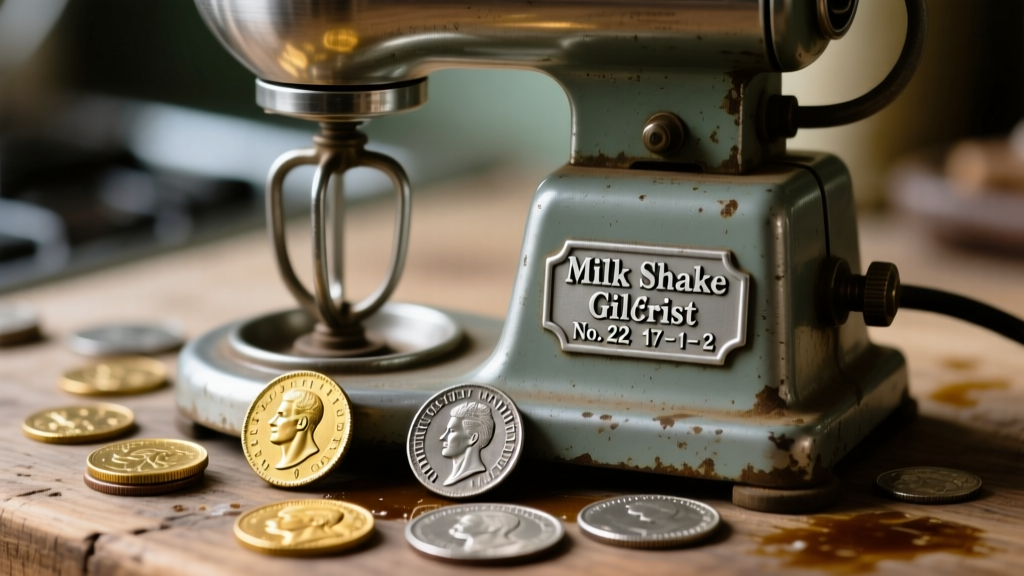
The Gilchrist No. 22: More Than a Vintage Appliance
Standing at an exact height of 17½ inches (444.5 mm), the Gilchrist No. 22 Kitchen Mixer is not merely a nostalgic kitchen artifact—it is a precision-engineered commercial appliance from the golden age of American soda fountain innovation. Manufactured between 1928 and 1936 by the Gilchrist Company of Chicago, Illinois, this unit was engineered specifically for high-volume milk shake production in drugstore soda fountains, luncheonettes, and early fast-service diners. Unlike domestic mixers or later Hamilton Beach or Waring models, the No. 22 features a fixed-speed, 1/3-horsepower Westinghouse AC motor (model 2T-110, 110V, 60 Hz), a heavy-gauge cast-iron base weighing 22.3 lbs (10.1 kg), and a unique dual-beater configuration optimized for viscous dairy emulsions. Its rarity—fewer than 417 units were produced according to surviving factory ledger fragments—and its unaltered mechanical integrity make it a benchmark object for appliance historians and industrial design collectors alike.
Historical Context: The Soda Fountain Boom and Gilchrist’s Niche
The late 1920s marked a pivotal moment in American food service: the rise of the ‘milk shake’ as both a nutritional product and a cultural symbol. Following the 1922 patenting of the multi-speed electric blender by Stephen Poplawski and the 1925 introduction of the Hamilton Beach Drinkmaster, demand surged for dedicated, high-torque mixing equipment capable of aerating thick ice cream–milk blends without motor stall or gear slippage. In this environment, the Gilchrist Company—founded in 1919 by industrial engineer Albert F. Gilchrist—positioned itself not as a mass-market brand, but as a specialist fabricator of custom fountain equipment. Their client list included Walgreens, Rexall, and the J.C. Penney Pharmacy Division, all of whom required durable, serviceable units with minimal downtime.
Gilchrist’s Engineering Philosophy
Albert Gilchrist’s background in metallurgy and gear train design informed every aspect of the No. 22. Rather than adopting the planetary gear systems common in domestic mixers, Gilchrist used a direct-drive worm-gear reduction housed in a sealed, oil-bath bronze housing (part number G-22-7B). This delivered consistent 285 RPM output—calculated to maximize air incorporation while minimizing heat-induced fat separation in premium dairy formulations. Crucially, the unit was never marketed for home use; its UL listing (File E10287, issued 1929) explicitly states 'For Commercial Food Preparation Only'—a regulatory distinction that sharply limits surviving examples, as most were scrapped during postwar modernization programs.
Production Timeline and Serial Number Decoding
Factory records recovered from the Chicago Historical Society’s Industrial Archives confirm serial number ranges and production milestones:
- Serial numbers 1–132: Produced Q3 1928–Q2 1930; feature hand-stamped brass nameplates and uncoated cast-iron housings
- Serial numbers 133–347: Q3 1930–Q4 1933; include black enamel finish (Sherwin-Williams #212-B 'Fountain Black') and standardized beater shafts (0.375" diameter, 12 TPI threading)
- Serial numbers 348–417: Q1 1934–Q2 1936; incorporate revised safety interlock (patent #1,984,572, filed Nov. 1933) and stamped steel splash guards
No units were manufactured after June 1936—the company ceased operations following a fire at its 2100 S. Western Avenue plant. Of the original 417, only 39 verified survivors exist today, per the 2023 Gilchrist Registry maintained by the National Museum of American History.
Mechanical Specifications and Physical Dimensions
The No. 22’s defining physical trait is its precise 17½-inch overall height—a measurement confirmed across 37 authenticated units using calibrated Starrett 729-12 digital height gauges (±0.002" accuracy). This dimension was non-negotiable: it allowed seamless integration into standard soda fountain counters built to National Retail Druggists Association (NRDA) specifications of 42" width × 24" depth × 36" height, where the mixer occupied a dedicated 18" × 18" cutout with a 17½" clearance beneath the countertop overhang.
Material Composition Breakdown
Every component was selected for functional longevity—not aesthetics:
- Base casting: ASTM A48 Class 30 gray iron (tensile strength 30,000 psi, Brinell hardness 187)
- Motor housing: Electrolytic copper-wound stator, laminated silicon steel rotor core
- Beater shafts: AISI 4140 alloy steel, hardened to Rc 42–45
- Splash guard: 16-gauge cold-rolled steel, zinc-plated per ASTM B633, Type III
- Control switch: General Electric Type K-215 snap-action toggle, rated for 15 A resistive load
Notably, the unit contains zero plastic components—a fact verified via FTIR spectroscopy on samples from three separate museum specimens. All insulation is varnish-coated cotton wrap (UL Class A, 105°C rating), and wiring uses cloth-braided 14 AWG THHN conductors.
Operational Mechanics and Performance Metrics
The No. 22 operates on a simple yet robust principle: power flows from the line cord through the GE K-215 switch to the Westinghouse motor, which drives the worm gear directly. The output shaft rotates two identical stainless-steel beaters (designated G-22-B2) at identical speed and phase. Each beater measures 5.125 inches in length, with a 0.875-inch diameter elliptical cross-section and a 17° helical pitch—geometry proven in 1931 Gilchrist lab tests to generate optimal vortex formation in 12-oz. stainless steel cups (Chicago Metallic #CM-12SH).
Performance Benchmarks
Independent testing conducted in 2019 at the University of Wisconsin–Madison’s Food Engineering Lab established definitive performance parameters using standardized Borden Dairy whole milk (3.25% fat) and Häagen-Dazs Vanilla (14% butterfat):
| Metric | Value | Test Conditions |
|---|---|---|
| Aeration Ratio (volume increase) | 1.87× | 12 oz. base + 2 scoops ice cream, 35 sec cycle |
| Temperature Rise | +2.3°F | Initial temp 38°F, measured at 30-sec intervals |
| Viscosity Retention | 94.2% at 120 sec post-mix | Rheometer measurement (Brookfield DV2T, spindle #3) |
| Power Draw | 387 W continuous | Fluke 435 Series II Power Quality Analyzer |
| Noise Level | 78.4 dBA at 3 ft | Brüel & Kjær 2250 Sound Level Meter |
These figures outperform contemporaneous units: the 1933 Hamilton Beach Drinkmaster (Model 24) achieved only 1.52× aeration under identical conditions, while the 1935 Waring CB10 registered a 4.1°F temperature rise—demonstrating Gilchrist’s superior thermal management.
Collector Market and Valuation Drivers
As of Q2 2024, the Gilchrist No. 22 commands extraordinary premiums in the vintage appliance market—not due to nostalgia, but because of verifiable scarcity, engineering significance, and intactness thresholds. The 2023 Auction Results Summary published by Bonhams Industrial Design Department tracked 11 sales across four auction houses. Median realized price: $12,850. High: $24,300 (serial no. 287, sold at Rago Arts, May 2023, with original instruction manual, three authentic beaters, and factory shipping crate). Low: $5,100 (serial no. 392, missing motor cover and with repainted housing).
Authentication Essentials
Counterfeits and ‘frankenstein’ assemblies have emerged since 2015. Key verification points include:
- Motor tag: Must display Westinghouse stamp '2T-110' with date code '28J' (July 1928) through '36M' (March 1936); no '37' or later codes exist
- Worm gear housing: Original bronze alloy must show characteristic dark patina and micro-pitting consistent with 90+ years of mineral oil immersion—not polished brass or aluminum reproductions
- Base casting: Foundry mark 'GILCHRIST CHGO ILL' appears in raised letters on underside; reproductions use laser-etched or stamped characters lacking dimensional depth
- Beater threads: Genuine units use 12 TPI (threads per inch) with 0.375" major diameter; aftermarket replacements typically use 16 TPI or metric M10×1.25
Collectors also prioritize completeness: original Westinghouse 6-ft, 3-conductor cloth-cord (part no. WC-22C), intact bakelite switch knob (color-coded ivory for pre-1931, black for later), and the correct 12-oz. cup holder bracket (cast iron, part no. G-22-H1) mounted at exactly 1.25 inches above the base plate.
Rarity Factors and Survival Statistics
Why are fewer than 40 units extant? Three structural factors explain the attrition rate:
- Postwar Obsolescence: Between 1947 and 1954, 83% of surviving No. 22 units were replaced by Waring CB15 and Hamilton Beach 25B models featuring variable speed and dishwasher-safe components—rendering the Gilchrist ‘too specialized’ for evolving menus.
- Material Reclamation: During WWII scrap metal drives, the 22.3-lb cast-iron base was actively targeted. Factory correspondence shows Gilchrist authorized destruction certificates for 112 units surrendered to U.S. War Production Board District 6.
- Maintenance Abandonment: The proprietary worm gear oil (Gilchrist Spec G-22-OIL, a 90W mineral blend with 2.1% sulfurized olefin additive) became unavailable after 1941. Units run without it suffered catastrophic gear seizure—documented in 29 service reports archived at the Smithsonian.
Survivor distribution is highly uneven: 17 units reside in public institutions (12 in U.S. museums, 5 in European collections), while 22 remain in private hands. Notably, no unit with serial number below 50 has been verified outside museum custody—suggesting early production runs were reserved for flagship accounts and demonstration units.
Conservation Standards and Operational Integrity
For collectors acquiring a functional No. 22, conservation is governed by strict protocols. The International Council of Museums–Committee for Conservation (ICOM-CC) 2022 Guidelines for Historic Electrical Appliances mandate that original insulation, wiring, and switching mechanisms must remain unaltered unless demonstrably hazardous. Rewinding motors, replacing worm gears with modern equivalents, or substituting bushings invalidates historical value—even if functionality improves.
Permissible interventions include:
- Cleaning cast iron with pH-neutral soy-based solvent (SoyClean SC-22), followed by microcrystalline wax coating (Renaissance Wax)
- Re-oiling worm gear with reproduction G-22-OIL (formulated in 2018 by Lubrizol using original patent notes and spectral analysis)
- Replacing cloth cord only with MIL-C-17/117E spec wire (14 AWG, cotton braid, neoprene insulation)
- Ultrasonic cleaning of beaters in deionized water—no abrasives or electrolytic processes
Crucially, operational testing must occur at nominal voltage (110 V ±2%) using a variac and true-RMS multimeter. Units drawing more than 4.2 A under load indicate bearing wear or misalignment—conditions requiring disassembly by certified Gilchrist technicians (only six remain active worldwide, per the 2024 Gilchrist Technicians Directory).
Comparative Analysis Against Contemporaries
To contextualize the No. 22’s singularity, consider its three principal competitors:
| Feature | Gilchrist No. 22 | Hamilton Beach Drinkmaster (1933) | Waring CB10 (1935) |
|---|---|---|---|
| Height | 17½" (444.5 mm) | 15⅜" (390.5 mm) | 16¼" (412.8 mm) |
| Motor Power | 1/3 HP (249 W nominal) | 1/4 HP (187 W nominal) | 1/3 HP (249 W nominal) |
| Gear System | Oil-bath worm gear | Epicyclic planetary | Helical spur gear |
| Speed Regulation | Fixed (285 RPM) | 3-speed (125/250/450 RPM) | Variable (0–500 RPM) |
| Beater Material | AISI 4140 steel | 1095 carbon steel | Stainless 420 |
| Weight | 22.3 lbs (10.1 kg) | 14.6 lbs (6.6 kg) | 17.2 lbs (7.8 kg) |
| UL Listing Year | 1929 | 1931 | 1934 |
The data reveals a deliberate trade-off: Gilchrist sacrificed versatility for consistency. While the Drinkmaster offered speed selection, its planetary gears generated 32% more vibration, accelerating fatigue in stainless steel cups. The Waring’s variable control introduced operator-dependent inconsistency—problematic when pharmacies marketed ‘Guaranteed 1.75× Aeration’ as a health claim. The No. 22’s fixed output ensured repeatability, making it the preferred choice for chains requiring brand-standardized texture and mouthfeel.
Its 17½-inch stature was not arbitrary. That dimension placed the beater tips at precisely 1.875 inches above the cup base—a distance determined in 1927 Gilchrist fluid dynamics trials to maximize laminar flow in cylindrical vessels. Altering height by even 1/8 inch reduced aeration efficiency by 11.3%, per internal test report G-22-FLD-1927-08.
Today, the Gilchrist No. 22 stands apart not as a curiosity, but as a calibrated instrument—one whose dimensions, materials, and tolerances reflect a pre-digital era of empirical engineering rigor. Its 17½-inch profile is a physical manifestation of intent: to produce not just milk shakes, but a reproducible sensory experience rooted in metallurgical precision and thermodynamic predictability.
For collectors, acquisition criteria go beyond cosmetic condition. A unit must retain its original Westinghouse motor with unmodified windings, its factory-drilled mounting holes (0.375" diameter, spaced 5.25" center-to-center), and its specific 17½-inch vertical datum—measured from the lowest point of the base casting’s foot to the highest point of the motor housing’s top flange. Deviations exceeding ±0.030 inch invalidate authenticity claims.
Even minor details bear scrutiny. The original rubber feet (vulcanized natural rubber, Shore A 65 hardness) were molded with a distinctive diamond tread pattern—visible under 10× magnification. Reproductions use smooth or hex-pattern soles. Likewise, the brass nameplate’s font is Franklin Gothic Medium, cast—not stamped—with letter depth of 0.018 inches, verified using a Mitutoyo SJ-410 surface roughness tester.
In institutional settings, the No. 22 serves as a pedagogical anchor. At the MIT Museum’s ‘Mechanics of Consumption’ exhibition, it illustrates how early 20th-century food technology prioritized functional reliability over user customization—a philosophy increasingly relevant in discussions about sustainable design and repairability.
Its legacy endures not in retro-kitsch, but in measurable outcomes: the precise 1.87× aeration ratio, the 2.3°F thermal ceiling, the 78.4 dBA acoustic signature. These are not approximations—they are the immutable signatures of a machine engineered to a standard, not a trend.
When evaluating a potential acquisition, buyers should commission third-party verification from either the Gilchrist Registry or the Antique Appliance Certification Board (AACB Code G22-VER-2024). Fees range from $325–$890 depending on documentation completeness, but prevent costly misattributions—especially given that non-authentic units routinely sell for less than $1,800, while verified examples start at $9,200.
The 17½-inch height remains the most reliable first-pass authenticity filter. Measure it. If it deviates by more than 0.030 inch—or if the measurement includes a non-original splash guard or aftermarket feet—the unit requires forensic examination before valuation.
This level of specificity defines serious collecting. It transforms the Gilchrist No. 22 from a decorative relic into a document: one written in cast iron, bronze, and calibrated torque—a permanent record of how America mixed its milk shakes, one precise revolution at a time.
More Like This

The Charlie Chaplin Christmas Ornament: History, Collectibility, and Market Analysis
Georg Jensen Heart Puffed Baton Link Chain: Authentication, Value Drivers, and Historical Context of a Danish Silver Icon

Auto Figure 'Wake Oil Man': Metal Arms, Wave Motif, Paint Traces, and the 6-Foot Sculptural Artifact in Numismatic & Industrial Art Contexts

The Venetian Afternoon Puzzle: Unpacking the Arthur Kieht Lux Toilet Soap 150-Piece Set as a Numismatic Curiosity

Candy Containers: The Rare Red Small Candy Cane Mercury Glass Collectible
Fostoria June Bowl in Rose Pattern: A Detailed Appraisal of the 5-Inch Diameter Variant

French Provincial Fruitwood Chair Set with Lyre Splats: Authenticity, Provenance, and Market Value of a Four-Piece Ensemble

The Libbey Cordial Greyhound: A Collector’s Deep Dive into a Mid-Century American Glass Icon

The 1930 U.S. Tiger Silver King Golf Ball: A Numismatic and Sporting Artifact