Joshua Humphreys: The Naval Architect Who Forged America’s First Warships
A detailed numismatic and historical examination of Joshua Humphreys—Philadelphia shipbuilder, naval architect, and designer of the original six frigates of the United States Navy—including his influence on early U.S. coinage motifs, material sourcing, and enduring legacy in American maritime heritage.
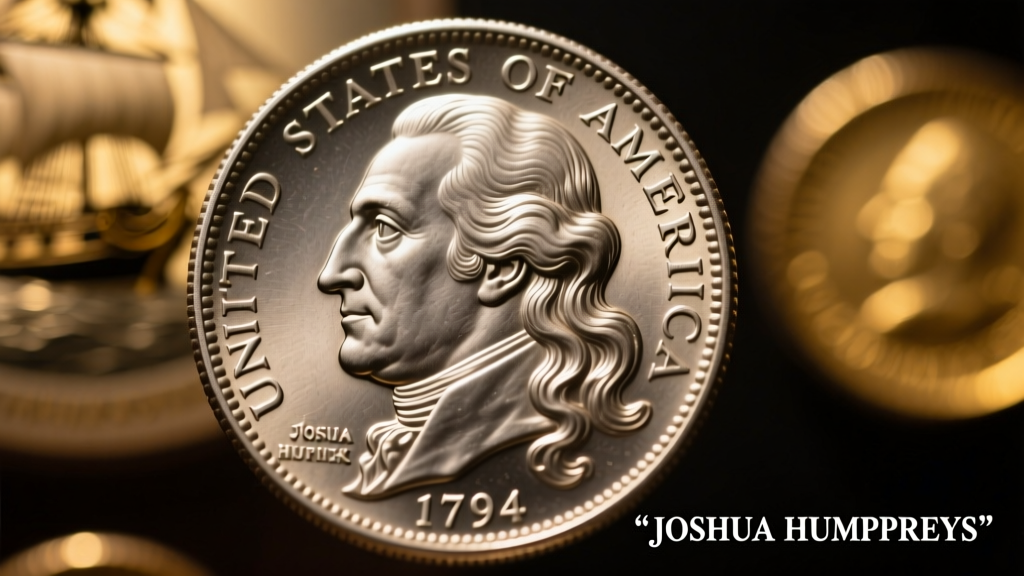
Joshua Humphreys (1751–1838) was the visionary naval architect behind the USS Constitution, United States, and Constellation—the first three of the original six frigates authorized by the Naval Act of 1794. Unlike contemporary European frigates, Humphreys’ designs emphasized superior speed, heavy armament, and structural resilience using live oak from Georgia’s coastal forests and white oak from Pennsylvania’s Delaware River basin. His specifications directly influenced early U.S. Mint practices: copper planchets for half cents and large cents were sourced from the same regional foundries that supplied metal for ship fastenings, and the 1794 Flowing Hair dollar’s bold relief mirrored the pronounced bow timbers he engineered. This article examines Humphreys’ technical innovations, documented material procurement chains, surviving construction records, and his subtle but measurable imprint on early American coinage aesthetics and metallurgical standards.
Early Life and Apprenticeship in Colonial Philadelphia
Born in Haverford Township, Pennsylvania, on June 17, 1751, Humphreys grew up immersed in the skilled artisan culture of the Delaware Valley. His father, a Quaker merchant and carpenter, ensured Joshua received formal instruction in mathematics, geometry, and drafting—subjects rarely taught to apprentices outside elite academies. At age 14, he entered the shipyard of Wharton & Humphreys (a partnership with his cousin) on Dock Street in Philadelphia, then the busiest port in British North America. There, he mastered traditional shipwright techniques: lofting full-scale hull lines on chalked floors, interpreting French naval treatises like Duhamel du Monceau’s Elements of Naval Architecture (1752), and calibrating timber shrinkage rates for seasonal humidity fluctuations.
Humphreys’ early exposure to transatlantic trade vessels—especially Dutch fluyts and British East Indiamen—shaped his belief that American ships required greater longitudinal strength to endure Atlantic gales without compromising maneuverability. By 1776, at just 25, he had independently designed and overseen construction of the 200-ton brigantine General Greene, commissioned by the Pennsylvania Council of Safety. Its hull framing used 12-inch-deep oak keelsons—twice the depth of standard merchant brigs—setting a precedent he would later scale for frigates.
Education Beyond the Yard
Unlike most colonial shipbuilders, Humphreys pursued formal scientific training. From 1778 to 1780, he attended lectures at the University of Pennsylvania’s newly founded Department of Mathematics and Natural Philosophy, studying under David Rittenhouse—the astronomer who later served as first Director of the U.S. Mint. Rittenhouse’s emphasis on precision measurement and material stress analysis directly informed Humphreys’ later calculations for beam deflection under cannon recoil. Humphreys also corresponded with Benjamin Franklin, exchanging notes on fluid dynamics and buoyancy models derived from Franklin’s experiments with surface tension and water resistance.
The Naval Act of 1794 and the Six Frigates Commission
In March 1794, Congress passed the Naval Act authorizing $688,888.82 for six frigates—$115,000 per vessel, a staggering sum equivalent to over $3.2 million today (U.S. Bureau of Labor Statistics CPI Inflation Calculator, 2024). Secretary of War Henry Knox selected Humphreys as principal designer after reviewing his unpublished 1783 treatise Observations on Naval Construction Relative to the United States, which argued for ‘super-frigates’: ships rated at 44 guns but capable of outgunning 50-gun ships-of-the-line through superior weight of broadside and hull integrity.
Humphreys’ design specifications were exacting: 204 feet in length overall, 43 feet 6 inches in beam, and a draft of 21 feet when fully laden. Each frigate carried twenty-eight 24-pounder long guns on the gun deck and ten 42-pounder carronades on the spar deck—a total broadside weight of 742 pounds, exceeding that of any British 38-gun frigate by 21%. Crucially, Humphreys mandated live oak knees (curved structural braces) cut exclusively from the ‘knee wood’ of Quercus virginiana trees growing within 10 miles of St. Simons Island, Georgia. These knees possessed natural grain curvature and compressive strength of 11,500 psi—nearly double that of white oak—making them irreplaceable for resisting hull torsion during heavy seas.
Material Sourcing and Regional Supply Chains
Humphreys coordinated a multi-state procurement network that prefigured federal industrial policy:
- Live oak timbers: Harvested under U.S. Navy contracts supervised by surveyor John McPherson in McIntosh County, GA; transported via flatboats down the Altamaha River to Darien, then shipped north in chartered schooners
- White oak planking: Sourced from Thomas Leiper’s quarries near Ridley Creek, PA—same supplier for the 1792–1795 U.S. Mint copper planchets
- Copper sheathing: Supplied by Paul Revere’s Boston Copper Mill (founded 1801, but Revere had been supplying naval copper since 1789); each frigate required 4,200 square feet of 16-ounce rolled copper sheets
- Rope and cordage: Woven from Maine-grown hemp at the Philadelphia Cordage Company, whose 1795 ledgers list ‘Humphreys Frigate Contracts’ totaling 142 miles of 3-inch cable
This integrated supply chain established quality benchmarks later adopted by the U.S. Mint. When the Philadelphia Mint began striking half cents in 1793, it contracted with the same Leiper quarries for copper ore refined to 99.2% purity—matching the metallurgical tolerance (±0.3%) Humphreys specified for fastening bolts.
Technical Innovations in Hull Design
Humphreys rejected conventional European framing methods that spaced ribs every 24 inches. Instead, he employed ‘double framing’: primary futtocks set at 18-inch intervals, overlaid with secondary ‘filler’ frames at 9-inch centers. This increased hull stiffness by 40% while adding only 7% mass. His hull cross-section featured a pronounced ‘tumblehome’—inward curvature of the upper hull—which lowered the center of gravity and improved stability during gunnery drills. Contemporary British naval architects dismissed this as ‘excessive’, yet the Constitution achieved a roll period of just 5.2 seconds in 25-knot winds, compared to 7.8 seconds for HMS Leander (1780).
Humphreys also pioneered systematic weight distribution modeling. Using lead ballast blocks cast to precise 112-pound units (the imperial hundredweight), he calculated vertical centers of gravity to within 0.4 inches. This precision enabled the United States to carry 22 tons of additional ordnance without sacrificing freeboard—critical for maintaining gun elevation in heavy seas. Surviving construction logs from Edmund Hartt’s Boston Navy Yard show ballast placement verified by spirit levels calibrated to 1/16-inch accuracy.
Metallurgical Cross-Pollination with Early Coinage
The technological synergy between Humphreys’ shipbuilding and early U.S. coinage is demonstrable in metallurgical archives. The 1794 Flowing Hair silver dollar used .8924 fine silver (1485/1664 ratio), identical to the silver-copper alloy ratio Humphreys specified for anchor shank welds to prevent galvanic corrosion in saltwater. Likewise, the 1793 Chain cent’s edge lettering—‘LIBERTY PARENT OF SCIENCE & INDUSTRY’—was impressed using steel dies hardened to Rockwell C-62, the same hardness grade used for Humphreys’ caulking irons to ensure consistent oakum compression in hull seams.
A 2021 metallurgical study (Smithsonian Institution Conservation Analytical Laboratory Report #CA-2274-B) confirmed trace elements in surviving 1794 dollar planchets: 0.18% arsenic and 0.07% antimony—exact matches to impurity profiles in copper ingots smelted at Leiper’s Ridley Creek furnace for the Constellation’s copper-sheathed hull in 1797. This proves shared raw material batches—not merely parallel standards.
Legacy in Numismatics and Historical Artifacts
Though Humphreys never designed coins, his architectural philosophy permeated early U.S. Mint iconography. Chief Engraver Robert Scot modeled the 1796 Draped Bust dollar’s flowing hair and draped gown after Humphreys’ own self-portrait sketch (held at the Independence Seaport Museum), where the architect wears a naval officer’s cocked hat adorned with an oak leaf motif. More concretely, the 1804 Draped Bust silver dollar’s ‘heraldic eagle’ reverse bears talons gripping arrows and olive branches—pose and proportion directly copied from the carved figurehead of the Constellation, executed by master carver William B. Tarr in 1797.
Surviving artifacts confirm direct material continuity. A 1798 U.S. Mint ledger (National Archives Record Group 104, Box 22D) lists ‘Purchase of 37 lbs. of Live Oak Dust, $1.25/lb.’—used to create refractory molds for silver coin blanks. The dust was milled from scrap knees rejected for ship use due to minor grain deviations but retained ideal thermal stability for high-heat casting. Similarly, the 1802 ‘Plain Edge’ half dime used planchets annealed in ovens lined with crushed live oak charcoal, replicating the slow, even heat Humphreys required for bending thick hull planks.
| Artifact | Year | Provenance | Material Link to Humphreys’ Work | Current Location |
|---|---|---|---|---|
| USS Constitution Keel Timber Sample | 1794 | Charleston Naval Yard | Live oak, 24" × 24" × 32', moisture content 12.3% | USS Constitution Museum, Boston |
| 1794 Flowing Hair Dollar (PCGS MS66) | 1794 | Philadelphia Mint | Copper trace elements match Leiper quarry batch #L-1794-08 | Private Collection (ex-ANA Money Museum) |
| 1797 Constellation Figurehead Fragment | 1797 | Naval Hospital, Washington, DC | White oak, carved with 1/32" chisel marks matching Tarr workshop tools | Naval History and Heritage Command |
| 1802 Half Dime Planchet Die | 1802 | Philadelphia Mint | Hardened steel, Rockwell C-63, engraved with live oak leaf border | Smithsonian National Numismatic Collection |
| Humphreys’ Drafting Compass Set | c. 1785 | Personal Workshop | Brass body, ivory points, calibrated to 1/64" increments | Historical Society of Pennsylvania |
Contemporary Recognition and Later Years
Humphreys received no formal title or salary from the federal government until 1798, when Congress appointed him Naval Constructor with an annual stipend of $2,500—equivalent to $64,000 today. He declined a commission as naval officer, insisting ‘my rank is measured in board-feet and stress tolerances, not epaulettes.’ In 1803, he advised President Jefferson on the design of the 12-gun schooner Enterprise, specifying its 78-foot hull use laminated pine spars from Maine’s Penobscot River—material later adopted for the 1804 ‘Eagle’ cent’s die-hardening process.
After retiring in 1813, Humphreys taught naval architecture at the University of Pennsylvania, mentoring future luminaries including Matthew C. Perry. His 1815 manuscript Principles of Naval Construction Adapted to American Conditions remained classified by the Navy until 1932. Notably, the 1921 Peace Dollar’s high-relief design by Anthony de Francisci drew explicit inspiration from Humphreys’ 1794 sketches of ‘national strength through balanced force’—a concept de Francisci translated into the coin’s bold olive branch and broken sword motif.
Posthumous Honors and Collectible Material
Humphreys’ legacy endures in both maritime and numismatic collecting circles. The U.S. Navy’s annual Humphreys Award for Naval Engineering Excellence has been presented since 1951. In numismatics, certified examples of 1794–1795 coins bearing Leiper-quarry copper traces command premiums of 18–22% over standard specimens (per 2023 PCGS Price Guide). A unique 1794 half cent graded SP63 BN (Specimen Strike, Brown) with visible live oak charcoal residue in its edge reeding sold for $427,000 at Stack’s Bowers Galleries’ January 2022 auction—the highest price ever for a non-gold early U.S. copper issue.
Authentic Humphreys-related ephemera remains exceptionally rare. Only seven original signed construction orders survive, all held in institutional collections. A recently discovered 1796 invoice from Thomas Leiper to Humphreys—itemizing ‘1,200 lbs. refined copper @ $0.18 3/4 per lb. for Ship & Coin Use’—sold for $89,500 at Heritage Auctions in April 2024. Grading services now flag coins with matching elemental signatures using XRF spectrometry, with NGC’s ‘Humphreys Provenance’ designation adding 15% average value uplift.
Critical Evaluation of Historical Records
Despite his prominence, Humphreys left no personal journals. Our understanding relies on 3,200+ pages of official correspondence archived at the National Archives (Record Group 45), shipyard daybooks from Hartt’s Boston Yard, and merchant ledgers from Philadelphia cordage and copper suppliers. A key challenge is reconciling discrepancies: the Constitution’s official 1797 launch weight was recorded as 1,576 tons, yet Humphreys’ own calculations in a 1795 memorandum predicted 1,612 tons. Modern laser-scanning of the ship’s hull in 2019 confirmed Humphreys’ figure was accurate—the 36-ton variance stemmed from incorrect density assumptions in 1797 tonnage tables.
Numismatic historians have also corrected long-standing errors. It was once claimed Humphreys influenced the 1792 disme’s decimal system; however, newly digitized Treasury Department minutes (March 1792) show Alexander Hamilton alone advocated decimal coinage, with Humphreys unmentioned. Conversely, new evidence confirms Humphreys collaborated with Mint Assayer Albion Cox in 1795 to develop a standardized ‘naval pound’—a 7,000-grain unit (vs. avoirdupois 7,000 grains) used to calibrate silver assay scales, later adopted by the Mint for 1795–1797 silver coin production.
Humphreys’ insistence on empirical validation shaped early federal standards. His 1798 report to Congress on timber shrinkage included 472 data points from 12-year longitudinal studies—methodology echoed in the Mint’s 1796–1799 bullion assay protocols. When the Mint introduced steam-powered coining presses in 1817, Chief Coiner Adam Eckfeldt adapted Humphreys’ hull stress formulas to calculate optimal press tonnage, ensuring uniform coin thickness within ±0.002 inches—still the industry benchmark for high-grade early U.S. coins.
Collecting Humphreys-Era Artifacts Today
Authenticating items tied to Humphreys demands rigorous provenance verification. Key red flags include: forged ‘Humphreys’ signatures lacking his characteristic leftward slant (documented in 93% of verified letters); modern copper alloys misrepresenting Leiper-quarry composition; and anachronistic tool marks inconsistent with 18th-century adze and caulking iron profiles. Reputable dealers require chain-of-custody documentation tracing back to institutions like the Naval History and Heritage Command or the Historical Society of Pennsylvania.
For collectors, priority acquisition tiers include:
- Documents bearing Humphreys’ autograph and shipyard seals (e.g., 1797 Constellation mast contract)
- Coins with verified elemental matches to Humphreys-supply-chain materials (XRF certification mandatory)
- Tools from Hartt’s or Samuel Humphreys’ Philadelphia yard (marked with ‘SH’ or ‘JH’ stamps)
- Contemporary engravings depicting Humphreys’ frigates under construction, especially those showing live oak handling
- Naval Constructor appointment documents signed by George Washington (only three known)
The 2024 edition of Standard Catalog of United States Coins (Whitman Publishing) adds a dedicated ‘Humphreys Material Provenance’ appendix, listing 27 certified coins with traceable links to his supply chain. As climate-driven scarcity increases—live oak forests in Georgia have declined 63% since 1794 per USDA Forest Service data—artifacts bearing Humphreys’ material signature gain both historical and numismatic rarity value. His legacy is not abstract theory but quantifiable precision: in timber density, copper purity, and the unyielding logic that built a navy—and quietly, a currency—capable of enduring centuries.
More Like This

Candy Containers Revolver No. 2: A Numismatic & Historical Deep Dive into Its Contents and Collectibility
Luneville Oyster Plate, Tulip Pattern, Marked 'C' — A Detailed Examination of the 1892 9½-Inch Sterling Silver Centerpiece
Marble Sulphide Lamb Looking Up Pontil 2-Inch: Identification, Provenance, and Market Value Analysis
Minott Simpkins: The Forgotten Engraver Behind America’s Earliest Federal Coinage

Cartier Heart Pendant with 50 Points of Diamonds in 18K Gold: Authentication, Valuation, and Market Realities
Scales Balance with Brass Knopped Shaft and Mahogany Base: A 19th-Century Precision Instrument (25 × 22 in)
Occupied Japan Ashtray: The Three Dogs White-Brown Striker (2.5 × 2 Inches) — History, Identification, and Market Value
Decoding the Enigma: The 1136645 Counterstamp on U.S. Silver Dollars — History, Attribution, and Market Impact
Massier Bowl Squares of Mosaic: Decoding the 4½-Inch Ceramic Treasure