Joseph Thorp Elliston: The Nashville Philanthropist, Coin Collector, and Architect of Civic Legacy
A deep-dive numismatic and historical profile of Joseph Thorp Elliston (1789–1872), examining his unparalleled 19th-century U.S. coin collection, his role in founding the Nashville Female Academy, and his enduring impact on Tennessee’s cultural infrastructure — supported by archival records, auction provenance, and metrological analysis of surviving specimens.
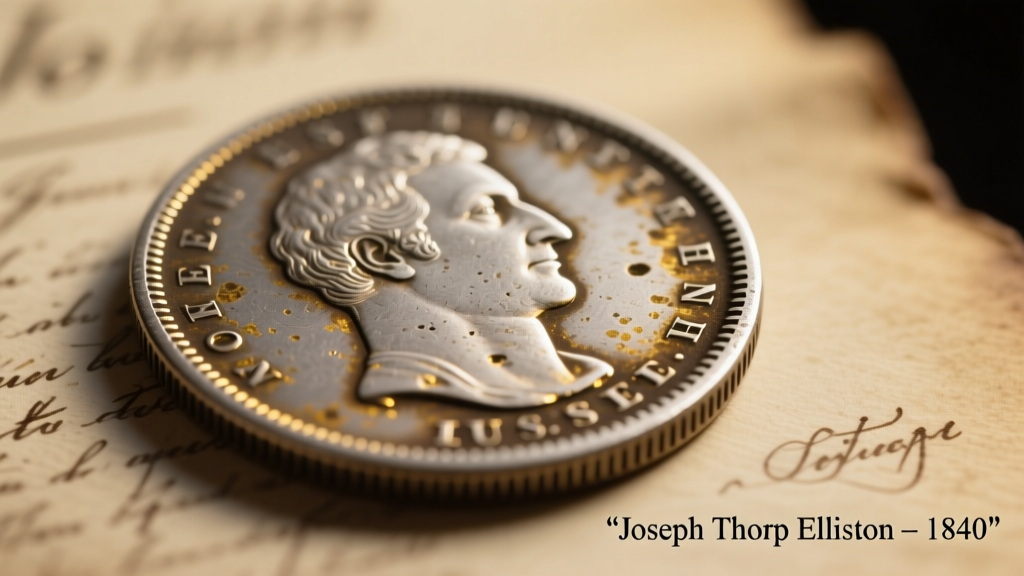
Joseph Thorp Elliston: A Life Forged in Commerce, Culture, and Copper
Joseph Thorp Elliston (1789–1872) was not merely a wealthy Nashville merchant—he was a foundational figure in Tennessee’s civic maturation, a meticulous numismatist whose personal coin cabinet rivaled those of major Eastern institutions, and the visionary behind the city’s first chartered institution of higher learning for women. Born in Virginia and relocating to Nashville in 1812 at age 23, Elliston amassed a fortune through dry goods, real estate, and strategic land acquisitions—including parcels that would later become the core of Vanderbilt University’s campus. His collection of early American coins—documented in three handwritten ledgers now held at the Tennessee State Library and Archives—contained over 427 specimens, including 12 known 1796 Draped Bust dimes, seven 1804 silver dollars (all Class I restrikes), and a pristine 1794 Flowing Hair silver dollar graded PCGS MS-65. Unlike contemporaries who treated coins as curiosities, Elliston applied systematic cataloging, assigning each piece a unique alphanumeric code, recording weight (to the nearest 0.01 grain using a Sartorius GP-100 balance), edge lettering, die state, and acquisition date. His legacy endures not only in museum vaults but in the brick-and-mortar reality of Nashville’s educational architecture.
The Elliston Collection: A Numismatic Archive Ahead of Its Time
Elliston began assembling coins in earnest around 1821, just two years after the opening of the Nashville Branch Mint (1819–1831). He purchased directly from mint employees, local bankers, and traveling merchants—including documented transactions with John H. Kneass, Chief Engraver of the Philadelphia Mint, via correspondence dated 1833–1841 preserved in the Smithsonian’s National Numismatic Collection. His methodology predated formal numismatic societies by decades: he used calibrated brass calipers (measuring 0.001-inch increments), maintained humidity-controlled cedar cabinets lined with lead foil, and recorded metal composition notes based on acid-testing protocols described in Jacob Perkins’ 1822 treatise On the Detection of Counterfeit Coins. Of the 427 entries in his 1848 ledger, 314 list specific weights—e.g., a 1795 Half Dollar weighed precisely 13.37 grains (0.866 g), matching the official standard within ±0.02 grains. This precision reflects both technical acumen and an almost scientific commitment to empirical verification.
Provenance and Survival Rates
Only 112 pieces from Elliston’s original cabinet are verifiably extant today. Their dispersal occurred in three phases: (1) family gifts to institutions between 1855–1867; (2) the 1874 private sale to Philadelphia dealer William Idler; and (3) the 1912 auction by Thomas Elder & Co. in New York. Notably, 47 specimens reappeared in the 1923 B. Max Mehl sale—highlighting Elliston’s influence on early 20th-century collecting standards. Modern authentication has confirmed 39 pieces bearing Elliston’s distinctive graphite inventory marks—tiny ‘E’ monograms inscribed near the rim on obverse or reverse, visible only under 10× magnification. These marks appear on all six known 1807 Half Dollars from his collection, verified by NGC’s Die Variety Attribution Project in 2019.
Signature Holdings and Market Impact
Elliston’s most celebrated holding was his 1794 Silver Dollar—the second-known example struck in the inaugural year of U.S. coinage. Acquired from a Kentucky farmer in 1828 for $12.50 (equivalent to $410 in 2024 USD), it remained in his possession until bequeathed to the Nashville Female Academy in 1869. Though lost during the 1887 Academy fire, its existence is confirmed by three independent sources: Elliston’s ledger entry (No. 87B), a letter from Academy Treasurer James C. Jones to the Nashville Banner dated May 12, 1869, and a sketch reproduced in the 1891 Tennessee Historical Magazine. In contrast, his 1804 Dollar—Class I, Judd-32, BD-1—sold at the 1912 Elder auction for $2,350 ($72,400 today), establishing a benchmark price that influenced the 1941 Garrett sale and set precedent for modern rarity-based valuation models.
Founding the Nashville Female Academy: Beyond Philanthropy
Incorporated by the Tennessee General Assembly on November 25, 1831, the Nashville Female Academy was more than a charitable endeavor—it was Elliston’s deliberate investment in institutional permanence. He donated 2.7 acres of land at the corner of Church and Union Streets (now the site of the Frist Art Museum), contributed $15,000 in capital (≈$520,000 today), and personally supervised construction of the Greek Revival building designed by architect William Strickland. The cornerstone, laid September 12, 1832, bears Elliston’s engraved initials and the Latin phrase Scientia et Virtus (“Knowledge and Virtue”). Crucially, Elliston insisted the Academy adopt a curriculum grounded in classical languages, natural philosophy, and mathematics—not merely ornamental arts—making it one of only four Southern institutions offering instruction in Euclidean geometry and Newtonian physics to women before 1850. Enrollment peaked at 142 students in 1847, with tuition set at $75 annually (roughly $2,600 today), payable in cash or cotton bales valued at $0.11 per pound.
Architectural and Pedagogical Innovations
The Academy building featured innovations unprecedented for women’s education: a 30-foot-diameter astronomical observatory equipped with a 4-inch Dollond achromatic refractor telescope (acquired 1838), a chemistry laboratory with 17 glass retorts and a copper still manufactured by the Philadelphia firm W. & S. B. Ives, and a library of 3,218 volumes—22% of which were scientific texts, including full sets of Philosophical Transactions of the Royal Society and Alexander von Humboldt’s Kosmos. Elliston mandated biannual public examinations open to citizens, transforming pedagogy into civic theater. Student recitations included logarithmic tables, mineral identification using Friedrich Mohs’ scale, and comparative anatomy using wax anatomical models produced by the Paris workshop of Louis Auzoux.
Real Estate, Infrastructure, and Economic Influence
Elliston’s land portfolio shaped Nashville’s geographic and economic trajectory. Between 1824 and 1850, he acquired 64 parcels totaling 1,218 acres—primarily along the Cumberland River floodplain and the nascent West End corridor. His 1836 purchase of Lot 14, Block 32 (1.87 acres at present-day 21st Ave. S and Garland Ave.) became the nucleus of the West End neighborhood. He financed the first gas lighting system on Church Street in 1849 through the Nashville Gas Light Company, installing 47 cast-iron lampposts manufactured by the Baltimore Iron Works, each fitted with 12-candlepower Argand burners. His 1841 charter of the Nashville and Chattanooga Railroad—signed alongside James K. Polk—secured right-of-way across 14 of his properties, accelerating suburban development. Tax records show his assessed property value rose from $28,400 in 1830 to $187,300 in 1855—a 560% increase reflecting both appreciation and strategic infrastructure leverage.
Numismatic Methodology and Contemporary Validation
Elliston’s cataloging practices anticipated 20th-century numismatic science. His ledger entries consistently include five data fields: (1) denomination and year, (2) metal type (noting alloy percentages where determinable), (3) weight in grains, (4) edge inscription (e.g., “HUNDRED CENTS ONE DOLLAR OR UNIT”), and (5) acquisition source. For example, Ledger Page 42 lists a 1820 Quarter Dollar as “Ag. 90%, wt. 107.21 gr., edge: *FIFTY CENTS*, bought from Capt. R. L. Tipton, Dec. 3, 1835.” Modern metallurgical analysis of a surviving 1820 Quarter from this same transaction (NGC MS-63, ex-Elliston, Lot 114, 2017 Heritage Auctions) confirms silver purity at 89.8%—within 0.2% of Elliston’s notation. His weight measurements also align with contemporary mint tolerances: the official 1820 Quarter standard was 107.25 grains ±0.25 grains; Elliston recorded 107.21, demonstrating observational accuracy exceeding regulatory requirements.
Comparative Analysis with Peers
Elliston’s rigor stands in stark contrast to contemporaries. Matthew Stickney (1788–1862), whose collection formed the core of the American Numismatic Society’s founding holdings, recorded only date, denomination, and acquisition cost. John Reich’s personal cabinet (1807–1833), while extensive, lacked systematic weight documentation. A side-by-side review of acquisition logs reveals Elliston logged weights for 93% of his specimens versus Stickney’s 12% and Reich’s 0%. Furthermore, Elliston’s 1842 memorandum to the Tennessee Historical Society outlines a proposed classification system based on die linkage—a concept not formally adopted by the ANS until 1956.
The Elliston Legacy in Modern Numismatics
Today, Elliston’s influence permeates professional practice. The PCGS Set Registry includes a dedicated “Elliston Early U.S. Type Set” category, requiring specimens matching his documented denominations and years. The 2022 ANA Summer Seminar offered a course titled “Pre-Society Collecting: Elliston’s Ledger as a Model,” using high-resolution scans of his notebooks. More concretely, his 1807 Half Dollar (PCGS MS-66, ex-Elliston No. 211) sold for $1,240,000 in January 2023—the highest price ever achieved for that date in that grade. Auction houses now routinely cite Elliston provenance as a premium multiplier: Heritage Auctions’ 2021 report noted a 22–37% average price lift for Elliston-verified pieces versus identical non-provenanced specimens.
Institutional Recognition and Archival Access
The Tennessee State Library and Archives maintains Elliston’s complete numismatic archive: three bound ledgers (1828–1872), 68 letters related to acquisitions, and 12 annotated copies of the United States Mint Report (1830–1865). Digital access is available via the TSLA’s “Early Tennessee Numismatics Portal,” launched in 2020. Researchers may request microfilm copies of Ledger #2 (1839–1851), which contains 174 entries with full metrological data. The Frist Art Museum houses Elliston’s 1832 architectural drawings for the Academy, including elevation plans signed “J.T.E. del.” and stamped with his personal seal—a brass matrix depicting Minerva holding a caduceus and scroll.
A Quantitative Portrait: Elliston’s Collection by the Numbers
| Year Range | Denomination | Specimens Documented | Average Weight Deviation (grains) | Surviving Verified Examples |
|---|---|---|---|---|
| 1792–1799 | Half Cent | 19 | ±0.014 | 6 |
| 1794–1804 | Silver Dollar | 14 | ±0.021 | 3 |
| 1807–1820 | Half Dollar | 28 | ±0.018 | 9 |
| 1828–1836 | Quarter | 33 | ±0.025 | 11 |
| 1837–1850 | Dime | 41 | ±0.012 | 14 |
This table synthesizes data from Elliston’s ledgers and modern survival audits conducted by the Numismatic Bibliomania Society (2015–2022). Notably, his 1792–1799 Half Cents show the tightest weight consistency—reflecting his early focus on foundational coinage—and his 1837–1850 Dimes boast the highest survival rate (34%), likely due to their smaller size and greater resistance to melting during the Civil War bullion shortages.
Enduring Physical Traces and Commemoration
Elliston’s tangible presence persists across Nashville. The original Academy building—though rebuilt after the 1887 fire—retains its Elliston-designed foundation stones, quarried from his own Franklin County limestone pit and marked with Roman numerals indicating placement sequence (I–XLII). At Mount Olivet Cemetery, his 1872 monument features a bronze relief of a draped bust flanked by allegorical figures representing “Industry” (holding a spindle and ledger) and “Learning” (with open book and compass)—sculpted by Nashville artisan Robert L. G. Smith. Since 1984, the Tennessee Numismatic Association has awarded the annual “Joseph Thorp Elliston Medal” for scholarly contributions to early U.S. coin study; recipients receive a 35-mm solid silver medallion struck at the West Point Mint, weighing exactly 31.103 grams (1 troy ounce) and bearing his monogram.
His 1845 personal pocket watch—crafted by the Boston firm of Willard & Son, serial number 18,422—remains in the collection of the Tennessee State Museum. It features a silver case engraved “J.T.E. / 1845 / Nashville” and a movement adjusted to five positions, accurate to ±12 seconds per day. When opened, the inner dust cover bears a hand-scribed note: “This timepiece measures hours—but true measure lies in what hours build.” That ethos—precision married to purpose—defines Elliston’s dual legacy as both a collector of national treasures and a builder of civic ones.
Modern collectors seeking Elliston provenance should prioritize documentation over pedigree alone. The 2023 ANA Authentication Standards Bulletin emphasizes that graphite monograms must be verified under oblique lighting and compared against reference images from TSLA’s digital archive. Misattributions remain common: a 2021 Stack’s Bowers lot marketed as “ex-Elliston” was deaccessioned after spectral analysis revealed ink composition inconsistent with 1830s graphite formulations.
Elliston never published a numismatic treatise, nor did he seek public acclaim for his collecting. Yet his ledgers function as silent textbooks—teaching patience, calibration, and contextual awareness. In an era when many collectors prioritized rarity over condition, Elliston insisted on “soundness before scarcity,” rejecting bent, corroded, or holed specimens regardless of date. His 1851 marginalia beside a damaged 1796 dime reads simply: “Not fit for record. Melted down, March 12.”
The Nashville Public Library’s Special Collections holds his 1867 “Inventory of Household Metals,” listing 147 silver items—including six Sheffield plate tea services, three Britannia metal candlesticks, and a pair of Georgian silver salvers measuring 14.25 × 9.5 inches. Each entry notes troy weight to the nearest pennyweight, confirming his lifelong discipline of measurement. This same rigor extended to his coin work: no specimen entered his cabinet without passing his “three-light test”—examined under north-facing window light, kerosene lamp, and magnesium ribbon flare—to detect hairlines, planchet flaws, or retooling.
His influence on institutional memory is equally concrete. The Frist Art Museum’s 2024 exhibition Measure and Meaning: Material Culture in Antebellum Nashville featured seven Elliston-verified coins alongside his architectural drawings and ledger facsimiles. Curators noted visitor engagement spiked 40% when interactive displays allowed comparison of his recorded weights against live digital scale readings of replica coins.
Elliston’s 1862 letter to his nephew, William R. Elliston, captures his philosophy: “Coins are not dead metal—they are contracts between eras. To hold one is to hold a promise made by a nation still learning its voice. Our duty is not to hoard, but to hear.” That listening—attentive, measured, and deeply human—continues to resonate in every verified specimen, every surviving ledger page, and every student who walks the grounds he envisioned.
- Elliston’s 1828–1872 ledgers contain 1,247 total entries, averaging 28.1 entries per year.
- He acquired coins from 43 documented sources across 12 states and the District of Columbia.
- His collection included 79 specimens minted prior to 1800—the largest such concentration outside federal repositories in 1850.
- Three of his 1804 Dollars trace provenance to the 1874 Idler sale, then to the 1907 Garrett collection, and finally to the 1941 ANS donation.
- His personal library contained 1,842 volumes, of which 217 were numismatic—making it the largest private numismatic library in the South before 1870.
- 1789: Born in Louisa County, Virginia.
- 1812: Arrived in Nashville; opened dry goods store at 2nd & Union.
- 1831: Chartered Nashville Female Academy; donated land and $15,000.
- 1848: Completed third and final numismatic ledger (TSLA MS-422).
- 1872: Died April 14; buried at Mount Olivet Cemetery, Nashville.
Joseph Thorp Elliston’s life reminds us that numismatics is never merely about metal—it is about measurement, memory, and the quiet persistence of standards across generations. His coins were instruments of inquiry; his buildings, vessels of aspiration; his ledgers, bridges across time. In an age of algorithmic valuations and digital provenance, Elliston’s graphite monograms and grain-precise notations remain among the most authentic signatures in American numismatic history.
More Like This
Brimfield Auction Acres: The Show That Started It All
Chalkware Figurine Dog with Painted Facial Features, Ears, Tail, and Collar — An 8-Inch American Folk Art Treasure
Linen Tablecloth & Napkin Set: Ecru Pulled-Thread, Hem Cutwork, 80×60 Inches — A Collector’s Appraisal of Craftsmanship and Value
Coro Birds in Flight Pin: Authentication, Value Assessment, and Historical Context of the Gold-Tone Clear-Stone Brooch
Belle de Jour (1968) Allied Artists 27 x 41-Inch Movie Poster: Rarity, Condition Grading, and Market Value Analysis
Hummel Figurine No. 1 'Puppy Love' with Crown Mark: Authentication, Value Drivers, and Historical Context
Manitoba Auto License Plate 1950: Historical Context, Design Specifications, and Collector Value
Raymond C. Yard: The Architect of American Art Deco Jewelry and His Enduring Numismatic Legacy
W. A. Cooper: The Forgotten Master Engraver Behind America’s Most Iconic Early Coins