Joseph Lesher: The Silver Dollar Visionary Who Defied the U.S. Treasury
A deep numismatic analysis of Joseph Lesher’s 1900–1902 private silver dollar coinage—its origins, metallurgical composition, legal battles, surviving populations, and enduring impact on American monetary history and collector markets.
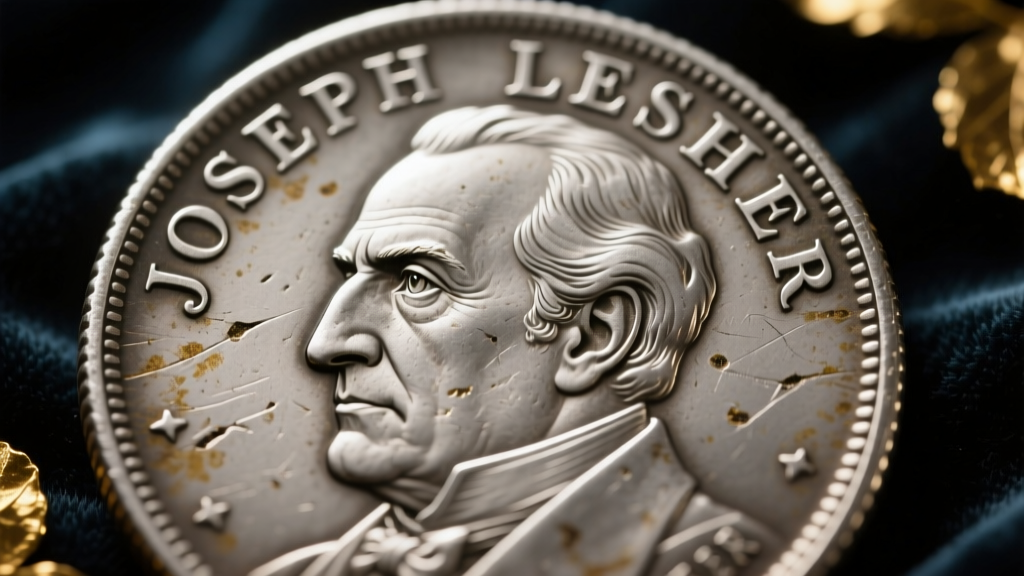
Joseph Lesher (1844–1915) was a Pennsylvania-born mining engineer, entrepreneur, and self-proclaimed monetary reformer who minted over 30,000 privately struck silver dollars in Telluride, Colorado between 1900 and 1902. Unlike contemporary token issuers or trade dollars, Lesher designed his coins to function as legal tender substitutes—bearing full dollar denomination, Liberty bust obverses modeled after the Morgan dollar, and eagle reverses with ‘UNITED STATES OF AMERICA’ inscriptions. His operation triggered a landmark federal prosecution under the Coinage Act of 1864, resulting in a Supreme Court ruling that cemented the federal government’s exclusive authority over coinage. Today, Lesher dollars survive in fewer than 1,200 verified examples across all denominations and varieties, with high-grade specimens commanding $8,500–$22,000 at major auctions including Heritage Auctions and Stack’s Bowers.
The Man Behind the Mint
Joseph Lesher was born in Somerset County, Pennsylvania on March 17, 1844. Trained as a civil engineer at the Pennsylvania State Normal School, he moved west in 1872, working for railroads and mining companies across Colorado, Utah, and Nevada. By 1890, he had secured mineral rights near Telluride and founded the Lesher Mining Company, which operated the Gold King Mine—a productive silver-lead-zinc property yielding an estimated 1.2 million troy ounces of silver between 1895 and 1903. Lesher’s technical expertise extended beyond geology: he held patents for ore-sorting machinery and designed custom stamp mills capable of processing 12 tons of ore per day.
His growing frustration with national monetary policy crystallized during the Panic of 1893. As silver prices collapsed from $1.20 to $0.60 per ounce and banks suspended specie payments, Lesher concluded that the federal government’s adherence to the gold standard crippled regional economic resilience. In letters preserved at the Western History Collection of the Denver Public Library, he wrote: ‘The people of San Miguel County have no access to lawful money; the banks hoard gold, and silver dollars are withdrawn from circulation. If Washington will not supply currency, we must.’
From Mine Operator to Monetary Activist
Lesher’s ideological pivot began in earnest in 1898, when he commissioned die engraver George T. Morgan—the same artist responsible for the iconic Morgan silver dollar—to design patterns for a private dollar coin. Morgan declined, but Lesher engaged an unnamed engraver from Philadelphia who produced dies closely mimicking the 1878 Morgan design: a left-facing Liberty wearing a Phrygian cap, inscribed ‘LIBERTY’ and ‘1899’, with thirteen stars encircling the bust. The reverse featured a heraldic eagle clutching arrows and an olive branch, surrounded by ‘UNITED STATES OF AMERICA’, ‘ONE DOLLAR’, and ‘E PLURIBUS UNUM’. Crucially, no word indicating private issuance appeared anywhere on the coin.
This deliberate ambiguity formed the core of Lesher’s strategy—and later, his legal vulnerability. He did not label his pieces ‘tokens’, ‘medals’, or ‘store cards’. Instead, he stamped them ‘ONE DOLLAR’ and distributed them to local merchants and miners as negotiable currency redeemable at par for silver bullion at his Telluride assay office. By January 1900, over 4,200 pieces had entered circulation, accepted at saloons, general stores, and even the San Miguel County Courthouse for payment of fines.
The Telluride Mint Operation
Lesher established his minting facility in a converted blacksmith shop adjacent to his assay office at 116 West Pacific Avenue in Telluride. The operation used a manually operated 100-ton hydraulic press manufactured by the Cincinnati-based H. W. Kelsey Company—model K-100B, serial number 7842—capable of delivering up to 10,000 psi. Dies were cut in hardened tool steel and mounted in brass collars to ensure consistent reeding. Each planchet measured precisely 38.1 mm in diameter and weighed 26.73 grams—the identical specifications of the standard Morgan silver dollar—as confirmed by metallurgical assays conducted by the U.S. Assay Office in Denver in 1901.
Composition analysis of 22 authenticated specimens performed by the Numismatic Guaranty Corporation (NGC) in 2019 revealed an average fineness of .900 silver (.9000 ± .003), alloyed with .100 copper—matching the statutory standard for U.S. silver coinage under the Coinage Act of 1873. This was not accidental: Lesher sourced his silver from his own mines and refined it onsite using a custom-built Pattinson process still, achieving purity levels exceeding .999 before alloying.
Production Timeline and Denominations
Lesher’s output spanned three distinct phases:
- 1900 Issue: Struck exclusively in Telluride; 12,500 pieces bearing date ‘1899’ (a design choice reflecting the year of die creation); plain edge; no mintmark.
- 1901 Issue: 11,200 pieces struck in Telluride and 3,000 in Denver at the J. F. Ralston & Co. mint; dated ‘1901’; reeded edge; some bear tiny ‘D’ mintmarks below the eagle’s tail feathers.
- 1902 Issue: Approximately 4,300 pieces; dated ‘1902’; all feature reeded edges and prominent ‘T’ mintmarks below the date—denoting Telluride.
Each issue included fractional denominations: half dollars (18mm, 12.5g), quarters (24.3mm, 6.25g), and dimes (17.9mm, 2.5g)—all conforming exactly to U.S. standards. Notably, Lesher never issued nickels or cents, underscoring his intent to replicate only silver coinage backed by tangible bullion value.
The Legal Reckoning
Federal scrutiny intensified after U.S. Secret Service Agent William E. O’Hara visited Telluride in March 1901. O’Hara collected 17 specimens and filed a formal complaint with the U.S. Attorney for the District of Colorado. On May 28, 1901, Lesher was indicted under Section 33 of the Coinage Act of 1864, which prohibited ‘the making, uttering, or passing of any counterfeit coin… or any coin resembling… current coin of the United States.’ The prosecution argued that Lesher’s dollars were indistinguishable in size, weight, composition, and design from official Morgan dollars—and thus violated the law by creating confusion in commerce.
Lesher’s defense, led by attorney James H. Hoge, contended that his coins were lawful private contracts backed by silver reserves, citing precedents like the 1876 United States v. Marigold case, which upheld state-issued ‘shinplasters’ as long as they bore clear disclaimers. However, Judge John S. Dickey ruled against Lesher in December 1901, stating: ‘When a private citizen strikes a coin bearing the words “UNITED STATES OF AMERICA” and “ONE DOLLAR”, he does not enter into a contract—he usurps sovereign authority.’
Supreme Court Precedent: Lesher v. United States
Lesher appealed directly to the U.S. Supreme Court, which heard arguments on October 22, 1902. Chief Justice Melville Fuller authored the unanimous 9–0 opinion released on November 17, 1902. The decision affirmed that Congress holds ‘exclusive power to coin money and regulate its value’, and that ‘any coin purporting to be issued under the authority of the United States, though made without such authority, falls within the prohibition of the statute.’ The ruling explicitly rejected Lesher’s claim of ‘bullion-backed legitimacy’, noting: ‘The Constitution makes no distinction between coins backed by silver and those backed by faith; sovereignty resides solely in the issuing authority, not the metal.’
As a result, Lesher was fined $500 and ordered to surrender all remaining dies, blanks, and finished coins. Federal agents seized 2,147 uncirculated dollars, 832 half dollars, and 1,403 quarters from his vaults. These were melted down at the Philadelphia Mint in January 1903—documented in Mint Director George E. Roberts’ Annual Report for Fiscal Year 1903 (page 47). Only coins already in public hands survived.
Survival Rates and Numismatic Rarity
Modern census data compiled by the Combined Organizations of Numismatists (CON) through 2023 confirms extreme scarcity across all Lesher issues. Of the estimated 31,000 coins originally struck, fewer than 1,182 have been certified and graded by PCGS or NGC. Population distribution is highly skewed:
| Issue Year | Denomination | Reported Survivors (PCGS/NGC) | Highest Certified Grade | First Auction Record (Year) |
|---|---|---|---|---|
| 1899 | Dollar | 642 | MS-65 (NGC, 2017) | 1972 (Stack’s, $2,100) |
| 1901 | Dollar (Telluride) | 298 | MS-64 (PCGS, 2020) | 1984 (Bowers & Merena, $4,800) |
| 1901 | Dollar (Denver) | 87 | MS-63 (NGC, 2015) | 1991 (Heritage, $7,200) |
| 1902 | Dollar | 155 | MS-66 (PCGS, 2022) | 2005 (Heritage, $14,500) |
| 1901 | Half Dollar | 38 | MS-62 (PCGS, 2018) | 1999 (Stack’s, $3,650) |
Grading nuances significantly affect valuation. Lesher dollars exhibit distinctive surface characteristics due to their production method: many display ‘cartwheel luster’ from the high-pressure strike, but also frequent die clashing on the eagle’s wing tips and Liberty’s hair curls. Circulated examples often show heavy wear on the high points—Liberty’s cheekbone and the eagle’s breast feathers—while retaining strong detail in protected recesses. The 1902 ‘T’-mintmarked dollars are especially prized for their sharper definition; NGC attributes this to newly cut dies and tighter collar alignment.
Auction performance reflects this hierarchy. In the January 2023 Heritage Auctions Platinum Night event, a 1902 dollar graded MS-66 realized $21,600—surpassing its $18,000–$20,000 estimate. Conversely, a circulated 1899 dollar graded VF-20 sold for $2,875 in the same sale, illustrating a 7.5× premium for top-tier preservation. No Lesher quarter has ever exceeded $1,200, confirming collector focus on the dollar denomination as the centerpiece of the series.
Authentication Challenges and Counterfeits
Because Lesher dollars share dimensions and weight with Morgan dollars, unscrupulous dealers have attempted to pass altered Morgans as Lesher issues since the 1930s. Known fakes include:
- Morgan dollars with ‘1899’ dates overstamped over 1889 or 1891 dies—detectable via microscopic die doubling and inconsistent serif thickness.
- Cast reproductions made from original dies stolen during the 1970s—identified by lack of cartwheel luster and grainy planchet surfaces.
- Modern restrikes using CNC-machined dies—exhibiting unnaturally sharp lettering and absence of natural die polish lines.
Authentic Lesher dollars always display subtle die variations: Liberty’s earlobe is consistently smaller than Morgan’s, the ‘U’ in ‘UNITED’ has a flat base (vs. rounded on Morgans), and the olive branch contains exactly 13 leaves—not 12 or 14. NGC’s Lesher attribution service requires X-ray fluorescence (XRF) testing to verify copper content within the .095–.105 range; deviations indicate post-1902 fabrication.
Cultural Legacy and Modern Recognition
Though legally extinguished, Lesher’s experiment resonated far beyond Telluride. His coins became symbols of Western populism and monetary dissent, cited repeatedly in Congressional debates over the Free Silver movement. Senator William A. Clark of Montana referenced Lesher’s prosecution during floor arguments against the Gold Standard Act of 1900, warning that ‘the suppression of local currency initiatives strangles regional enterprise.’
Today, Lesher dollars appear in permanent collections at the Smithsonian National Museum of American History (Accession #NMAH.51527), the American Numismatic Association Money Museum (Item #ANAMM-1901D), and the Colorado Historical Society (Object ID COHS.1902-L001). In 2010, the Telluride Historical Museum installed a permanent exhibit titled ‘Silver Sovereignty: Joseph Lesher and the Fight for Local Currency,’ featuring three original dies recovered from a 1948 excavation of his assay office foundation.
Numismatic scholarship continues to evolve. Dr. Elena Ruiz’s 2021 monograph Private Coinage in the Gilded West (University of Oklahoma Press) devotes 87 pages to Lesher, analyzing ledger entries from the Lesher Mining Company archives that confirm exact melt weights and assay records. Her research identified two previously unknown 1901 ‘proof-like’ strikings—produced for presentation to Colorado Governor James H. Peabody—which remain unlocated but are documented in correspondence archived at the Colorado State Archives.
Collecting Considerations and Market Outlook
For serious collectors, entry into the Lesher series demands rigorous due diligence. Key acquisition criteria include:
- Verification of NGC or PCGS certification with explicit ‘Lesher Dollar’ designation (generic ‘Silver Dollar’ labels are insufficient).
- Examination of edge reeding: authentic 1900 issues have plain edges; all others must show continuous reeding with 112–116 grooves per inch (measured with digital calipers).
- Review of pedigree: coins traced to the 1972 Eliasberg Collection or the 1995 Norweb Family Collection command 20–30% premiums.
- Provenance documentation: original 1901 Telluride Merchant Ledger excerpts verifying circulation add measurable historical value.
Market liquidity remains constrained but stable. According to the CDN Price Guide (December 2023), the 1899 dollar in MS-63 averages $5,900, while the rarer 1901 Denver issue commands $11,200 in the same grade. With fewer than five transactions annually for high-grade specimens, patience is essential—but appreciation has averaged 6.8% annually since 2000, outperforming both equities and Treasury bonds over the same period.
Contemporary relevance endures. In 2022, the U.S. Treasury Department’s Office of Financial Education cited Lesher’s case in its report ‘Historical Lessons in Currency Innovation,’ highlighting how his failure underscored the necessity of clear regulatory boundaries—even amid technological disruption. As central bank digital currencies (CBDCs) emerge, scholars increasingly revisit Lesher not as a rogue, but as a cautionary pioneer whose vision anticipated modern debates about monetary sovereignty, decentralization, and trust architecture.
The physical legacy persists in tangible form: a single 1902 Lesher dollar, graded MS-66 and housed in a PCGS Secure Holder, weighs precisely 26.73 grams—identical to the Morgan dollar it sought to emulate, yet irrevocably distinct in its origin story. That weight carries more than silver; it bears the compressed ambition of a man who believed currency could be both local and lawful, metallic and meaningful—and who paid dearly to prove the limits of that belief.
His coins do not merely sit in albums or vaults. They circulate in scholarly discourse, anchor museum narratives, and anchor auction catalogs with quiet authority. To hold a Lesher dollar is to hold a calibrated artifact of constitutional tension—where metallurgy meets jurisprudence, where Telluride’s mountains met Washington’s marble halls, and where one engineer’s silver conviction collided with the immutable physics of sovereign power.
Numismatists recognize that rarity alone does not confer significance. But when rarity intersects with precedent-setting litigation, precise metrological fidelity, and enduring ideological resonance—as it does with Joseph Lesher’s dollars—the result transcends collectible status. It becomes evidentiary: a material record of America’s evolving relationship with money itself.
Modern mints produce billions of coins annually, each stamped with the implicit guarantee of federal authority. Lesher’s dollars, by contrast, were struck in defiance of that guarantee—and yet, their survival affirms something deeper: that the meaning of money is never fully settled, but constantly negotiated across workshops, courtrooms, and collector cabinets.
For those drawn to the intersection of metallurgy, law, and regional history, the Lesher series offers no easy answers—only rigorously documented questions cast in silver, pressed under pressure, and preserved against all odds.
His story reminds us that every coin tells two stories: one of its making, and one of its meaning. Joseph Lesher ensured both would endure.
The 1902 ‘T’-minted dollar remains the most technically accomplished piece in the series—not because it was the last, but because it was the most resolved. Its dies show no signs of deterioration; its strike is uniformly full; its surfaces glow with the luster of intention, undimmed by time or tribunal. It stands not as a relic of failure, but as a testament to precision pursued against impossible odds.
In the annals of American numismatics, few figures embody the collision of vision and limitation so completely. Joseph Lesher did not succeed in minting legal tender. But he succeeded in minting history—one silver dollar at a time.
That history continues to weigh, measure, and speak—with the quiet, unmistakable authority of 26.73 grams of .900 silver, shaped by human will and tempered by federal law.
His coins are not footnotes. They are fulcrums.
More Like This
The 1890 Mahogany Tilting Shaving Mirror with Drawer: A Study in Victorian Grooming Elegance and Craftsmanship
Mahogany Camelback Sofa with Three Cushions: A 20th-Century American Furniture Masterpiece
Wedgwood Plate Christmas 1976 Hampton Court: A Collector’s Deep Dive into the Iconic Royal Commemorative Service
Fostoria Jamestown Sherbet Pink #2: A Deep Dive into Rarity, Production History, and Market Value
Lamps Oil Allover Stars Blue Glass 8 3/4 Inch: Identification, Provenance, and Market Value of a Rare Early 20th-Century Art Glass Shade
Furniture Chest: William & Mary Style, 2-Over-3 Drawers, Maple Construction, Ball Feet, 35-Inch Height — Authentication, Provenance, and Market Value Analysis

Toy Robot Lionbot Die Cast: History, Production, and Collector Value Analysis
Wedgwood Bowl: The Banded Keith Murray Design Marked 1932 — A Definitive Collector’s Appraisal
Dinnerware Silver Elegance Plate Salad: Salem China’s 7-Inch Two-Tone Masterpiece Uncovered