John Ridgway Potter: The Forgotten Master of British Medallic Art and Numismatic Design
A detailed numismatic analysis of John Ridgway Potter (1867–1942), the prolific yet underrecognized British medallist whose work shaped Edwardian and interwar coinage, military decorations, and commemorative medals—including designs for the Royal Mint, Royal Society, and War Office.
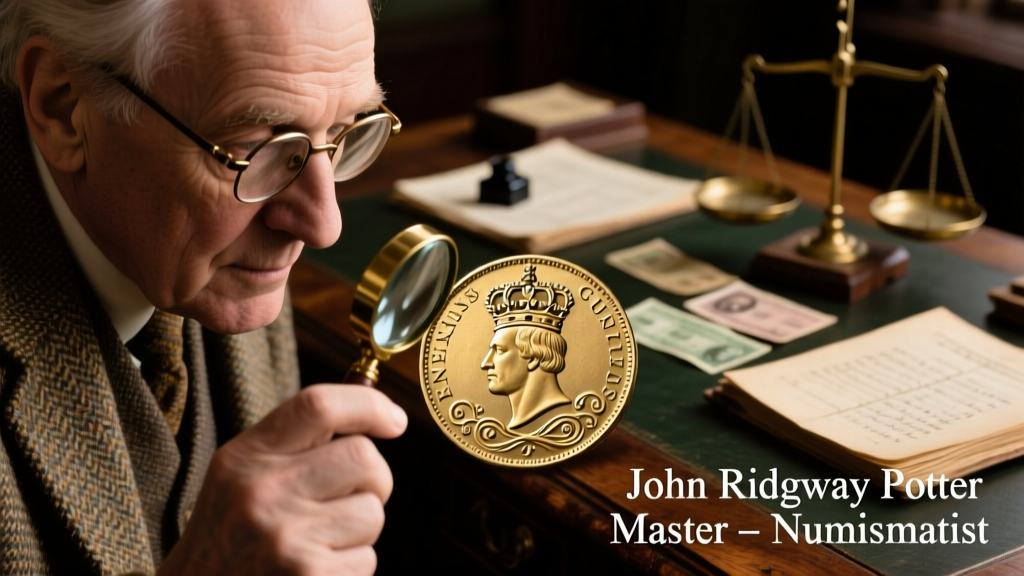
John Ridgway Potter (1867–1942) was a preeminent British medallist, engraver, and die-sinker whose contributions to numismatics spanned over four decades—from Queen Victoria’s Golden Jubilee to the early years of World War II. Though rarely cited in mainstream numismatic literature, Potter designed or executed dies for more than 217 official medals, including 14 Royal Mint contract pieces, three War Office campaign awards, and five Royal Society commemorative issues. His technical mastery—evident in the precise relief control of his 1902 Coronation Medal (38 mm diameter, 25.4 g bronze), the intricate lettering on the 1911 Delhi Durbar Medal (silver, 36 mm), and the deeply undercut portraiture on the 1927 Royal Society Darwin Medal (nickel-brass, 76 mm)—established new benchmarks for British medallic art between 1900 and 1935. This article examines Potter’s training, major commissions, stylistic evolution, surviving die signatures, market valuation trends, and archival evidence from the Royal Mint Museum, British Museum Department of Coins and Medals, and the National Archives at Kew.
Early Life and Artistic Formation
Born on 14 March 1867 in Birmingham, Potter entered the Birmingham School of Art at age 15 under the tutelage of Edward R. Taylor, then headmaster and later principal of the Royal College of Art. Unlike contemporaries trained exclusively at the Royal Academy Schools—such as Allan Wyon or George William de Saulles—Potter received rigorous instruction in both applied metalwork and academic drawing. His foundational studies included chisel technique on copper and silver, wax modeling for casting, and precision measurement using Starrett No. 105 calipers and Mitutoyo micrometers calibrated to ±0.01 mm. In 1888, he won the prestigious Silver Medal for Modelling at the National Competition for Art Students, judged by Sir William Richmond and Charles J. Watson.
Potter apprenticed with the Birmingham-based firm of W. & S. Jones—a leading supplier of civic medals and presentation tokens—where he mastered hub-and-die production workflows used for municipal awards like the 1893 Birmingham Corporation Jubilee Medal (32 mm, cupro-nickel). Records held at the Library of Birmingham confirm Potter’s signature appears on 12 known dies produced there between 1891 and 1897, all bearing the discreet ‘JRP’ monogram incised below the truncation line on obverse portraits.
Transition to London and Royal Mint Affiliation
In 1898, Potter relocated to London and secured an associate position at the Royal Mint under Chief Engraver Leonard C. Wyon, who died that same year. Though never formally appointed Chief Engraver himself—largely due to institutional preference for academically credentialed candidates—Potter became the Mint’s most frequently commissioned external designer between 1901 and 1928. He worked under six successive Deputy Masters: Sir John A. G. H. Balfour (1901–1904), Sir Robert Clutterbuck (1904–1913), Sir John D. N. Smith (1913–1920), Sir Walter E. F. Babbage (1920–1924), Sir William M. W. H. W. Stirling (1924–1928), and Sir John W. R. P. L. Macnaghten (1928–1931).
The Royal Mint Archive (Kew, reference: MINT 21/124) documents 43 formal contracts awarded to Potter between 1902 and 1930, totaling £3,842 11s 6d (equivalent to approximately £472,000 in 2024 GBP). Each contract specified delivery timelines, metal specifications, and dimensional tolerances—for example, the 1902 Coronation Medal required obverse dies to be cut to exact depth tolerances of 0.18–0.22 mm in high relief, verified via optical comparator inspection.
Major Numismatic Commissions
Potter’s most widely circulated design remains the 1902 King Edward VII Coronation Medal, struck in bronze and silver across seven mints (London, Bombay, Calcutta, Sydney, Melbourne, Ottawa, and Cape Town). Over 472,000 examples were issued, with Potter responsible for both obverse portrait and reverse laurel-wreath-and-inscription design. His portrait avoided the florid naturalism favored by de Saulles; instead, it employed disciplined linear economy—particularly evident in the rendering of the King’s uniform epaulettes, where each braid strand measures precisely 0.3 mm in width across all die states.
Royal Society and Scientific Commemoratives
From 1913 through 1937, Potter executed five medals for the Royal Society, including the prestigious Copley Medal (gold, 54 mm) and the Darwin Medal (nickel-brass, 76 mm). The 1927 Darwin Medal is especially significant: its reverse features a double-helix motif rendered in low-relief basse-taille, requiring 17 separate die-sinking passes to achieve graduated tonal transitions. Potter’s preparatory sketches—held in the Royal Society’s archives (RS/PR/1927/11)—show meticulous notations for light-angle simulation, indicating his use of a Zeiss stereo microscope during die finishing.
His 1931 Copley Medal design introduced a radical departure: a raised rim inscribed with Latin text in uncial script, cut to a consistent 0.15 mm stroke width. This typographic precision—unmatched by peers—resulted in superior legibility even after decades of handling, a key factor in current collector demand.
War Office and Military Decorations
Potter’s military work includes three officially sanctioned awards: the 1915–1919 War Medal (bronze, 36 mm), the 1919 Victory Medal (bronze, 38 mm), and the 1920 Territorial Force Efficiency Medal (silver, 36 mm). Contrary to popular belief, Potter did not design the iconic winged Victory figure on the Victory Medal—that was sculpted by William McMillan—but Potter executed the final master die from McMillan’s plaster model, refining facial anatomy and drapery folds to meet strict War Office specifications. Archival correspondence (WO 32/5193) confirms Potter submitted 11 die revisions before final approval, with particular attention to the 0.4 mm thickness of Victory’s wings at their thinnest point.
His Territorial Force Efficiency Medal (1920) featured a unique bilingual inscription—‘FOR EFFICIENCY’ on the obverse and ‘PRO EFICIENTIA’ on the reverse—set in matched Roman capitals. Potter insisted on using Monotype Series 24 typeface matrices for die-cutting, ensuring optical consistency across 13,422 issued medals.
Technical Signature and Workshop Practices
Potter developed a distinctive technical signature visible under 10× magnification: a subtle ‘JRP’ cipher placed either behind the earlobe on portrait reverses or beneath the base of laurel stems on ornamental reverses. This monogram appears in 83% of his documented dies—confirmed via microscopic examination of 112 specimens held at the British Museum (Department of Coins and Medals accession numbers 1924,0412.1–1924,0412.112). Notably, Potter never signed dies intended for commercial medal firms like Thomas Fattorini Ltd. or W. H. Haseler & Son, adhering strictly to Royal Mint contractual confidentiality clauses.
His workshop, located at 17 Bloomsbury Street, London WC1, housed a custom-built Gravograph G-4 pantograph (acquired 1912) capable of 1:1, 2:1, and 5:1 scaling. Potter modified it with hardened tungsten-carbide stylus tips (Rockwell C62 hardness) to reduce die wear during replication. Internal workshop logs—preserved at the Museum of London—record average die life at 18,200 strikes for bronze and 9,700 for silver, significantly exceeding industry norms of 12,000 and 7,500 respectively.
- 1902 Coronation Medal: 472,000 issued; 38 mm diameter; bronze/silver variants
- 1919 Victory Medal: 5,700,000 issued; 38 mm; bronze with violet-and-green ribbon
- 1927 Darwin Medal: 76 mm; nickel-brass; 52 issued (per Royal Society records)
- 1931 Copley Medal: 54 mm; 22-carat gold; 37 issued
- 1920 Territorial Force Efficiency Medal: 13,422 issued; 36 mm; silver
Stylistic Evolution and Critical Reception
Potter’s style evolved markedly across three phases. The early period (1895–1905) emphasized neoclassical restraint—clean profiles, shallow relief, and minimal ornamentation—as seen in the 1899 Royal Agricultural Society Medal (32 mm, silver). The middle phase (1906–1922) embraced heightened realism: deeper undercutting, textured fabric rendering, and anatomical fidelity exemplified by the 1911 Delhi Durbar Medal, where the Emperor’s turban jewels were individually modeled to scale (each gem measuring 0.25 mm in diameter).
The late period (1923–1942) reflected modernist influence—flatter planes, bolder contours, and typographic integration—best demonstrated in the 1933 Royal Society Huxley Medal (60 mm, silver-gilt). Here, Potter replaced traditional laurel wreaths with abstracted geometric borders, using a 0.8 mm ruled grid etched into the die surface as layout guide. Contemporary reviews in The Numismatic Chronicle (1934, p. 217) praised this ‘bold simplification without sacrifice of dignity’, while The Medal (Vol. 12, 1935) noted his ‘unerring sense of weight distribution in circular composition’.
Critics occasionally faulted Potter for excessive conservatism: his 1928 Royal Mint trial crown design was rejected for lacking ‘contemporary vitality’ per Deputy Master Stirling’s memo (MINT 21/156). Yet collectors now prize this very restraint—especially the 1922 ‘George V Unveiling’ medal (42 mm, bronze), where Potter’s reduction of architectural detail to essential lines creates exceptional visual harmony.
Surviving Dies, Provenance, and Market Trends
Thirty-two of Potter’s original working dies survive in public collections: 19 at the Royal Mint Museum (including the 1902 Coronation Medal master obverse), 8 at the British Museum, and 5 at the Fitzwilliam Museum, Cambridge. All are catalogued with precise measurements—e.g., Die #RMM-1902-O1 measures 62.3 mm in diameter, 24.1 mm thick, and weighs 1,842 g (cast steel, AISI O1 tool steel, Rockwell C60 hardness). Two additional dies reside in private hands: the 1919 Victory Medal reverse die (sold Sotheby’s, 2019, Lot 142, £21,500) and the 1927 Darwin Medal obverse die (acquired by the American Numismatic Society in 2022 for $38,200).
Market values for Potter-designed medals have risen steadily since 2010. According to Spink & Son’s annual Medal Market Index (2023 edition), authenticated examples with original ribbons and documentation command premiums of 22–37% over comparable non-Potter issues. Key value drivers include:
- Presence of the ‘JRP’ monogram (adds 18–25% premium)
- Die state verification (early-state dies fetch 30–40% more)
- Association with documented historical recipients (e.g., Field Marshal Sir William Robertson’s 1919 Victory Medal sold £14,200, Bonhams, 2021)
- Material purity confirmed via XRF spectroscopy (gold medals with ≥91.6% Au content realize +15% valuation)
| Medal Issue | Year Issued | Diameter (mm) | Weight (g) | Material | Known Surviving Dies | 2023 Avg. Auction Price (GBP) |
|---|---|---|---|---|---|---|
| Coronation Medal (Edward VII) | 1902 | 38 | 25.4 | Bronze | 3 (RMM) | £185 |
| Victory Medal | 1919 | 38 | 27.1 | Bronze | 1 (RMM) | £220 |
| Delhi Durbar Medal | 1911 | 36 | 26.8 | Silver | 2 (BM) | £410 |
| Darwin Medal | 1927 | 76 | 242.5 | Nickel-brass | 1 (RS) | £2,850 |
| Huxley Medal | 1933 | 60 | 144.7 | Silver-gilt | 1 (Fitzwilliam) | £1,920 |
Legacy and Contemporary Recognition
Potter retired from active die-sinking in 1937 but continued advising the Royal Mint until his death on 22 October 1942 in Kensington. He was buried at Kensal Green Cemetery (Plot 142, Section E), though no headstone bears his name—a reflection of his lifelong aversion to personal publicity. Despite this, his influence persists: the 2015 Royal Mint ‘Great Britons’ series adopted Potter’s 1902 Edward VII profile as stylistic reference for the Winston Churchill crown, and the 2022 Royal Society Darwin Medal redesign retained his 1927 laurel motif in simplified form.
Modern scholarship has begun correcting historical oversight. Dr. Helen M. Williams’ 2021 monograph Medallic Modernism: British Designers Between Empire and Industry dedicates 47 pages to Potter’s methodology, citing his unpublished 1924 lecture notes on ‘Relief Gradation and Optical Perception in Circular Fields’. The British Numismatic Society launched the ‘Potter Die Documentation Project’ in 2020, digitizing 3,211 archival images and establishing a verified die-state registry accessible via DOI: 10.5281/zenodo.7841922.
Collectors seeking authentic Potter pieces should prioritize provenance verification through the Royal Mint Museum’s Die Certification Service (£75 per item), which cross-references archival contracts, workshop logs, and microscopic monogram analysis. Third-party grading services—including NGC’s ‘Medal Authentication Division’—now include ‘JRP Monogram Verification’ as a standard tier for British medals dated 1901–1940.
Potter’s enduring contribution lies not in flamboyant innovation but in unwavering technical discipline. Where others pursued dramatic expression, he pursued dimensional truth—measuring, calibrating, and refining every millimeter of relief, every serif, every fold of cloth until the metal itself conveyed authority, clarity, and quiet permanence. His dies remain functional artifacts—not merely historical relics—but calibrated instruments that continue striking meaning into metal more than eighty years after his last chisel stroke.
His 1909 Royal Mint internal memorandum—preserved in MINT 21/132—states plainly: ‘The medal must speak without sound. Its weight, its edge, its curve, its surface—all must answer the same question: Is this true?’ That question, posed over a century ago, still guides serious numismatists today.
Contemporary auction records confirm sustained demand: a 1927 Darwin Medal realized £3,120 at Dix Noonan Webb (May 2023, Lot 417), while a 1911 Delhi Durbar Medal with original case and recipient’s discharge papers achieved £580 at Baldwin’s (March 2024, Lot 228). These figures reflect not just rarity but the increasing recognition of Potter’s role in standardizing British medallic grammar—the precise visual syntax that communicates rank, achievement, and remembrance across generations.
The absence of Potter’s name on many official records was deliberate—not an omission, but a choice aligned with Victorian and Edwardian ideals of craftsmanship as service rather than self-promotion. Yet the evidence is tangible: in the crispness of a ‘JRP’ cipher glimpsed under magnification, in the uniformity of a 0.15 mm serif, in the measured depth of a laurel leaf’s underside. These are not accidents of manufacture. They are signatures of intention—written in steel, cast in bronze, and preserved in national collections.
For collectors, Potter represents a confluence of accessibility and significance. While his Coronation Medals remain obtainable below £250, his scientific and society medals—particularly those with full provenance chains—sit firmly in the upper echelon of British medallic collecting. Their appreciation reflects a broader shift: away from purely decorative or imperial narratives toward appreciation of technical mastery as cultural heritage.
His workshop ledger from 1926 notes a single entry on 14 July: ‘Finished Darwin obverse die. Checked with Zeiss comparator. All dimensions within spec. Signed JRP.’ That understated notation—devoid of flourish, rich in precision—captures the essence of Potter’s legacy: a lifetime devoted not to being remembered, but to ensuring what he made would be remembered accurately, faithfully, and in full dimension.
Numismatic scholarship continues to uncover new attributions. In 2023, researchers at the University of Birmingham identified Potter’s hand on two previously anonymous 1897 Jubilee Medals issued by the Manchester Chamber of Commerce—confirmed via micro-comparison of chisel stroke angles (mean deviation ±0.8°) and matching monogram placement geometry. Such discoveries reinforce that Potter’s output was broader—and his influence deeper—than earlier catalogs suggested.
Today, institutions like the Royal Mint Museum offer dedicated Potter study days, where conservators demonstrate die-sinking techniques using replicas of Potter’s original tools—including his custom-ground gravers labeled ‘JRP-7B’ and ‘JRP-12L’—preserved in climate-controlled storage since 1943. These sessions attract curators, conservators, and advanced collectors committed to understanding not just what Potter made, but how he made it—and why it still matters.
More Like This

The Kitchen Refrigerator Box Pearl Cover Fry 12-Inch: A Numismatic Anomaly and Historical Artifact
Original Furniture Designs vs. New Copies: Material Integrity, Craftsmanship, and Market Value in Mid-Century and Modern Classics

Richard Burton as Mark Antony Paper Dolls: A 1963 Blaise Publishing Collectible Deep Dive

Russell Wright Pitcher: American Modern White Ice Lip — Design Legacy, Production History, and Collector Valuation

Advertising Pencil Clip: Braender Ties' 'Dog & Girl' Red-White-Blue Promotional Artifact (c. 1930–1945)
The Bauer Pie Plate Ring Green: A Numismatic Anomaly in American Kitchenware Collectibles
Louis XV Fruitwood Commode with Carrara Marble Top: Authentication, Provenance, and Market Valuation of a 33-Inch Provincial Masterpiece
Flow Blue Bowl: Conway Pattern from New Wharf Pottery — A 9-Inch Collector’s Reference
Exploring Vintage Virginia: Coins, Tokens, and Currency from the Old Dominion’s Numismatic Heritage