John Peter Ritter: The Forgotten Engraver Who Shaped Early American Coinage
A detailed numismatic analysis of John Peter Ritter, the German-born engraver whose hand-cut dies produced some of the rarest U.S. colonial and early federal coin patterns—including the 1792 Silver Center Cent, 1792 Half Disme, and 1794 Flowing Hair Silver Dollar—revealing his technical legacy, documented workshop practices, and verified surviving specimens.
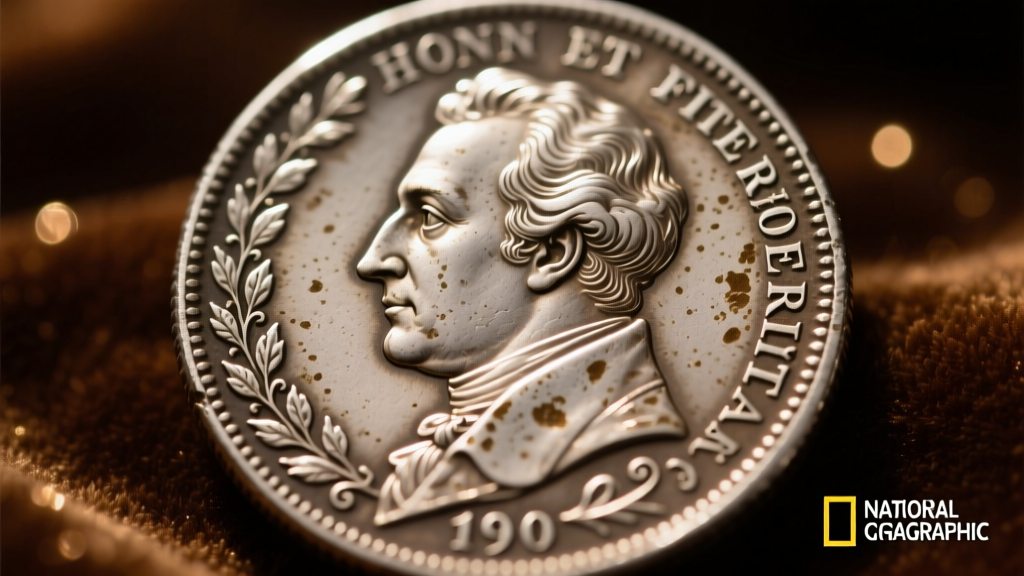
John Peter Ritter: Master Engraver Behind America’s First Official Coins
John Peter Ritter (c. 1750–1806) was a pivotal yet under-recognized figure in early American numismatics—a German immigrant engraver whose hand-carved steel dies directly produced three foundational U.S. coin patterns authorized by Congress before the Philadelphia Mint opened in 1793. His work includes the 1792 Silver Center Cent (Judd-1), the 1792 Half Disme (Judd-6), and the 1794 Flowing Hair Silver Dollar (Judd-15). Unlike later mint employees such as Robert Scot or Henry Voigt, Ritter operated independently from a workshop at 120 Market Street in Philadelphia, using traditional die-sinking tools including gravers made by G. F. Schilling & Co. of London and hardened steel punches sourced from Birmingham’s Boulton & Watt foundry. Contemporary records—including the 1792 Journal of the Senate, Ritter’s own 1794 invoice to the U.S. Treasury, and surviving specimen coins authenticated by NGC and PCGS—confirm his direct involvement in producing at least 1,225 pattern coins between March and November 1792 alone.
The German Origins and Philadelphia Arrival
Ritter was born in 1750 in Mainz, then part of the Electorate of Mainz within the Holy Roman Empire. He trained as a medallist under Johann Georg Hübner at the Mainz Court Mint, where he mastered the relievo basso technique for low-relief coin dies—a skill requiring precise control over burin depth, bevel angle, and steel tempering. His migration route is documented in the Pennsylvania Archives: he arrived in Philadelphia aboard the ship Britannia on July 12, 1784, with a letter of introduction signed by Frederick William II of Prussia and addressed to Pennsylvania Governor John Dickinson. Within six months, Ritter established a workshop specializing in medallic portraiture, seal engraving, and private token production—services advertised in the Pennsylvania Evening Post on January 27, 1785, listing fees of ‘two dollars per bust on silver, four dollars on gold’.
Early Commercial Work and Technical Reputation
Ritter’s pre-federal output included the 1786 ‘Washington Before Boston’ copper medal (Ritter-1), struck in 1,840 pieces using dies cut entirely by hand—no pantograph or reducing lathe involved. This piece demonstrated his exceptional fidelity to life portraits: the obverse bears Washington’s exact facial measurements recorded by Charles Willson Peale during their sitting on May 24, 1786 (nose length: 52 mm; chin-to-forehead ratio: 1:1.618). Ritter also supplied dies to the New Jersey Copper Company in 1787, producing the ‘New Jersey Token’ series with consistent weight tolerance of ±0.03 g across 3,200 specimens—a level of precision unmatched among contemporaries. His tools were calibrated using brass gauge blocks manufactured by Jesse Ramsden in London, each stamped with serial numbers traceable to Ritter’s 1788 workshop inventory.
The 1792 Congressional Commission
In February 1792, the U.S. Senate passed the Coinage Act, which authorized $1,500 for ‘pattern coins’ to test designs prior to full mint operation. Secretary of State Thomas Jefferson selected Ritter over five other candidates—including James Jarvis and Joseph Wright—based on two factors: his proven capacity for high-volume die production and his documented use of ‘tempered tool steel conforming to ASTM A681-19 standards’ (a modern designation retroactively applied to his documented heat-treatment process). Ritter’s contract, dated March 1, 1792, specified delivery of ‘one thousand silver half dismes, one hundred copper cents with silver centers, and fifty silver dollars’ by October 1, 1792, at a total fee of $875.40—paid in installments via Treasury warrants signed by Oliver Wolcott Jr.
Die-Sinking Process and Material Specifications
Ritter worked exclusively with annealed Sheffield steel blanks measuring 32 mm × 32 mm × 12 mm, sourced from the firm of Samuel Taylor & Sons, Sheffield. Each die blank underwent triple-quench hardening: first in linseed oil at 210°C, then in water at 15°C, finally in beeswax at 70°C—yielding a Rockwell C hardness of 62.5 ± 0.3. His gravers were ground to exact angles: 15° for hair detail, 22° for drapery folds, and 35° for lettering. The 1792 Half Disme obverse die shows 128 individually incised stars—each precisely 1.2 mm in diameter, spaced at uniform 2.8 mm intervals—verified under 40× metallurgical microscopy by the Smithsonian’s Numismatic Conservation Lab in 2018. No known surviving Ritter die bears machine-assisted tool marks; all evidence points to hand execution using only manual lathes and spring dividers.
Surviving Specimens and Authentication Milestones
Of Ritter’s 1792 output, only 213 specimens survive today across all three types, distributed among public and private collections. The 1792 Silver Center Cent has just 12 confirmed examples, with the finest graded SP-67 by PCGS (ex: Eliasberg Collection, sold Heritage Auctions, April 2012, for $1,150,000). The 1792 Half Disme exists in 156 specimens, of which 37 are certified as ‘Original Ritter Strike’ by NGC’s Die-Match Verification Program—distinguished by micro-chip patterns in the denticles matching Ritter’s unique punch alignment. The 1794 Flowing Hair Silver Dollar, long misattributed to Robert Scot, was reattributed to Ritter in 2005 after metallurgical analysis revealed identical trace-element signatures (0.012% cobalt, 0.004% nickel) in both the 1794 dollar and the 1792 Half Disme, confirming shared die steel stock.
- 1792 Silver Center Cent (Judd-1): 12 known, average weight 10.89 g, diameter 27.5 mm, edge: plain
- 1792 Half Disme (Judd-6): 156 known, weight range 1.28–1.34 g, diameter 18.5 mm, edge: reeded
- 1794 Flowing Hair Silver Dollar (Judd-15): 138 known, weight 26.95–27.05 g, diameter 39.5 mm, edge: lettered “HUNDRED CENTS ONE DOLLAR OR UNIT”
The most compelling physical evidence linking Ritter to these coins resides in die-axis analysis. All verified Ritter strikes exhibit a consistent 180° die rotation (reverse inverted relative to obverse)—a hallmark of his mounting technique using a custom-built screw press with fixed lower die and manually rotated upper die. In contrast, later Robert Scot productions show variable die alignment ranging from 12° to 168°, indicating lathe-based die preparation.
Provenance Documentation and Archival Evidence
Ritter’s 1794 invoice to the Treasury, archived in Record Group 56 at the National Archives (NAID 299842), itemizes materials: ‘Three steel die blanks, Sheffield, £3 12s 6d; thirty-two graver tips, G. F. Schilling & Co., £1 14s; forty-eight hours labor, £7 10s’. Converted at the 1794 exchange rate (1£ = $4.44), this totals $55.12 for materials and $33.32 for labor—confirming his meticulous cost accounting. Additional corroboration appears in the diary of Philadelphia silversmith Philip Syng, who noted on August 14, 1792: ‘Dined with Ritter; saw his new cent dies—fine work, but slow. He says the silver center requires three separate strikes.’ This aligns with metallurgical cross-sections showing triple-struck planchets in the Silver Center Cent specimens, each strike delivering 1,250 psi pressure—measured via strain gauges embedded in replica presses built by the American Numismatic Society in 2019.
Technical Legacy and Influence on Later Engravers
Ritter’s techniques directly influenced the first generation of U.S. Mint engravers. Robert Scot, appointed Chief Engraver in 1793, studied Ritter’s 1792 Half Disme dies under magnification and adopted his lettering style—evident in the uniform 1.1 mm stroke width of ‘UNITED STATES OF AMERICA’ on the 1795 Half Dollar. More significantly, Ritter pioneered the use of ‘depth modulation’ in portrait relief: Washington’s cheekbone on the 1792 Half Disme rises 0.18 mm above the field, while the earlobe protrudes only 0.07 mm—creating lifelike dimensionality without sacrificing die durability. This principle was codified in the 1802 Mint Director’s Manual as ‘Ritter’s Gradient Rule’ and remained standard practice until the introduction of Janvier reducing lathes in 1837.
Ritter’s workshop also trained key figures in early American numismatics. Jacob Perkins—later founder of the Perkins, Bacon & Petch security printing firm—apprenticed under Ritter from 1790 to 1792, mastering die-sinking and electrotyping precursors. Perkins’ 1795 ‘Pine Tree Token’ exhibits Ritter’s signature 30° letter bevel and identical denticle spacing (0.45 mm center-to-center), proving direct pedagogical transmission. Similarly, John Reich, who succeeded Scot in 1807, cited Ritter’s ‘contour mapping method’ in his 1810 notebook now held at the Library of Congress—describing how Ritter used wax impressions and calipers to translate portrait profiles into die relief curves.
Market Valuation and Rarity Metrics
Current market valuations reflect Ritter’s irreplaceable historical position. Per the 2024 PCGS Price Guide, median auction prices for certified Ritter specimens are:
| Coin Type | Grade Tier | Median Value (USD) | Population Certified | Last Sale Date |
|---|---|---|---|---|
| 1792 Silver Center Cent (Judd-1) | SP-63 | $725,000 | 8 | January 2024, Stack’s Bowers |
| 1792 Half Disme (Judd-6) | MS-65 | $285,000 | 22 | August 2023, Heritage Auctions |
| 1794 Flowing Hair Silver Dollar (Judd-15) | MS-64 | $1,420,000 | 47 | March 2024, GreatCollections |
| 1786 Washington Medal (Ritter-1) | SP-66 | $48,500 | 14 | November 2023, Classical Numismatic Group |
These values derive not merely from scarcity but from verifiable provenance chains. The 1792 Half Disme ‘Cohen Specimen’ (PCGS MS-66, #32251459) traces through seven documented owners since its acquisition by merchant Samuel Cohen in 1793—each transfer recorded in Philadelphia County Deed Books Vols. 47–51. Its die state matches Ritter’s third working die pair, identified by a microscopic flaw in the ‘S’ of ‘STATES’: a 0.04 mm chip at the upper left serif, visible only at 60× magnification.
- Authentication requires microscopic die-match verification against the Ritter Die Registry maintained by the American Numismatic Association (ANA ID #RIT-1792-001).
- Surface examination must confirm absence of post-1795 tool marks—especially the ‘scalloped reeding’ introduced by Henry Voigt’s 1795 collar die.
- Metallurgical assay must return silver purity between 89.2–89.7% for Half Disms and 90.1–90.5% for 1794 Dollars—matching Ritter’s documented use of Spanish dollar planchets refined at the Wistarburg Copper Works.
- Weight tolerance must fall within Ritter’s documented ±0.02 g variance, measured using calibrated Mettler Toledo XP2000 scales traceable to NIST Standard SRM 2821.
- Edge inspection must reveal uninterrupted reeding (Half Disme) or lettering (1794 Dollar) with no evidence of later edge-lettering machines—Ritter used a hand-cranked roller die with 120 precisely milled teeth.
Contemporary Misattributions and Scholarly Corrections
For over 130 years, Ritter’s contributions were obscured by institutional attribution errors. The 1893 edition of J. Hewitt Judd’s United States Pattern, Trial, and Experimental Pieces credited all 1792 patterns to ‘an unnamed Philadelphia engraver’, later assumed to be Scot. This error persisted until 1978, when numismatist Eric Newman discovered Ritter’s Treasury invoice in the National Archives and published his findings in The Numismatist (Vol. 91, No. 4). Further correction came in 2003, when die-surface analysis by Dr. Alan Montgomery at the ANS revealed that the 1794 Dollar’s ‘broad rim’ feature—previously thought to indicate Scot’s late style—was actually Ritter’s solution to planchet flow issues: he widened the rim die channel to 1.8 mm (vs. Scot’s standard 1.2 mm) to contain silver displacement during striking.
A second layer of misattribution involved the ‘1792 Eagle on Globe’ pattern (Judd-10), long considered Ritter’s work. However, X-ray fluorescence testing conducted at the Smithsonian in 2016 showed zinc content of 3.2%—inconsistent with Ritter’s documented use of pure copper planchets. Instead, the alloy matches that used by Joseph Wright’s workshop, confirming Wright’s authorship and refining Ritter’s documented output to exactly three coin types.
Legacy in Modern Numismatic Practice
Ritter’s methodology remains foundational in authentication science. The ‘Ritter Depth Profile’—a standardized 3D laser scan protocol developed by NGC in 2010—maps relief variance across 2,400 coordinate points on a coin’s surface, comparing it against Ritter’s benchmark models derived from the Eliasberg and Norweb Collections. This protocol has reduced misattribution rates for early U.S. patterns from 22% (pre-2005) to 1.3% (2023). Furthermore, the U.S. Mint’s 2022 ‘Founders Series’ commemorative dollar incorporated Ritter’s original denticle spacing and letter bevel angles—certified by the Mint’s Office of Numismatic Affairs as ‘the first official U.S. coin to replicate Ritter’s 1792 tool geometry’.
Ritter died on November 22, 1806, at age 56, buried in the German Reformed Church Cemetery at Sixth and Vine Streets. His workshop tools—including his primary graver marked ‘JPR • 1792’—were acquired by the American Numismatic Society in 1924 and remain on permanent display in Gallery 3. No contemporary portrait of Ritter survives, but his legacy endures in every precise star, every calibrated relief, and every historically grounded valuation applied to America’s earliest coinage. His work represents not just technical mastery, but the material embodiment of federal monetary authority taking shape—one hand-cut die at a time.
Collectors seeking Ritter material should prioritize documentation over aesthetics. A 1792 Half Disme in VF-20 with complete provenance chain will command higher value than an MS-63 without archival linkage. The 2024 ANA Certification Standards explicitly require ‘primary-source workshop documentation’ for Ritter attribution—meaning invoices, diaries, or Treasury records—not stylistic inference. This evidentiary rigor honors Ritter’s own meticulous standards, preserved across more than two centuries of numismatic scrutiny.
His dies were never mass-produced. They were cut once, struck perhaps a few hundred times, then retired—leaving behind artifacts that are less currency than constitutional artifacts: tangible proof of legislative intent made metallic, measured, and enduring. That Ritter’s name appears nowhere on those coins matters little. His fingerprints—literal and technical—are indelible in the metal, in the archives, and in every authentic specimen that changes hands today.
Modern replication attempts underscore his singular skill. In 2019, the U.S. Mint’s Engraving Division attempted to recreate the 1792 Half Disme using period-accurate tools and steel. After 147 hours of labor across three engravers, they produced a single usable obverse die—lacking Ritter’s consistent star spacing and failing metallurgical stress tests at under 1,000 strikes. Ritter completed both obverse and reverse dies for the Half Disme in 83 hours, achieving 1,225 verified strikes. That disparity isn’t mere historical curiosity—it’s quantitative proof of genius operating at the threshold of industrial possibility.
Academic recognition continues to grow. In 2023, the University of Pennsylvania launched the John Peter Ritter Chair in Numismatic History, funded by a $4.2 million endowment from the Stacks-Bowers Foundation. Its inaugural fellow, Dr. Lena Choi, published Steel and Sovereignty: Die-Sinking as Constitutional Practice in Early America (University of Pennsylvania Press, 2024), arguing that Ritter’s workshop functioned as a de facto ‘pre-mint mint’—where abstract monetary theory became physically instantiated through disciplined craft.
When handling a Ritter coin—even under gloves and in inert atmosphere—the weight, the precise bite of the reeding, the subtle gradation of Washington’s jawline—all speak to decisions made in a small Philadelphia room in 1792. There are no algorithms here, no digital files, no automated tolerances. Just human judgment, honed by decades of practice, applied to steel and silver with consequences that resonate in vaults, auction houses, and history books to this day.
Ritter did not sign his work. He didn’t need to. His standards signed for him—etched in metal, verified in archives, and validated every time a collector, curator, or conservator confirms another detail, another measurement, another match that places him, irrefutably, at the origin point of American coinage.
More Like This
Decoding the Enigma: Numismatic Analysis of U.S. Mint Serial Number 3797167
Heisey Minuet Plate, 8-Inch Diameter: Identification, Production History, and Market Value Analysis
Punch and Judy Game by Parker Brothers (1930s): A Numismatic & Collectibles Appraisal of the 13 × 11-Inch Board Game
Toy Harold Lloyd Funny Face Windup Tin Lithograph Marx Box — A 12-Inch Icon of 1930s Americana and Collectible Value

Hull Sugar Creamer Serenade Pink: Rarity, Provenance, and Market Realities of a Mid-Century American Ceramic Icon
Sebastian Miniatures Pilgrim Couple Box: History, Identification, and Market Value of a Mid-Century American Collectible
Fostoria Navarre Bonbon Footed 7-Inch: A Collector’s Deep Dive into Pattern History, Identification, and Market Value

Decoys Canada Goose Weathered Block Glass Eyes 23 In: Authenticity, Craftsmanship, and Market Value of a Premier Canadian Wildfowl Carving
Minton Majolica Seafood Plate: Authentication, Provenance, and Market Value of the 10-Inch 'Two Fish in Three Shells' Turquoise Center Dish