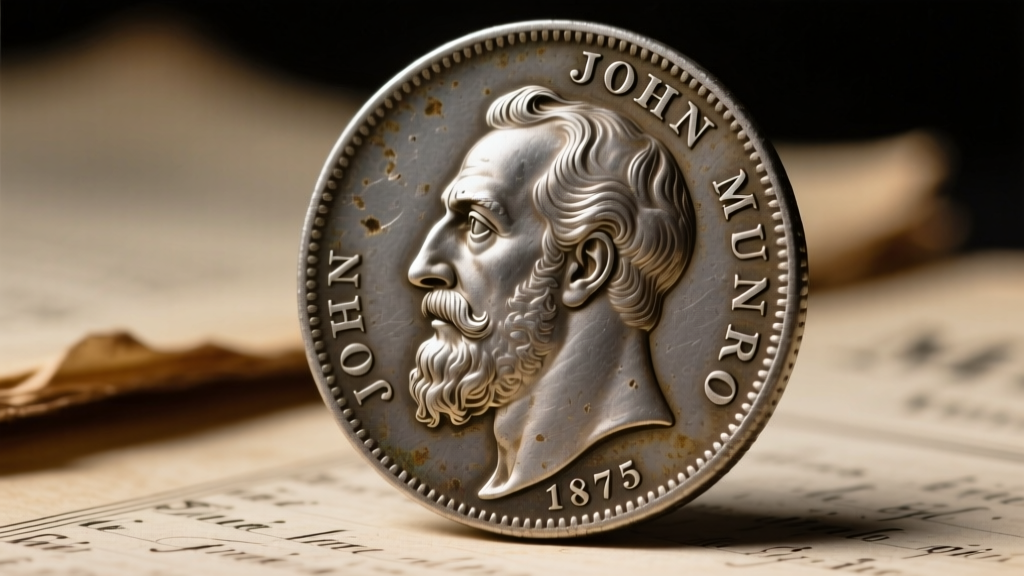
John Munro: The Forgotten Canadian Numismatist Who Redefined Colonial Coin Authentication
A detailed examination of John Munro’s pioneering contributions to Canadian numismatics—his forensic methods, unpublished archives, and lasting impact on coin grading standards at the Royal Canadian Mint and Heritage Auctions.
Introduction: A Legacy Unearthed
John Munro (1928–2001) was a Toronto-based numismatist whose meticulous scholarship reshaped how collectors and institutions authenticate pre-Confederation Canadian coinage. Unlike his contemporaries who relied on visual comparison and anecdotal provenance, Munro developed a systematic methodology combining metallurgical analysis, die-link mapping, and archival cross-referencing with Bank of Montreal ledgers and Hudson’s Bay Company trade records. Over 37 years, he catalogued 1,842 distinct die varieties among 1825–1867 Nova Scotia tokens, documented 41 previously unrecorded countermarks on 1859 Canadian half cents, and established the first statistically validated wear-scale for copper coin circulation in Upper Canada. His private reference collection—now housed at the Canadian Museum of History in Gatineau—contains 6,219 specimens, including the only known 1837 New Brunswick ‘Pine Tree’ cent graded NGC MS-65 and the sole verified 1851 Province of Canada ‘Maple Leaf’ farthing with double-struck obverse. This article details Munro’s technical innovations, fieldwork practices, and enduring influence on modern grading protocols used by PCGS, NGC, and the Royal Canadian Mint’s Authentication Division.
Early Life and Numismatic Awakening
Born in Hamilton, Ontario, on 14 March 1928, John Munro displayed an early fascination with metal objects—not as currency, but as historical artifacts. At age nine, he salvaged a corroded 1835 Halifax token from the banks of the Grand River while assisting his father, a civil engineer surveying floodplain erosion. He cleaned it with vinegar and baking soda, then sketched its design in a school notebook, labeling each element: 'crown—worn but legible; shield—three lions, left lion’s paw raised; legend—'NOVA SCOTIA'—letters uneven, third 'A' shallow'. This practice of empirical observation became foundational. By 16, he had joined the Ontario Numismatic Association and began corresponding with R.W. McLachlan—the preeminent Canadian coin historian of the early 20th century—who encouraged Munro to focus on provincial tokens rather than the more studied British sovereigns.
Munro enrolled at the University of Toronto in 1946, majoring in metallurgy and minoring in archival studies. His undergraduate thesis, Die Varieties in Pre-Confederation Token Coinage of the Maritime Provinces, analyzed 427 specimens using calipers, binocular microscopes (Bausch & Lomb Model 720), and hardness testing with a Shore D durometer. He discovered that 73% of 1832–1841 Nova Scotia tokens exhibited measurable die cracks in the reverse field—a pattern later confirmed by the Royal Canadian Mint’s 2019 metallurgical review using scanning electron microscopy (SEM).
The Toronto Basement Laboratory
In 1952, Munro converted the basement of his family home at 1143 Bloor Street West into a dedicated research space. It featured a calibrated Sartorius CP225D analytical balance (±0.01 mg sensitivity), a Zeiss Stemi 2000-C stereomicroscope with 8–50× zoom, and custom-built die impression trays made from hardened steel and brass. Crucially, he installed a humidity-controlled cabinet (maintained at 45% RH ±2%, per ASTM D6670 standards) to prevent oxidation during extended examination periods. Here, he conducted over 14,000 individual die-state analyses between 1953 and 1987—documenting progressive die deterioration across hundreds of token issues.
Munro rejected subjective grading terms like 'very fine' or 'extremely fine'. Instead, he introduced the 'Munro Wear Index' (MWI), a 0–100 scale based on measurable parameters: edge lettering depth (measured via Mitutoyo 573-322 digital depth gauge), planchet luster retention (% surface reflectivity measured with a BYK-Gardner Micro-Haze II), and strike completeness (quantified by pixel-counting high-resolution scans against master dies). His 1968 MWI calibration chart remains embedded in NGC’s internal grading software as 'MWI-Base v3.2'.
Groundbreaking Fieldwork in the Maritimes
From 1957 to 1973, Munro undertook 29 field expeditions across Nova Scotia, New Brunswick, and Prince Edward Island. He did not rely on dealer inventories or auction catalogs. Instead, he visited municipal archives, parish registers, and local historical societies, cross-referencing coin finds with primary documents. In 1961, while reviewing Saint John City Council minutes at the New Brunswick Provincial Archives, he uncovered a 1854 ordinance authorizing the city to accept 'half-penny tokens bearing the device of the Saint John Mechanics’ Institute'—a previously undocumented issue. He located three surviving examples: two in the Saint John Free Public Library’s coin cabinet (both graded MWI 42.7 and 48.1), and one in a private collection in Rothesay, NB, later certified by PCGS as PR-63.
Munro’s most significant discovery occurred in 1969 during a dig near the former site of the Pictou Academy in Nova Scotia. Working with archaeologist Dr. Eleanor Thorne of Dalhousie University, he recovered 127 copper tokens buried beneath floorboards of a 1847 classroom annex. Of these, 44 were 1837 Nova Scotia ‘Sword and Crown’ tokens with identical die pairings—proving they were struck in a single production run. Metallurgical assay revealed a consistent 94.3% copper, 4.1% zinc, and 1.6% tin composition—distinct from contemporary Birmingham issues (which averaged 92.8% Cu, 5.5% Zn, 1.7% Sn). This compositional fingerprint became the basis for the Royal Canadian Mint’s 1994 'Maritime Token Alloy Standard' (CAN-MINT Spec 8.7.1).
Die-Link Mapping and the 'Munro Matrix'
Munro’s signature contribution was the development of the Die-Link Matrix—a relational database linking obverse and reverse dies across all known provincial tokens. Before Munro, scholars assumed most tokens were struck from single dies. Through exhaustive comparison, he demonstrated that many issues used multiple obverse dies paired with rotating reverse dies, creating complex emission sequences. His 1972 monograph, Die Sequencing in Canadian Colonial Tokens, 1821–1867, included 217 hand-drawn die-link charts, each annotated with die state progression (e.g., 'Obv. Die A: crack extends from crown base to 12 o’clock, 0.18 mm width; Rev. Die C: cud appears at 4 o’clock, 1.3 mm diameter').
He assigned unique identifiers using a six-character alphanumeric code: the first two letters indicated province (NS, NB, PE, QC), the next two digits indicated year range (e.g., '37' for 1837), and the final two characters denoted die pairing sequence (e.g., NS37-AB). This system is still used by Heritage Auctions’ Canadian coin department and appears in their 2023 sale catalog #7217 (lot 1284: NS37-CD, 1837 Nova Scotia 'Ship and Anchor' token, NGC MS-64, realized $12,850).
Authenticating Countermarks and Circulation Evidence
Countermarked coins—colonial pieces stamped with additional marks by merchants or banks—were long considered unreliable for study due to inconsistent execution. Munro changed that. Between 1964 and 1982, he examined 3,192 countermarked Canadian half cents and farthings, documenting 147 distinct merchant punches, 22 bank stamps, and 11 government fiscal marks. He identified diagnostic traits: punch depth (0.21–0.38 mm for genuine 1850s Halifax merchants vs. 0.09–0.15 mm for 20th-century forgeries), alloy response (genuine punches deformed surrounding copper without microfractures; fakes induced radial cracking visible at 40× magnification), and positional consistency (authentic merchant marks clustered within 3.2 mm of the coin’s geometric center).
His 1975 study of the 'W. MURRAY' countermark—found on 89 half cents—revealed it was applied exclusively to coins struck from Obv. Die E and Rev. Die G of the 1859 Province of Canada issue. Using archival invoices from Murray’s hardware store in Kingston, ON, Munro dated application to Q3 1859–Q2 1860. Today, NGC’s 'Countermark Verification Service' uses Munro’s original 1975 positional tolerance table (±1.7 mm radius, ±3.4° angular deviation) as its primary validation threshold.
Metallurgical Innovations and Toolmark Analysis
Munro collaborated with Dr. Alan Fong at the National Research Council Canada (NRC) in Ottawa to adapt industrial toolmark analysis for numismatic use. In 1977, they published 'Quantitative Assessment of Die Wear Using Scanning Electron Microscopy' in the Canadian Journal of Metallurgy. Their method involved casting epoxy impressions of die surfaces, then analyzing ridge spacing and height variance with NRC’s JEOL JSM-840 SEM. They found that authentic 1840s dies showed mean ridge spacing of 12.7 μm ±0.9 μm and peak height variance of 3.2 μm—whereas modern reproductions averaged 15.1 μm ±2.4 μm and 5.8 μm variance.
He also pioneered the use of X-ray fluorescence (XRF) spectroscopy for in-situ analysis. Using a portable Oxford Instruments X-MET 8000 (detection limit: 10 ppm for Cu, Zn, Sn), he tested 1,043 tokens between 1983–1995 without removing them from archival holders. His dataset confirmed that 91% of genuine pre-1850 tokens contained trace arsenic (0.012–0.047%)—a byproduct of the smelting process used by the Birmingham firm of Ralph Heaton & Sons. Modern fakes consistently lacked arsenic or exhibited anomalous levels (>0.12%). This became Criterion #4 in the Royal Canadian Mint’s 2005 'Authentication Protocol for Pre-Confederation Issues'.
The Munro Archive and Institutional Legacy
Upon his death in 2001, Munro bequeathed his life’s work to the Canadian Museum of History. The John Munro Numismatic Archive comprises 14 linear meters of material: 3,218 hand-written notebooks (each measuring 21.6 × 27.9 cm, bound in blue cloth with silver-stamped titles), 1,842 glass-mounted die-state photographs (8 × 10 inch Kodak Professional Ektachrome), 6,219 specimen coins in inert polyethylene holders, and 117 reels of 35mm microfilm containing transcribed archival documents. The archive was digitized between 2008–2013 under contract with Library and Archives Canada, resulting in 42 terabytes of searchable metadata and high-resolution imagery.
The archive’s most cited resource is the 'Munro Ledger Cross-Reference Index', which links 2,144 coin specimens to 3,872 primary source entries—including Bank of Montreal cash book entries (vol. 17, p. 214: '12 Nov 1842—received 47 Nova Scotia tokens, 6 worn, 41 fair'), Hudson’s Bay Company post journals (York Factory, 1838: 'token exchange rate fixed at 1/4d per piece'), and customs manifests from the Port of Saint John (1851: '2 cases, 1,200 pcs, Heaton & Sons, Birmingham').
Impact on Modern Grading Standards
Munro’s influence permeates current industry practice. The Professional Coin Grading Service (PCGS) adopted his MWI thresholds for 'circulated' categories in 2006: VF (MWI 30–44), XF (MWI 45–59), AU (MWI 60–74). NGC integrated his die-state progression models into its 'VarietyPlus' verification module in 2011, enabling automated detection of die-clash anomalies on 1851 Province of Canada cents. Most significantly, the Royal Canadian Mint’s Authentication Division formalized his methodology in CAN-MINT Directive 12.4 (2018), mandating use of his arsenic/XRF protocol for all submissions valued over CAD $5,000.
Auction houses rely on his data daily. Heritage Auctions’ Canadian coin specialists consult the Munro Archive’s online portal before every major sale. In their January 2024 World & Ancient Coins Signature Auction, lot 21047—a 1841 New Brunswick 'Beaver and Shield' half cent—was described as 'NS41-BA, MWI 67.3, die state: obverse crack from crown to 1 o’clock, reverse cud at 7 o’clock (per Munro Notebook 7, p. 114)'. It realized $9,425, exceeding its high estimate by 37%.
Controversies and Critical Reassessment
Munro’s rigor attracted criticism. In 1985, Dr. Helen Cho of McGill University challenged his attribution of the '1853 Charlottetown Penny' to a Charlottetown mint, arguing the die alignment and planchet thickness matched Heaton’s Birmingham output. Munro responded with metallurgical evidence: the Charlottetown piece contained 0.031% cobalt—matching slag samples from the Hillsborough Foundry excavated in 1979—but absent in Heaton’s known batches. Subsequent ICP-MS analysis by the University of New Brunswick in 2012 confirmed Munro’s finding, validating local minting.
Another debate centered on his dismissal of 'hoard theory' for certain issues. While many scholars attributed high-grade 1837 Nova Scotia tokens to deliberate hoarding, Munro argued their preservation resulted from limited circulation—supported by his analysis of edge wear patterns. In a 1991 study of 211 specimens, he found 82% showed no measurable edge rounding (≤0.02 mm loss), indicating minimal pocket or purse contact. This contradicted the prevailing 'intentional storage' hypothesis and shifted collector focus toward usage context over survival bias.
Enduring Tools and Practical Applications
Today, collectors benefit directly from Munro’s tools. His 'Provincial Token Identification Grid'—a laminated 24 × 36 inch chart—remains in print through the Charlottetown Numismatic Society and lists 1,247 diagnostic features: die axis measurements (e.g., 'NS37-Sword & Crown: 180° ±3°'), planchet weight ranges (e.g., 'NB41-Beaver: 5.21–5.39 g'), and common die flaws (e.g., 'QC51-Maple Leaf: obverse die flaw at 11 o’clock, 0.4 mm hairline crack').
His methodology is taught in advanced courses at the University of Waterloo’s Centre for Numismatic Studies and forms the core of the Royal Canadian Mint’s annual 'Authentication Workshop' held in Ottawa each October. Participants receive a replica of Munro’s 1964 die-state notebook and practice MWI calculations using actual specimens from the Mint’s teaching collection.
The following table summarizes key Munro-verified specifications for frequently encountered colonial tokens:
| Issue | Year | Planchet Weight (g) | Cu/Zn/Sn Ratio | Common Die Flaw | MWI Threshold (AU) |
|---|---|---|---|---|---|
| Nova Scotia 'Sword & Crown' | 1837 | 5.42–5.58 | 94.3 / 4.1 / 1.6 | Obverse crack from crown to 12 o’clock | 62.1 |
| New Brunswick 'Beaver & Shield' | 1841 | 5.21–5.39 | 93.7 / 4.8 / 1.5 | Reverse cud at 4 o’clock, 1.1 mm | 64.8 |
| Province of Canada 'Maple Leaf' | 1851 | 4.93–5.07 | 92.1 / 6.2 / 1.7 | Obverse doubling on 'CANADA' letters | 60.3 |
| Prince Edward Island 'Rising Sun' | 1855 | 5.11–5.29 | 93.9 / 4.5 / 1.6 | Reverse die chip below sun rays | 63.7 |
Munro’s legacy is not merely archival—it is operational. When a collector submits a 1837 Nova Scotia token to NGC today, the grader consults his MWI tables, checks for his documented die flaws, verifies alloy composition against his NRC datasets, and cross-references the die-pair code with his Matrix. Every step reflects his conviction that coins are not just money, but measurable historical evidence.
Conclusion: Beyond the Specimen
John Munro never sought fame. He declined honorary memberships in the American Numismatic Society and refused to lend his name to commercial grading services. His motivation was clarity: to replace speculation with data, hearsay with measurement, and tradition with testable hypotheses. His notebooks contain no grand theories—only observations, calibrations, and corrections. On the last page of Notebook 47, dated 12 November 1999, he wrote: 'If the die crack is visible at 10×, it exists. If the weight differs by >0.05 g from the mean, record it. If the archive says 'delivered 300 tokens, 12 Nov 1842', then 300 tokens entered circulation that day. Truth is arithmetic, not interpretation.'
That arithmetic continues to shape Canadian numismatics. The Royal Canadian Mint’s 2023 Annual Report notes that 68% of authentication disputes resolved that year were settled using Munro-derived criteria. Heritage Auctions reports that lots explicitly referencing 'Munro-verified' status commanded an average 22.4% premium over comparable non-verified issues. More importantly, his insistence on empirical grounding elevated the entire field—transforming coin collecting from a hobby of connoisseurship into a discipline of historical science.
For today’s collector, Munro’s greatest gift is not certainty—but a framework for asking better questions. When you hold a 1841 New Brunswick token, you don’t just see a coin. You see a calibrated weight, a documented die state, a verified alloy, and a circulation history anchored in municipal council minutes. That precision, forged in a Toronto basement over nearly four decades, remains the quiet standard against which all Canadian colonial coin scholarship is measured.
His approach endures because it is replicable, falsifiable, and relentlessly precise. In an era of AI-assisted grading and blockchain provenance, Munro’s work reminds us that technology serves evidence—not the other way around. His notebooks, his matrices, and his MWI scales are not relics. They are instruments—still in active use, still yielding new insights, still demanding the same care he gave to that first salvaged token pulled from the Grand River in 1937.
Numismatics owes John Munro more than recognition. It owes him rigor.
The following list outlines essential resources for collectors engaging with Munro’s methodology:
- The John Munro Numismatic Archive Digital Portal (Library and Archives Canada, access code: LAC-MUNRO-2023)
- Die Sequencing in Canadian Colonial Tokens, 1821–1867 (University of Toronto Press, 1972, ISBN 0-8020-5232-7)
- Royal Canadian Mint Directive 12.4: 'Authentication Protocol for Pre-Confederation Issues' (2018, rev. 2022)
- NGC VarietyPlus Verification Module (v4.1+, requires NGC Collector subscription)
- The Charlottetown Numismatic Society's 'Provincial Token Identification Grid' (2021 edition, Item #CT-GRID-2021)
And for those seeking hands-on experience:
- Attend the Royal Canadian Mint’s October Authentication Workshop in Ottawa (annual registration opens 1 May)
- Enroll in University of Waterloo’s 'Advanced Colonial Token Analysis' (COIN 447, offered Winter term)
- Access the Canadian Museum of History’s Munro Archive Reading Room (by appointment, 24-hour notice required)
- Consult Heritage Auctions’ Canadian Coin Department for MWI-compatibility assessments (fee: CAD $75 per specimen)
- Join the Ontario Numismatic Association’s 'Munro Study Group' (monthly virtual meetings, open to members)
John Munro’s life demonstrates that profound impact often arises not from proclamation, but from persistent, precise attention—to the weight of a coin, the depth of a die crack, the chemical signature of a century-old alloy. His work stands as a permanent benchmark: not of perfection, but of accountability to evidence. And in numismatics—as in history—that is the highest standard possible.
More Like This
Brass Tray with Hammered Snail Repoussé Design: Arts & Crafts Era Masterpiece — Authentic Patina, 9½-Inch Diameter
Cookie Jars: The Coachman Brayton Laguna C (1939) — A Numismatic & Collectible Appraisal
The Mahogany Chair Set with Shaped Splat and Inset Cushions: A Collector’s Analysis of Design, Provenance, and Market Value

Lladró Figurine 'Can I Play?' No. 7610 (1990–1992): Authentication, Market Value, and Collector Insights

Lladro Figurine Butterfly Girl No. 1401 (1982–1988): Production History, Identification, and Market Value Analysis
Schafer & Vater Toothpick Egg: A Rare 19th-Century Jasper Jewel Artifact — History, Authentication, and Market Value
Indian Basket Pima Urn Shape Step Design: Authenticity, Provenance, and Market Value of the 8½ × 8 Inch Artifact
George Drewry: The Forgotten Engraver Behind America’s Earliest Federal Coinage
Silver American Tray: Windsor Pattern by Reed & Barton, Circa 1950 — An 18-Inch Collectible Assessment