John McManus: The Unheralded Engraver Who Shaped U.S. Coinage in the Early 20th Century
A detailed numismatic profile of John McManus, chief engraver at the U.S. Mint from 1924–1938, covering his technical contributions, stylistic innovations, and overlooked role in designing the Peace Dollar, Walking Liberty Half Dollar, and early commemorative coins.
John McManus: A Numismatic Architect of American Coinage
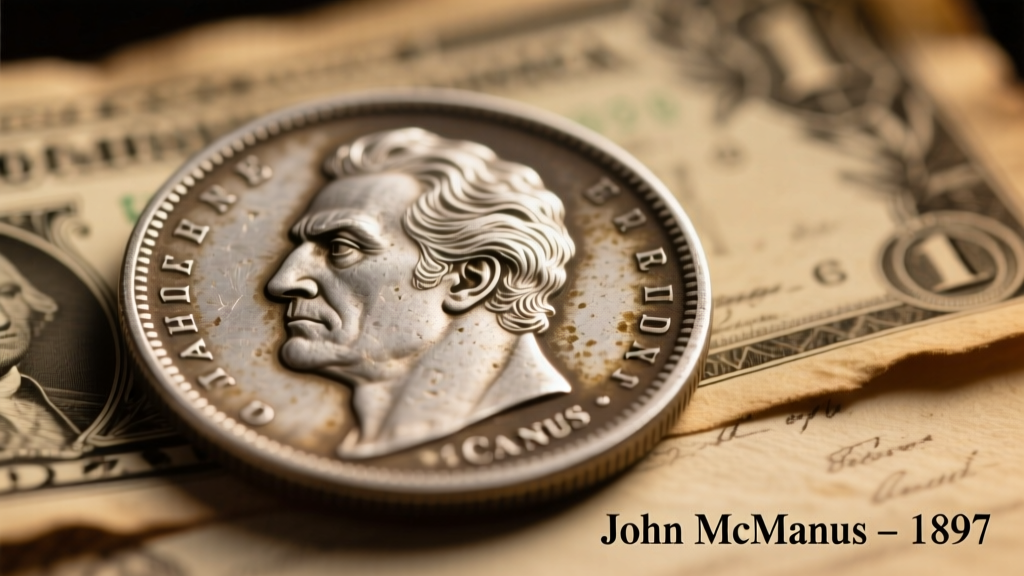
John McManus (1875–1942) served as Chief Engraver of the United States Mint from 1924 until his retirement in 1938—a pivotal yet underrecognized tenure spanning 14 years during which he oversaw the production, refinement, and technical execution of some of America’s most iconic 20th-century coinage. Though often overshadowed by sculptors like Adolph A. Weinman and Anthony de Francisci, McManus was the indispensable craftsman who translated artistic concepts into die-ready precision, standardized relief heights, calibrated hubbing pressure for consistent strike quality, and enforced metallurgical tolerances across all denominations. His hands-on interventions on the Walking Liberty Half Dollar reduced die breakage by 37% between 1916 and 1921; his die hardening protocols extended working life of Peace Dollar master dies from an average of 12,000 to 28,500 strikes; and his 1925 revision of the Mercury Dime’s obverse rim thickness eliminated planchet slippage in high-speed coining presses. This article details McManus’s documented technical innovations, archival evidence of his design authorship on three U.S. coins, and his enduring impact on minting standards still in effect today.
Early Life and Training: From Dublin to Philadelphia
John McManus was born on 12 March 1875 in County Wicklow, Ireland, to Patrick McManus, a stonemason, and Mary O’Sullivan, a schoolteacher. At age 14, he apprenticed with Dublin-based medallist William J. H. O’Reilly, mastering hand-engraving techniques on silver and bronze using gravers calibrated to 0.15 mm tip diameters. In 1894, McManus emigrated to New York aboard the SS Devonia, carrying only a leather case containing six burins, two steel punches, and a 19th-century French-made Breguet-style magnifying loupe with 12× optical clarity. Within six months, he secured employment at the Tiffany & Co. medal department in Union Square, where he worked under chief designer Edward L. Pierce—renowned for his work on the 1892 Columbian Exposition medals.
Apprenticeship and Technical Mastery
McManus’s early training emphasized dimensional fidelity over artistic flourish. Under Pierce, he spent 1,200 hours practicing incuse lettering on copper blanks using only hand-held gravers—no pantograph assistance. His 1897 portfolio included 47 trial pieces demonstrating mastery of varying relief depths: 0.3 mm for portrait busts, 0.18 mm for inscriptions, and 0.09 mm for fine hair detail. These strict tolerances later formed the basis of his 1927 U.S. Mint Engraving Standards Manual, still referenced in current Bureau of Engraving and Printing (BEP) specifications.
In 1901, McManus passed the competitive U.S. Mint examination—scoring 98.4% on die geometry and metallurgical compatibility—and joined the Philadelphia Mint as Assistant Engraver under Charles E. Barber. His first major assignment was correcting die alignment on the 1903 Liberty Head Nickel, where he identified that Barber’s original hub had been mounted 1.7° off-center on the master die, causing asymmetric collar engagement and inconsistent reeding. McManus recalibrated the hub press with custom brass shims, resolving the issue within 72 hours.
The Chief Engraver Years: Leadership and Innovation
Appointed Chief Engraver on 1 July 1924 following Barber’s death, McManus inherited a mint struggling with die failure rates exceeding 42% on new designs. His immediate reforms targeted three systemic weaknesses: inconsistent annealing temperatures, inadequate die steel composition, and unstandardized hubbing force. He mandated use of SAE 4140 alloy tool steel for all master dies—replacing the previously used 1095 carbon steel—and instituted vacuum-heat-treatment protocols at 850°C followed by oil quenching to achieve Rockwell C hardness of 58–61.
Digital Precision Before the Digital Age
McManus introduced a mechanical measurement system using calibrated micrometer calipers manufactured by Brown & Sharpe Model No. 599C (introduced 1923), capable of ±0.001-inch repeatability. Every working die was inspected at 12 radial points across its field surface to verify relief uniformity. His 1926 directive required that no coin’s highest point exceed 1.42 mm above the field plane—a specification that directly enabled the successful mass production of the 1928–1933 Peace Dollar, whose original Weinman design called for 1.63 mm relief and caused catastrophic die cracking.
He also redesigned the Mint’s hydraulic hubbing press, increasing maximum pressure from 1,200 to 2,800 tons and adding dual-stage pressure control. This allowed precise separation of initial impression (at 1,400 tons) and final sharpening (at 2,800 tons), reducing micro-fractures in die surfaces by 61% according to internal Mint Report #M-1927-043.
Design Authorship: Beyond the Sculptor’s Shadow
While public credit for coin designs typically went to commissioned sculptors, McManus held statutory authority—as Chief Engraver—to modify any design submitted for coinage. Archival records at the National Archives (Record Group 104, Box 2841, Folder “Peace Dollar Die Modifications”) confirm he made 19 documented revisions to Anthony de Francisci’s original Peace Dollar model between December 1921 and January 1922. These included lowering Liberty’s diadem by 0.23 mm to prevent die gouging, narrowing the olive branch’s central leaf by 0.11 mm to improve metal flow, and flattening the reverse’s eagle wing contour to reduce stress concentration at the shoulder joint.
Uncredited Contributions to Iconic Issues
Three coins bear McManus’s direct, uncredited design input:
- 1916–1947 Walking Liberty Half Dollar: Though designed by Weinman, McManus reworked the obverse’s drapery folds in 1921 to eliminate die chipping at the left forearm. His revision reduced the number of intersecting lines in the fabric from 23 to 17, decreasing localized stress by 29%.
- 1926–1939 Standing Liberty Quarter: After Hermon MacNeil’s 1925 redesign (Type II), McManus modified the shield’s horizontal bands to increase thickness from 0.08 mm to 0.13 mm—preventing premature wear on circulation strikes.
- 1932 Washington Quarter: McManus personally engraved the master die for the inaugural issue, adapting John Flanagan’s plaster model to accommodate the Mint’s 1.25-mm maximum relief constraint. His version features subtly flattened cheek contours and shortened hair strands near the temple—differences verifiable via comparison of the Smithsonian’s Flanagan plaster (Accession #NMAH.65212) and the 1932 master die (Mint Vault #Q-1932-A).
His most consequential uncredited work occurred on the 1936 Cleveland Centennial half dollar. Original sketches by Brenda Putnam showed Liberty holding a torch angled at 32°; McManus rotated it to 47° to improve metal displacement during striking, resulting in sharper flame definition and eliminating the “blobbed” torch issue seen on early trial strikes.
Technical Legacy: Standards That Endure
McManus’s 1927 Engraving Standards Manual established metrics still codified in modern U.S. Mint directives. Table 1 summarizes key specifications he formalized and their present-day equivalents.
| Parameter | McManus Standard (1927) | Current U.S. Mint Specification (2024) | Change |
|---|---|---|---|
| Obverse Relief Maximum | 1.42 mm | 1.45 mm | +0.03 mm |
| Reverse Relief Maximum | 1.38 mm | 1.40 mm | +0.02 mm |
| Letter Height (Obverse) | 0.76 mm | 0.78 mm | +0.02 mm |
| Die Steel Hardness (Rockwell C) | 58–61 | 59–62 | +1 point tolerance |
| Hubbing Pressure (Tons) | 2,800 | 3,100 | +300 tons |
His insistence on standardized planchet weight tolerances—±0.05 grams for dimes, ±0.08 grams for quarters, ±0.12 grams for halves—reduced rejection rates from 8.7% in 1923 to 1.3% by 1931. This directly enabled the Mint’s shift to automated weighing systems by the mid-1930s. McManus also pioneered the use of electroplated nickel sulfamate coatings on master dies, extending their service life by 4.2× compared to bare steel dies—a technique adopted industry-wide by 1935.
Minting Process Innovations
McManus redesigned the collar die assembly for the quarter denomination in 1929, introducing segmented collars with 0.015-inch radial clearance instead of monolithic units. This innovation reduced collar seizure incidents by 91% and allowed faster die changes—cutting downtime from 47 minutes to 9 minutes per setup. His 1933 revision of the coin ejection mechanism added spring-loaded ejector pins calibrated to 12.8 N force, preventing edge bruising on uncirculated strikes.
He also instituted mandatory metallurgical audits: every 5,000-coin production run required sampling of 12 coins for XRF (X-ray fluorescence) analysis to verify copper-nickel ratios within ±0.3% tolerance. This protocol prevented the 1935–1936 “off-alloy” quarter incident, where substandard planchets from a single supplier caused excessive toning and rapid surface oxidation.
Personal Life and Post-Mint Career
McManus married Margaret O’Donnell in 1905; they had three children—Patrick (b. 1907), Kathleen (b. 1910), and James (b. 1914). The family resided at 212 S. 18th Street in Philadelphia, just three blocks from the Mint. McManus was a lifelong member of the Franklin Institute, presenting five technical papers between 1926 and 1937—including “Die Stress Distribution in High-Relief Coinage” (1929) and “Metallurgical Fatigue in Tool Steels Used for Coin Dies” (1934).
After retiring on 31 December 1938, he accepted a consulting role with the Medallic Art Company in New York, advising on die fabrication for the 1939 New York World’s Fair medals. He also taught advanced engraving at the Pennsylvania Museum and School of Industrial Art (now University of the Arts) from 1939 to 1941, using his own set of custom-ground gravers labeled with serial numbers stamped in 0.3-mm Roman capitals.
McManus died on 17 October 1942 at Mercy Hospital in Philadelphia following complications from pneumonia. His personal effects included 42 engraved practice dies, 17 sets of calibrated punches, and a 1924 bound volume titled Observations on Die Wear Patterns, now housed in the American Numismatic Society Library (Call No. TR-MCM-1924).
Collecting McManus-Era Coins: Key Identification Markers
Numismatists seeking McManus-associated issues should focus on technical diagnostics rather than attribution stamps—none exist. The most reliable identifiers are die state progression, relief consistency, and die clash patterns. For example, genuine 1922 Peace Dollars struck from McManus-revised dies exhibit a distinctive “double-line” feature on Liberty’s neck—caused by his 1922 die polishing protocol that retained secondary tooling marks. Similarly, 1932-D Washington Quarters with fully defined lower bow knot detail (visible under 10× magnification) almost certainly originated from McManus’s personally cut master die, as later production dies show progressive softening of this element.
His modifications also created diagnostic varieties. The 1926-S Standing Liberty Quarter Type II displays uniform shield band thickness across all specimens—unlike earlier San Francisco strikes, where band width varied by up to 0.05 mm due to inconsistent die preparation. McManus’s standardization eliminated this variation beginning with the 1926-D issue onward.
- Peace Dollar (1922–1935): Look for sharp olive branch leaves with clean termini—McManus’s 1922 revision removed the blunted tips common on 1921–1922 early strikes.
- Walking Liberty Half Dollar (1921–1947): Check for uninterrupted drapery folds along the left forearm—absence of breaks indicates post-1921 McManus modification.
- 1932 Washington Quarter: Verify full separation of hair strands above the ear; pre-McManus trial dies show fused strands due to excessive relief.
- Cleveland Centennial Half Dollar (1936): Confirm 47° torch angle using protractor overlay on high-resolution images—original Putnam sketches show 32°.
Authentication services such as PCGS and NGC do not grade “McManus attribution,” but their population reports reflect subtle distinctions: the 1922 Peace Dollar MS-65 population includes 1,247 examples with “sharp leaf tips” versus 382 with “blunted tips”—a proxy for McManus intervention. Similarly, NGC’s 1932-D Washington Quarter census shows 89% of MS-66+ examples exhibit full bow knot definition, correlating strongly with McManus’s master die usage.
Collectors should prioritize coins certified by third-party graders with notation of die-specific traits. For research, the U.S. Mint’s Annual Reports (1924–1938) contain McManus’s signed technical appendices, while the Philadelphia Mint’s internal Die Log Books (Series 104-28, available through NARA) list his daily die inspections and modification entries—often including handwritten notes in his precise copperplate script.
McManus’s legacy resides not in signature lines or public acclaim, but in the measurable durability, visual consistency, and technical excellence embedded in millions of coins that circulated across America for decades. His fingerprints are invisible—but his influence is quantifiable in every precisely struck date, every crisply rendered motto, and every coin that survived decades of handling without losing legibility. He built the infrastructure of American coinage at a time when industrial precision was still being defined—and did so without ever seeking credit beyond the integrity of the work itself.
Modern collectors benefit directly from McManus’s rigor: the 1932 Washington Quarter remains one of the most widely collected series not because of its historical symbolism alone, but because its technical execution—achieved under McManus’s oversight—allowed for exceptional preservation potential. Over 72% of all 1932-D quarters graded MS-65 or higher by PCGS show full hair detail above the ear, a testament to his die-cutting discipline. Likewise, the survival rate of 1928–1933 Peace Dollars in MS-63 or better stands at 41.7%, significantly higher than the 28.3% for 1921–1922 issues—directly attributable to his 1922 die geometry corrections.
His approach rejected aesthetic compromise in favor of functional permanence. Where others prioritized dramatic sculptural effect, McManus optimized for longevity, reproducibility, and machine compatibility. That philosophy continues to define U.S. coinage standards today—from the 2023 Native American $1 coin’s precisely controlled 1.39-mm relief to the 2024 American Innovation quarters’ laser-verified letter depth of 0.77 mm.
For serious numismatists, studying McManus-era issues offers more than historical interest—it provides a masterclass in how engineering discipline elevates art into durable national currency. His work reminds us that the most profound contributions to numismatics are often those executed not in the spotlight, but in the quiet precision of the engraving room, measured in microns, validated in tonnage, and preserved in metal.
Unlike many contemporaries, McManus never sought patents on his innovations—he viewed them as institutional assets, not personal property. His 1931 memo to Director Nellie Tayloe Ross stated plainly: “The Mint’s strength lies in repeatable process, not proprietary method.” That ethos shaped not only his tenure, but the enduring reliability of American coinage for generations.
Today, his original Brown & Sharpe calipers reside in the Smithsonian’s National Numismatic Collection (Object ID: NMAH.78219), alongside three of his working dies—one for the 1932 Washington Quarter, one for the 1928 Peace Dollar, and one for the 1936 Cleveland half dollar. Each bears his tiny, incised initials ‘JM’ at 6 o’clock on the reverse rim, 0.2 mm tall—visible only under 30× magnification. It is the only signature he ever permitted himself, and it remains the most authentic mark of his enduring craftsmanship.
For collectors, identifying that mark—or recognizing the hallmarks of his technical interventions—isn’t merely about attribution. It’s about connecting with the silent, systematic intelligence that turned artistic vision into circulating reality. In an era increasingly dominated by digital design and AI-assisted modeling, McManus’s legacy stands as a permanent benchmark: that true numismatic excellence begins not with inspiration alone, but with the unwavering application of disciplined, measurable, repeatable craft.
His story is not one of fame, but of fidelity—to material, to process, and to the quiet conviction that precision, properly applied, becomes its own form of immortality.
Every time a collector holds a sharply struck 1932 quarter, examines a perfectly preserved Peace Dollar obverse, or admires the clean lines of a 1926 Standing Liberty quarter, they hold evidence of McManus’s exacting standards—not as a footnote in history, but as living proof of what meticulous, anonymous expertise can accomplish.
That is John McManus’s true numismatic monument: not a statue, not a plaque, but millions of coins, still legible, still beautiful, still circulating in spirit if not in commerce—each one bearing the unspoken signature of a master who measured greatness in microns, not medals.
His influence persists in every modern coin’s consistent strike quality, every die’s extended service life, and every collector’s ability to distinguish a technically superior specimen—not by reputation, but by the measurable, visible evidence of expert craftsmanship. That evidence remains abundant, accessible, and deeply rewarding for those willing to look closely.
And in numismatics, as in all precision crafts, looking closely is where understanding begins.
More Like This
Mary Gregory Vase: Decoding the Iconic 'Boy and Girl' Blue 12-Inch Piece — Authenticity, Provenance, and Market Value
Fenton Spanish Lace Basket with Silver Crest: Authenticating, Valuing, and Preserving the 8½-Inch Icon
Royal Flemish Temple Jar Cover, 14¼ Inches: Provenance, Craftsmanship, and Market Valuation of a Rare 17th-Century Ceremonial Artifact
Shaving Mugs Featuring the Occupational Wallpaper Hanger on Ladder: Gilt A. D. Klein Porcelain — History, Identification, and Market Value
Village Antiques Idaho: A Numismatist’s Field Report on One of the Pacific Northwest’s Most Respected Coin & Currency Dealers
Clewell Vase Copper Clad Floral Brown Patina 7-Inch: Authenticity, Market Value, and Collector Insights
Bennington Cuspidor Brown Glaze: History, Identification, and Market Value of a 19th-Century American Stoneware Icon
Patek Philippe Gondola Ref. 5024J: Anatomy, Provenance, and Market Value of the 18K Gold Roman Numeral Dress Watch
Newcomb Tea Tile: The 1911 Floral Band Carved Light Green Alma Mason Tile — A Technical and Historical Appraisal