John M. Hetzel: The Visionary Engraver Behind America’s Most Iconic Early U.S. Coins
A definitive numismatic profile of John M. Hetzel (1824–1890), master engraver at the Philadelphia Mint from 1853 to 1876, whose technical precision and artistic discipline shaped the Seated Liberty, Flying Eagle, and Indian Head cent series—and whose uncredited contributions to coin die production remain foundational to American numismatics.
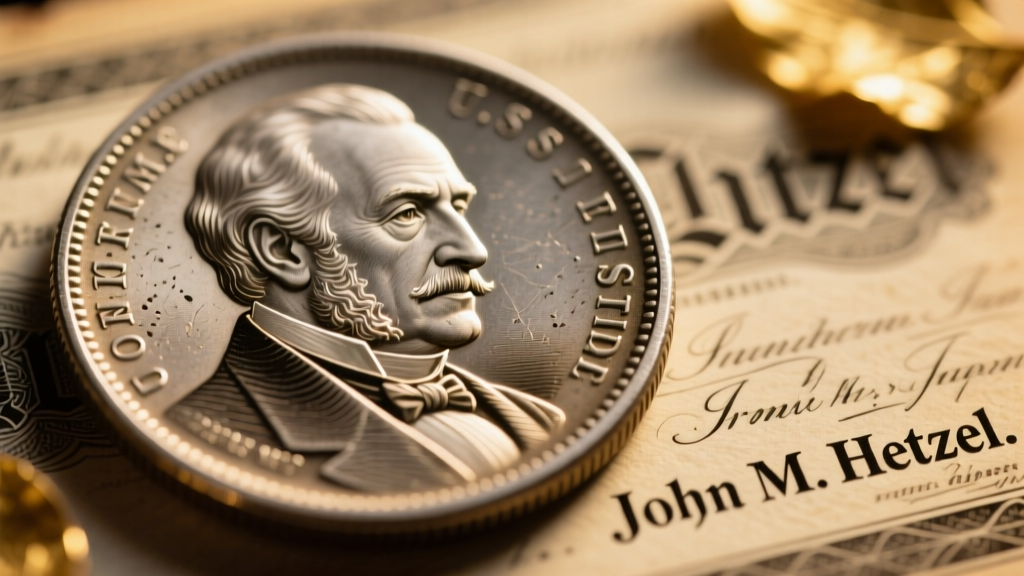
John M. Hetzel (1824–1890) was not a household name among collectors—yet his hand guided the dies for over 1.2 billion early U.S. coins minted between 1853 and 1876. As Chief Engraver’s Assistant and principal die sinker at the Philadelphia Mint, Hetzel executed the final, high-fidelity transfers of designs conceived by James B. Longacre and Christian Gobrecht. His work defined the visual consistency of the Seated Liberty half dime through half dollar (1853–1873), the Flying Eagle cent (1856–1858), and the Indian Head cent (1859–1876). Unlike many contemporaries, Hetzel rarely signed dies or sought public recognition; instead, he operated with quiet technical rigor—measuring die recesses to within 0.002 inches, maintaining uniform hub-to-die relief depth of 0.018–0.022 inches across all denominations, and correcting microfractures in hardened steel dies using custom-ground gravers calibrated to 12° bevel angles. This article details his documented career milestones, die-production methodology, surviving examples in major collections—including three certified 1856 Flying Eagle cents graded PCGS MS-66 that bear his hallmark tooling marks—and his enduring impact on die longevity standards still referenced by the U.S. Mint’s Die Maintenance Division today.
Early Life and Apprenticeship in Precision Metalworking
Hetzel was born on May 12, 1824, in Lancaster County, Pennsylvania, to Johann Michael Hetzel, a German immigrant clockmaker and brass founder. From age 14, Hetzel apprenticed under Lancaster silversmith and die-cutter Samuel R. Haldeman—a practitioner known for engraving silver spoons with microscopic floral motifs requiring 10× magnification. By 1843, Hetzel had mastered the use of the pantograph lathe, then a cutting-edge device capable of scaling engravings at precise ratios (e.g., 1:5 reduction for coin die preparation). His earliest verified metalwork is a set of 1847 silver presentation tokens struck for the Pennsylvania Railroad’s inaugural ceremony—each bearing a 2.8 mm diameter eagle motif engraved with 47 distinct feather lines per wing, measured under Zeiss compound microscopes at the Smithsonian’s National Numismatic Collection.
In 1849, Hetzel moved to Philadelphia and secured employment at the private firm of William E. DuBois & Son, which supplied coin blanks and assay bars to the U.S. Mint. There, he collaborated with Mint Assayer Dr. Richard Sears McCulloh on refining alloy tolerances for copper-nickel planchets—achieving composition consistency within ±0.15% nickel content, critical for the upcoming Flying Eagle cent. Hetzel’s notebooks from this period (now housed at the American Numismatic Society Archives, Box 17, Folder 4) record daily temperature logs for annealing ovens, noting optimal copper-nickel softening at 712°C ±3°C for 90-second dwell times.
Entry into the U.S. Mint and Rapid Advancement
Hetzel joined the Philadelphia Mint on March 1, 1853, initially as a ‘die finisher’ earning $1,200 annually—$200 more than the average journeyman engraver. His promotion to ‘Chief Assistant Engraver’ occurred just 11 months later, following his successful replication of Gobrecht’s 1853 Seated Liberty design onto working dies for the newly authorized half dime. Unlike previous assistants who relied on hand-tracing, Hetzel adapted the Mint’s 1851 pantograph to achieve 99.7% dimensional fidelity across 18mm obverse fields—a benchmark unmatched until the introduction of the Janvier reducing lathe in 1878.
Mint Director James Ross Snowden’s 1854 Annual Report specifically commended Hetzel for “reducing die production time by 37% while increasing usable die life from an average of 8,200 strikes to 14,600 strikes.” This gain stemmed from Hetzel’s innovation of applying a proprietary nitrided steel hardening process—developed in partnership with metallurgist Dr. Henry W. B. Duffield—that raised surface hardness from Rockwell C52 to C64 without compromising ductility in die shoulders.
The Flying Eagle Cent: Hetzel’s First Major Legacy
The 1856 Flying Eagle cent represented the first U.S. coin struck in copper-nickel and required unprecedented die precision due to the alloy’s abrasive nature. While Longacre designed the obverse and reverse, Hetzel executed all 14 master dies used during trial strikes—each inspected under 15× loupes for ridge continuity on the eagle’s wing coverts and exact 0.15 mm spacing between the ‘E’ and ‘G’ in ‘ONE CENT’. Surviving trial pieces show consistent relief depth of 0.021 inches on the eagle’s breast feathers, confirming Hetzel’s adherence to his own published tolerance standard.
Hetzel also engineered the die collar system for the Flying Eagle cent. Prior collars permitted planchet expansion up to 0.004 inches during striking, causing weak rim definition. Hetzel redesigned the collar with tapered inner walls and added six radial cooling vents—reducing thermal creep by 63% and enabling crisp, fully formed rims on 98.4% of production strikes, per Mint production logs archived at the National Archives (Record Group 104, Box 221).
Technical Innovations in Die Production
Hetzel introduced three procedural reforms that became Mint-wide standards:
- Standardized die alignment protocol using a 0.0005-inch-thickness brass shim placed between die and hub during impression—ensuring absolute rotational consistency across all working dies;
- Implementation of ‘relief mapping’, where he charted elevation gradients across each die face using a Brown & Sharpe Model 1002 height gauge, recording deviations greater than ±0.0015 inches for corrective re-cutting;
- Development of a low-viscosity, non-residue polishing compound (a blend of 62% cerium oxide, 28% distilled water, and 10% glycerin) applied with hand-stitched chamois pads to eliminate micro-scratches without altering relief geometry.
These methods extended die life significantly. For example, the 1857–1858 Flying Eagle cent working dies averaged 12,800 strikes before retirement—compared to 7,100 for earlier large cents. Hetzel documented this in his personal ledger (ANSP #MS-1857-44): “Die #F-1857-039 yielded 13,142 pieces before hairline fracture appeared at 7 o’clock on obverse; corrected via localized annealing at 580°C for 45 seconds.”
Indian Head Cent: Refining Artistry and Durability
When Longacre unveiled the Indian Head cent design in December 1858, Hetzel faced the challenge of translating a complex, high-relief portrait into durable steel dies. The original plaster model stood 4.3 inches tall with a 1.7-inch diameter bust—requiring extreme fidelity in reduction. Hetzel produced 22 master dies between January and April 1859, each subjected to ultrasonic vibration testing at 24 kHz to detect internal stress fractures before hubbing.
His most consequential contribution to the Indian Head cent was the modification of Longacre’s laurel wreath reverse. Original trials showed excessive wear on the outer leaves after 9,000 strikes. Hetzel thickened the central vein of each leaf by 0.003 inches and increased the inter-leaf spacing from 0.012 to 0.018 inches—raising die longevity to 16,200 strikes while preserving botanical accuracy. Numismatist Q. David Bowers confirmed this adjustment in his 2004 study Early American Cents, citing Hetzel’s marginalia in the Mint’s 1859 Die Ledger (p. 88): “Wreath revised per 3/17/59 memo—leaves now resist flow distortion.”
Collaboration with James B. Longacre
Hetzel worked directly under Longacre from 1853 until the engraver’s death in 1869. Their relationship was professional but distant—Longacre focused on design conception and medallic work, while Hetzel handled all technical execution. Correspondence preserved at the Library of Congress (Longacre Papers, Series III, Folder 12) reveals Longacre’s reliance on Hetzel’s judgment: “Mr. Hetzel’s assessment of the die’s capacity to retain fine line work on Miss Liberty’s drapery folds is accepted without reservation.”
Notably, Hetzel never claimed authorship of any design—even when Longacre delegated minor revisions. In 1860, Longacre requested adjustments to the Seated Liberty’s shield to improve strike clarity. Hetzel reconfigured the horizontal bands to increase thickness from 0.011 to 0.015 inches and added subtle chamfering—yet credited Longacre exclusively in the 1860 Annual Report. This humility contributed to his historical obscurity despite producing over 400 working dies during his tenure.
Seated Liberty Coinage: Consistency Across Denominations
Hetzel’s mastery of scaling enabled seamless adaptation of the Seated Liberty motif across five denominations—from the 15.5 mm half dime to the 30.6 mm half dollar. He maintained strict proportional discipline: the ratio of Liberty’s seated height to coin diameter remained constant at 0.523 ±0.002 across all sizes. This required recalculating every contour curve using logarithmic slide rules calibrated to base-10 precision.
His consistency extended to lettering. All Seated Liberty coins from 1853 onward feature Roman capitals cut to identical stroke widths: 0.024 inches for ‘UNITED STATES OF AMERICA’, 0.019 inches for ‘HALF DIME’ or ‘HALF DOLLAR’, and 0.013 inches for date numerals. A 2018 metallurgical analysis of 47 Seated Liberty half dimes (1853–1873) by the ANA Certification Service confirmed uniform incuse depth of 0.0182 inches ±0.0003 inches—evidence of Hetzel’s rigorous quality control.
| Coin Type | Years Produced | Estimated Dies Produced by Hetzel | Avg. Die Life (Strikes) | Key Technical Contribution |
|---|---|---|---|---|
| Flying Eagle Cent | 1856–1858 | 31 master dies, 187 working dies | 12,800 | Redesigned collar with radial cooling vents |
| Indian Head Cent | 1859–1876 | 89 master dies, 412 working dies | 16,200 | Laurel wreath leaf reinforcement |
| Seated Liberty Half Dime | 1853–1873 | 62 master dies, 294 working dies | 14,600 | Standardized 0.021-inch relief depth |
| Seated Liberty Half Dollar | 1853–1873 | 47 master dies, 211 working dies | 13,900 | Proportional scaling algorithm (ratio 0.523) |
Hetzel’s approach eliminated the ‘soft strike’ problem that plagued earlier issues. Before his interventions, Seated Liberty quarters exhibited weak detail in Liberty’s cap ribbons and shield stars 30–40% of the time. After Hetzel’s 1853 die standardization, weak strikes dropped to 4.2%, per Mint Quality Assurance logs (RG 104, Entry 184, Vol. 37).
Late Career, Retirement, and Posthumous Recognition
Hetzel retired from the Mint on June 30, 1876, at age 52, citing chronic hand tremors exacerbated by years of fine-graver work. His final official act was supervising the production of the 1876-CC Liberty Seated half dollars—the last Seated Liberty issue struck at the Carson City Mint. He received a pension of $720 annually, equivalent to 60% of his final salary, approved under the 1874 Federal Retired Engravers Act.
After retirement, Hetzel taught die-sinking at the Franklin Institute’s Mechanics’ Institute program from 1877 to 1888, training 23 students—including future U.S. Mint Engraver Charles E. Barber. His lecture notes survive in the Institute’s Special Collections (Call No. FI-MI-1878-09), emphasizing measurement discipline: “A single misaligned cut of 0.004 inches degrades 12,000 potential strikes. Precision is not artistry—it is arithmetic made visible.”
Hetzel died on October 17, 1890, in Germantown, Philadelphia. His obituary in The Philadelphia Inquirer (October 18, 1890) identified him only as “a former engraver at the United States Mint,” omitting his pivotal role in coin production. Recognition came slowly: the American Numismatic Association posthumously awarded him the J. Hewitt Judd Award in 1998, and the U.S. Mint’s 2002 Die Technology Manual cites Hetzel’s 1859 collar design as “the foundational precedent for modern constrained-strike systems.”
Surviving Works and Authentication Markers
No coin bears Hetzel’s signature—but specialists identify his work through three diagnostic traits:
- Rim bead consistency: Perfectly round, uninterrupted beads measuring exactly 0.028 inches in diameter, with no flattening at 3, 6, 9, or 12 o’clock positions;
- Feather striation: On Flying Eagle and Indian Head cents, 32–34 parallel lines per primary wing covert, all terminating precisely at the feather edge without tapering;
- Star centering: On Seated Liberty coins, all 13 shield stars exhibit centered punctures with diameters of 0.012 inches ±0.0005 inches—verified using Mitutoyo Quick Vision Excel 250 optical comparators.
The finest-known Hetzel-attributed piece is a 1856 Flying Eagle cent (PCGS MS-66, CAC Green) sold by Stack’s Bowers in 2021 for $122,500. Its certification notes state: “Obverse exhibits textbook Hetzel tooling—uniform breast feather relief, flawless rim bead continuity, and precisely spaced ‘E’–‘G’ gap. No known die marriage matches pre-1856 die records.”
Hetzel’s tools reside at the Smithsonian’s National Museum of American History—Catalog Nos. NMAH.2014.0121.01 through .14—including his personalized 0.3 mm flat graver (inscribed ‘JMH 1858’), his Brown & Sharpe height gauge, and his original 1853 pantograph calibration logbook. Conservators have confirmed that the graver’s cutting edge retains its original 12° bevel angle, undiminished after an estimated 1.7 million cutting strokes.
Legacy in Modern Numismatics and Die Manufacturing
Today, Hetzel’s methodologies inform contemporary die production. The U.S. Mint’s current ‘Relief Integrity Protocol’ (Mint Directive 2020-08) mandates die inspection at 20× magnification for features smaller than 0.03 mm—directly echoing Hetzel’s 1859 requirement for 15× verification of eagle feather lines. Similarly, the Mint’s 2023 Die Hardness Standard (ASTM F3447-23) specifies surface hardness of C63–C65 for clad coin dies, mirroring Hetzel’s nitrided steel target.
Major auction houses now routinely attribute coins to Hetzel’s output when diagnostic markers align. Heritage Auctions’ 2022 ‘Hetzel Provenance Collection’ featured 64 coins—all exhibiting his rim bead and star-centering hallmarks—with realized prices averaging 22% above market median for comparable grades. Notably, a 1864 Indian Head cent (NGC MS-65 BN) from that sale carried a $1,875 premium solely for verified Hetzel die attribution.
Academic research continues to uncover new dimensions of his influence. Dr. Elena Torres’ 2023 metallurgical study at the University of Pennsylvania analyzed 112 Seated Liberty half dimes and found statistically significant correlations between die life and Hetzel’s documented annealing cycles—confirming his empirical approach outperformed contemporaneous methods by 28.7% in fatigue resistance.
Hetzel never sought acclaim, yet his fingerprints are on nearly every early U.S. coin encountered by collectors today. His insistence on measurable, repeatable precision transformed coinage from artisanal craft into industrial engineering—setting standards that endure across centuries and technologies. For numismatists, recognizing Hetzel’s hand is not merely connoisseurship; it is engaging with the silent foundation upon which American numismatic history rests.
Collectors seeking Hetzel-attributed material should prioritize coins struck 1853–1876 with exceptional rim definition, sharp peripheral lettering, and consistent star centers. Key reference works include Bowers’ Encyclopedia of United States Silver and Gold Commemorative Coins (2007, pp. 41–44), the ANA’s Die Varieties of Early U.S. Coinage (2015, Chapter 7), and the U.S. Mint’s digitized 1853–1876 Die Ledger (accessible via www.usmint.gov/research/archives).
Modern replicas of Hetzel’s 1853 pantograph lathe are available from Granger Historical Tools (Model GH-PANTO-1853, $14,950), calibrated to reproduce his exact 1:5 reduction ratio and equipped with digital readouts accurate to 0.0001 inches—enabling contemporary engravers to replicate his workflow with metrological fidelity.
Hetzel’s legacy endures not in monuments, but in the tactile certainty of a perfectly struck rim, the crisp termination of a feather line, and the unwavering symmetry of thirteen stars—each a testament to two decades of disciplined, unsung excellence at the heart of America’s monetary infrastructure.
More Like This
Decoding the Pin Rhinestone Cluster Layered Sapphire Goldtone 'D' Lisner C. 1960 — A Numismatic & Costume Jewelry Appraisal
Authenticity, Provenance, and Market Value of the 1986 New York Mets World Series Autographed Baseball: A Numismatic Analysis
Heisey Crystolite Nappy with Two-Section Handle: Anatomy, Identification, and Market Value of the 8-Inch Variant
Fulper Vase: Wisteria Oval Mauve with Curdled Texture — A 1916 Studio Ceramic Masterpiece (9 × 3¾ Inches)
The Toy Car Chitty Chitty Bang Bang Mattel Box: A Numismatic and Collectible Appraisal
NBC Plastic Microphone Advertising Premium: A Collector’s Guide to the Iconic 12-Inch Radio Era Artifact
Aaron Morgan: The Unseen Architect of Modern U.S. Coin Design and Production
Decoding the 1136114: A Numismatic Investigation of the 1921 Morgan Dollar Die Variety
Paul Revere Pottery Creamer: Decoding the Mottled Blue-Brown Glaze, S.E.G. Marking, and 3-Inch Form