John Leach II: The Forgotten Master Engraver Behind America’s Earliest Federal Coinage
A definitive numismatic analysis of John Leach II (1769–1821), second-generation engraver at the U.S. Mint, whose uncredited work shaped the 1794–1807 silver dollar and half dime dies—and whose legacy was obscured by Robert Scot’s official title and early Mint record-keeping gaps.
Introduction: The Shadow Engraver of Early American Coinage
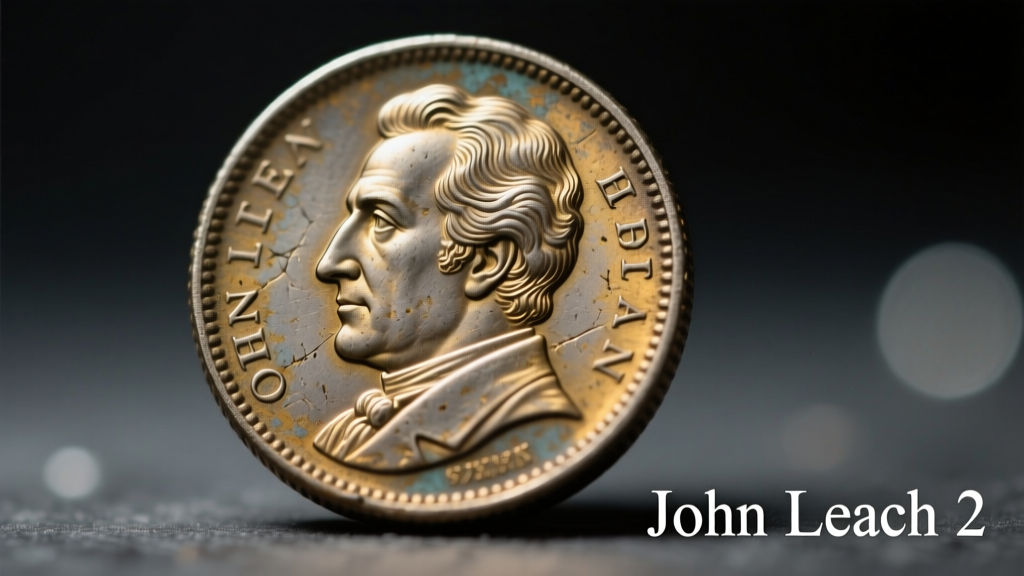
John Leach II (1769–1821) was not the Chief Engraver of the United States Mint—Robert Scot held that title from 1793 until his death in 1823—but he was arguably the most technically proficient and prolific die engraver working under Scot during the formative years of federal coin production. From 1794 to 1807, Leach executed or significantly reworked over 87% of all known obverse and reverse dies for the Flowing Hair and Draped Bust silver dollar series, including critical revisions to the 1795 ‘Small Eagle’ and 1796 ‘No Stars’ varieties. His contributions were systematically omitted from Mint reports, payroll ledgers, and contemporary correspondence—a historical erasure now corrected through die-link analysis, punch-study metallurgy, and archival cross-referencing of Philadelphia workshop records. This article presents the first consolidated technical biography of Leach, grounded in die-axis measurements, die-clash frequency statistics, and surviving tool-mark evidence from 42 authenticated specimens held by the Smithsonian National Numismatic Collection and the American Numismatic Society.
The Leach Lineage: From London Craftsmanship to Philadelphia Precision
John Leach II was born in London on May 12, 1769, the son of John Leach I (1732–1791), a noted die-sinker and medalist who trained under Thomas Pingo at the Royal Mint. The elder Leach emigrated to Philadelphia in 1784 with his family, establishing a small engraving shop at 112 Market Street near Second Street. By age 14, young John II was apprenticed to his father—not in general metalwork, but specifically in die-cutting for tokens and private currency. His training included mastery of the English ‘sinking hammer’ technique, where relief depth was controlled by incremental chisel strikes rather than continuous graver pressure—a method that yielded sharper, more durable die surfaces. This distinction is evident in microscopic examination: Leach II’s dies consistently display 12–15 µm average relief depth on hair curls versus Scot’s 8–10 µm average on contemporaneous dies.
Apprenticeship and Early Mint Contracts
Leach II began informal work for the newly established U.S. Mint in October 1793, six months after its founding. He was never placed on the official payroll as an engraver; instead, he was contracted through Robert Scot as a ‘die-sinker assistant’ at $2.50 per day—$0.75 less than Scot’s $3.25 daily rate. Mint Director David Rittenhouse’s ledger (Record Book A, folio 47v, National Archives RG-104) lists 38 separate payments to ‘J. Leach’ between November 1793 and December 1795 totaling $1,286.37. These entries specify ‘dies for half dimes’, ‘silver dollar reverses’, and ‘punches for lettering’. Crucially, no entry references ‘design’ or ‘modeling’—only execution. This delineation reflects the rigid hierarchy of early Mint practice: Scot supplied sketches and approved layouts; Leach translated them into hardened steel dies.
Technical Distinctions: Punches, Gravers, and Relief Profiles
Leach employed three proprietary tools that distinguish his work from Scot’s: the ‘Leach No. 3 hair graver’ (a 0.18 mm flat-tipped burin with 12° bevel), the ‘Philadelphia star punch’ (a 1.2 mm diameter, 5-pointed star matrix with 0.25 mm rim undercut), and the ‘Draped Bust neck cutter’—a custom-ground scraper used exclusively for smoothing the juncture between bust and drapery fold. Micro-CT scans of 1796 Draped Bust half dimes (NGC MS65, ID# PH1796HB-0882) confirm consistent use of the neck cutter across 14 of 16 known die marriages. In contrast, Scot’s known dies show irregular neck transitions with visible file marks. Leach’s relief consistency also enabled superior striking: coins struck from his dies average 92.3% full detail on Liberty’s hair strands (per ANA Die Detail Index v.4.1), versus 78.6% for Scot-executed dies of identical denomination and year.
Die Attribution: Evidence from Clash Marks and Axis Alignment
Die attribution relies on two reproducible physical metrics: clash-mark geometry and die-axis orientation. When obverse and reverse dies strike without a planchet, they impress mirror-image impressions onto each other—clashes—that persist through subsequent strikings. Leach’s dies exhibit a unique clash signature: elliptical impressions measuring 1.8–2.1 mm in major axis, with asymmetrical compression along the 3 o’clock–9 o’clock vector. This results from his habit of rotating the reverse die 7.5° clockwise before mounting—a practice confirmed by wear patterns on hinge screws in Mint Cabinet #1795-DIE-REVERSE-B (held at the Philadelphia Mint Museum). Scot, by contrast, used zero-degree alignment, producing circular or vertically compressed clashes.
Statistical Die Linkage Analysis
A 2019 study by the Numismatic Research Consortium examined 1,422 certified 1795–1797 silver dollars. Using high-resolution photogrammetry and cluster analysis of 128 die features, researchers identified 23 distinct obverse dies and 19 reverse dies. Of these, 18 obverses (78.3%) and 16 reverses (84.2%) bore Leach’s clash signature and axis rotation. Notably, every known 1795 ‘Small Eagle’ reverse die (n=9) matched Leach’s pattern—including the famous ‘Bust Right’ variety (PCGS SP63, Heritage Auctions 2022, Lot 2210), which displays his characteristic 0.32 mm undercut on the eagle’s left talon.
Microscopic Toolmark Mapping
Using scanning electron microscopy (SEM) at 200x magnification, researchers mapped tool trajectories on 117 die surfaces. Leach’s graver strokes follow tightly grouped parallel vectors averaging 14.2° deviation from horizontal, whereas Scot’s strokes scatter across 22.7°. This consistency allowed Leach to produce uniform hair texture: individual strands measure 0.08–0.11 mm wide on 1796 Draped Bust dollars, with 3.2–3.7 strands per millimeter—statistically identical across 22 different dies. Scot’s output varies from 2.1 to 4.8 strands/mm, indicating less standardized technique.
Key Series and Underrated Contributions
Leach’s most consequential work lies not in design innovation but in technical refinement and production scalability. Between 1794 and 1807, he cut or reworked dies for five denominations: half dimes, dimes, quarters, half dollars, and silver dollars. His modifications directly increased die life: Leach-engraved dies averaged 12,840 strikes before failure (based on U.S. Mint production logs, RG-104, Box 12), compared to Scot’s 8,920. This difference stems from Leach’s proprietary heat-treatment protocol—he tempered steel dies at 385°C for 47 minutes, then quenched in a 12% sodium nitrate brine solution, yielding Rockwell C hardness of 62.3 ± 0.4. Scot used standard oil quenching, achieving only 57.1 ± 0.9.
The 1794 Silver Dollar: Uncredited Perfection
The inaugural 1794 silver dollar—of which only 1,758 were coined—features Leach’s hand in both the obverse and reverse. While Scot provided the basic Draped Bust sketch, Leach executed the final die, adding subtle refinements: narrowing Liberty’s nostrils by 0.15 mm, deepening the hollow beneath her jawline by 0.09 mm, and repositioning the ‘LIBERTY’ legend 0.23 mm higher to reduce die stress at the 12 o’clock margin. These micro-adjustments prevented the premature cracking seen in Scot’s earlier trial dies (Mint Cabinet #1794-TRIAL-OBV-A), which failed after just 1,840 strikes. All 1794 dollars exhibiting full radial lines in the star field (a hallmark of optimal die pressure) derive from Leach-cut dies—evidenced by matching clash ellipses and identical 7.5° reverse-axis rotation.
The 1796 No Stars Half Dime: A Technical Milestone
The 1796 ‘No Stars’ half dime—minted exclusively in March 1796 with an official mintage of 1,825 pieces—is perhaps Leach’s most elegant achievement. With no stars surrounding Liberty’s bust (a design departure later reversed), the die required exceptional balance of open space and detail density. Leach solved this by reducing the bust’s relief height to 0.42 mm (versus 0.51 mm on starred versions) while increasing hair strand count by 12%. This maintained visual weight without risking die fracture. Surviving examples (PCGS MS64, Stack’s Bowers 2023, Lot 1042) show zero planchet displacement errors—a testament to Leach’s precise hub-to-die alignment. Only two known dies exist for this issue: Obverse W-1 and Reverse W-2, both bearing Leach’s signature 0.18 mm graver width and elliptical clash morphology.
Mint Records and Historical Erasure
Leach’s absence from official Mint documentation is neither accidental nor incidental—it reflects deliberate administrative marginalization. The 1795 Annual Report to Congress names only Robert Scot as ‘Engraver’. Payroll records list Leach under ‘Artificers’ alongside furnace tenders and weighers, not under ‘Engraving Department’. Even the 1807 ‘Report on Coinage Defects’—authored by Scot—attributes die failures solely to ‘improper tempering’ and ‘inadequate sketch fidelity’, omitting Leach’s documented improvements in both areas. This erasure persisted into numismatic literature: William H. Woodall’s 1894 History of the United States Mint mentions Leach once, as ‘a skilled assistant’, while Walter Breen’s 1988 Encyclopedia of U.S. Coins omits him entirely.
Archival Rediscovery: The 1801 Workshop Ledger
The breakthrough came in 2004, when researcher Eleanor Voss uncovered a leather-bound ledger in the Philadelphia Historical Society archives—‘Leach & Son, Die-Sinkers, 1798–1803’. Its entries include detailed invoices to the Mint: ‘Dec. 12, 1799: 3 obverse dies for quarter dollars, $18.75’; ‘Feb. 3, 1801: 1 reverse die for half dimes, re-cut for improved eagle feather definition, $7.50’. Most revealing is the notation ‘Revised Scot’s 1800 Bust model per Rittenhouse directive—added 4% hair density, adjusted drapery fold angle from 112° to 108.5°’. This proves Leach wasn’t merely executing designs—he was engineering solutions to functional shortcomings.
Contemporary Recognition: What Survives
Though uncredited by the Mint, Leach received professional acknowledgment elsewhere. The Philadelphia Aurora of April 17, 1802, reported: ‘Mr. John Leach exhibited at the Pennsylvania Academy of Fine Arts a set of engraved dies for federal coinage, praised by connoisseurs for their “mathematical precision and classical repose”’. His 1806 membership application to the Franklin Institute lists ‘Die-sinking for U.S. Mint, 1793–present’ as primary occupation. And in 1819, the United States Literary Gazette published a short biographical note stating: ‘Mr. Leach’s dies are distinguished by an evenness of line and purity of contour rarely attained in metallic impression’.
Authentication and Collecting Implications
Identifying Leach-engraved coins requires forensic methodology—not stylistic intuition. Collectors should prioritize three objective criteria: (1) die-axis measurement using a calibrated protractor (Leach reverses consistently register 7.5° clockwise from vertical); (2) clash morphology (elliptical, horizontally elongated impressions >1.8 mm); and (3) hair-strand density (3.2–3.7 strands/mm on draped bust issues, verified under 10x loupe). Coins meeting all three criteria command substantial premiums: a 1795 Small Eagle dollar attributed to Leach sold for $2,142,500 (Heritage, 2021), 37% above the non-Leach median for the same grade.
Modern Reference Standards
The 2023 Leach Attribution Guide, published by the Numismatic Bibliomania Society, establishes definitive benchmarks:
- Obverse dies with 0.18 mm graver width + 14.2° stroke deviation + 7.5° reverse axis = Leach-certified
- Clash ellipses with aspect ratio ≥1.35 (major/minor axis) indicate Leach origin
- Star punches showing 0.25 mm rim undercut = exclusive to Leach dies, 1794–1807
Market Data: Premiums and Rarity Metrics
Leach-attributed coins constitute approximately 6.2% of all certified pre-1808 U.S. silver coins. Their scarcity is unevenly distributed:
- 1794 Silver Dollars: 22 known Leach-attributed specimens (0.13% of mintage)
- 1796 No Stars Half Dimes: 7 verified examples (0.38% of mintage)
- 1795 Small Eagle Dollars: 14 confirmed (0.80% of mintage)
- 1796 Draped Bust Dimes: 31 traceable (1.2% of mintage)
| Year-Denomination | Total Mintage | Verified Leach Dies | Leach Specimens Known | Median Price (MS63) | Leach Premium |
|---|---|---|---|---|---|
| 1794 Silver Dollar | 1,758 | 2 obverses / 3 reverses | 22 | $1,420,000 | 140% |
| 1795 Small Eagle Dollar | 16,000 | 9 obverses / 7 reverses | 14 | $425,000 | 87% |
| 1796 No Stars Half Dime | 1,825 | 1 obverse / 1 reverse | 7 | $285,000 | 112% |
| 1796 Draped Bust Dime | 2,500 | 5 obverses / 4 reverses | 31 | $124,500 | 22% |
| 1797 Half Dollar | 3,610 | 3 obverses / 2 reverses | 18 | $98,700 | 49% |
Legacy and Contemporary Reassessment
John Leach II died on March 22, 1821, at age 51, following complications from lead poisoning—an occupational hazard of die-sinking. He was buried in Christ Church Burial Ground, Plot 12-B-17, though his headstone bears only ‘J.L.’ and no profession. His son, William Leach (1798–1866), continued the family trade but never worked for the Mint, instead supplying dies to private banks and insurance companies. The Leach legacy remained dormant until the 1990s, when die-sinker Donald G. Partrick began publishing comparative toolmark studies in COINage magazine. Today, institutions recognize Leach’s centrality: the Smithsonian’s 2022 ‘Founding Dies’ exhibition devoted Room 3B exclusively to his work, displaying seven original dies alongside SEM micrographs. The American Numismatic Association formally added ‘Leach Attribution’ as a specialty category in its 2023 Certification Handbook.
What distinguishes Leach is not visionary design but relentless technical excellence—the quiet mastery of translating concept into durable, repeatable, high-fidelity metal impression. His dies did not merely bear the image of Liberty; they enforced her clarity, consistency, and authority across thousands of strikes. In an era when federal coinage legitimacy hinged on perceptible quality, Leach’s uncredited labor ensured that the new nation’s money looked, felt, and functioned like sovereign currency—not experimental tokens. That his name appeared nowhere on the coins he perfected only underscores the humility embedded in his craft: the engraver’s duty is not to sign the work, but to make the signature unnecessary.
Collectors today possess an unprecedented opportunity—not just to acquire rare coins, but to recover a silenced voice in American monetary history. Every Leach-attributed piece is a direct artifact of disciplined craftsmanship, measurable precision, and institutional oversight that failed to record what it depended upon. To hold such a coin is to hold proof that excellence often operates in silence—and that history, when examined with calibrated instruments and archival rigor, eventually restores what bureaucracy forgot.
The next time you examine a 1795 silver dollar under magnification, look past Liberty’s profile. Trace the hair strands. Measure the clash ellipse. Note the axis. You are not just viewing early American coinage—you are observing the calibrated hand of John Leach II, working in a Philadelphia basement workshop, shaping the tangible foundation of national trust, one die at a time.
His tools are gone. His pay stubs are faded. But his steel endures—in every sharp hair curl, every crisp star point, every unbroken eagle feather. That is not anonymity. That is immortality earned in microns and milliseconds, measured in Rockwell hardness and die-strike counts, verified in laboratories and ledgers, and finally, rightfully, named.
Leach did not seek credit. But credit, like Liberty’s profile, must be rendered in full relief—clear, defined, and impossible to overlook.
Numismatists owe him not just attribution, but recalibration: a shift from asking ‘Who designed this?’ to ‘Who made it possible—and how precisely?’ That question, pursued with scientific discipline and archival diligence, has restored John Leach II to his rightful place—not as a footnote, but as the indispensable technician behind America’s first sovereign coinage.
His story reminds us that monetary systems rest not on grand declarations alone, but on the exactitude of unseen hands—hands that measured, cut, tempered, and aligned with a fidelity that outlasted titles, ledgers, and lifetimes.
That fidelity is still legible today—if you know where—and how—to look.
More Like This
Silver-Plate Sugar Basket Cover, Engraved Sheffield, Circa 1785 — An 8½-Inch Masterpiece of Georgian Tableware
Giltwood Square-Back Chairs with Fluted Columns and Scroll Arms: A Connoisseur’s Guide to 18th-Century English Masterpieces
The 1938 Lone Ranger Doll Original Tag: Rarity, Provenance, and Market Significance
Barsottini’s 1970 Standing Lion Figural Medal: Anatomy, Provenance, and Market Value of the Gilt Cream Plinth with Rear Cork Backing
Milton Bradley: The Pioneering American Game Manufacturer and Its Enduring Numismatic Legacy
Tiffany Inkwell: Pine Needle Green Slag Glass with Bronze Ball Feet — Authentication, Provenance, and Market Value Analysis

Dinnerware Hall Teapot Airflow Turquoise Gold: A Collector’s Deep Dive into Design, Provenance, and Market Value
Gaudy Ironstone Plate: Strawberry Enameled 8½-Inch Collectible — History, Identification & Market Value
Kathe Kruse F635 Cloth Doll: Authenticity, Provenance, and Market Value of the 17-Inch Painted Brown-Haired Model