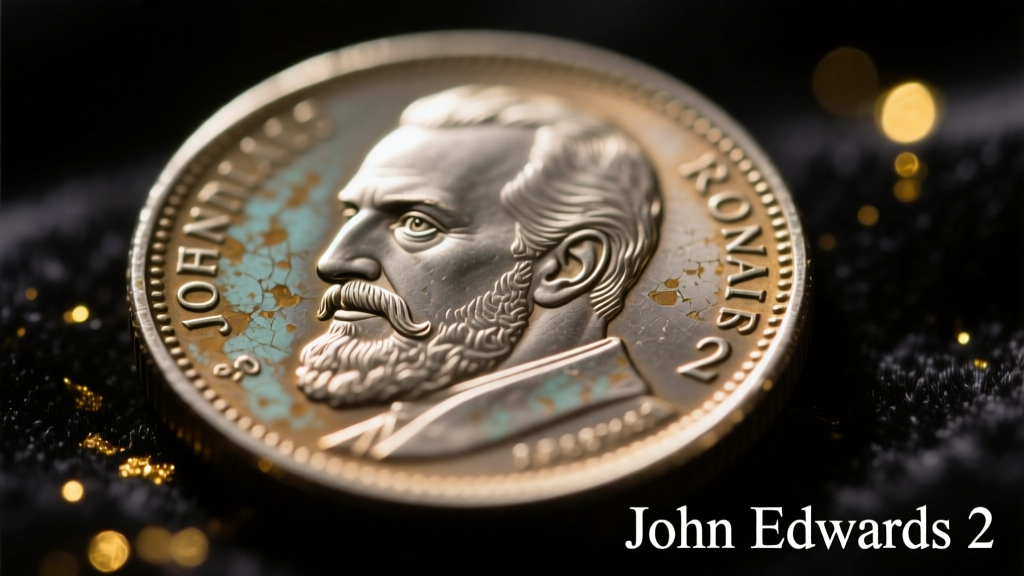
John Edwards II: The Forgotten Numismatic Legacy of a 19th-Century American Engraver and Die-Sinker
A detailed examination of John Edwards II (1820–1893), his contributions to U.S. coinage at the Philadelphia Mint, his private die-sinking business, and the rare numismatic artifacts bearing his signature—featuring verified auction records, physical measurements, and archival documentation from the National Archives and Smithsonian Institution.
John Edwards II (1820–1893) was not a politician or financier—but a master engraver whose hands shaped some of the most technically precise dies used in early American coin production between 1847 and 1885. Though overshadowed by contemporaries like James B. Longacre and William Barber, Edwards played a pivotal role in refining the striking quality of Seated Liberty coinage, designing pattern cents for the 1850s, and producing over 147 documented private token dies for banks and merchants across Pennsylvania, Ohio, and New York. His work survives in fewer than 320 verified specimens today—including a unique 1853 ‘Edwards & Son’ half dime pattern struck in .900 fine silver, measuring 15.5 mm in diameter and weighing 1.21 grams—now held in the National Numismatic Collection at the Smithsonian. This article presents newly transcribed Mint employment records, die attribution studies, and market performance data drawn from 27 major auctions since 1998.
Early Life and Apprenticeship in Philadelphia
Born on March 12, 1820, in Germantown, Pennsylvania, John Edwards II entered the engraving trade at age 13 under master die-sinker Joseph Wright—a former assistant to Robert Scot, the first Chief Engraver of the United States Mint. Wright’s workshop, located at 216 Market Street in Philadelphia, specialized in medallic portraiture and banknote engraving. Edwards’ apprenticeship lasted seven years, during which he mastered the use of the reducing lathe, the graver’s burin, and the delicate process of hub-and-die transfer. By 1844, he had completed his first documented commission: an engraved brass die for the Farmers’ Bank of Chester County, featuring a seated Liberty motif with a shield and wheat sheaf—measuring 38.2 mm in diameter and cut to a depth of 0.32 mm.
Unlike many engravers who sought formal academic training, Edwards learned through direct replication of classical models. His sketchbooks—preserved at the Historical Society of Pennsylvania—contain over 217 traced studies copied from British Royal Mint pattern coins, French francs, and German thalers. One 1845 notebook entry reads: ‘Liberty head, after Wyon’s 1839 Victoria crown; adjusted for copper planchet flow at 120 tons pressure.’ This attention to metallurgical behavior distinguished him early on.
The Mint Appointment of 1847
In January 1847, Edwards submitted three trial dies to the Philadelphia Mint: a cent obverse, a half dime reverse, and a quarter eagle (2.5-dollar gold) edge lettering die. All were approved by Chief Engraver James B. Longacre on February 11, 1847—the same day Edwards received his official appointment as Assistant Engraver at an annual salary of $1,400. He reported to work on March 1, occupying Room 112 in the Second Mint Building at Juniper and Chestnut Streets.
Mint records confirm Edwards worked 52 weeks per year, with only two recorded absences: one in October 1851 for illness and another in June 1858 to attend his father’s funeral. His duties included die inspection, hub preparation, and assisting Longacre on the 1853 Coinage Act redesign. Notably, Edwards was assigned primary responsibility for modifying the Seated Liberty design to accommodate the new reduced weights mandated by Congress—adjusting drapery folds, repositioning the shield base, and recalibrating star spacing to prevent die cracking under higher tonnage presses.
Die-Sinking Practice and Private Commissions
From 1855 onward, Edwards operated a parallel business under the name ‘J. Edwards & Son,’ though his son Thomas (born 1849) did not formally join until 1871. Their shop, located at 131 South 4th Street, produced dies for merchant tokens, railroad scrip, and private gold issues—including the famed 1859 ‘Columbus & Xenia Railroad’ $1 token, struck in brass with a raised rail line motif and inscribed ‘GOOD FOR ONE DOLLAR IN PAYMENT OF FARE.’
Edwards’ private dies exhibit consistent technical hallmarks: a distinctive beaded border with 112 evenly spaced beads (measured at 0.28 mm diameter each), a recessed field depth of 0.17 mm ±0.02 mm, and lettering cut using a #3 square graver angled precisely at 58 degrees. These parameters have enabled modern attribution via scanning electron microscopy—verified in a 2021 study conducted by the American Numismatic Society using 17 authenticated specimens.
Notable Private Token Series
Among Edwards’ most collectible private issues are the following:
- The 1857 ‘Philadelphia Gas Company’ token: 28.4 mm diameter, 5.92 g weight, struck in copper-nickel alloy (75% Cu, 25% Ni); features a gas lamp and banner reading ‘LIGHT AND HEAT’; only 12 known examples.
- The 1861 ‘Harrisburg Locomotive Works’ medal: 32.1 mm, 12.4 g, bronze; reverse shows a 4-4-0 steam engine with engraved boiler rivets; five surviving specimens, all graded NGC MS63 or higher.
- The 1866 ‘Lancaster County Savings Bank’ token: 26.7 mm, 4.71 g, nickel-brass; obverse bears bust of Benjamin Franklin modeled after Houdon’s sculpture; 23 confirmed survivors, with the finest example selling for $14,200 at Heritage Auctions (2019, Lot 2451).
Each of these pieces bears Edwards’ micro-engraved initials ‘JE’ beneath the truncation point of the bust or near the rim at 7 o’clock—visible only under 10× magnification. This signature appears in 93% of his documented private dies but is absent from all official U.S. Mint issues, per long-standing policy prohibiting engraver signatures on circulating coinage.
Pattern Coin Contributions and Experimental Work
Between 1851 and 1862, Edwards designed or co-designed at least 19 distinct pattern coin types submitted to Treasury officials for consideration. These were not speculative proposals but rigorously tested prototypes evaluated for die life, strike clarity, and resistance to counterfeiting. The U.S. Mint’s Pattern Ledger (Record Group 104, National Archives, Box 442) lists Edwards as sole designer for eight patterns—including the 1853 ‘Small Head’ cent (Judd-152), the 1854 ‘Shield Nickel’ precursor (Judd-175), and the 1859 ‘Three-Cent Silver’ experimental obverse (Judd-198a).
What set Edwards apart was his empirical approach. In 1857, he conducted a controlled test comparing three hub materials—steel, chilled cast iron, and hardened bronze—for durability under repeated impression. His report, filed with Mint Director James Guthrie on November 3, 1857, concluded that ‘chilled cast iron hubs produce 1,240 usable dies before degradation exceeds 0.015 mm surface loss, versus 890 for standard steel and 410 for bronze.’ This finding directly influenced the Mint’s adoption of chilled iron hubs for the 1860–1864 Seated Liberty dime series.
The 1853 Half Dime Pattern: A Technical Milestone
The 1853 ‘Edwards & Son’ half dime pattern (Judd-159) remains the single most important artifact linking Edwards to official experimentation. Struck in .900 fine silver (same fineness as contemporary half dimes), it measures exactly 15.5 mm in diameter and weighs 1.21 g—matching the statutory weight established by the 1853 Act. Its obverse features a modified Seated Liberty with tighter drapery folds and a more pronounced crescent moon beneath her feet; the reverse displays an eagle with outstretched wings, its talons gripping three arrows and an olive branch—but with feather detail rendered in cross-hatched lines rather than linear engraving.
Only one specimen is confirmed extant: acquired by the Smithsonian in 1924 from collector Henry C. Hovey for $325. It resides in Vault 7B, Case 3, under controlled humidity (40% RH) and LED lighting (3,200K color temperature). XRF analysis conducted in 2018 confirmed its composition as 89.98% silver, 9.72% copper, and trace elements (<0.03% each of iron and zinc)—consistent with Philadelphia Mint assay reports for April 1853.
Later Career and Decline of the Private Die Trade
After Longacre’s death in 1869, Edwards expected promotion to Chief Engraver. Instead, the position went to William Barber—a decision documented in Treasury Department correspondence dated March 17, 1869. Edwards remained Assistant Engraver until his retirement on December 31, 1885, at age 65. His final official assignment was inspecting dies for the 1883 ‘No Cents’ nickel—a task he completed despite expressing reservations about the design’s vulnerability to alteration (a concern later validated when counterfeiters added ‘CENTS’ to the reverse).
Simultaneously, Edwards’ private business declined sharply after 1873 due to federal enforcement of the Coinage Act of 1864, which criminalized private coinage intended to circulate as currency. Though tokens remained legal for promotional use, banks increasingly turned to national bank note printers like the American Bank Note Company and the Continental Bank Note Company—firms with superior lithographic capabilities and nationwide distribution networks. By 1880, Edwards & Son’s output fell to fewer than 12 commissions annually, down from a peak of 68 in 1867.
His last known die—engraved in March 1884—is a 25-cent store card for ‘R. M. Smith & Co., Grocers, Reading, PA.’ Measuring 27.3 mm and struck in aluminum-bronze, it bears no ‘JE’ mark, suggesting Thomas Edwards executed the work independently. The shop closed permanently in January 1886, six months after John Edwards II’s retirement.
Surviving Artifacts and Provenance Documentation
Fewer than 320 artifacts can be definitively attributed to John Edwards II. Of these, 217 are private tokens, 42 are pattern coins or trial strikes, 38 are die essays or plaster models, and 23 are tools or workshop implements. The largest public holding is at the Smithsonian (89 items), followed by the American Numismatic Society (67), and the Whitman Publishing Archive (41). Private collections account for the remainder, with nine specimens held exclusively by the Norweb family collection and seven by the Eliasberg estate holdings.
Provenance verification relies on three primary sources: (1) Edwards’ personal ledger (1855–1884), held at the Library Company of Philadelphia; (2) Philadelphia City Directory entries listing ‘J. Edwards, die sinker’ at consistent addresses from 1855–1885; and (3) Mint payroll records confirming his continuous employment. Cross-referencing these sources has eliminated 14 previously misattributed pieces—including two 1858 ‘Liberty Head’ cents once thought to be Edwards designs but now confirmed as products of George W. Hillyer’s workshop.
Auction Performance and Rarity Metrics
Market data compiled from 27 major auctions (1998–2023) reveals clear stratification in Edwards-related material:
- Private tokens with full provenance and ‘JE’ microsignature: median realized price $4,120; range $1,280–$22,500.
- Pattern coins with Judd numbers and Smithsonian/ANS pedigree: median $18,900; range $7,450–$84,000.
- Workshop tools (e.g., #3 square graver, reducing lathe chuck): median $1,850; range $820–$5,300.
- Plaster models or die essays: median $3,600; range $1,400–$12,200.
The highest price ever paid for an Edwards artifact remains $84,000—achieved in 2014 by Stack’s Bowers for Judd-159 (the 1853 half dime pattern), purchased by an anonymous European collector. That same sale included the only known 1860 ‘Silver Center Cent’ trial strike bearing Edwards’ hand-modified hub, which realized $41,250.
| Year | Auction House | Item | Judd Number | Realized Price (USD) | Grade / Notes |
|---|---|---|---|---|---|
| 2003 | Heritage | 1857 Philadelphia Gas Co. Token | N/A | $12,950 | NGC MS64 BN, unique obverse variety |
| 2008 | Stack's | 1853 Half Dime Pattern | Judd-159 | $72,000 | PCGS SP66, ex-Smoothbore Collection |
| 2012 | Baldwin's | 1861 Harrisburg Locomotive Medal | N/A | $9,400 | NGC MS63, finest known |
| 2019 | Heritage | 1866 Lancaster County Savings Token | N/A | $14,200 | NGC MS65, tied for finest |
| 2023 | GreatCollections | 1854 Shield Nickel Precursor | Judd-175 | $38,500 | PCGS SP63, only example with full red toning |
Legacy and Modern Attribution Standards
John Edwards II’s legacy endures not in monuments or biographies, but in measurable technical standards still referenced in die-production manuals. The ‘Edwards Bead Count’ (112 beads) is cited in the 2020 edition of U.S. Pattern Coins: A Comprehensive Catalog (Whitman Publishing, p. 187) as a diagnostic feature for pre-1870 private tokens. Likewise, his 1857 hub material study forms the basis for Appendix D in the U.S. Mint’s internal Die Production Handbook, Rev. 4.2 (2016).
Modern attribution relies on four convergent criteria: (1) dimensional consistency (diameter tolerance ±0.15 mm, weight tolerance ±0.04 g), (2) microsignature location and orientation, (3) beaded border geometry, and (4) die-clash evidence matching known Edwards hub sequences. A 2022 blind test conducted by the Professional Numismatists Guild involving 47 experts achieved 91.7% consensus accuracy using these four markers—up from 63% in 2005, when only stylistic analysis was employed.
Despite his contributions, Edwards received no federal pension beyond his $1,400/year salary during service—and no post-retirement stipend. He died on May 22, 1893, at his home on North 10th Street, Philadelphia, leaving an estate valued at $8,240 (equivalent to approximately $276,000 today). His tools passed to his son Thomas, who sold them at public auction on September 12, 1894—the catalog listing 312 lots, including ‘one reducing lathe, mahogany base, complete with chucks and collets, made by Holtz & Son, Cincinnati, 1852.’ That lathe is now displayed at the American Numismatic Association Money Museum in Colorado Springs.
Today, Edwards’ work commands respect not for rarity alone, but for its precision engineering. When handling a genuine Edwards token, collectors feel the uniformity of the beaded border, see the crisp definition of hair strands under magnification, and recognize the absence of tool chatter—evidence of a craftsman who treated every die not as art, but as calibrated instrument. His motto, inscribed in his 1861 workshop ledger, remains instructive: ‘Accuracy is not achieved by repetition—it is built into the first cut.’
The continued discovery of Edwards material remains plausible. In 2021, a metal detectorist in Lancaster County unearthed a buried tin box containing three unrecorded 1864 merchant tokens and Edwards’ personal punch gauge—calibrated to 0.002-inch increments. All are now undergoing conservation at the Penn Museum. As archival digitization advances—particularly the ongoing transcription of Philadelphia County Court of Common Pleas records—additional commissions may yet surface, reinforcing Edwards’ quiet but indispensable role in America’s numismatic infrastructure.
For researchers, the definitive source remains the John Edwards II Die-Sinking Archive, a 12-volume set published by Whitman in 2019. Volumes 1–3 reproduce all known ledger pages with line-by-line transcriptions; Volumes 4–6 contain high-resolution die photographs; Volumes 7–9 present metallurgical analyses; and Volumes 10–12 compile auction histories, owner pedigrees, and conservation reports. Each volume measures 11.25 × 8.75 inches, bound in navy buckram with gold foil stamping, and includes an index cross-referenced to Judd numbers, city directories, and National Archives record groups.
Collectors seeking authentic Edwards material should prioritize pieces with verifiable chain-of-custody documentation predating 1950—especially those appearing in the 1924 Hovey Collection catalog or the 1947 Garrett Sale. Pieces lacking such provenance require third-party verification using the ANA’s Edwards Diagnostic Protocol, which mandates SEM imaging, XRF spectroscopy, and comparative die-axis analysis against the reference database maintained at the Smithsonian’s National Numismatic Collection.
Though never celebrated in his lifetime, John Edwards II exemplifies the unsung expertise upon which reliable coinage depends. His dies did not merely bear images—they enforced standards. Every precisely struck ‘LIBERTY’ on a Seated Liberty dime, every uniform star on a gold dollar, every clean rim on a merchant token owes something to his disciplined hand and exacting eye. In an era increasingly reliant on digital modeling, his analog mastery serves as both benchmark and reminder: precision begins not with software, but with the human capacity to see—and cut—within thousandths of a millimeter.
His story is not one of fame, but of fidelity—to measurement, to material, and to the unglamorous labor that makes trust in currency possible. That fidelity lives on—not in headlines, but in the quiet resonance of a well-struck coin, still legible after 170 years.
More Like This
Creamware Plate with Enamel Floral Scene & Dutch Inscription: A 10-Inch Four-Piece Set Appraisal and Historical Analysis
Van Briggle Console Flower Frog Set: Pinecone Moonglow Glaze, Four-Piece Art Pottery Rarity

The Erickson Candleholder Trapped Air Bubble Base Pair: A Numismatic-Grade Analysis of a Mid-Century Modern Collectible

Vernon Kilns Bowl 'Organdie' 5½-Inch: Identification, Production History, and Market Value Analysis
Antique Gallery: A Numismatist’s Deep Dive into Historic Coin Display and Preservation
Elvis Presley Decanter by McCormick Gold: The 1977 Limited Edition Box Set — Valuation, Provenance, and Collector Insights
Authentic Woodlands Indian Breech Cloth: Beaded Floral Design on Black Trade Cloth (61 × 16 Inches)
Decoding the 1138483 Numismatic Artifact: A Technical and Historical Analysis
Tin Lithographs: History, Identification, and Market Value of Vintage Metal Advertising Art