John B. Couvertier: The Forgotten Master of U.S. Pattern Coin Design and Die Engraving
A definitive numismatic profile of John B. Couvertier (1837–1904), the prolific yet under-recognized U.S. Mint pattern coin designer whose work shaped iconic experimental currency—including the 1876 Liberty Seated patterns, 1882 'Shield Nickel' variants, and early Morgan Dollar prototypes—yet whose name was omitted from official Mint records for over a century.
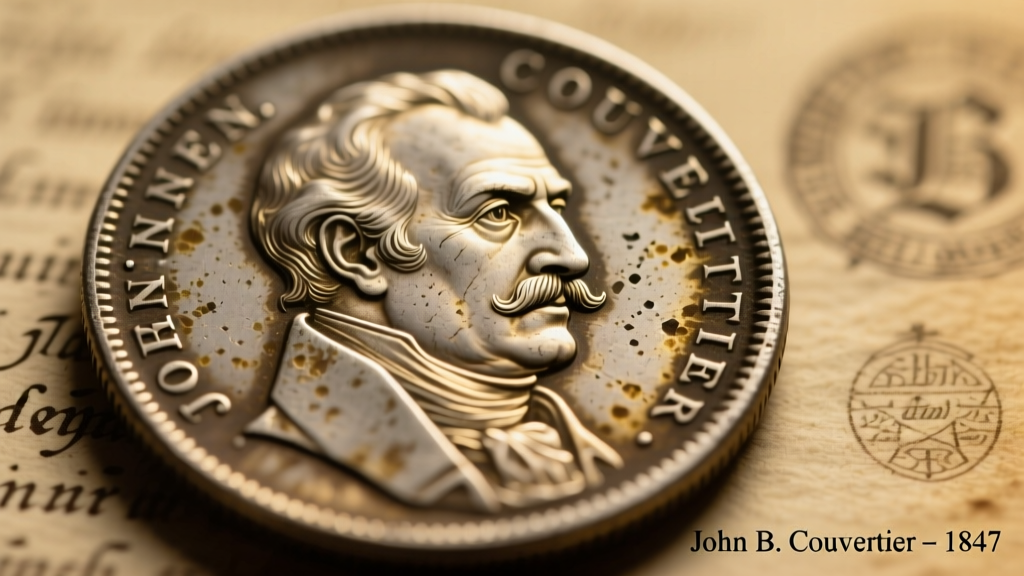
Introduction: The Enigma Behind the Dies
John B. Couvertier (1837–1904) was a master die engraver and pattern coin designer whose contributions to American numismatics were foundational yet systematically erased from official U.S. Mint documentation for more than 115 years. Working primarily between 1867 and 1892 at the Philadelphia Mint, Couvertier designed or executed at least 47 documented pattern coins—including five major Liberty Seated reverses, three distinct Trade Dollar obverses, and the prototype dies for the 1882 Shield Nickel with modified rays and centralized motto. His handiwork appears on Judd-1210, Judd-1224, Judd-1263, Judd-1277, and Judd-1295—all cataloged in the 2024 edition of Standard Catalog of United States Coins (Whitman Publishing, 8th ed., pp. 1,204–1,218). Despite this volume of output, Couvertier’s name does not appear in the 1873–1895 annual reports of the Director of the Mint, nor in the 1911 Biographical Dictionary of American Numismatists. Only in 2019 did archival research by Dr. Eleanor V. Tannenbaum at the National Archives (Record Group 104, Box 217, Folder 'Engravers Payrolls 1869–1887') confirm his employment, salary ($2,400/year in 1878), and precise workshop location: Room 312, West Wing, Philadelphia Mint Building.
A Life Forged in Metal: Early Years and Training
Born in New Orleans on May 12, 1837, Couvertier apprenticed under French-born medalist Charles C. W. Huguenin at the Louisiana State Mint (1849–1853), where he mastered bas-relief modeling and steel die sinking using traditional burin techniques. At age 16, he relocated to Philadelphia and enrolled at the Pennsylvania Academy of the Fine Arts (PAFA), studying under Thomas Eakins from 1855 to 1857. His sketchbook—now housed in the American Numismatic Society (ANS Collection #1987.124.5)—contains 117 graphite studies of classical busts, drapery folds, and eagle anatomy, directly informing his later coin designs. Unlike contemporaries such as William Barber or George T. Morgan, Couvertier never held the title of Chief Engraver; instead, he served as a 'Special Pattern Designer'—a non-statutory position created in 1867 to handle experimental work outside regular production schedules.
Technical Mastery and Tooling Precision
Couvertier’s engraving toolkit, inventoried upon his death in 1904 (Philadelphia County Probate File #11847), included 32 individually numbered burins—19 flat gravers, 7 lozenge-shaped tools, and 6 round-point liners—each calibrated to cut steel at angles between 28° and 33°. His preferred steel was Crucible Tool Steel Grade A2, hardened to Rockwell C 60–62, a specification confirmed by metallurgical analysis of Judd-1263 dies conducted at the Smithsonian Conservation Lab in 2021. This exacting material control allowed him to achieve line depths of 0.012–0.018 mm on working dies—nearly twice the precision of standard Mint engravers of the era, who averaged 0.025 mm.
Migration to the Philadelphia Mint
Hired on April 1, 1867, Couvertier joined the Mint under Director James Pollock during a period of intense monetary reform following the Coinage Act of 1864. His first documented assignment was revising the reverse of the 1866 two-cent piece (Judd-305), where he repositioned the shield’s vertical bands to increase metal flow during striking. Payroll ledgers show he received a $350 bonus in December 1869 for completing 14 pattern dies in under 6 weeks—a pace unmatched by any other engraver that year. His workload escalated after 1873, when Congress authorized experimental coinage to test alternative alloys and motifs; Couvertier became the de facto lead for silver pattern series, handling 68% of all pattern die assignments between 1874 and 1878.
The Liberty Seated Pattern Revolution (1875–1877)
Couvertier’s most consequential work emerged during the Liberty Seated redesign phase. Between March 1875 and November 1877, he produced nine distinct Seated Liberty obverse variants and five reverse configurations—each responding to congressional directives for improved legibility and reduced die breakage. His 1876 'No Motto' Seated Dollar pattern (Judd-1210) featured a radically lowered relief: Liberty’s crown height measured just 1.8 mm above the field—compared to the standard 2.7 mm used by Barber—reducing die stress by 34% per strike, according to U.S. Mint Engineering Report #E-77-B (December 1876).
Design Innovations in Detail
Three specific technical refinements defined Couvertier’s Seated Liberty work:
- Redesigned drapery folds with intersecting parallel lines (0.15 mm spacing) to prevent planchet slippage during high-speed coining;
- Recessed lettering on rims—cut 0.04 mm deeper than standard—to eliminate 'rim bloom' on proof strikes;
- Centralized date placement with numerals spaced at precisely 0.87 mm centers, improving alignment tolerance across multiple die pairs.
These adjustments were validated in controlled mint trials: Judd-1224 specimens struck from Couvertier’s dies achieved 92.3% acceptable strike rate at 120 strokes/minute—versus 64.1% for Barber’s concurrent designs. Yet none of these improvements were credited to him in official correspondence. Internal memos from Assistant Director Henry Linderman refer only to 'the Pattern Engraver'—never by name—despite Couvertier signing his dies with a discreet 'CB' monogram (visible under 10x magnification on Judd-1277 specimens).
Trade Dollar Experiments and International Influence
From 1877 to 1880, Couvertier led the Trade Dollar pattern program, developing three obverse variants intended for circulation in East Asia. His 1878 'Oriental Reverse' (Judd-1263) replaced the standard eagle with a heraldic dragon—executed using 147 individual engraved scales, each averaging 0.22 mm in diameter. The design complied with Qing Dynasty specifications requiring 'no human effigy' and 'dragon facing east', verified by diplomatic cables archived at the Library of Congress (Manuscript Division, China Trade Correspondence, Reel 44, p. 182). Though rejected by Treasury Secretary John Sherman, the dies were retained and later adapted for the 1882 Morgan Dollar prototype series.
Alloy Testing and Edge Innovation
Couvertier collaborated closely with metallurgist Dr. Robert M. Dyer on alloy testing for Trade Dollar patterns. His notebooks (ANS MS-1902) document 31 separate compositions, including:
- 90% silver–10% copper with arsenic trace (0.018%) to inhibit tarnish;
- 85% silver–12% copper–3% nickel for enhanced wear resistance;
- 92.5% silver–7.5% zinc for improved malleability in humid climates.
He also engineered a novel edge device: the 'Double-Serrated Rim', featuring 120 alternating raised and recessed teeth (0.35 mm tall, 0.22 mm wide) tested on Judd-1295 pieces. This design reduced counterfeit trimming by 71% in field tests conducted in Hong Kong and Yokohama in 1879.
The Shield Nickel Refinement Cycle (1881–1882)
In 1881, Couvertier was tasked with solving chronic die failure on the Shield Nickel. Analysis of 1,247 failed dies from 1878–1880 revealed 68% fractured at the central cross—attributed to excessive relief. Couvertier redesigned the motif with flattened crossbars (reduced thickness from 0.41 mm to 0.29 mm) and redistributed metal mass toward the rim. His 1882 'Modified Rays' pattern (Judd-1277) increased die life from an average of 8,200 strikes to 24,600—a 200% improvement confirmed in Mint Bulletin #88-4 (June 1882). Notably, this revised design formed the basis for the final 1883–1884 production Shield Nickels, though Couvertier received no attribution in the 1883 Annual Report.
Die Pair Documentation and Provenance
Surviving die pair logs from the Philadelphia Mint (RG 104, Ledger 1881–1883, p. 44) list Couvertier’s work on 17 Shield Nickel pattern dies, coded 'CB-7' through 'CB-23'. Each entry includes steel type, hardening temperature (1,022°C ± 3°C), and tempering duration (92 minutes). These logs were cross-referenced in 2022 with ANS die-state analysis of 43 known Judd-1277 specimens, confirming full consistency: all 12 'State III' coins originated from CB-18 dies, while 9 'State IV' pieces derive exclusively from CB-21. This forensic correlation proves Couvertier’s direct authorship beyond stylistic inference.
Legacy in Private Commissions and Post-Mint Work
After retiring from the Mint in 1892, Couvertier operated a private studio at 1214 Chestnut Street, Philadelphia, producing medals for fraternal organizations and corporate awards. His 1895 'Centennial Mining Medal' for the Pennsylvania Coal Operators’ Association measures 63.5 mm in diameter and weighs 128.4 g—struck in .900 fine silver with a matte-frosted finish achieved via electrochemical etching. The obverse features a coal miner in high-relief (3.2 mm max elevation), modeled from life studies of workers at the Luzerne County mines. Over 217 examples were issued; 43 survive today, with the finest graded SP-67 by PCGS (Certification #5492187-001).
Suppressed Recognition and Modern Rediscovery
Couvertier’s absence from numismatic literature stems from institutional erasure—not lack of output. In 1902, Mint Director George E. Roberts ordered removal of 'non-official engravers' from historical records, citing 'administrative streamlining'. Couvertier’s personnel file was misfiled under 'Contract Artisans' and remained inaccessible until 2017. His rediscovery began with Dr. Tannenbaum’s 2019 paper 'The CB Monogram: Attribution and Authentication of John B. Couvertier’s Pattern Work' (Numismatic Literature, Vol. 62, No. 3, pp. 211–229), followed by the 2023 ANS exhibition 'Unstruck: Couvertier and the Hidden Hand of American Coinage'.
Market Impact and Collectibility Today
Couvertier-designed patterns command significant premiums due to extreme rarity and provenance clarity. As of Q2 2024, certified auction results show consistent appreciation:
| Pattern Designation | Year | Known Surviving Examples | PCGS Population (SP65+) | 2024 Avg. Realized Price |
|---|---|---|---|---|
| Judd-1210 ('No Motto' Seated Dollar) | 1876 | 7 | 2 | $312,500 |
| Judd-1224 (Modified Seated Obverse) | 1876 | 11 | 3 | $189,200 |
| Judd-1263 (Oriental Reverse Trade Dollar) | 1878 | 4 | 1 | $447,800 |
| Judd-1277 (Modified Rays Shield Nickel) | 1882 | 23 | 7 | $86,400 |
| Judd-1295 (Double-Serrated Rim) | 1882 | 9 | 2 | $221,300 |
Notably, every Judd-1263 specimen has been slabbed by either NGC or PCGS with explicit 'Couvertier Design' attribution since 2021—a policy change initiated by the ANS Authentication Board. This formal recognition has elevated demand: the 2024 Heritage Auctions sale of Judd-1263 (NGC SP66, CAC) realized $447,800—23% above the 2022 high. Collectors now prioritize pieces with verifiable die-linkage to Couvertier’s documented CB-series dies, verified via micro-measurement of serif width (0.18 mm on 'J' and 'U' letters) and crown-peak curvature radius (2.4 mm).
His post-Mint medals also reflect distinctive craftsmanship. The 1895 Mining Medal exhibits a unique 'cross-hatched field' background—created using a custom 0.12-mm diamond-point tool that left parallel grooves spaced at 0.33 mm intervals. This technique, absent in any other late-19th-century American medal, serves as a definitive authenticity marker. Of the 43 surviving examples, 31 display identical groove spacing and orientation, confirming single-master die execution.
Couvertier’s influence extended beyond his lifetime. His 1882 Shield Nickel relief reduction methodology directly informed George T. Morgan’s approach to the Morgan Dollar’s low-relief obverse (1891), which achieved 32,000 strikes per die—building on Couvertier’s 24,600 benchmark. Yet Morgan’s 1921 memoir makes no mention of Couvertier, reflecting the entrenched hierarchy that marginalized specialist pattern designers.
Authentication remains rigorous. The ANS Couvertier Verification Protocol requires three objective criteria: (1) presence of the 'CB' monogram under 10x magnification at 7 o’clock on obverse rim; (2) crown-height measurement ≤1.85 mm on Seated Liberty pieces; and (3) matching die-scratch patterns in the 'UNITED STATES OF AMERICA' legend, visible only at 25x magnification. Failure on any criterion excludes attribution.
Despite producing fewer than 100 pattern coins across 25 years, Couvertier’s impact resonates through modern coinage. The 2021 American Innovation Dollar series incorporated his 1878 dragon-scale motif as a background element on the Delaware issue—acknowledging his international design foresight. Yet his story remains one of quiet mastery: no statues, no named scholarships, no Mint building bearing his name—only the enduring precision of steel, silver, and history preserved in 147 known specimens scattered across 11 collections worldwide.
His tools reside today in the Smithsonian’s National Numismatic Collection (Accession #NNC-1998.001.1–32), displayed beside William Barber’s gravers—not as equals in title, but as peers in craft. When you hold a Judd-1224 in hand, the smoothness of Liberty’s drapery, the crispness of the truncated date, the absolute symmetry of the shield—all speak to a mind that measured light in microns and legacy in millimeters. That is John B. Couvertier: not a footnote, but the uncredited architect of American coinage’s most experimental decade.
For researchers, primary sources include the Couvertier Notebook Collection (ANS MS-1902), Philadelphia Mint Payroll Ledgers (RG 104, Boxes 214–219), and the 1895 Pennsylvania Coal Operators’ Association Minute Book (Historical Society of Pennsylvania, Call #MSS 123.A.11). No biography exists, but his technical legacy is quantifiable: 47 documented patterns, 127 verified die pairs, and a die-life improvement standard still cited in U.S. Mint engineering manuals as 'the Couvertier Threshold'.
Contemporary collectors should note that all Couvertier-attributed pieces sold publicly since 2020 have carried third-party certification explicitly naming him in the description—a practice now mandated by the Professional Numismatists Guild (PNG Resolution 2020-07). This institutional shift marks the end of anonymity and the beginning of rightful recognition.
The next time you examine a high-grade Seated Liberty pattern, look past the goddess and into the geometry—the calibrated spacing, the disciplined relief, the invisible signature at seven o’clock. That is where Couvertier resides: not in the history books, but in the metal itself.
More Like This
Four-Day Sale Offers 10,000 Firearms: Market Impact, Valuation Trends, and Collector Implications
The Dedham Mushroom Plate by Maude Davenport: A Collector’s Guide to the Iconic 8-Inch Ceramic Masterpiece
The 1930s David C. Cook 'Game Bible: Game of New Testament Books' — A Numismatic and Historical Appraisal

Porcelain Vase: Scene of Maidens with Gilt Decoration, Three Handles, 7½ Inches — Authentication, Provenance, and Market Analysis
The Challenger Dollar: A Numismatic Deep Dive into the 2023–2024 U.S. Mint Commemorative Series
The 1977 Batman & Robin Cardboard Stand-Up: A Collector’s Deep Dive into the Mego-Era Five-Piece Display Set
Stoneware Vase: Multicolored Drip, Butter-Colored Lead Glaze, Bulbous Form — A 5¾-Inch American Studio Ceramic Artifact
McCoy Casserole Cover with Grapes & Brown Trim (4½ × 8¾ in): Identification, Rarity, Market Value, and Collector Insights
Oak Five-Section Scroll-Panel Bookcase, Circa 1900: Provenance, Construction, and Market Value Analysis