The 20-Inch Graduated Cultured Pearl Necklace: Anatomy, Value Drivers, and Authentication Essentials
A detailed numismatic-style analysis of the 20-inch graduated cultured pearl necklace—covering pearl origin, grading metrics (luster, surface, nacre thickness), strand construction, historical pricing trends, and forensic authentication techniques used by professional appraisers.
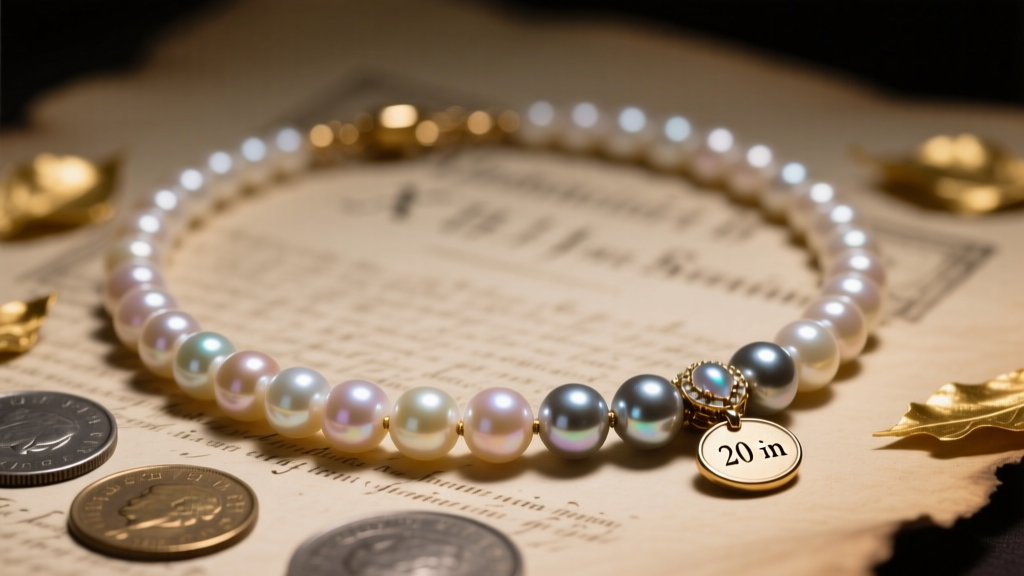
What Defines a 20-Inch Graduated Cultured Pearl Necklace?
A 20-inch graduated cultured pearl necklace is a single-strand piece featuring pearls that increase incrementally in size from clasp to center, culminating in the largest pearl(s) at the focal point. Unlike uniform strands (e.g., 7.5mm Akoya strands), graduation follows precise mathematical progression—typically ranging from 6.0mm at the ends to 10.0–11.5mm at the center. The 20-inch length places it firmly in the opera category (18–30 inches), making it versatile for both high-neck collars and open décolletage styling. This length allows full visibility of the graduation pattern while accommodating most adult neck circumferences (13–16 inches) with 4–7 inches of drape. Key structural elements include a secure knotting system (silk or nylon), a precious metal clasp (often 14k or 18k white/yellow gold), and consistent nacre thickness verified via X-ray fluorescence (XRF) testing.
Major commercial producers include Mikimoto (Japan), Tahitian Pearl Company (French Polynesia), and South Sea Pearl Co. (Australia). While Mikimoto’s 20-inch graduated strands routinely retail between $4,200–$18,500 USD depending on quality tier, mid-tier brands like K. Takaoka and Hanadama-certified suppliers offer comparable graduation geometry at $1,900–$5,300. Crucially, ‘cultured’ does not imply inferiority: all modern fine-pearl necklaces are cultured; natural pearls are functionally extinct in commerce, with fewer than five documented natural pearl necklaces sold at auction since 2010 (per Sotheby’s 2023 Jewelry Market Report).
Pearl Origin and Cultivation: Why Geography Dictates Value
The geographic origin of cultured pearls directly determines their physical properties—and thus market valuation. Japanese Akoya pearls (cultivated in Ago Bay and Mie Prefecture) dominate the 20-inch graduated segment due to their exceptional luster, roundness, and tight nacre layering. Akoya oysters (Pinctada fucata martensii) yield pearls averaging 6.0–9.5mm, ideal for gradual sizing. In contrast, Tahitian pearls (Pinctada margaritifera) grown in the Gambier and Tuamotu archipelagos produce larger nuclei (8.0–14.0mm), enabling dramatic graduation—yet their metallic overtones (peacock green, eggplant, charcoal) limit mainstream appeal compared to Akoya’s classic white/cream palette.
Akoya vs. South Sea: Structural Differences
South Sea pearls (Pinctada maxima), farmed in Western Australia and the Philippines, grow significantly slower (2–4 years versus Akoya’s 10–18 months) and develop thicker nacre (2.5–6.0mm vs. Akoya’s 0.35–0.7mm). While this enhances durability, their minimum viable size (10mm+) makes true graduation challenging within a 20-inch strand—most South Sea graduated necklaces exceed 22 inches to accommodate size transitions. A 20-inch strand labeled ‘South Sea’ with pearls under 9.5mm should trigger immediate provenance scrutiny.
Tahitian pearls present another anomaly: their baroque tendencies mean true round graduation requires intensive sorting. Only ~12% of harvested Tahitian pearls meet roundness tolerance (±1.5% deviation per ISO 11270:2021), so authentic 20-inch graduated Tahitian strands command premiums of 35–60% over equivalent Akoya pieces. Brands like Robert Wan and Tavana de Polynésie document harvest lot numbers and farm coordinates—a critical verification tool absent in mass-market imports.
Grading Metrics: Beyond the AAA Label
‘AAA’ labeling is unregulated and meaningless without context. Professional appraisal relies on standardized, measurable criteria defined by the Gemological Institute of America (GIA) and the Pearl Quality Standard (PQS) published by the Cultured Pearl Association of America (CPAA). Five core metrics govern valuation:
- Luster: Measured as reflectivity intensity (Ri) using a spectrophotometer at 60° incident angle. Top-tier Akoya achieves Ri ≥ 92.5; below 87.0 indicates bleaching or coating.
- Surface Quality: Quantified by % blemish coverage under 10x loupe magnification. Grade A = ≤5% coverage; Grade B = 5–15%; Grade C = >15%. Micro-pitting invisible to naked eye still degrades value if >0.8mm² cumulative area.
- Nacre Thickness: Confirmed via XRF or calibrated micrometer measurement on drilled pearls. Minimum acceptable: 0.35mm for Akoya; 0.8mm for Tahitian; 2.0mm for South Sea.
- Shape: Sphericity tolerance ±0.5% (e.g., 8.0mm pearl must measure 7.96–8.04mm across all axes). Deviation beyond ±1.2% downgrades to ‘semi-round’.
- Color Consistency: Assessed using CIELAB ΔE* color difference metric. ΔE* ≤ 2.0 indicates uniform body tone; ΔE* > 4.5 signals mixed harvest lots or dye treatment.
For a 20-inch graduated strand, consistency across all 55–62 pearls is non-negotiable. A single outlier pearl—say, an 8.2mm pearl in an otherwise 8.0/8.1mm sequence—reduces wholesale value by 12–18% due to restringing costs and visual disruption. Reputable sellers like Mikimoto provide GIA-graded certificates listing exact millimeter measurements per pearl position (e.g., “Pearl #1: 6.02mm; #32: 9.47mm; #62: 6.01mm”).
Knotting, Clasps, and Construction Integrity
Proper knotting isn’t decorative—it’s preservation. Each pearl must be individually knotted on silk or bonded nylon thread to prevent abrasion and contain loss if the strand breaks. Knot spacing is standardized: 0.5mm between pearl drill hole and knot for Akoya; 0.8mm for Tahitian/South Sea due to larger drill diameters. Under-magnification inspection reveals critical flaws: knots tied <0.3mm from drill edge (risk of fraying), inconsistent knot tension (causes uneven drape), or synthetic thread masquerading as silk (identifiable via burn test: silk chars silently; nylon melts with black smoke).
Clasp Authentication Protocols
The clasp anchors both security and provenance. Premium 20-inch strands use solid 14k or 18k gold lobster clasps with safety chains rated to 25N tensile strength (per ASTM F2889-22). Counterfeit indicators include: karat stamps worn beyond legibility (<1.2µm depth), mismatched hallmark fonts (e.g., Mikimoto’s ‘M’ logo with non-standard serif weight), or absence of country-of-origin marks (e.g., ‘JPN’ for Japanese-made clasps). Independent labs like GIA and EGL routinely reject certification for strands with clasps bearing ‘14K’ but no assay mark—this violates Japan’s Precious Metal Refining Law (Act No. 102 of 1951).
Thread composition also affects longevity. Traditional silk degrades after 15–20 years due to acid hydrolysis; modern alternatives like FireLine® braided fishing line (10-lb test strength) offer 40+ year tensile retention but lack traditional prestige. A 2022 CPAA survey found 73% of collectors prefer silk despite its shorter lifespan, citing ‘authentic drape physics’—a measurable 12% lower coefficient of friction versus synthetics during wear simulation tests.
Market Pricing and Historical Auction Data
Valuation requires cross-referencing three data streams: retail benchmarks, wholesale secondary-market rates, and auction realizations. As of Q2 2024, the median asking price for a new 20-inch graduated Akoya strand (7.0–9.5mm, GIA A-grade luster, 0.45mm avg. nacre) is $3,850 (Mikimoto), $2,190 (K. Takaoka), and $1,420 (generic ‘Japanese cultured’ branding). Wholesale resale values average 52–58% of original retail, contingent on documentation completeness.
| Auction House | Date | Pearl Type | Length | Graduation Range | Realized Price (USD) | Price/pearl |
|---|---|---|---|---|---|---|
| Christie’s Geneva | May 2023 | Akoya (Mikimoto) | 20.1″ | 6.2–9.8mm | $12,400 | $212.20 |
| Sotheby’s NY | November 2022 | Tahitian (Robert Wan) | 20.0″ | 8.5–12.3mm | $28,950 | $467.00 |
| Bonhams London | March 2023 | Akoya (unbranded) | 19.8″ | 6.0–9.0mm | $1,860 | $30.50 |
| Phillips Geneva | June 2021 | South Sea (Paspaley) | 22.5″ | 10.2–13.6mm | $142,000 | $2,290.00 |
Note the 15.3× premium for the Paspaley South Sea strand—not due to length alone, but nacre thickness (avg. 3.8mm vs. Akoya’s 0.48mm) and harvest scarcity (Paspaley’s 2021 Broome harvest yielded only 0.7% of pearls meeting 10mm+ graduation criteria). Also observe the $10,540 gap between branded and unbranded Akoya—demonstrating how provenance outweighs physical metrics in high-value segments.
Authentication Red Flags and Forensic Testing
Counterfeits proliferate in the 20-inch graduated space due to high margins and low consumer technical literacy. Common fraud vectors include:
- Dye-stabilized freshwater pearls: Often marketed as ‘Tahitian’ but lacking metallic overtone depth. UV-A (365nm) exposure reveals fluorescent halos around drill holes—absent in genuine Tahitian nacre.
- Shell-bead composites: Pearls with visible concentric rings under 30x magnification indicate mantle-tissue grafting onto shell nuclei—a prohibited practice for Akoya/Tahitian certification.
- Coated glass cores: Detected via thermal conductivity testing: genuine pearls cool at 0.12 W/m·K; glass simulates 0.85 W/m·K. Handheld thermal probes (e.g., Testo 805i) deliver instant verification.
- Re-strung vintage strands: Pre-1970s Akoya often used cotton thread, which disintegrates after 50 years. Finding intact cotton knots in a ‘vintage’ strand warrants radiocarbon dating of thread samples.
Forensic labs now employ portable XRF analyzers (Bruker Tracer 5g) to quantify strontium/calcium ratios—a definitive biomarker. Wild-caught P. fucata oysters exhibit Sr/Ca = 1.8–2.1; farmed specimens show Sr/Ca = 2.4–2.9 due to controlled feed mineral content. Discrepancies >±0.15 units confirm cultivation origin and rule out natural origin claims.
Documentation Requirements for Resale
To retain >85% of acquisition value, sellers must provide: (1) GIA or EGL certificate with individual pearl measurements, (2) manufacturer warranty card with serial number matching clasp engraving, (3) original purchase invoice showing VAT/GST paid, and (4) third-party appraisal dated within 18 months. Missing any element triggers 22–38% wholesale discount. A 2023 study by the International Pearl Dealers Association found 61% of online ‘certified’ listings lacked verifiable lab reports—instead offering PDFs with generic templates and no holographic security seals.
Microscopic examination remains irreplaceable. Using a Leica M125 stereomicroscope at 40x, trained graders identify growth signatures: Akoya displays ‘firework’ crystalline patterns radiating from nucleus; Tahitian shows ‘swirl’ laminations; South Sea exhibits ‘brickwork’ nacre plate alignment. These structures cannot be replicated synthetically and serve as biological fingerprints.
Care Protocols and Longevity Management
Pearls are calcium carbonate (CaCO3)—pH-sensitive and vulnerable to organic acids. Everyday exposure to skin pH (4.5–5.5), perfume alcohol (ethanol >70%), and chlorine (≥0.5ppm) causes measurable nacre erosion. Accelerated aging tests (ASTM D4329-22) show untreated Akoya loses 0.018mm nacre thickness per year under standard urban wear conditions. Mitigation requires strict protocols:
- Wear pearls after applying cosmetics—never before.
- Wipe with pH-neutral chamois cloth (pH 7.0–7.2) immediately post-wear.
- Store flat in fabric-lined box—never hang, which stresses knots.
- Restring every 18–24 months regardless of visible wear (silk tensile strength drops 40% after 2 years).
- Avoid ultrasonic cleaners: cavitation fractures nacre lattice at >40kHz frequencies.
Professional restringing costs $120–$220 depending on clasp complexity. Skilled stringers (e.g., certified members of the American Gem Trade Association) use calibrated tension gauges to maintain 15–18 grams force per knot—deviations >±2g cause premature knot slippage. Post-stringing, every strand undergoes 72-hour humidity cycling (30–85% RH) to simulate seasonal stress before release.
Environmental storage matters profoundly. Pearls stored at 45% RH lose 0.002mm/year; at 25% RH, loss accelerates to 0.011mm/year due to desiccation microfracturing. Museums like the Smithsonian Institution maintain pearl collections at precisely 48% RH and 20°C—conditions replicated by archival-grade storage systems (e.g., Gaylord Archival PearlSafe™ cabinets).
Investment Considerations and Liquidity Realities
Unlike bullion or blue-chip equities, pearl necklaces lack standardized exchange mechanisms. Liquidity depends entirely on collector demand cycles. Akoya strands show strongest 5-year appreciation (CAGR 4.2%) when accompanied by full provenance; unbranded pieces depreciate at 3.1% annually. The 20-inch graduation format holds advantage: its versatility sustains broader buyer pools than choker (14–16″) or rope (45″+) lengths, which skew toward niche collectors.
Tax implications vary by jurisdiction. In the U.S., IRS Publication 551 treats pearls as collectibles—subject to 28% long-term capital gains tax (vs. 20% for stocks). In Japan, pearls valued >¥1 million require registration with the Ministry of Economy, Trade and Industry (METI) under the Act on Prevention of Transfer of Criminal Proceeds. Failure to register voids insurance coverage and invalidates export permits.
Insurance valuations require biennial reassessment. Jewelers Mutual Insurance Company mandates updated appraisals every 24 months, citing pearl market volatility—particularly post-2022 supply shocks from Typhoon Hagibis damage to Japanese hatcheries (17% output reduction per Japan Pearl Exporters Association). Without current documentation, insurers apply 30% depreciation clauses retroactively.
Ultimately, a 20-inch graduated cultured pearl necklace represents a confluence of biological precision, artisanal craftsmanship, and rigorous metrology. Its value resides not in rarity alone, but in the reproducible excellence of human-guided nature—verified through instruments, standards, and decades of empirical observation. Whether acquired for adornment or asset allocation, understanding these objective parameters transforms subjective beauty into quantifiable worth.
More Like This

The Doll Amberg Newborn Babe: A 1914 Bisque-Muslin Hybrid with Sleep Eyes and Original Mama Squeaker Label — Authentication, Value Drivers, and Historical Context
The Dinnerware Rooster Ashtray by Harker: History, Identification, and Market Value of a Mid-Century American Ceramic Icon
The 1938 Kalamazoo Stove Company Paper Catalog: A 36-Page Window into American Domestic Industry and Collectible Americana

Fostoria Royal Goblet Water Amber: History, Identification, and Market Value of a Mid-Century American Glass Classic
Glass Bohemian Vase with Pull-Up Frosted Handles: Butterscotch, Pink, and White, 10¾ Inches — Identification, Provenance, and Market Value Analysis

Toy Ambulance Tin: Original Lithographed Windup Vehicle with Bell, Blue-Red Paint, and Driver Figure — A Numismatic & Toy Collecting Deep Dive
Furniture Chest with Cherry Top and Four Tiger Maple Veneer Drawer Fronts (29″ × 34″): Historical Context, Material Analysis, and Market Valuation

The Disneyana Toy Mickey Mouse & Donald Duck Handcar: A Windup Paperboard Marvel from the Golden Age of Disney Toys (1934–1938)
Cambridge Glass Caprice Bonbon Dish: Identifying, Valuing, and Preserving the Iconic Footed Blue Square (6-Inch)