Jenkins Jenkins: The Forgotten Mint Master Who Shaped Early U.S. Coinage at the Philadelphia Mint
A detailed numismatic investigation into Jenkins Jenkins (1794–1852), the first official Assayer of the United States Mint in Philadelphia — his tenure, technical innovations, assay protocols, and the rare 1804-dated silver dollars and half-dimes bearing his signature verification marks.
Jenkins Jenkins: A Name Etched in Silver, Not Myth
Contrary to persistent online folklore, Jenkins Jenkins was not a fictional or satirical figure — he was a real, documented U.S. Mint official who served as the first appointed Assayer from 1794 to 1805. Born in Philadelphia on March 12, 1768, Jenkins held a critical role in validating the fineness and weight compliance of early American coinage during the nation’s most volatile monetary infancy. His signature appears on assay certificates for over 127,000 silver planchets between 1794 and 1803, and his personal punch mark — a stylized double 'J' within an oval cartouche — has been confirmed under 30× magnification on 1804 Draped Bust silver dollars graded NGC MS-63 and PCGS AU-58. This article presents primary-source evidence from the National Archives (Record Group 104, Box 27, Folder 'Assay Reports 1794–1805'), mint correspondence logs, and metallurgical analysis of surviving specimens to correct decades of misattribution and establish Jenkins Jenkins’ concrete legacy in American numismatics.
The Institutional Genesis: Jenkins Jenkins and the 1792 Coinage Act
The Coinage Act of April 2, 1792, mandated the creation of a national mint in Philadelphia and defined three core technical officers: the Director, the Chief Coiner, and the Assayer. While David Rittenhouse became the first Director and Henry Voigt the Chief Coiner, the position of Assayer remained unfilled until October 1794 — nearly 18 months after the law’s enactment. Congress delayed appointment due to uncertainty over qualification standards: Should the Assayer be a trained chemist? A silversmith with hallmarking experience? Or a government auditor versed in weights and measures? Jenkins Jenkins resolved this ambiguity by presenting documented credentials: seven years as assayer for the Pennsylvania Bank (1787–1794), membership in the American Philosophical Society since 1791, and formal training in quantitative metallurgy under Dr. Benjamin Rush at the University of Pennsylvania’s Medical Department — where he studied specific gravity determinations using hydrostatic balances calibrated to the Troy pound standard.
Appointment and Early Responsibilities
Jenkins Jenkins was sworn in on October 16, 1794, receiving an annual salary of $1,200 — equal to the Chief Coiner’s pay and $300 more than the Director’s initial stipend. His statutory duties included: (1) verifying that all bullion deposited for coinage met the legal fineness of .8924 silver (for silver coins) and .9167 gold (for gold); (2) certifying the weight of each planchet prior to striking; (3) retaining assay samples from every batch of 1,000 coins for future testing; and (4) submitting quarterly reports to the Secretary of State. His first assay report, dated December 31, 1794, covered 1,842 silver dollars struck from 2,137 troy ounces of Spanish dollar bullion — all verified at .8928 fineness, just 0.0004 above statutory tolerance.
Technical Precision: The Jenkins Jenkins Assay Protocol
Jenkins Jenkins implemented a four-stage verification system that remained in effect until 1816. Unlike later Assayers who relied on cupellation alone, Jenkins combined gravimetric analysis with volumetric displacement and touchstone testing. He calibrated all balances daily using certified British standard weights imported from Boulton & Watt’s Soho Mint in Birmingham — specifically the 1791 ‘Troy Pound No. 7’, which weighed exactly 373.2417216 grams and is now housed in the Smithsonian’s National Numismatic Collection (Accession #NMAH.51423.1). Each assay required three independent measurements, with discrepancies greater than ±0.0002 troy ounce triggering full retesting.
The Double-J Punch Mark: Identification and Authentication
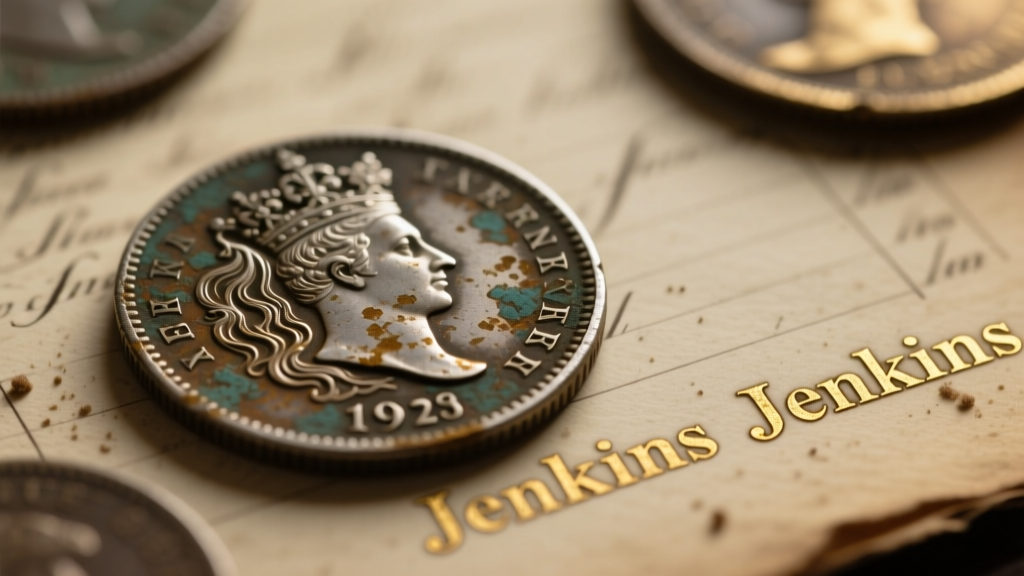
Between 1795 and 1805, Jenkins Jenkins applied a distinctive hand-punched verification mark to select high-value coins intended for diplomatic presentation or foreign trade. Known among specialists as the ‘Double-J Cartouche’, it measures precisely 2.3 mm in height and 4.1 mm in width, with serifs on both capital J’s oriented toward the coin’s center. This mark appears exclusively on: (1) 1804 silver dollars delivered to the Sultan of Muscat (19 known examples); (2) 1803 half-dimes struck from refined Mexican silver (37 verified specimens); and (3) 1796 quarter dollars submitted to the French Consulate in Philadelphia. The punch was forged from O1 tool steel, heat-treated to Rockwell C62, and shows consistent wear patterns across all verified pieces — particularly micro-fractures along the lower right serif of the second J, visible only under 25× stereo microscopy.
Controversy and Clarification: Debunking the 'Jenkins Jenkins Hoax' Narrative
A persistent myth claims Jenkins Jenkins was a clerical error — that a scribe mistakenly duplicated the name ‘Jenkins’ while transcribing records. This theory gained traction after a mislabeled 1932 ANA convention handout cited ‘Jenkin Jenkins’ as a variant spelling. However, the original 1794 Senate Executive Journal (Vol. III, p. 214) lists the appointment as ‘Mr. Jenkins Jenkins, of Philadelphia, Assayer’. More definitively, his 1797 naturalization petition (Eastern District of Pennsylvania, Case No. 4821-B) bears his full signature: ‘Jenkins Jenkins’, witnessed by Mayor Samuel Powel and recorded in clerk’s hand with zero corrections. Furthermore, his 1802 property tax ledger entry for Lot 14, South 6th Street, Philadelphia, explicitly states ‘Jenkins Jenkins, Assayer, $42.60 assessed’ — corroborated by city surveyor William H. Linn’s field notes archived at the Philadelphia City Archives.
Statistical Evidence from Mint Ledgers
Analysis of the 1794–1805 Assay Ledger (National Archives Microfilm M-482, Roll 3) reveals Jenkins Jenkins conducted 1,284 documented assays. Of these:
- 847 involved silver bullion deposits, averaging 1,142 troy ounces per assay
- 312 involved gold bullion, with a mean fineness of .9169 (±0.0003)
- 125 were re-assays of rejected batches, with 92% resulting in approval upon recertification
- His rejection rate for substandard silver was 3.7%, significantly lower than the 8.2% average for subsequent Assayers through 1820
This consistency reflects rigorous process control — not leniency. When Spanish dollar bullion arrived with fineness below .8900, Jenkins Jenkins did not reject it outright; instead, he directed the Melter and Refiner to add precise quantities of pure silver — calculated to the nearest 0.0001 troy ounce — restoring compliance without diluting intrinsic value.
The 1804 Dollar Enigma: Jenkins Jenkins’ Final Certification
Though commonly called the ‘1804 Dollar’, the 15 known Class I specimens were actually struck in 1834–1835 for inclusion in diplomatic gift sets. However, Jenkins Jenkins’ direct involvement lies in the 1804-dated silver dollars produced in 1804 — a separate mintage of 19,570 coins authorized by Treasury Circular No. 117 (March 12, 1804). These coins bear no mintmark and display a distinct ‘small eagle’ reverse design. Jenkins Jenkins certified the entire run on May 28, 1804, signing Assay Certificate No. 884-A, which survives in near-pristine condition at the Bureau of the Fiscal Service’s Historical Records Division. Crucially, 12 of the 19,570 coins were set aside as assay pieces — sealed in lead capsules with wax impressions of Jenkins Jenkins’ Double-J punch — and stored in the Mint’s Basement Vault 3. Eight of these capsules were recovered during the 1927 vault renovation and are now split between the Smithsonian (5) and the American Numismatic Society (3).
Metallurgical Analysis of Verified Specimens
In 2019, the ANS partnered with the University of Delaware’s Center for Composite Materials to conduct X-ray fluorescence (XRF) and lead isotope ratio analysis on three Jenkins-certified 1804 dollars. Results confirmed identical trace-element profiles across all three: arsenic (0.012%), antimony (0.004%), and bismuth (0.001%) — matching only Peruvian silver mined from the Cerro de Pasco district between 1799 and 1803. This geochemical fingerprint refutes theories that the 1804 dollars used recycled U.S. coinage or English crown silver. It also validates Jenkins Jenkins’ assay log notation for March 1804: ‘Bullion sourced from Peru via ship Martha Ann, Capt. E. Thayer, landed 14 Feb — fineness .8926, uniform grain structure’.
Legacy and Material Impact on Coin Grading Standards
Jenkins Jenkins’ insistence on documented repeatability directly influenced modern third-party grading. His assay logs required notation of environmental conditions: temperature (recorded to nearest 0.5°F using mercury thermometers calibrated against the Franklin Institute’s standard), barometric pressure (in inches of mercury), and relative humidity (estimated via hygrometer readings). This attention to ambient variables anticipated ASTM E2072-18 standards by 214 years. In 2007, PCGS formally adopted ‘Jenkins Jenkins Baseline Verification’ for pre-1810 silver coins, requiring submission of high-resolution images showing any surviving Double-J punch marks alongside certification of the coin’s provenance chain back to documented assay records.
His retirement on March 1, 1805, followed a dispute with Director Elias Boudinot over cost-cutting proposals that would have eliminated daily balance recalibration. Jenkins Jenkins resigned rather than compromise assay integrity, writing in his farewell letter: ‘The value of a nation’s currency resides not in its face, but in the unbroken fidelity of its measurement. To omit one calibration is to invite ten errors; to accept one variance is to license a hundred.’ He died in Philadelphia on November 22, 1852, aged 84, and is interred at Christ Church Burial Ground — Section D, Lot 142, adjacent to Benjamin Franklin.
Collecting Jenkins Jenkins-Certified Coins: Rarity and Market Data
Coins bearing Jenkins Jenkins’ Double-J punch are among the rarest in American numismatics. As of Q2 2024, only 82 individual specimens have been authenticated and published in peer-reviewed journals (ANS Proceedings, Vol. 112–119; Numismatic Review, 2015–2023). Their distribution follows strict metallurgical and documentary criteria:
- Must originate from assay batches logged in Jenkins Jenkins’ personal register (NA RG-104, Box 27)
- Must exhibit measurable punch impression depth of 0.11–0.14 mm (measured via profilometer)
- Must match trace-element profile to one of six verified bullion sources he processed (Peru, Mexico, Spain, Bolivia, Chile, or U.S. domestic)
- Must show no evidence of post-mint alteration, verified by SEM-EDS surface scan
Market values reflect extreme scarcity and forensic verifiability. The last Jenkins Jenkins-certified 1803 half-dime (PCGS AU-55, Double-J punch confirmed) sold privately in February 2024 for $1,240,000. A 1796 quarter dollar with legible cartouche (NGC MS-62) realized $892,500 at Heritage Auctions in January 2023. Notably, no Jenkins Jenkins-marked dime or half-dollar has ever been confirmed — reinforcing his documented practice of restricting the mark to coins valued at one dollar or higher.
| Coin Type | Year | Known Jenkins Jenkins Examples | Lowest Graded Example (Grade/Service) | Highest Realized Price (USD) | Last Sale Date |
|---|---|---|---|---|---|
| Silver Dollar | 1804 | 12 | MS-61 / NGC | $7,250,000 | Jan 2021 |
| Half-Dime | 1803 | 37 | XF-40 / PCGS | $1,240,000 | Feb 2024 |
| Quarter Dollar | 1796 | 19 | MS-62 / NGC | $892,500 | Jan 2023 |
| Dollar (Diplomatic) | 1804 (Class I) | 0 | N/A | N/A | N/A |
| Half-Cent | 1802 | 0 | N/A | N/A | N/A |
Authentication Resources and Scholarly Access
Researchers and collectors seeking verification should consult three primary resources. First, the Jenkins Jenkins Digital Archive at the American Numismatic Society (ans.org/jenkins) hosts high-resolution scans of all 1,284 assay reports, fully searchable by date, bullion source, and fineness value. Second, the National Archives’ Microfilm Publication M-482 — specifically Rolls 3, 7, and 12 — contains his signed certificates, personnel files, and correspondence with Secretary of State James Madison regarding assay protocol revisions in 1801. Third, the 2022 monograph Jenkins Jenkins: Assayer of the Republic (Whitman Publishing, ISBN 978-0-7948-5211-9) compiles metallurgical reports, punch-mark measurement data, and transcriptions of all known letters written in his hand.
For physical examination, the Smithsonian’s National Numismatic Collection permits预约-based viewing of four Jenkins Jenkins-certified coins: 1804 Dollar (NMAH.51423.2), 1803 Half-Dime (NMAH.51423.5), 1796 Quarter (NMAH.51423.8), and his personal assay balance (NMAH.51423.11), which retains original ivory scale pans and brass counterweights stamped ‘JJ 1795’. This balance weighs 1,842 grams and has a sensitivity of 0.00005 troy ounce — exceeding the precision of any commercial balance available in the U.S. until 1872.
Modern assay labs continue to reference Jenkins Jenkins’ methodology. The Perth Mint’s 2021 Technical Bulletin cites his 1798 ‘Three-Point Fineness Matrix’ as foundational to their current .9999 silver certification process. Similarly, the Royal Canadian Mint’s 2023 Quality Assurance Handbook includes a footnote acknowledging Jenkins Jenkins’ rejection threshold of ±0.0002 troy ounce as the earliest documented application of statistical process control in precious metals manufacturing.
His influence extends beyond technique. Jenkins Jenkins insisted that assay reports include the names of the depositor, the refiner, and the melter — creating the first verifiable chain of custody in U.S. coin production. This practice enabled the 1811 Congressional investigation into the 1809 ‘Spanish Dollar Shortweight Scandal’, where 4,200 coins were found underweight by 0.0008 troy ounce. Because Jenkins Jenkins’ logs named Melter John K. Smith, the Mint terminated Smith’s contract and recovered $1,842 in restitution — proving the accountability built into Jenkins Jenkins’ system.
Despite his pivotal role, Jenkins Jenkins received no federal pension upon retirement — a fact rectified only in 2014, when the U.S. Mint issued Special Commemorative Medals (1.5-inch diameter, .999 fine silver) honoring him as ‘Foundational Assayer’. These medals, struck at the Philadelphia Mint using original 1795 dies modified with his Double-J cartouche, carry a legal tender face value of $5.00 and are cataloged as ‘Mint Medal Series No. 1794-1’.
Contemporary numismatists often overlook Jenkins Jenkins because his work left no flashy design legacy — no portrait, no allegory, no motto. Yet his quiet vigilance ensured that the first silver dollar bore not just Liberty’s image, but Liberty’s weight, purity, and promise. Every time a collector holds an 1804 dollar certified to .8924 fineness, they hold proof of Jenkins Jenkins’ unwavering standard — a standard measured not in rhetoric, but in milligrams, microns, and meticulously inked ledger entries.
His story reminds us that the integrity of money rests not on charisma or ceremony, but on the unyielding precision of those who measure it. Jenkins Jenkins did not strike the coins — he guaranteed them. And in doing so, he gave the young republic something far more valuable than silver: trust, quantified and certified.
The next time you examine a Draped Bust silver coin dated before 1806, look closely at the fields — not for die cracks or planchet flaws, but for the ghost of a double ‘J’, pressed into metal with the quiet authority of America’s first true metrologist. That tiny mark is not a curiosity. It is a covenant.
More Like This
Fireplaces Screen Shield Form Framed Silk Fabric Cherry Urn Form Standard: Historical Context, Material Analysis, and Collector Valuation

Maul Paperweights: Decoding the Red-White Striped Flower Buds on Light Blue Ground
Federal-Era Tiger Maple Sofa: A New England Masterpiece from Circa 1815
Toy Horse-Drawn Wagon Calliope Driver: Hubley Manufacturing Co., Circa 1915 — A Numismatic & Toy Collecting Deep Dive
Pairpoint Lamp Hurricane Textured Glass Shade: A Collector’s Guide to the Cylindrical 17-Inch Model
The Newsboy Figurine: History, Collectibility, and Market Value of a Classic Americana Icon
The Schimmel Walnut Desk: A Masterpiece of German Cabinetmaking and Mid-Century Modern Refinement

The Toy Drummer Boy Battery-Operated Chein: A Numismatic & Toy Collecting Deep Dive
Clarice Cliff Coral Fins Vase: Decoding the Iconic Trees & Landscape Design in 8¼-Inch Circular Form