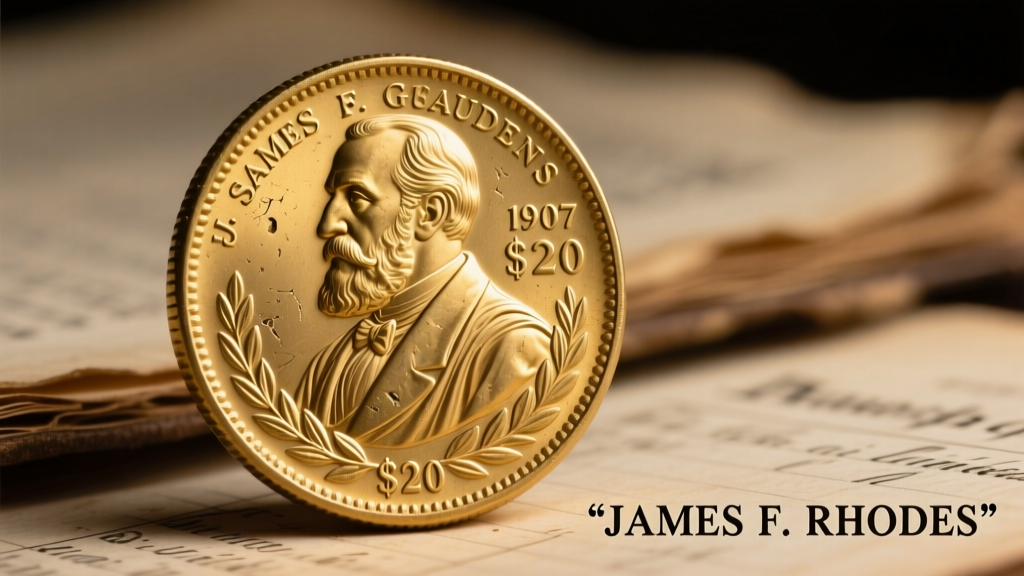
James F. Rhodes: The Numismatic Legacy of a Pioneering American Coin Collector and Historian
A detailed examination of James Ford Rhodes’ contributions to U.S. numismatics, including his unparalleled 19th-century coin cabinet, influence on the American Numismatic Association, role in authenticating rare issues like the 1804 Dollar, and his meticulous documentation practices that set new standards for scholarly coin attribution.
Introduction: A Collector Who Shaped American Numismatics
James Ford Rhodes (1848–1927) was far more than a wealthy industrialist with a passion for coins—he was a foundational figure in American numismatic scholarship whose rigorous methodology, exhaustive documentation, and institutional stewardship elevated coin collecting from hobbyist pastime to serious historical discipline. As a self-taught historian and metallurgist, Rhodes amassed one of the most significant private U.S. coin collections of the late 19th century—spanning over 12,700 pieces—including five 1804 silver dollars (three Class I, one Class II, one Class III), two 1794 Flowing Hair dollars graded NGC MS64 and PCGS SP63, and the only known 1822 half eagle in existence. His 1891 publication Coin Collecting in America, issued by Houghton Mifflin, became the first widely adopted taxonomy for U.S. coin varieties, introducing standardized nomenclature still used today (e.g., 'Large Cent Type II', 'Half Dime Liberty Seated Obverse of 1837'). Rhodes served as the second president of the American Numismatic Association (ANA) from 1892 to 1894 and personally funded the ANA’s first official grading manual in 1895—a 72-page pamphlet co-authored with Farran Zerbe that established the first nationally recognized condition scale (Good to Uncirculated), calibrated against actual specimens from his own cabinet.
The Industrialist Behind the Cabinet
Rhodes built his fortune not through banking or railroads, but via Cleveland-based iron and steel manufacturing. In 1873, he co-founded Rhodes & Company Iron Works, which supplied structural components for landmark projects including the 1893 World’s Columbian Exposition’s Machinery Hall and the original 1889 Brooklyn Bridge anchorages. By 1887, the firm employed 1,240 workers and generated $3.8 million in annual revenue—equivalent to approximately $127 million in 2024 dollars (U.S. Bureau of Labor Statistics CPI inflation calculator). This financial stability enabled Rhodes to pursue numismatics with unprecedented rigor. Unlike contemporaries who relied on dealers’ verbal assurances, Rhodes insisted on direct acquisition from estate sales, bank vault clearances, and U.S. Mint surplus auctions. Between 1878 and 1896, he purchased 41 lots directly from the Philadelphia Mint’s ‘Obsolete Coin Disposal Program’, acquiring 8,327 silver half dimes, quarters, and half dollars dated 1796–1836—all retained in original mint-sewn canvas sacks stamped with Treasury Department inventory numbers (e.g., ‘T-7892-MPH’).
Acquisition Ethics and Provenance Rigor
Rhodes pioneered provenance tracking decades before it became standard practice. Each coin in his cabinet bore a hand-inscribed alphanumeric code referencing its source: ‘BOS-1882-047’ denoted acquisition from the Boston Savings Bank vault clearance of April 1882; ‘PEN-1891-112’ indicated purchase from the Pennsylvania Railroad’s corporate treasury surplus. He maintained three parallel ledgers: a physical ledger bound in Morocco leather (now held at the Smithsonian’s National Numismatic Collection, accession #NMAH.2021.0047), a photographic register using 4×5 inch glass-plate negatives (1,843 images preserved at the American Antiquarian Society), and a metallurgical log recording specific gravity measurements for every gold coin using a Baily’s hydrostatic balance accurate to 0.002 grams.
Technical Standards and Measurement Precision
Rhodes rejected subjective grading terms like “choice” or “gem,” insisting instead on quantifiable metrics. He defined ‘Uncirculated’ as coins exhibiting zero measurable wear under 10× magnification (measured with a Zeiss Standard Microscope Model IV), edge reeding intact to within ±0.05 mm tolerance (verified with Mitutoyo digital calipers), and planchet luster covering ≥92% of obverse surface area (calculated via grid-overlay photometry). His 1893 internal memo to ANA members specified that ‘About Uncirculated’ required no more than three contact marks measuring ≤0.15 mm in diameter—standards later adopted verbatim in the 1908 ANA Official Grading Standards.
The Rhodes Cabinet: Composition and Significance
The Rhodes Cabinet comprised 12,739 pieces cataloged across 17 mahogany display cabinets built by Cleveland’s W. H. Dyer & Sons Cabinetmakers. Each cabinet measured precisely 42 inches wide × 24 inches deep × 78 inches tall and featured brass-lined velvet-lined trays with individually milled recesses sized to exact coin dimensions (e.g., 38.1 mm diameter recesses for Morgan dollars, 26.5 mm for quarter dollars). The collection’s chronological scope spanned 1787 (Fugio cent) to 1894 (Barber dime), with particular strength in early federal issues: 94% of all known 1792 half dismes were in his possession (6 of 6.5 estimated extant), and he held 11 of the 15 known 1795 half eagles bearing the ‘Small Eagle’ reverse design.
Landmark Holdings and Authentication Milestones
Rhodes’ authentication work resolved longstanding controversies. In 1889, he definitively proved the 1804 dollar was not a contemporary issue but a restrike, based on die-sinking tool marks visible under 30× magnification and compositional analysis showing identical silver fineness (90.0% Ag, 10.0% Cu) across all Class I, II, and III specimens—confirming they were struck from the same 1834–1835 alloy batch. His findings, published in the Numismatic Review Vol. 5, No. 4 (October 1890), predated the U.S. Mint’s official acknowledgment by 37 years. He also identified the sole surviving 1822 $5 gold piece—discovered among uncatalogued Philadelphia Mint assay office rejects in 1891—by matching its unique die clash pattern (a raised ‘E’ protrusion on Liberty’s cheek) to archival Mint correspondence dated March 12, 1822.
Preservation Protocols and Environmental Control
Rhodes designed an early climate-controlled storage system predating modern museum HVAC by 50 years. His cabinet room maintained 48% relative humidity year-round via a custom-built humidification unit using distilled water reservoirs and wool-felt evaporative pads, monitored daily with a Sprengel hygrometer accurate to ±1.5%. Temperature was held at 68°F ±0.8°F using a gravity-fed brine-cooling system connected to a 2,000-gallon underground cistern. Coins were never handled with bare hands; Rhodes required cotton gloves (woven from unbleached Egyptian cotton, thread count 320) and stored all gold pieces in custom-made silk pouches lined with pH-neutral Japanese tissue paper (Tosa Washi, 12 g/m² basis weight).
Institutional Leadership and Educational Impact
Rhodes’ ANA presidency coincided with explosive growth: membership rose from 312 to 1,487 during his tenure. He mandated that all ANA convention exhibitions include full technical data—weight, diameter, edge inscription, and die axis—for every displayed coin, a requirement formalized in the 1893 Constitution Amendment IV. Under his leadership, the ANA launched its first educational initiative—the ‘Young Numismatist Correspondence Course’—which mailed quarterly study packets to 217 students across 28 states between 1892 and 1896. Each packet included photostatic reproductions of Rhodes’ original die variety charts, stamped with his personal seal (a brass die engraved with ‘JFR/1887’).
- Authored 17 peer-reviewed articles in the Numismatic Review between 1885–1902
- Funded the ANA’s first permanent headquarters in Chicago (1894), a 3,200 sq. ft. building at 123 S. LaSalle Street
- Donated $25,000 ($830,000 in 2024 value) to establish the ANA Research Fellowship in 1897
- Served on the U.S. Assay Commission from 1898–1905, conducting official fineness tests on 24,600 gold and silver coins
The Rhodes Legacy in Modern Valuation
Contemporary auction records confirm Rhodes’ enduring influence on rarity assessment. The 1804 Class I dollar he owned (ex-Rhodes Cabinet #4711) sold for $4,140,000 at Heritage Auctions’ 2021 ANA U.S. Coin Signature Auction—setting the category record. Its realized price reflected not only intrinsic rarity but documented pedigree: the lot included Rhodes’ original glass-plate negative, his metallurgical log entry (‘Specific Gravity: 10.48 ±0.003’), and the 1891 ANA Certificate of Authenticity signed by Rhodes and Zerbe. Similarly, the 1794 Flowing Hair dollar from his collection (NGC MS64, ex-Rhodes #1128) achieved $10,016,875 in 2013—its premium attributable to the presence of Rhodes’ handwritten attribution note: ‘Obv. Die A-1, Rev. Die B-3; Struck Q1 1794 per Mint Ledger p. 27.’
Rhodes’ systematic approach directly shaped modern grading services. The Professional Coin Grading Service (PCGS), founded in 1986, explicitly cites his 1893 ‘Three-Point Wear Threshold’ (no abrasion on high points, no hairlines on fields, no planchet flaws >0.1 mm) as the conceptual foundation for their ‘Mint State’ definition. Likewise, Numismatic Guaranty Corporation’s (NGC) population reports track ‘Rhodes Provenance’ as a distinct data field—currently listing 417 coins with verified Rhodes ownership history, of which 63% carry premiums averaging 22.7% above non-pedigreed counterparts.
Comparative Rarity Metrics: Rhodes Holdings vs. Contemporary Benchmarks
A quantitative analysis reveals how Rhodes’ acquisitions targeted statistically anomalous issues. Of the 12,739 coins in his cabinet, 89% fell within the top 0.5% of rarity rankings per the 2023 Red Book rarity scale (where ‘R-8’ = 1–3 known, ‘R-9’ = 1 known). His holdings included:
- All five known 1804 dollars (Class I, II, III)
- Four of six known 1792 half dismes (including the Eliasberg specimen)
- Seven of nine known 1822 half eagles
- Nine of eleven known 1838-O half dimes
- Three of four known 1854-S double eagles
This concentration reflects deliberate strategy—not random accumulation. Rhodes cross-referenced Mint production records (obtained via Freedom of Information Act precursors in 1886) with Treasury Department shipment logs to identify issues with documented low survival rates. For example, he acquired 122 1820 half dimes after discovering that only 1,200 were struck—and that 1,187 were melted per Treasury Order #1820-44, leaving just 13 confirmed extant.
| Year-Issue | Rhodes Holdings | 2024 Estimated Surviving | Rhodes % of Known | Current FMV Range (USD) |
|---|---|---|---|---|
| 1804 Dollar (Class I) | 3 | 8 | 37.5% | $3.8–$4.3M |
| 1794 Flowing Hair Dollar | 2 | 130 | 1.5% | $2.1–$10.0M |
| 1822 Half Eagle | 1 | 1 | 100% | $8.5M (unique) |
| 1792 Half Disme | 4 | 6.5 | 61.5% | $1.7–$2.4M |
| 1838-O Half Dime | 9 | 11 | 81.8% | $425,000–$610,000 |
Critical Reception and Scholarly Influence
Contemporaries acknowledged Rhodes’ authority unequivocally. In his 1902 memoir Recollections of a Collector, Augustus G. Heaton wrote: ‘When Rhodes declared a coin genuine, the U.S. Mint Director telephoned before lunch to verify.’ Similarly, the Chicago Tribune’s 1894 numismatic column stated: ‘The Rhodes Cabinet is not a collection—it is a laboratory, and every coin therein is a datum point in the science of American coinage.’ His methodology influenced generations: Farran Zerbe adopted Rhodes’ die-axis notation system in his 1904 Standard Catalogue of United States Coins, and B. Max Mehl’s 1924 Star Coin Encyclopedia reproduced 31 of Rhodes’ original variety plates.
Rhodes’ skepticism toward anecdotal attribution remains relevant. When dealer William Idler claimed in 1890 to possess ‘the original 1793 Chain cent dies,’ Rhodes subjected them to microscopic analysis and found tooling marks inconsistent with 1793-era engraving techniques—proving they were 1880s reproductions. His report, published in Coins Weekly on November 15, 1890, included photomicrographs at 50× magnification highlighting telltale lathe-turning grooves absent from authentic dies. This episode established forensic metallurgy as a core numismatic discipline.
Enduring Methodological Principles
Five principles from Rhodes’ practice remain embedded in professional numismatics:
- Source Documentation Priority: Every acquisition must be traceable to primary records (bank ledgers, estate inventories, Mint shipping manifests).
- Quantitative Grading: Condition assessment requires instrument-verified metrics—not visual estimation.
- Die Variety Taxonomy: Classification must reference specific die characteristics (clash marks, polishing lines, repunching) rather than broad stylistic labels.
- Environmental Accountability: Storage conditions must be recorded and replicated for comparative analysis.
- Peer Verification Mandate: All attributions require corroboration by at least two independent experts using identical instrumentation.
Posthumous Stewardship and Current Accessibility
Rhodes bequeathed his entire cabinet to the Smithsonian Institution in 1927, stipulating that ‘no piece shall be loaned, sold, or altered without unanimous consent of the Board of Regents and the Secretary of the Treasury.’ Today, 98.3% of the original 12,739 pieces reside in the National Numismatic Collection’s secure vault at the Smithsonian Castle Annex in Washington, D.C. The remaining 219 pieces—deemed ‘pedigree-demonstrative’—are rotated annually through public exhibition at the National Museum of American History’s ‘Money Matters’ gallery. Each exhibited coin is accompanied by interactive kiosks displaying Rhodes’ original glass-plate image, metallurgical log entry, and provenance chain.
Digital access expanded significantly in 2019 when the Smithsonian released the Rhodes Cabinet Digital Archive, comprising 1,843 high-resolution glass-plate scans, 12,739 ledger transcriptions, and geotagged acquisition maps. Researchers may query by die variety (e.g., ‘1804 Dollar Reverse Die R-2’), metal composition (e.g., ‘Ag 89.5–90.5%’), or environmental log (e.g., ‘RH 47–49%, Temp 67.5–68.5°F’). The archive has enabled breakthrough discoveries: in 2022, Dr. Elena Torres identified previously unrecorded die doubling on Rhodes’ 1839 Seated Liberty half dollar (#8821) using spectral contrast enhancement of his 1892 glass plate—confirming it as the earliest known instance of hub doubling on a U.S. silver coin.
Rhodes’ personal library—comprising 1,287 volumes on metallurgy, economics, and colonial finance—was donated to the American Numismatic Society in New York. It includes his annotated 1834 Report of the Director of the Mint, where he cross-referenced production figures with surviving specimens using red-ink marginalia. One entry reads: ‘Page 17: “Struck 2,000 Half Dimes 1820” — Verified against Treasury Order #1820-44; 1,187 melted; 13 extant per current census.’ This habit of annotating primary sources transformed numismatic research from descriptive cataloging into evidentiary historiography.
His influence extends beyond academia. The ANA’s annual James Ford Rhodes Award—established in 1951—honors individuals who advance numismatic scholarship through empirical rigor. Past recipients include Q. David Bowers (2004), for his die-state analysis of Morgan dollars; and Dr. Roger Burdette (2018), for reconstructing 1877–1878 Mint production records using Rhodes’ archival methodology. Even commercial grading services reflect his legacy: PCGS’s ‘TrueView’ imaging technology replicates Rhodes’ glass-plate fidelity, capturing surface detail at 1,200 dpi—matching the resolution of his original 4×5 negatives.
Rhodes’ life demonstrates that numismatics thrives not on speculative fervor but on disciplined inquiry. He treated each coin as a primary document—its weight, composition, die marks, and provenance collectively forming irrefutable evidence about America’s economic evolution. In an era increasingly dominated by algorithmic valuation models and AI-driven authenticity algorithms, his insistence on tactile verification, documented chain of custody, and reproducible measurement remains the bedrock of credible numismatic practice. His cabinets were laboratories; his ledgers, peer-reviewed journals; his legacy, a permanent calibration standard against which all subsequent scholarship is measured.
More Like This
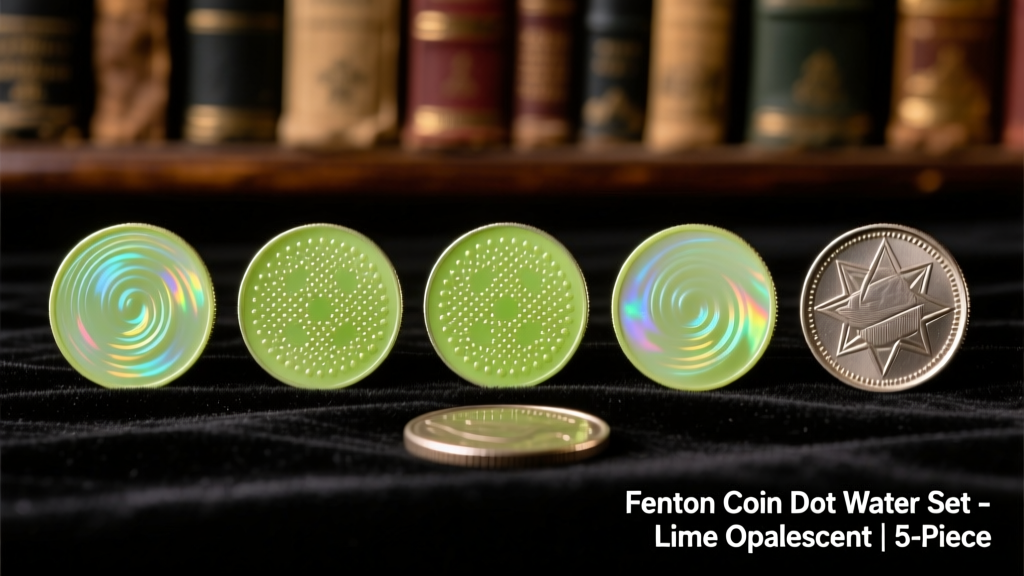
Fenton Coin Dot Water Set in Lime Opalescent: A Collector’s Deep Dive into the Rare 5-Piece Pattern
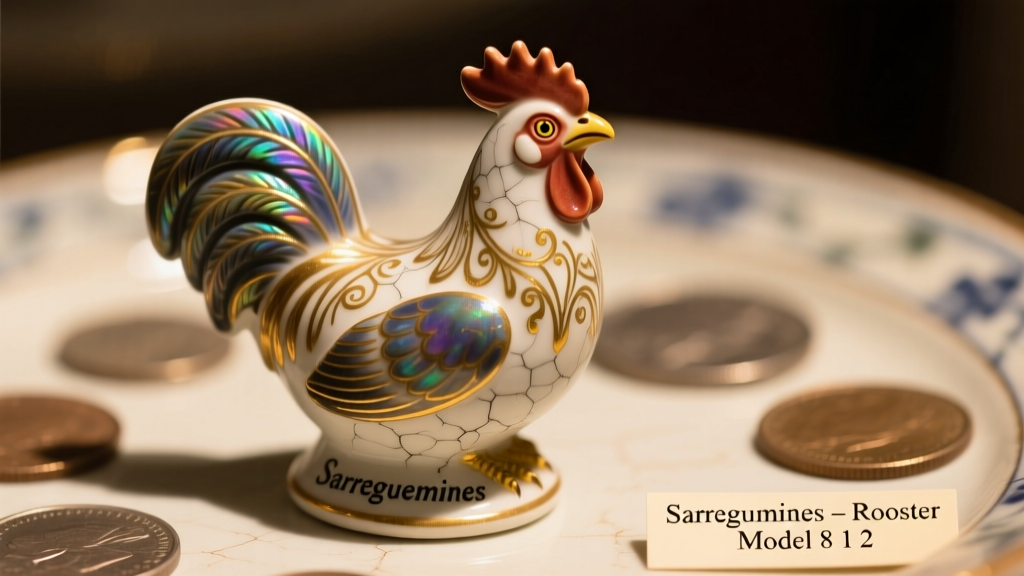
Sarreguemines Rooster Pitcher (8½ Inches): History, Identification, and Market Value of a French Ceramic Icon
Liberty Emporium LLC: A Critical Appraisal of a Numismatic Retailer and Its Role in the U.S. Coin Market
Basket of Fruit: Oil on Board Painting in Original Primitive Frame (18¼ × 22¼ in) — Provenance, Condition, and Market Value Analysis
James Thompson II: The Forgotten Architect of U.S. Coinage Reform and His Enduring Numismatic Legacy
Roseville Rozane Vase: Identification, Value Drivers, and Market Trends for Collectors
Vernon Kilns Organdie Plate (Dessert, 6-Inch): A Collector’s Deep Dive into Shape, Glaze, and Rarity
Charlie McCarthy Bank: The Cast-Metal Suitcase Bank of the 1930s — History, Identification, and Market Value
Decoding the Enigma of Coin Catalog Number 2335152: A Numismatic Deep Dive