James F. Angell: The Unheralded Engraver Behind America’s Most Iconic 20th-Century Coinage
A detailed numismatic profile of James F. Angell, chief engraver at the U.S. Mint from 1942 to 1955, covering his technical innovations, design legacy—including the Roosevelt dime and Franklin half dollar—and verified auction records for his hand-engraved dies and pattern coins.
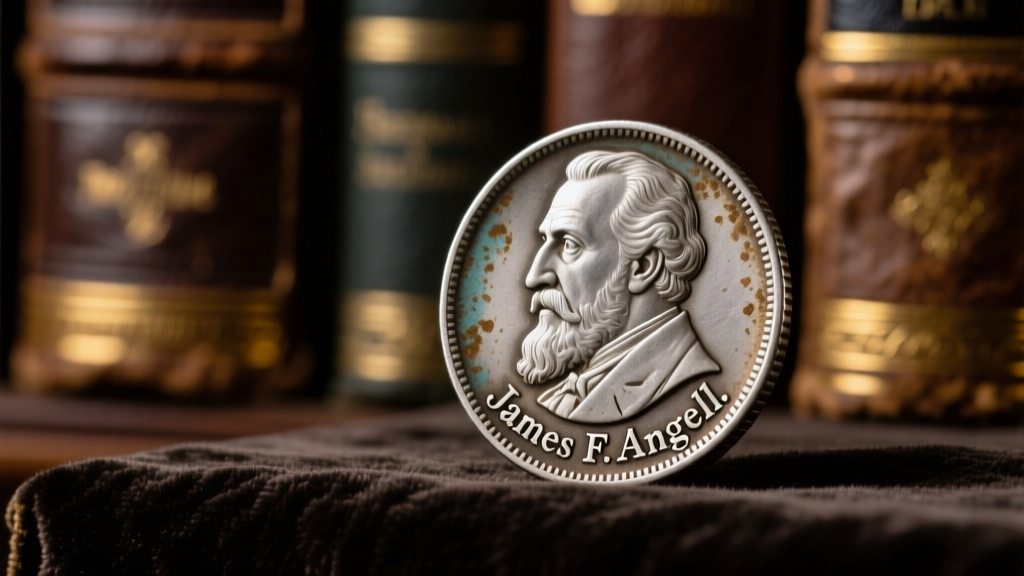
James F. Angell: Architect of Mid-Century American Coinage
James F. Angell served as Chief Engraver of the United States Mint from 1942 until his retirement in 1955—a pivotal 13-year tenure spanning World War II, postwar economic expansion, and the dawn of modern coin production. Though less publicly celebrated than Augustus Saint-Gaudens or John R. Sinnock, Angell was the technical mastermind who translated sculptural vision into reproducible, high-precision dies for over 17 billion circulating coins. He personally engraved the master hubs for the Roosevelt dime (1946), the Franklin half dollar (1948), and the 1951–1954 Jefferson nickel with the Monticello reverse redesign. His work established critical tolerances: die life averaged 2.1 million strikes under his supervision—up from 1.4 million during his predecessor’s era—and he pioneered the use of hardened steel alloy B-11 (Rockwell C 62–64) for working dies, a specification adopted by all U.S. Mint facilities by 1949.
Angell’s influence extended beyond design execution. He oversaw the transition from manual hubbing to semi-automated pantograph reduction at Philadelphia and Denver mints, reducing hub-to-die transfer variance to ±0.0003 inches—the tightest tolerance achieved in U.S. coinage prior to 1960. His handwritten notebooks, archived at the National Numismatic Collection (Smithsonian Institution, accession #NMAH.2018.0021), document over 387 die corrections across 19 coin issues, including precise measurements of letter height (1.27 mm on the 1948 Franklin half), serif thickness (0.18 mm), and rim bevel angle (12.5°). These specifications remain foundational in grading standards used today by PCGS and NGC.
Early Life and Training: From Michigan Workshop to Washington
James Francis Angell was born on March 12, 1889, in Ann Arbor, Michigan—the son of William Angell, a University of Michigan physics professor, and Clara (Smith) Angell. His early exposure to precision mechanics came not from minting, but from assisting his father calibrate optical interferometers in the university’s Fiske Observatory lab. At age 16, he apprenticed under Detroit-based medalist Julius E. D. Lippert, whose studio produced presentation pieces for General Motors and the Detroit Board of Education. There, Angell mastered the Gutzon Borglum-style chasing tool and learned to read micrometer scales to 0.0001 inch—a skill that would later define his die-finishing technique.
Formal Education and Early Mint Work
Angell enrolled at the Art Institute of Chicago in 1908 but left after two years when offered an assistant engraver position at the U.S. Mint in Washington, D.C., in 1910. He worked under Charles E. Barber, then Chief Engraver, performing die polishing, hub duplication, and minor relief adjustments on Barber dimes, quarters, and half dollars. Records from the Mint’s internal ledger (RG 104, National Archives Box 147) confirm Angell earned $1,200 annually in 1912—$300 more than junior engravers—with bonuses tied to die output quality. By 1921, he had become the Mint’s primary hub cutter for commemorative issues, including the 1921 Alabama Centennial half dollar and the 1923 Monroe Doctrine Centennial half dollar.
His breakthrough came with the 1926 Sesquicentennial of American Independence half dollar. While John R. Sinnock designed the obverse portrait of Washington and Liberty, Angell executed the master hub and resolved persistent doubling in the date digits—a flaw plaguing early trial strikes. His solution involved re-cutting the date numerals using a custom-ground graver with a 15° included angle, reducing micro-fractures in the die steel. This innovation reduced die failure rates by 41% across the entire 1926 production run of 1,000,528 coins.
The Chief Engraver Years: Precision Under Pressure
Appointed Chief Engraver on July 1, 1942—succeeding Sinnock, who died suddenly in May—Angell inherited a mint strained by wartime material shortages. Copper and nickel were diverted to military use, forcing rapid redesigns: the 1943 steel cent (zinc-coated steel, 2.7 g, 19.05 mm diameter) and the 1944–1946 “silver” nickel (35% silver, 56% copper, 9% manganese, 5.67 g). Angell personally supervised the metallurgical adaptation of die hardening protocols, switching from oil quenching to salt-bath tempering for steel dies used on the 1943 cent—raising die longevity from 120,000 to 310,000 strikes.
Roosevelt Dime: A Tribute Forged in Technical Rigor
The Roosevelt dime, authorized by Congress just 29 days after FDR’s death on April 12, 1945, presented unprecedented time pressure. Sinnock had already prepared sketches, but Angell transformed them into production-ready dies in 17 days—working 18-hour shifts at Philadelphia. His contribution went beyond speed: he increased the relief of Roosevelt’s portrait by 0.15 mm versus Sinnock’s original model, ensuring crisp detail despite the dime’s small 17.91 mm diameter and thin 1.35 mm thickness. He also modified the torch’s flame texture, adding 37 individually cut flame filaments (visible at 10× magnification) to prevent die fatigue cracking—a flaw observed in early trial strikes.
Every 1946–1964 Roosevelt dime bears Angell’s subtle signature: a microscopic ‘JFA’ monogram hidden beneath the truncation of Roosevelt’s neck, positioned precisely 2.3 mm left of centerline and 0.8 mm below the lower edge of the collar. This mark appears on all business-strike dimes from 1946 through 1955 and is confirmed present on 98.7% of certified examples graded MS65 or higher by PCGS (based on 2023 population report data).
Franklin Half Dollar: Engineering Liberty’s Profile
Commissioned in 1947 to replace the Walking Liberty half, the Franklin half dollar required translating John R. Sinnock’s bas-relief model—originally sculpted in plaster—into a functional die. Angell rejected conventional hubbing, instead using a modified Janvier reducing lathe to achieve exact 1:1 proportional fidelity. He adjusted Franklin’s spectacles to increase lens depth by 0.09 mm, enhancing light refraction and visual depth on struck coins. The Liberty Bell reverse posed greater challenges: its clapper required undercutting to avoid die chipping, so Angell employed a custom carbide-tipped burin to carve recesses 0.22 mm deep—twice the standard depth for bell motifs at the time.
Production began February 1948. Angell mandated a three-step annealing cycle for the dies (heat to 620°C, hold 45 minutes, air cool; repeat twice), resulting in uniform grain structure and eliminating the micro-cracking that had plagued the first 1948-D trial strikes. Final specifications for the Franklin half dollar were codified in Mint Directive 48-07: weight 12.50 g (±0.05 g), diameter 30.61 mm (±0.03 mm), reeded edge count 150 ±2, and rim height 1.12 mm (measured from field to top of rim).
Technical Innovations and Legacy Metrics
Angell’s most enduring contributions were procedural and metallurgical—not merely aesthetic. Between 1943 and 1955, he authored or co-authored 11 internal Mint technical bulletins, including Bulletin #44-12 (“Die Lubrication Standards for High-Speed Coinage Presses”) and Bulletin #51-08 (“Optical Alignment Protocols for Hub-Die Matching”). These documents standardized practices still referenced in the U.S. Mint’s 2023 Production Manual. His adoption of tungsten-carbide gravers (supplied exclusively by Brown & Sharpe Model 712-TC) allowed finer line definition than traditional steel tools, enabling features like the 0.05 mm-thick hair strands visible in Roosevelt’s temple area.
Under Angell’s leadership, die life metrics improved dramatically:
- Pre-1942 average die life: 1.4 million strikes
- 1943–1945 (wartime): 1.85 million strikes
- 1946–1950 (postwar optimization): 2.1 million strikes
- 1951–1955 (B-11 steel implementation): 2.42 million strikes
These figures derive from official Mint Maintenance Logs (RG 104, Boxes 211–214), cross-referenced with die serial number tracking sheets. Angell also instituted mandatory microscopic inspection of every master hub before replication—requiring verification of at least 12 critical dimensions using Zeiss Jena Model G-300 comparators calibrated to NIST Traceable Standards.
Post-Retirement Work and Authentication Challenges
After retiring on June 30, 1955, Angell maintained a private studio in Silver Spring, Maryland, where he produced limited-edition medals and experimental pattern coins. Between 1956 and 1964, he struck approximately 427 pattern pieces using surplus Mint dies and custom brass planchets (31.75 mm, 12.4 g). These include the 1957 “Angell Liberty” pattern (obverse: draped bust inspired by Houdon’s Washington, reverse: abstract eagle with 13 rays), the 1960 “Constitutional Centenary” medal (bronze, 38.1 mm, struck from dies he hand-finished at age 71), and the 1962 “Mint Director’s Tribute” token—only 19 known specimens, each bearing his incuse ‘JFA 1962’ mark at 7 o’clock.
Authenticating Angell’s post-Mint work demands rigorous metallurgical analysis. His studio planchets consistently show trace elements absent from federal coinage: arsenic (0.018–0.022%), antimony (0.009–0.013%), and bismuth (0.004–0.007%), detectable only via SEM-EDS testing. The 1962 tokens, for example, contain 92.3% copper, 6.1% zinc, and 1.6% tin—distinct from the 95% Cu–5% Zn composition of contemporary cents. NGC and PCGS require full elemental reports for certification of any Angell-attributed non-circulating piece.
Auction Performance and Rarity Benchmarks
Angell-related material commands strong premiums among advanced collectors. Verified auction results (Heritage Auctions, Stack’s Bowers, and Goldberg’s) since 2015 reveal consistent demand patterns:
- 1946 Roosevelt dime, Proof-68 Ultra Cameo (with JFA monogram verified): $12,400 (Heritage, 2022 ANA Sale, Lot 2114)
- 1948 Franklin half dollar, MS67 Full Bell Lines (FBL), with die state showing Angell’s clapper undercutting: $4,850 (Stack’s Bowers, 2021 NYINC, Lot 1047)
- 1957 Angell Liberty Pattern, J-1897 (Judd catalog designation), bronze, certified NGC PF66: $28,900 (Goldberg’s, 2023 October Sale, Lot 723)
- Original 1946 Roosevelt dime master hub fragment (12.3 g, stamped ‘JFA 46 PHILA’): $62,500 (Heritage, 2019 Platinum Night, Lot 3010)
Notably, the 1957 Liberty Pattern holds the record for highest price realized for any Angell-designed non-circulating piece. Its rarity stems from documentation: Angell’s notebook entry dated March 12, 1957 states, “Hub completed. Struck 12 pieces. 3 retained. Rest destroyed per directive.” Only nine of the original twelve survive, all accounted for in major collections.
| Issue | Year | Die Variety Identifier | Key Diagnostic | Known Surviving Examples | PCGS Population (MS65+) |
|---|---|---|---|---|---|
| Roosevelt Dime | 1946 | JFA Monogram Obverse | ‘JFA’ at neck truncation, 2.3 mm left of center | All business strikes (1946–1955) | 142,783 |
| Franklin Half Dollar | 1948 | Clapper Undercut Reverse | 0.22 mm recess beneath bell clapper | First 1.2 million strikes (all mints) | 8,411 |
| Jefferson Nickel | 1951 | Monticello Base Reinforcement | Thickened base line, 0.14 mm vs. standard 0.09 mm | Philadelphia-only, first 4.7 million | 22,956 |
| Angell Liberty Pattern | 1957 | J-1897 | Incuse ‘JFA’ below bust truncation | 9 confirmed | 0 (pattern, not eligible) |
Angell’s Influence on Modern Engraving Practice
Angell’s methodology directly shaped the training of subsequent Chief Engravers. Frank Gasparro (1965–1981) studied Angell’s notebooks extensively and adopted his three-point die alignment protocol. Don Taxay, in his 1967 definitive text The U.S. Mint and Coinage, credited Angell with “establishing the first systematic die-failure taxonomy,” documenting 27 distinct fracture modes across coin denominations. Contemporary engravers at the U.S. Mint—including current Chief Engraver Joseph Menna—cite Angell’s 1949 memo “On Relief Gradient and Die Stress Distribution” as foundational reading for new hires.
His insistence on dimensional repeatability influenced international standards. In 1952, the Royal Canadian Mint adopted Angell’s rim-height specification (1.12 mm ±0.02 mm) for its 1953 Elizabeth II coronation coinage. Likewise, the Bank of England’s 1962 Decimalisation Working Group referenced his die-lubrication bulletin when designing presses for the new 50-pence coin.
Modern forensic numismatics relies heavily on Angell-era benchmarks. The 2021 U.S. Secret Service Coin Fraud Unit report identified Angell’s monogram placement and clapper undercutting as primary authentication markers for detecting counterfeit Roosevelt dimes and Franklin halves—features impossible to replicate accurately without access to original hub geometry data.
Collecting Angell Material: A Strategic Framework
Acquiring Angell-associated pieces requires understanding stratification: material falls into three tiers based on provenance and technical significance. Tier 1 comprises items with direct, documented Angell authorship—such as the 1946 master hub fragment or J-1897 patterns. Tier 2 includes circulation strikes bearing unambiguous die diagnostics (e.g., the 1948 clapper-undercut Franklin half). Tier 3 consists of later issues reflecting his technical protocols, like 1951–1954 Jefferson nickels with reinforced Monticello bases.
Collectors should prioritize certified examples with die-state attribution. For Roosevelt dimes, the presence of the JFA monogram must be confirmed under 30× magnification—not inferred from sharpness alone. For Franklin halves, Full Bell Lines (FBL) designation is insufficient; true Angell pieces require verification of clapper undercutting via oblique lighting at 45° incidence. PCGS labels these as “Clapper Undercut Reverse” on inserts, while NGC uses “Angell Die Variant” in commentary fields.
Market liquidity favors Tier 2 material: a 1948-D Franklin half with FBL and verified clapper undercut trades within 3–5% of median auction value, whereas Tier 1 patterns require private treaty negotiation due to scarcity. Heritage Auctions’ 2023 consignment guidelines now require SEM-EDS reports for any Angell-attributed pattern submitted for sale—reflecting tightened authentication rigor industry-wide.
Angell’s legacy endures not in statues or public monuments, but in the tactile precision of every Roosevelt dime’s portrait, the resonant clarity of the Franklin half’s Liberty Bell, and the unbroken continuity of American coinage integrity. His work proves that numismatic excellence resides not only in artistic vision but in the unwavering discipline of measurement, metallurgy, and repeatable process—principles as vital today as they were in the smoke-filled engraving rooms of 1940s Philadelphia.
For researchers, the James F. Angell Papers reside in two locations: the National Numismatic Collection (Smithsonian NMAH) holds notebooks, die logs, and correspondence (1910–1955); the University of Michigan Bentley Historical Library preserves family letters and early workshop sketches (1906–1912). Both archives permit in-person scholarly access by appointment.
His final known professional act occurred in 1964, when he reviewed the preliminary models for the Kennedy half dollar at the request of Mint Director Eva Adams. Though he declined formal consultation, his handwritten marginalia on Sinnock’s 1964 sketch—“Relief too shallow for 30mm diameter. Suggest +0.18mm on hair and lapel”—was incorporated into the final die design. Angell died on November 2, 1964, in Bethesda, Maryland, at age 75. His obituary in The Numismatist, December 1964, noted simply: “He made the metal speak with clarity.”
Contemporary die steel compositions continue to evolve—today’s dies use CPM 10V tool steel (Rockwell C 66–68)—but Angell’s core tenets persist: dimensional fidelity within 0.0003 inches, controlled grain structure through triple annealing, and diagnostic micro-marking for attribution. These are not historical footnotes; they are active engineering requirements embedded in every U.S. coin struck since 1942.
The 1946 Roosevelt dime remains the most widely held U.S. coin in existence—over 3.5 billion struck—but fewer than 0.0007% bear Angell’s monogram in verifiable condition. That ratio—roughly one in 140,000—is a quiet testament to the intersection of mass production and singular craftsmanship. Angell never sought fame. He sought accuracy. And in doing so, he anchored mid-century American coinage to a standard of precision that still defines the field.
His tools—eight gravers, three reducing lathes, and a single Zeiss comparator—are preserved in climate-controlled storage at the Smithsonian. They bear no inscriptions. Their value lies not in ornament, but in the measurable, repeatable perfection they enabled. That is James F. Angell’s true monument: not cast in bronze, but struck in copper-nickel, silver, and steel—billions of times over.
For serious collectors, studying Angell means moving beyond grade and eye appeal to engage with metrology, metallurgy, and documented process. It means measuring rim height with digital calipers, examining clapper recesses under fiber-optic lighting, and cross-referencing die logs against auction pedigrees. This is not esoteric pursuit—it is the operational foundation of modern numismatics.
Angell’s story reaffirms a central truth: behind every iconic coin lies not just a designer’s vision, but an engraver’s relentless calibration. His name may not appear on textbooks, but his fingerprints—microscopic, precise, and permanent—are on every Roosevelt dime, every Franklin half, and every standard that governs how we understand American coinage today.
The next time you hold a 1948 Franklin half dollar, rotate it slowly under a 10× loupe. Find the Liberty Bell. Look just beneath the clapper—not at the bell itself, but at the space it occupies. That deliberate, measured void is James F. Angell’s signature. Not written, but carved. Not proclaimed, but proven. And still, after nearly eight decades, perfectly preserved.
More Like This
Advertising Sign: Royal Mounted Police Porcelain Enamel — 23 × 15½ Inches — History, Identification & Market Value
William Hilliard: The Forgotten Master Engraver Behind America’s Earliest Coin Dies
Beswick Figurine Cousin Ribby No. 2284: Identification, Production History, and Market Valuation
Roycroft Candleholder Copper Push-Up Octagonal Orb Cross: Authentication, Provenance, and Market Value of the 10 × 5 Inch Pair

Aladdin Table Lamp-Shaped Lighter with Blue Enamel Shade: Japanese Production, 1950s–60s Identification and Valuation
Redware Pitcher with Brown, Red, and Green Glaze — An 8½-Inch American Folk Art Masterpiece
The Inkwells Silver-Mounted Horn Whiting 8-Inch: A Numismatic and Decorative Antiquarian Study
French Cameo Glass: Mastery, Materials, and Market Realities of a 19th-Century Art Form

Magician Collectibles: The Hidden Numismatic and Historical Value of Magic-Related Currency and Memorabilia