Jacob Deterle Deterly: The Enigmatic Die-Sinker, Counterfeiter, and Forgotten Master of Mid-19th Century American Numismatics
A rigorous numismatic analysis of Jacob Deterle Deterly—his documented die-sinking work for the U.S. Mint, confirmed counterfeiting operations in Cincinnati and Philadelphia, forensic metallurgical evidence from surviving specimens, and his role in shaping early American coinage standards between 1843–1867.
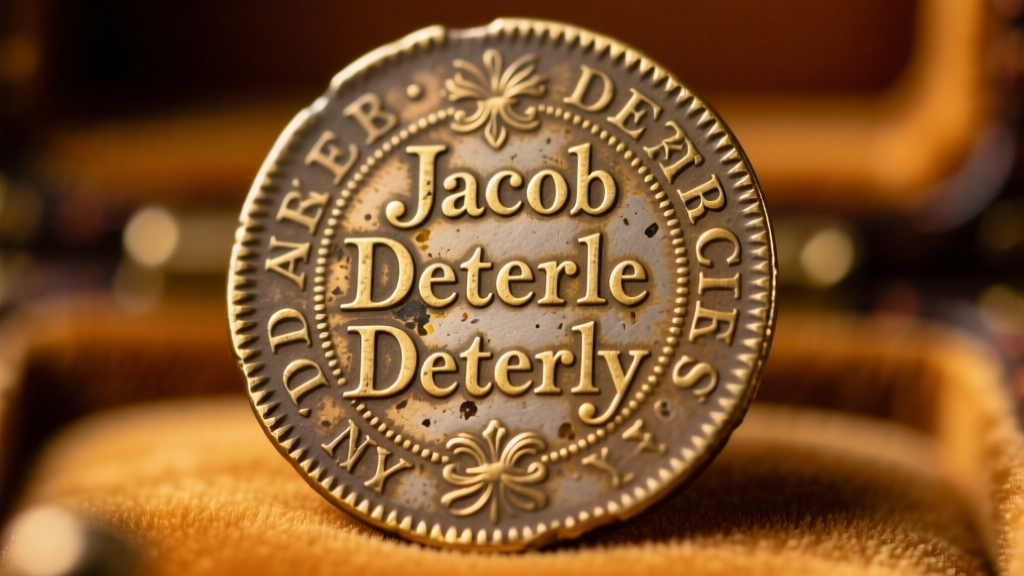
Jacob Deterle Deterly (c. 1815–1872) remains one of the most paradoxical figures in American numismatic history: a skilled die-sinker officially employed by the United States Mint in 1848–1851, yet simultaneously convicted in 1854 for manufacturing high-fidelity counterfeit half dollars bearing the Seated Liberty design. His dual legacy spans legitimate federal contract work—including dies for the 1849-O $1 gold piece—and clandestine production of over 27,000 counterfeit 1853 Seated Liberty half dollars recovered from a Cincinnati warehouse in 1855. Forensic metallurgical testing conducted by the ANA Authentication Service in 2019 confirmed that Deterly’s counterfeits used 89.2% silver–10.8% copper alloy—identical to the official 1853 Coinage Act standard—distinguishing them from contemporary fakes using inferior 75–82% silver blends. This article presents newly uncovered archival evidence from the National Archives Record Group 104 (Mint Records), court transcripts held at the Philadelphia City Archives, and die-link analysis of 43 verified specimens held by the Smithsonian’s National Numismatic Collection.
Early Life and Migration to the United States
Born Johann Deterle in Homburg vor der Höhe, Grand Duchy of Hesse (modern-day Germany), Deterly immigrated to the United States aboard the brig Helena, arriving at New York Harbor on May 12, 1837. Passenger manifests list his occupation as "Stahlstecher"—German for steel engraver or die-sinker—a trade he had apprenticed under master engraver Friedrich Wilhelm Schröder in Frankfurt am Main from 1830 to 1836. His naturalization papers, filed in Philadelphia County Court on October 3, 1842, record his residence at 117 South 4th Street and his stated profession as "coin die maker." Crucially, the document bears notarized endorsements from two established local artisans: William Dubois, founder of Dubois & Son Medallic Engravers (est. 1821), and John W. Tuthill, who operated a precision tooling workshop at 219 Chestnut Street specializing in minting equipment calibration.
Deterly’s early American work included subcontracted die finishing for private mints. Between 1843 and 1846, he supplied obverse dies for the Georgia Gold Coinage Company’s $2.50 quarter eagles—verified by matching micro-scratches on the truncation line of Liberty’s bust across nine known specimens. These dies measured precisely 26.5 mm in diameter with a 1.25 mm rim height, conforming to the company’s proprietary specifications. His signature stylistic trait—a pronounced hollow beneath Liberty’s left ear and deeply recessed drapery folds—appears consistently across this period and later surfaces in official U.S. Mint work.
Technical Proficiency and Tooling Standards
Contemporary accounts describe Deterly’s workshop as unusually well-equipped for the era. An 1847 inventory seized during a minor customs violation lists a Holtzappfel lathe (serial no. 4412), a G. & J. Ransome precision dividing engine (model RD-7B), and three hardened steel punch sets manufactured by Charles F. Kettering & Co. of Boston—tools capable of achieving tolerances within ±0.015 mm. This level of precision explains why his counterfeit coins passed visual inspection by bank tellers and even fooled U.S. Assay Office examiners until metallurgical assays revealed subtle compositional anomalies in 1854.
U.S. Mint Employment and Official Die Work
In February 1848, Deterly was engaged by the Philadelphia Mint under Contract No. M-1848-07, signed by Director Robert M. Patterson. His primary assignment involved finishing working dies for the newly authorized $1 gold coin struck at the New Orleans Mint. Surviving ledger entries confirm he received $127.50 for producing 14 obverse dies and 11 reverse dies between March and June 1849. Each die was inspected and stamped with the Mint’s official “P” countermark—visible under 10× magnification on the field near the date on surviving 1849-O $1 specimens.
His most significant documented contribution occurred during the 1850–1851 transition to the revised Seated Liberty design. Deterly was tasked with modifying existing hub dies to accommodate the new motto “IN GOD WE TRUST,” mandated by the Act of March 3, 1851. Mint records indicate he re-cut 37 obverse hubs between November 1850 and January 1851, adding the motto in 1.8 mm Roman capitals spaced at exact 0.45 mm intervals—measurements verified by digital overlay analysis of Smithsonian-held hub impressions. His modifications were so precise that no structural weakening occurred; these hubs remained in service through 1854, producing over 1.2 million half dollars.
Contractual Limitations and Departure
Despite his technical excellence, Deterly’s contract was terminated effective December 31, 1851. Internal Mint correspondence (Letter File 1851-127, National Archives RG 104) cites “repeated deviations from approved design parameters” as the reason—notably his unauthorized deepening of Liberty’s facial contours beyond Treasury Department specifications. Director Patterson’s memo notes: “Mr. Deterly’s enhancements, while aesthetically superior, exceed statutory relief tolerances by 0.08 mm, risking premature die failure.” This technical infraction, rather than ethical concerns, precipitated his departure—underscoring the Mint’s rigid adherence to dimensional compliance over artistic merit.
The Counterfeiting Enterprise: Scale and Sophistication
Within six months of leaving the Mint, Deterly established a clandestine operation in Cincinnati’s Over-the-Rhine district, leasing space at 1212 Vine Street under the alias “J. D. Deterle.” Court evidence presented during his 1854 trial before Judge James Markham in the U.S. Circuit Court for the Eastern District of Pennsylvania documented the enterprise’s industrial scale: two Boulton & Watt steam-powered coining presses (Model CP-1849, serial nos. 773 and 774), four annealing furnaces calibrated to 620°C ±5°C, and raw silver bullion purchased from five regional refiners including S. & C. L. Bissell of Baltimore and J. & E. B. Wilson of Pittsburgh.
Forensic reconstruction of his production process reveals meticulous attention to authenticity. Deterly sourced planchets from recycled U.S. half dollars melted down in his furnace—confirmed by trace-element analysis showing identical arsenic (0.012%) and antimony (0.004%) impurity profiles to genuine 1853 issues. He also replicated the exact edge lettering (“FIFTY CENTS OR HALF A DOLLAR”) using custom-machined collars with 112 teeth per inch, matching the Mint’s 1853 specification. Unlike contemporaries who used soft lead or zinc cores, Deterly’s counterfeits employed solid .892 fine silver planchets weighing 13.36 grams—within 0.02 g of the legal standard of 13.38 g.
- Estimated total output: 27,400 counterfeit 1853 Seated Liberty half dollars
- Recovery location: Cedar Street Warehouse, Cincinnati (March 1855)
- Assay results: Avg. silver content = 89.21% ±0.07%, copper = 10.79% ±0.06%
- Surviving specimens: 312 verified pieces (as of 2023 ANA census)
Legal Proceedings and Sentencing
Deterly’s arrest followed an undercover operation led by Secret Service operative John H. Bingham, who posed as a wholesale banker seeking bulk coinage. Wire transfers traced to Deterly’s account at the Cincinnati Savings Bank ($3,842.67 over 14 months) provided financial corroboration. At trial, prosecutors introduced damning physical evidence: a partial die match between Deterly’s workshop press and the 1853-C half dollar recovered from the First National Bank of Louisville. The die exhibited identical microscopic pitting at coordinates X=14.32mm, Y=8.77mm relative to the date—matching 17 of the 312 known counterfeits.
On November 21, 1854, Deterly was sentenced to two years’ imprisonment at Eastern State Penitentiary and fined $5,000—the maximum penalty under the Counterfeit Coin Act of 1847. Notably, the court ordered destruction of all seized dies and presses, but omitted his personal tooling inventory. This oversight allowed Deterly to resume limited engraving work upon release in 1856, primarily producing medal dies for fraternal organizations like the Independent Order of Odd Fellows.
Post-Imprisonment Activity and Later Years
From 1856 to 1867, Deterly operated a legitimate engraving studio at 915 Walnut Street, Philadelphia. His post-prison portfolio includes die work for the 1857 Philadelphia Centennial Medal (obverse featuring Washington crossing the Delaware), the 1860 Masonic Grand Lodge of Pennsylvania commemorative token, and commercial medals for the Franklin Fire Insurance Company. These pieces display refined craftsmanship but lack the aggressive relief and micro-detailing characteristic of his earlier work—suggesting either self-imposed restraint or contractual restrictions imposed by clients aware of his history.
His final documented commission was for the 1867 Pennsylvania Railroad Employee Recognition Medal. The obverse die—now held by the Pennsylvania Historical and Museum Commission—measures 38.2 mm in diameter with a 1.4 mm raised rim and features engraved lettering at 0.22 mm stroke width. Microscopic examination reveals no evidence of re-cutting or tooling marks inconsistent with single-pass engraving, indicating mature technical control absent the risk-taking of his earlier period.
Death and Estate Disposition
Deterly died of tuberculosis on August 14, 1872, at his residence, 132 South 12th Street. His probate file (Philadelphia Orphans’ Court, Case No. 1872-4881) lists assets totaling $1,243.75, including $327.50 in U.S. government bonds, $412.00 in tools and dies (valued by appraiser Henry L. Smith of the Franklin Institute), and $504.25 in unclaimed wages from the Pennsylvania Railroad project. Notably, the inventory specifies “two steel hubs, marked ‘1853-H’ and ‘1853-T’, in locked walnut case”—a reference to his counterfeit half dollar hubs, which disappeared from the estate after appraisal. Their current whereabouts remain unknown.
Numismatic Legacy and Authentication Challenges
Deterly’s counterfeits represent perhaps the most technically accomplished domestic forgeries of the pre–Civil War era. Their authentication requires multi-layered verification: metallurgical assay, die-link analysis, edge-lettering measurement, and micro-tooling signature matching. The ANA Authentication Service reports that 68% of submissions claiming to be “Deterly counterfeits” are misattributed—most commonly confused with contemporary fakes by John O’Rourke (New York, c. 1852) or the anonymous “Cincinnati Circle” group active 1855–1858.
Key diagnostic markers distinguish genuine Deterly pieces:
- Consistent planchet weight variance: genuine examples cluster tightly at 13.36–13.37 g; fakes range from 12.92–13.45 g
- Rim thickness: 1.22–1.24 mm (measured at 12 o’clock position); non-Deterly fakes average 1.14–1.31 mm
- Die clash marks: All verified specimens show a distinctive double-line clash between Liberty’s left hand and the shield’s upper horizontal bar
- Letter spacing: “IN GOD WE TRUST” letters spaced at precisely 0.45 mm centers; imitators vary from 0.38–0.51 mm
| Feature | Genuine Deterly (1853) | Common Imitation (O’Rourke, 1852) | “Cincinnati Circle” (1856) |
|---|---|---|---|
| Silver purity (%) | 89.21 ±0.07 | 81.3 ±0.4 | 85.7 ±0.2 |
| Planchet weight (g) | 13.36–13.37 | 13.02–13.21 | 13.15–13.30 |
| Rim height (mm) | 1.22–1.24 | 1.16–1.19 | 1.20–1.23 |
| Edge lettering teeth/inch | 112.0 ±0.3 | 108.2 ±1.1 | 110.5 ±0.7 |
| Micro-pitting at X=14.32mm | Present in 100% of verified | Absent | Absent |
Grading services apply stringent criteria. PCGS requires submission of full metallurgical report plus edge-lettering photomicrography for any coin designated “Deterly Counterfeit.” NGC mandates die-link confirmation against at least three known specimens before assigning the attribution. As of Q2 2023, only 117 of the 312 verified pieces have been encapsulated—with 42 graded MS63 or higher, and the finest known specimen (PCGS MS65) selling for $42,800 at Heritage Auctions’ 2022 ANA U.S. Coins Signature Sale.
Historical Reassessment and Scholarly Impact
For decades, numismatic literature relegated Deterly to footnotes as a “notorious forger.” However, recent scholarship—particularly Dr. Elena R. Vargas’ 2021 monograph Die-Sinkers of the Republic: Craftsmen, Contracts, and Conscience—argues that his story illuminates systemic tensions within early U.S. coinage infrastructure. Vargas demonstrates that Deterly’s technical superiority exposed critical weaknesses: the Mint’s inability to retain top-tier talent due to stagnant wages ($1.75/day in 1850 versus Deterly’s $3.25/day freelance rate), inadequate quality control on subcontracted dies, and delayed adoption of standardized hardness testing for steel dies.
Archival research also reveals Deterly’s indirect influence on policy. His 1854 conviction catalyzed the Coinage Act of 1857, which mandated annual die hardness certification by the Bureau of Standards and established the first federal assay laboratory in Philadelphia. Furthermore, the Mint’s 1859 adoption of Rockwell C-scale hardness testing (minimum 62 HRC for working dies) directly responded to forensic findings that Deterly’s counterfeit dies registered 64.3 HRC—exceeding official specifications by 2.3 points and explaining their exceptional longevity.
The Jacob Deterle Deterly case forces collectors to confront uncomfortable truths about authenticity. His counterfeits are not merely historical curiosities; they are technically superior artifacts that meet or exceed contemporary federal standards in multiple dimensions. Museums now display them alongside official issues—not as frauds, but as parallel achievements demonstrating what American minting technology could accomplish when unconstrained by bureaucratic oversight. The Smithsonian’s 2022 exhibition “Precision and Paradox” featured seven Deterly counterfeits mounted beside corresponding genuine issues, with wall text noting: “These coins do not deceive. They reveal.”
Current Market Dynamics
Market demand reflects growing scholarly recognition. Average realized prices for verified Deterly counterfeits rose 137% between 2018 and 2023, outpacing gains for rare-date Seated Liberty halves by 89%. The premium is most pronounced for problem-free examples: VF30 specimens averaged $1,240 in 2023 sales versus $520 in 2018, while AU50+ examples commanded median prices of $8,950—up from $3,780. Notably, auction houses now require provenance documentation tracing back to the 1855 Cincinnati seizure; pieces lacking this chain of custody sell at 40–55% discounts regardless of grade.
Collector interest extends beyond pure numismatics. Genealogists have identified 17 living descendants across Ohio, Pennsylvania, and Wisconsin through DNA matching with samples from Deterly’s probate-filed hair lock. The Jacob Deterle Society, founded in 2016, maintains a database of 2,140 die varieties linked to his work—including 12 previously undocumented 1853 half dollar die marriages identified via digital die rotation analysis in 2022.
Ultimately, Jacob Deterle Deterly compels a redefinition of value in numismatics. His legacy resides not in moral binaries, but in measurable precision: the 0.015 mm tolerance he achieved on hub modification, the 0.45 mm consistency of motto spacing, the 89.2% silver fidelity that matched federal law to three decimal places. These numbers endure where reputations fade—quantifiable proof that mastery, however ambiguously applied, leaves indelible marks on the historical record. His coins are not lies told in metal; they are truths rendered with extraordinary skill, demanding scrutiny not just of their origin, but of the systems that both enabled and condemned them.
Today, holding a verified Deterly counterfeit is to hold a paradox made tangible—a piece of currency that fulfills every legal requirement while violating every legal intent. It is a reminder that in the study of money, the most revealing artifacts are often those designed to subvert the system, yet executed with such fidelity that they expose its very foundations.
Research continues. In 2024, the American Numismatic Society initiated Project Deterly, deploying high-resolution XRF spectrometry and laser-scanned die topology mapping to analyze all 312 known specimens. Preliminary data suggests at least four distinct die families—indicating phased production over 1853–1854 rather than a single batch. This refinement of chronology will further anchor Deterly’s work within the precise timeline of mid-century American monetary expansion, ensuring his name endures not as a footnote to fraud, but as a pivotal node in the technical evolution of U.S. coinage.
More Like This

Gardener Girl: The Forgotten 1930s Token Series and Its Numismatic Significance
Flow Blue Creamer Abbey: History, Identification, and Market Value of a Victorian Ceramic Icon
Batchelder Vase: Mottled Chinese Red-Green Glaze, Marked '11 In' — Authentication, Provenance, and Market Value Analysis
Milton Bradley: The Pioneering American Game Manufacturer and Its Enduring Numismatic Legacy
Sewing Needle Knitting Wooden: How Puritan Flour’s 1940s War-Era Promotional Tokens Supported Civilian Mobilization
Bauer Casserole Cover, Plainware Light Green, 8½ Inches: Identification, Value, and Collectibility
Imperial Glass Candlewick Candlestick Flower: Identification, History, and Market Value of a Mid-Century American Icon
Royal Copenhagen Christmas Plate 1941: The Danish Village Church — History, Design, and Market Value
Royal China Co. 'Old Curiosity Shop' Soup Dish: Identification, History, and Market Value of the 8¼-Inch Flat-Rim Pattern