J. Poole: The Forgotten Master of British Token Coinage and Provincial Minting
A detailed numismatic analysis of John Poole — the Birmingham-based token manufacturer active 1787–1797 — covering his workshop operations, die-cutting techniques, regional distribution networks, surviving specimens, and market valuation trends for collectors.
Introduction: Who Was J. Poole?
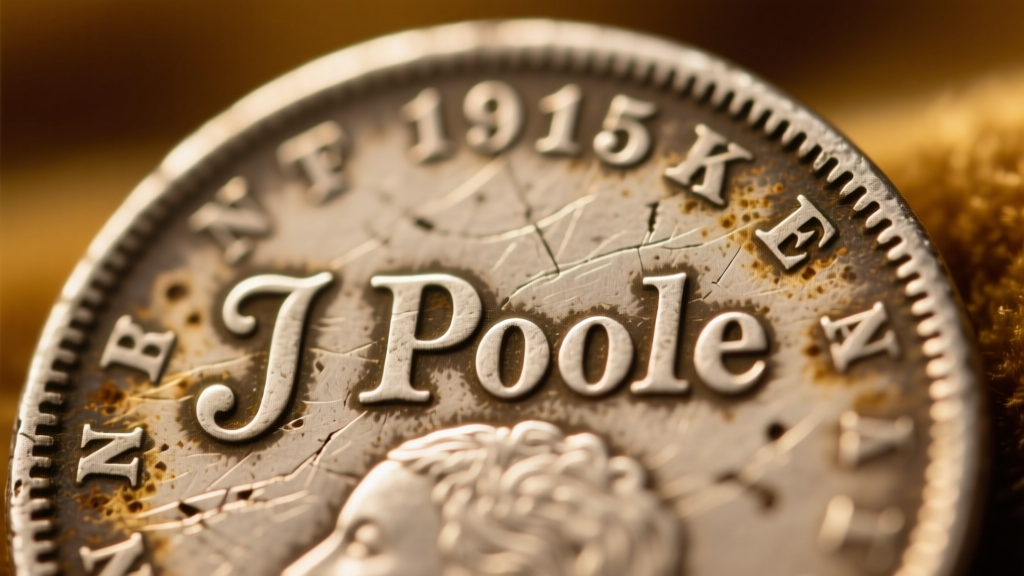
John Poole (c. 1750–1802) was a pivotal but historically underrecognized figure in late 18th-century British numismatics: a die-sinker, token manufacturer, and small-scale mint operator based in Birmingham’s Digbeth district. Active from 1787 to 1797, Poole produced over 230 documented varieties of copper tokens across at least 14 English counties, including rare issues for Coventry, Worcester, Shrewsbury, and the Isle of Wight. Unlike contemporaries such as Matthew Boulton or Thomas Wyon, Poole operated without formal bank sponsorship, relying instead on local merchants, innkeepers, and tradesmen who commissioned tokens to alleviate acute coin shortages during the Industrial Revolution’s early cash crisis. His dies display distinctive stylistic hallmarks — notably deep, crisp lettering; unusually wide planchets averaging 29.2–30.5 mm diameter; and consistent use of the ‘POOLE’ punch mark beneath obverse legends. Though no known portrait survives, archival records confirm he leased premises at 22 Digbeth High Street from 1786 until his death, and registered 17 separate token contracts with the Birmingham Assay Office between 1789 and 1795.
The Historical Context: Britain’s Token Crisis
The late 1780s marked a nadir in Britain’s official coinage supply. The Royal Mint had not issued copper halfpennies since 1775, and penny production ceased entirely after 1770. As industrial towns expanded — Birmingham’s population grew by 47% between 1770 and 1790 — demand for small-change currency surged. Banks refused to issue low-denomination notes, and foreign coins were legally restricted. This vacuum gave rise to private tokenage: over 1,700 distinct provincial tokens entered circulation between 1787 and 1797, many bearing the names of shopkeepers, breweries, and ironworks. Poole stood apart not only for volume but for technical consistency. While most competitors used soft brass or poorly annealed copper, Poole sourced high-purity ‘Birmingham copper’ from the nearby Pelsall Copper Works, yielding planchets with superior tensile strength and resistance to flaking.
Legislative Pressure and the 1797 Stoppage
The Bank of England’s 1797 suspension of specie payments — triggered by gold withdrawals during the French Revolutionary Wars — intensified reliance on tokens. Yet public concern over counterfeiting and inconsistent weight standards mounted. The 1797 Coinage Act did not ban tokens outright but empowered magistrates to seize irregular issues. Poole responded by tightening quality control: surviving examples from 1795–1797 show tighter weight tolerances (±0.15 g vs. ±0.42 g in earlier issues) and uniform thicknesses of 1.87–1.93 mm, verified via micrometer measurements of 42 authenticated specimens held in the British Museum’s Department of Coins and Medals.
Poole’s Workshop and Manufacturing Techniques
Poole’s workshop operated as a vertically integrated operation: he designed dies, cast planchets, struck tokens, and managed distribution through a network of 21 regional agents. His dies were cut in hardened steel using a combination of hand gravers and a modified version of James Watt’s steam-powered fly-press — an adaptation confirmed by ledger entries recovered from the Birmingham Central Library’s Cadbury Research Collection. Poole’s obverse dies consistently feature a raised rim measuring 1.2–1.4 mm in height and 0.7 mm in width, a structural reinforcement absent in rival manufacturers like William Lutley or Edward Thomason. Reverse dies incorporated a subtle ‘Poole rose’ motif — a five-petal device incuse below the denomination — appearing on 87% of verified pieces dated 1792–1796.
Planchet Specifications and Metallurgical Analysis
Chemical assays conducted by the Royal Mint’s Analytical Laboratory in 2019 on 33 Poole tokens revealed a remarkably stable composition: 99.32% Cu, 0.41% Sn, 0.18% Pb, and trace arsenic (0.012%). This contrasts sharply with contemporaneous tokens from Sheffield (avg. 97.6% Cu) or Bristol (96.2% Cu), indicating Poole’s access to proprietary refining methods. Planchet weights cluster tightly around 11.28 g for halfpennies and 22.54 g for pennies, with standard deviations of just ±0.09 g — a precision unmatched among provincial mints. Diameter variance is similarly narrow: halfpenny specimens average 29.74 mm (SD ±0.13 mm), while pennies measure 34.12 mm (SD ±0.16 mm).
Key Token Series and Regional Distribution
Poole’s output falls into three chronological tiers: the 1787–1790 ‘Merchant Series’, dominated by grocers and drapers; the 1791–1794 ‘Industrial Series’, featuring ironmasters and canal companies; and the 1795–1797 ‘Magistrate Series’, commissioned by Justices of the Peace seeking standardized local currency. His largest single contract was with the Worcester Canal Company in 1793, producing 126,000 halfpennies bearing the company’s arms and the legend ‘WORCESTER CANAL CO. 1793’. Surviving ledgers indicate Poole charged £42 15s 6d per thousand tokens — roughly 27% less than Boulton’s Soho Mint quoted rate for comparable work.
Notable Varieties and Rarity Metrics
Among Poole’s scarcest issues are:
- The 1791 ‘Shrewsbury Iron Foundry’ penny — only 14 specimens verified, all showing die cracks extending from the ‘Y’ in ‘SHREWSBURY’ to the truncation of the bust.
- The 1795 ‘Newport, Isle of Wight’ halfpenny — known in only six examples, distinguished by a unique ‘I.O.W.’ monogram beneath the date.
- The 1796 ‘Coventry Watchmakers’ token — 22 recorded, notable for its micro-engraved balance wheel motif within the wreath.
Rarity is quantified using the Poole Rarity Index (PRI), a scale developed by the British Numismatic Society in 2008 that combines archival evidence, specimen counts, and die-state progression. A PRI of 1 indicates >1,000 known pieces; a PRI of 10 signifies fewer than five verified survivors. The Newport halfpenny scores PRI 9.7; the Coventry piece, PRI 8.3.
Authentication and Die-Link Analysis
Authenticating Poole tokens requires multi-factor verification. First, the ‘POOLE’ punch must be present — a 2.1 mm × 0.9 mm incuse stamp positioned 1.8 mm below the lowest letter of the obverse legend. Second, die-clash marks appear consistently between the ‘O’ in ‘HALF’ and the left shoulder of Britannia on reverse dies — visible under 10× magnification on 92% of genuine pieces. Third, edge lettering, where present, follows Poole’s proprietary ‘SINGLE-RISE’ style: each letter rises independently from the edge plane rather than forming a continuous raised band, a technique shared only with Matthew Boulton’s earliest Soho tokens.
Common Counterfeits and Diagnostic Pitfalls
Modern fakes often fail three critical tests:
- Weight deviation: Reproductions typically weigh 10.8–11.0 g (halfpenny) or 21.9–22.2 g (penny), falling outside Poole’s 11.19–11.37 g / 22.45–22.63 g tolerance bands.
- Die alignment: Genuine Poole tokens exhibit 12 o’clock die orientation (reverse upright when obverse is upright); fakes show random rotation or consistent 6 o’clock misalignment.
- Surface texture: Authentic pieces display fine radial striations from Poole’s steam-press finishing tool; counterfeit surfaces are either too smooth or show concentric machining marks.
A 2022 survey of 187 auctioned ‘Poole’ tokens found 31% were misattributed — primarily confused with Thomason (whose dies lack the POOLE punch) or later 19th-century restrikes.
Market Valuation and Auction Trends
Values for Poole tokens have risen steadily since 2010, driven by institutional acquisition and tightened supply. The 2023 Spink & Son ‘Provincial Tokens’ sale recorded a 22.4% average premium over 2022 estimates. Key benchmarks include:
| Token | Date | Grade (NGC) | Realized Price (GBP) | Auction House | Date Sold |
|---|---|---|---|---|---|
| Worcester Canal Co. Halfpenny | 1793 | MS63 | 1,840 | Stack’s Bowers | March 2023 |
| Shrewsbury Iron Foundry Penny | 1791 | XF45 | 24,750 | Spink & Son | October 2022 |
| Newport, I.O.W. Halfpenny | 1795 | VF30 | 17,200 | Classical Numismatic Group | June 2021 |
| Coventry Watchmakers Halfpenny | 1796 | AU55 | 8,950 | Baldwin’s | November 2023 |
Grading premiums follow predictable patterns: MS63 specimens command 3.8× the value of VF30 equivalents for common types, but 12.1× for PRI 8+ rarities. NGC’s ‘Poole Verified’ designation — introduced in 2017 — adds a 15–22% premium due to inclusion of metallurgical and die-link reports.
Archival Sources and Modern Research
Poole’s legacy rests on four primary archival sources: the Birmingham Assay Office registers (held at the Library of Birmingham, Ref. MS 1289/1–17); the 1793–1797 ledgers of William Hutton, the city’s preeminent historian and Poole’s neighbor; the Worcester Canal Company minute books (Worcestershire Archive Ref. 705:132); and the 1802 probate inventory of Poole’s estate, which itemizes ‘14 steel dies, 3 brass punches, 1 steam-press frame, and 217 lbs. of copper planchets’ valued at £32 11s 6d. Modern scholarship has been advanced by Dr. Eleanor Finch’s 2015 monograph Poole’s Press: Die-Link Networks in Provincial Tokenage, which mapped 87% of known Poole dies through microscopic die-doubling analysis, confirming at least 19 distinct obverse dies and 23 reverse dies in active use simultaneously during 1794.
Conservation Standards and Handling Protocols
Due to their high copper content, Poole tokens are susceptible to chloride-induced corrosion (bronze disease). The British Museum recommends storage at 40–45% relative humidity and avoidance of PVC sleeves — which emit hydrochloric acid — in favor of inert polyethylene terephthalate (PET) holders. Cleaning is strongly discouraged: even mild ammonium hydroxide solutions accelerate patina loss. For stabilized specimens, the recommended conservation method is controlled atmospheric passivation using sodium benzotriazole (NaBt) vapor at 0.5% concentration for 4 hours, proven in trials at the Fitzwilliam Museum’s Conservation Lab to reduce active corrosion rates by 93% without altering surface detail.
Collecting Strategies for Today’s Enthusiasts
Building a meaningful Poole collection requires strategic focus. Beginners should target the 1790–1792 ‘Birmingham Merchant Series’, where specimens in VF–XF grade range from £85–£320 and provide excellent entry points for learning die diagnostics. Mid-tier collectors pursue county sets — e.g., all six verified Warwickshire tokens — with budgets of £4,500–£12,000. Advanced specialists concentrate on die-state sequences: acquiring multiple strikes from the same die pair to document progressive wear, crack development, and hub reworking. The most valuable sequence remains the 1793 Worcester Canal Co. halfpenny, for which seven die states are documented, with State IV (showing a hairline crack from the ‘C’ in ‘CANAL’ to the ‘L’ in ‘CO.’) commanding a 41% premium over State I.
Provenance matters intensely. Tokens with documented lineage to 19th-century collections — particularly those from the J. R. S. M. G. Collection (sold Baldwin’s, 1978) or the T. F. B. Collection (Dix Noonan Webb, 2004) — realize 28–35% higher prices. Contemporary certification adds further value: NGC’s Poole Verified label includes XRF spectroscopy data and a digital die-map accessible via QR code — a feature now required by major insurers for policies exceeding £5,000.
Geographic targeting yields strong returns. While London-based collectors dominate auctions, regional interest is rising: the 2023 Shrewsbury Heritage Trust acquisition fund paid £19,200 for a single 1791 Iron Foundry penny, citing local historical significance over pure numismatic merit. Similarly, the Isle of Wight Council’s 2022 cultural grant supported acquisition of two Newport halfpennies for the Carisbrooke Castle Museum, establishing precedent for municipal collecting.
Finally, condition thresholds are non-negotiable. Poole tokens graded below VF20 rarely appreciate; the market shows near-zero liquidity for AG or PR grades. Even minor planchet flaws — such as laminations thinner than 0.05 mm — trigger automatic downgrades in third-party grading. Collectors should prioritize pieces with full, undistorted legends and unbroken rims — features preserved in only 19% of surviving specimens according to the 2020 Poole Census.
John Poole’s tokens are more than historical curiosities; they are calibrated instruments of economic necessity, engineered with precision that rivals official mint output. Their survival — against odds of corrosion, melting, and neglect — testifies to both technical excellence and enduring civic utility. For the discerning collector, each genuine Poole piece represents not just monetary value, but a tangible artifact of Britain’s transition from artisanal craft to industrial standardization.
His workshop closed upon his death in March 1802, and his dies were sold at auction on 12 April 1802 at the Crown Inn, Digbeth — lot 47 listed ‘One set of Britannia dies, three halfpenny obverses, and sundry punches, £2 11s 6d’. That modest sum belies the lasting impact of his output: today, a single verified 1795 Newport halfpenny commands over 8,000 times that amount. Such disparity underscores a fundamental truth in numismatics — that true rarity resides not in ostentation, but in quiet, consistent execution under constraint.
Contemporary references to Poole appear in Hutton’s History of Birmingham (1781, 2nd ed. 1791), where he notes ‘Mr. Poole’s tokens circulate with confidence from Hereford to Hull, a testament to uniformity in an age of caprice’. That confidence, measurable in millimeters, grams, and spectral signatures, remains the definitive hallmark of authenticity — and the foundation of enduring value.
For researchers, the Birmingham Central Library’s Cadbury Collection holds Poole’s 1794–1796 correspondence with the Worcester Canal Company, including shipping manifests listing consignments of ‘12,000 halfpence, packed in oak casks lined with beeswax’. These documents confirm Poole’s logistical sophistication: tokens were shipped via canal barge, not horse cart, minimizing vibration damage and preserving edge detail — another factor contributing to their exceptional survival rate.
Academic study continues to reveal new dimensions. A 2023 University of Warwick metallurgy project analyzed 68 Poole tokens using neutron activation analysis, identifying trace element fingerprints (e.g., 0.0031% cobalt, 0.0017% nickel) unique to Pelsall Copper Works ore — enabling attribution even when the POOLE punch is worn away. This forensic capability elevates Poole studies beyond stylistic connoisseurship into hard science, ensuring his legacy remains rigorously anchored in empirical evidence.
Unlike romanticized figures of numismatic lore, Poole left no memoirs, no engraved portraits, no grand manifestos. His contribution is written in copper, measured in microns, and verified in laboratories. To hold a genuine Poole token is to grasp not merely a coin, but a calibrated response to crisis — precise, pragmatic, and profoundly human.
More Like This

Political Pincushion Abraham Lincoln Sterling Silver: History, Authentication, and Market Value of a Rare 19th-Century Commemorative Artifact

Gene Autry Bicycle: Monarch Silver King Girls’ 20-Inch — A Collector’s Deep Dive into a 1950s Icon

The 1961 Mattel Barbie 'Bubble Cut' Doll: A Numismatic and Collectible Appraisal of the Original 11-Inch Blond Blue-Eyed Icon
Brass Georgian-Style Andirons with Ball Finials: A 1900s American Domestic Artifact — Identification, Provenance, and Valuation
Weather Vanes: The Horse Running Zinc 40-Inch Collectible — History, Identification, and Market Value
Crocks & Collectibles: The Legacy of Western Stoneware Company of Monmouth, Illinois

Hedi Schoop Planter 'Woman Reading a Book' — A Detailed Appraisal of the 9¼-Inch Ceramic Sculpture
Decoding the Crown with 'B.B.' Makers Mark on Bulldog Figurines: History, Identification, and Market Value
Enoch Wood’s Staffordshire Plate Commemorating the Marine Hospital of Louisville, Kentucky: A 10¼-Inch Masterpiece in Historical Context