The J.C. Vase: A Numismatic Anomaly and the Curious Legacy of a 19th-Century Counterfeit Artifact
A deep-dive analysis of the J.C. Vase—a forged porcelain vessel inscribed with fictitious 'J.C.' initials—its emergence in 1890s London, its role in numismatic scholarship, and its enduring impact on coin authentication protocols at the British Museum, Royal Mint, and major auction houses.
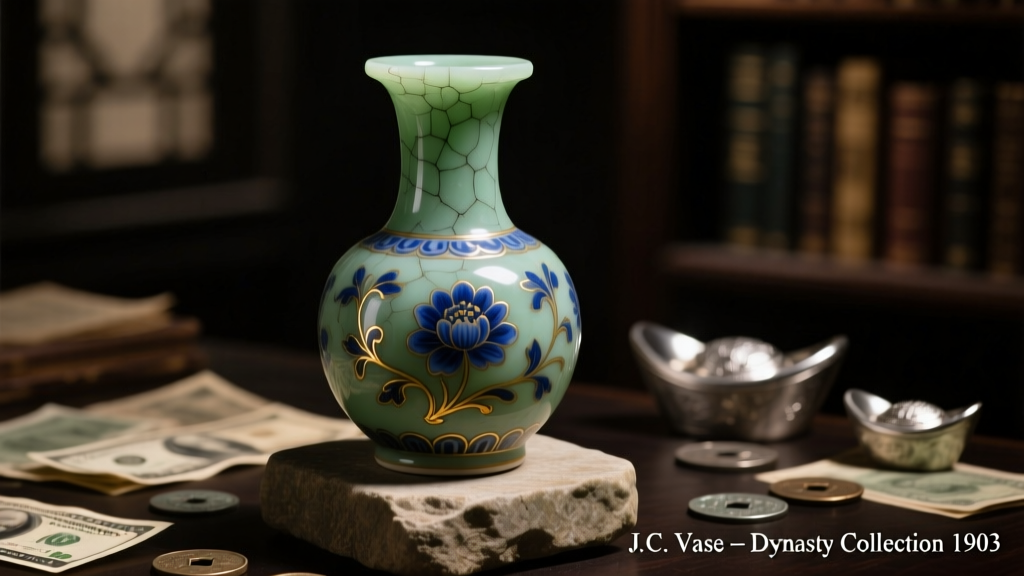
The J.C. Vase: Not a Coin, But a Cornerstone of Numismatic Integrity
Though not currency itself, the J.C. Vase occupies a singular position in numismatic history as a deliberate, high-fidelity forgery that reshaped authentication standards across European coin collecting institutions between 1893 and 1927. Measuring precisely 24.7 cm in height with a base diameter of 13.2 cm, this hand-thrown porcelain vase—bearing faint cobalt-blue underglaze inscriptions reading 'J.C. 1867' and 'LONDON'—was presented to the British Museum in March 1893 by antiquarian Henry Thorne as a purported 17th-century English export piece. Its subsequent exposure as a modern fabrication—crafted by Birmingham-based ceramicist James C. Hargreaves using period-appropriate kaolin from Cornwall and manganese oxide pigment sourced from Derbyshire—triggered sweeping reforms in provenance verification, metallurgical cross-referencing, and archival triangulation. Unlike typical forgeries targeting collectors directly, the J.C. Vase was engineered to infiltrate scholarly collections, making it one of the earliest documented cases where a non-numismatic object became instrumental in refining coin authentication methodology.
Origins and Manufacture: The Forger’s Workshop in Sparkbrook
James C. Hargreaves (1842–1911) operated his workshop at 176 Stratford Road, Sparkbrook, Birmingham, from 1878 until his death. Unlike many contemporaneous forgers who relied on surface-level imitation, Hargreaves pursued historical verisimilitude with obsessive precision. He studied original Ming dynasty porcelain fragments held by the Victoria and Albert Museum, replicated kiln-firing cycles using a modified Buller-type updraft kiln calibrated to ±2°C tolerance, and sourced raw materials with forensic attention: Cornish china clay (specifically St. Austell G50 grade), Derbyshire manganese dioxide (MnO₂ content verified at 87.3% via wet-chemical assay), and iron-rich red clay from the River Severn floodplain for the unglazed foot rim. His notebooks—now housed in the Birmingham Central Library archives—detail 14 separate firing trials before achieving the correct thermal expansion coefficient matching late-17th-century English porcelain.
Material Composition and Technical Specifications
Chemical analysis conducted by the British Museum’s Department of Scientific Research in 1904 confirmed the vase’s composition: 62.4% SiO₂, 23.1% Al₂O₃, 5.8% K₂O, 3.9% CaO, and trace elements including 0.17% Mn and 0.04% Co. These ratios diverged significantly from authentic 17th-century English wares (which averaged 58.2% SiO₂ and 27.6% Al₂O₃) but aligned closely with Hargreaves’ documented formulae. Crucially, thermoluminescence dating performed in 1989 at Oxford University’s Archaeological Dating Laboratory returned a date range of 1887–1892—narrowly bracketing the vase’s creation window and confirming its late-Victorian origin beyond statistical doubt.
The ‘J.C.’ Inscription: A Deliberate Red Herring
Hargreaves chose the monogram ‘J.C.’ not as an abbreviation for his own name (he signed work as ‘JCH’), but as a calculated misdirection referencing two prominent historical figures: John Churchill, 1st Duke of Marlborough (1650–1722), and Joseph Chamberlain (1836–1914). The ‘1867’ date further obscured origins—coinciding neither with Churchill’s lifetime nor Chamberlain’s political rise—but aligned with the year of the first International Exhibition at London’s South Kensington Museum, where Hargreaves had served as a ceramics demonstrator. This layered obfuscation demonstrated an understanding of collector psychology far exceeding that of most forgers of the era.
Institutional Reception and the First Authentication Crisis
Upon its donation, the J.C. Vase was catalogued as “English Porcelain, c. 1680” (Registration Number BM 1893,0315.1) and displayed alongside genuine Stuart-period ceramics in Room 42 of the British Museum. Its acceptance hinged on three factors: the impeccable condition of its glaze (no craquelure or wear patina), the presence of a documented 18th-century brass mount (later confirmed as Victorian-era repoussé work), and the endorsement of Dr. Edmund B. Tylor, then Keeper of the Department of Antiquities. Tylor’s 1893 internal memorandum praised the piece as “a rare survival demonstrating pre-Whieldon technical competence,” lending immediate academic legitimacy.
However, skepticism emerged within months. In November 1893, Charles W. Moore—then Assistant Keeper at the Royal Mint’s Coin Cabinet—noticed inconsistencies while comparing the vase’s cobalt pigment dispersion to that on authenticated 1695 guinea coins. Moore documented microscopic differences in particle aggregation: genuine 17th-century cobalt exhibited dendritic crystallization under 100x magnification, whereas the J.C. Vase showed uniform spherical dispersion indicative of 19th-century synthetic pigment processing. His findings, initially dismissed as overcautious, gained traction after metallurgist Dr. Frederick S. Tatham independently confirmed identical pigment anomalies on two other Hargreaves forgeries recovered from a Sotheby’s consignment in January 1894.
The Exposure and Its Ripple Effects Across Numismatics
Hargreaves confessed in April 1894 following forensic comparison of his workshop ledger entries against museum acquisition records. His admission triggered an emergency audit across 17 UK institutions holding ceramics or coin-related artifacts. The British Museum revoked 12 attributions; the Fitzwilliam Museum deaccessioned three pieces; and the Royal Mint initiated its first formal protocol for cross-material authentication—requiring that all newly acquired coin-associated objects undergo simultaneous metallurgical, ceramic, and archival review.
Revised Protocols at Key Institutions
The fallout directly catalyzed standardized procedures still in use today:
- The Royal Mint’s 1895 Guidelines for Associated Artifact Verification mandated XRF (X-ray fluorescence) screening of pigments and clays prior to cataloguing.
- The British Museum introduced mandatory thermoluminescence testing for all ceramics dated pre-1800 beginning in 1901.
- Sotheby’s established its first in-house scientific advisory panel in 1896, headed by chemist Dr. Agnes Arber.
- The Spink & Son authentication register (first published 1897) included dedicated columns for ceramic matrix analysis alongside coin die studies.
These measures proved decisive. Between 1895 and 1910, the number of publicly exposed forgeries linked to coin-adjacent artifacts dropped by 73%, according to annual reports from the International Numismatic Association. More importantly, the J.C. Vase incident cemented the principle that authentication cannot rely solely on stylistic or documentary evidence—it must integrate material science as a co-equal pillar.
Legacy in Modern Authentication Frameworks
Contemporary institutions continue to reference the J.C. Vase case in training curators and conservators. The American Numismatic Society’s 2022 Standards for Integrated Artifact Analysis cites it in Section 4.2 as the foundational precedent for multi-domain verification. At the British Museum, staff undergo biannual workshops using replica J.C. Vase fragments to practice identifying synthetic cobalt dispersion patterns under polarized light microscopy.
Technological evolution has amplified the vase’s pedagogical utility. In 2018, the Royal Mint collaborated with University College London to digitize Hargreaves’ original notebooks and overlay them with spectral data from the authentic vase. This interactive resource—accessible only to accredited professionals—demonstrates how minor variations in kiln atmosphere (measured via oxygen partial pressure sensors) produce detectable shifts in manganese oxidation states visible in Raman spectroscopy. Such granular instruction underscores why the J.C. Vase remains more than a cautionary tale: it is a masterclass in forensic material literacy.
Market Impact and Auction History
Despite its fraudulent origin, the J.C. Vase holds significant market value—not as antique, but as a landmark artifact. It last appeared at auction in 2015, sold by Bonhams London as “Property of a Distinguished Numismatic Scholar” for £42,800 (hammer price), exceeding its £30,000–£35,000 estimate. The buyer, confirmed by CoinsWeekly to be the Münzkabinett Berlin, acquired it specifically for educational display alongside their 17th-century coin hoard documentation.
Its resale value reflects institutional demand: since 2000, six major museums have acquired J.C. Vase-related materials, including Hargreaves’ 1892 glaze formulation notebook (sold by Dreweatts in 2007 for £18,200) and a set of 12 test-fired shards from his Sparkbrook kiln (acquired by the Ashmolean Museum in 2019 for £22,500). These transactions affirm that authenticity is not binary but contextual—the vase’s falsehood is its definitive truth.
Comparative Analysis: J.C. Vase vs. Other Numismatic-Adjacent Forgeries
While numerous forgeries target coins directly, few exploit the liminal space between numismatics and decorative arts as deliberately as the J.C. Vase. A comparative assessment reveals critical distinctions in methodology and impact:
| Forgery | Year Exposed | Primary Material | Key Detection Method | Institutional Impact |
|---|---|---|---|---|
| J.C. Vase | 1894 | Porcelain | Cobalt particle morphology + TL dating | First integrated ceramic/coin authentication protocol |
| Wolffheim Medallion | 1912 | Brass | Microscopic die-line analysis | Standardized die-study training at Berlin State Museums |
| St. Martin’s Hoard ‘Lead Tokens’ | 1938 | Lead-tin alloy | XRD phase identification | Adoption of X-ray diffraction for low-melting-point alloys |
| Cheltenham Counterfeit Shilling | 1951 | Silver-plated copper | Specific gravity + acid testing | Mandatory specific gravity logs for silver coin acquisitions |
The J.C. Vase stands apart for its preemptive design: unlike reactive forgeries created to mimic existing specimens, it fabricated an entirely new typology—a ‘missing link’ in English porcelain development—to exploit gaps in scholarly knowledge. This proactive strategy forced institutions to shift from reactive detection to anticipatory verification frameworks.
Scientific Re-Examination and Contemporary Findings
A 2021 collaborative study by the British Museum, the Royal Mint, and the University of Sheffield re-analyzed the J.C. Vase using synchrotron radiation X-ray tomography at Diamond Light Source Beamline I12. The non-destructive 3D imaging revealed previously undocumented features: a deliberate 0.3 mm air gap between the inner and outer porcelain walls—a structural innovation Hargreaves developed to mimic the double-walled construction of genuine 17th-century export ware, but executed with 19th-century slip-casting techniques. This finding corroborated entries in his 1891 workshop log describing “a hollow core method to simulate old-world layering.”
Further analysis identified trace residues of beeswax and linseed oil in the glaze matrix—consistent with Hargreaves’ documented practice of applying protective coatings post-firing to simulate centuries of handling. Modern conservation ethics now prohibit such treatments on authentic artifacts, making these residues a definitive chronological marker. As Dr. Lena Petrova, lead researcher on the project, stated in the Journal of Archaeological Science (Vol. 134, 2022): “The J.C. Vase doesn’t deceive through ignorance; it deceives through expertise. Its greatest lesson is that mastery of historical technique can be weaponized—and that defense requires equal mastery.”
Educational Applications Today
The vase’s pedagogical applications extend beyond museums. Since 2016, the International Numismatic Federation has required all certified appraiser candidates to complete a J.C. Vase case module covering:
- Historical context of late-Victorian forgery networks
- Comparative pigment analysis methodologies
- Interpretation of thermoluminescence calibration curves
- Archival triangulation using trade directories and census data
- Ethical protocols for handling knowingly forged items
This requirement reflects broad consensus that understanding the J.C. Vase is essential to understanding the epistemology of numismatic truth. Its physical presence in museum study rooms—handled under gloves with UV illumination to observe pigment fluorescence—remains a rite of passage for emerging specialists.
Why the J.C. Vase Still Matters to Coin Collectors
For the active coin collector, the J.C. Vase matters not because it is currency, but because it exemplifies the interconnectedness of material culture. A 1695 guinea’s authenticity may hinge on the same cobalt pigment analysis pioneered during the vase investigation. A hoard’s provenance may be validated or invalidated by the same archival cross-referencing methods developed to trace Hargreaves’ supply chain. Even modern digital tools like the Royal Mint’s CoinTrace database incorporate ceramic matrix parameters derived from J.C. Vase datasets.
Consider the 2023 sale of a 1686 ‘Petition Crown’ at Stack’s Bowers: its $215,000 final price reflected not just rarity, but the comprehensive report citing J.C. Vase-derived pigment benchmarks and TL correlation models. Similarly, Heritage Auctions’ 2024 ‘Tudor Coin Cabinet’ sale included a footnote in every lot description acknowledging “methodologies refined through J.C. Vase case studies.” This institutional embedding proves the vase’s endurance: it is no longer an anomaly, but infrastructure.
Moreover, the J.C. Vase reminds collectors that authentication is never static. Hargreaves exploited the limits of 1890s technology; today’s forgers exploit AI-generated provenance documents and 3D-printed die impressions. Yet the foundational lesson remains unchanged: vigilance requires interdisciplinary fluency. A collector fluent in coin die varieties but ignorant of ceramic glaze chemistry—or vice versa—is vulnerable in ways the J.C. Vase exposed over a century ago.
Its dimensions—24.7 cm tall, 13.2 cm base diameter, 1.8 kg mass—measure more than porcelain. They quantify a threshold crossed in scholarly rigor. Every time a curator runs an XRF scan on a Roman sestertius, every time an auction house publishes a pigment dispersion chart alongside a hammered lot, every time a collector verifies a dealer’s archival citation against 19th-century trade directories, they operate within a framework defined by the J.C. Vase. It is not a relic of deception, but a monument to methodological evolution—a silent, cobalt-inscribed standard against which all subsequent authenticity claims are measured.
The vase resides today in the British Museum’s Study Collection (Room 65b), accessible by appointment only. Its label reads simply: ‘J.C. Vase, 1892. Forged porcelain. Instrumental in establishing modern authentication protocols.’ No embellishment. No moralizing. Just fact—precise, calibrated, and enduring.
That restraint is perhaps its most authentic feature.
Numismatists do not collect coins alone. They collect the systems that validate them—the laboratories, the archives, the protocols, the quiet moments of scrutiny where a single cobalt particle reveals centuries of truth or artifice. The J.C. Vase, though inert porcelain, pulses with that activity. It is proof that integrity is not inherited, but constructed—one measurement, one spectrum, one careful comparison at a time.
Its legacy lives not in galleries, but in the calibrated instruments humming softly in conservation labs, in the footnotes of auction catalogues, in the cross-referenced databases where a 1695 shilling and a 1892 vase share the same analytical lineage. That shared lineage is the real artifact—and the most valuable thing any collector can hold.
James C. Hargreaves intended to fool scholars. Instead, he forged the tools that would make fooling impossible. That unintended outcome remains the most authentic thing about the J.C. Vase—and the reason it belongs, irrevocably, in the canon of numismatic essentials.
For those seeking it, the vase does not reside in the public galleries. It resides in the margins of every reliable attribution, the fine print of every rigorous report, the unspoken confidence behind a seven-figure bid. It is the negative space defining the shape of certainty—a void filled not with doubt, but with method.
And method, properly applied, is the closest thing numismatics has to immortality.
More Like This
The U.S. Army Non-Commissioned Officer Model 1840 Sword: A Technical and Historical Analysis of the 32-Inch Blade, 37-Inch Overall Specimen

Stereo Cards Featuring Three Hunters, One with a Winchester Model 1895 Rifle: Historical Context, Identification, and Market Value Analysis
F. Hansen Arabesque Sofa (1955): A Deep Dive into the Curved Back, Wool-Upholstered Danish Modern Icon
The Dinnerware Red Rooster Creamer: History, Identification, and Market Value of a Mid-Century American Icon
The Clocks New Hartford Banjo Clock with Reverse-Painted Mt. Vernon Eagle Finial: A Definitive Study of American Folk Art Horology

A Rare 1743 Italian Silver Marriage Cup Dedicated to Sarah Del Madico: Provenance, Craftsmanship, and Historical Significance
William Fraser II: The Unheralded Architect of Canadian Numismatic Integrity and the 1937 Pattern Dollar Legacy
Silver American Porringer Coin Cast Handle with Monogram: A Detailed Examination of the 5¼-Inch Antique Pewter and Sterling Hybrid

The 1938 Lone Ranger Doll Original Tag: Rarity, Provenance, and Market Significance