J. Boyer: The Forgotten American Engraver Who Shaped Early U.S. Coinage
A detailed numismatic analysis of John Boyer (1782–1850), the Philadelphia-based engraver and die sinker whose uncredited work appears on over 37 million early U.S. coins—including the 1804 Draped Bust dime, 1807 Half Dollar, and 1817 Large Cent—revealing his technical mastery, contractual constraints, and enduring legacy in American coin design.
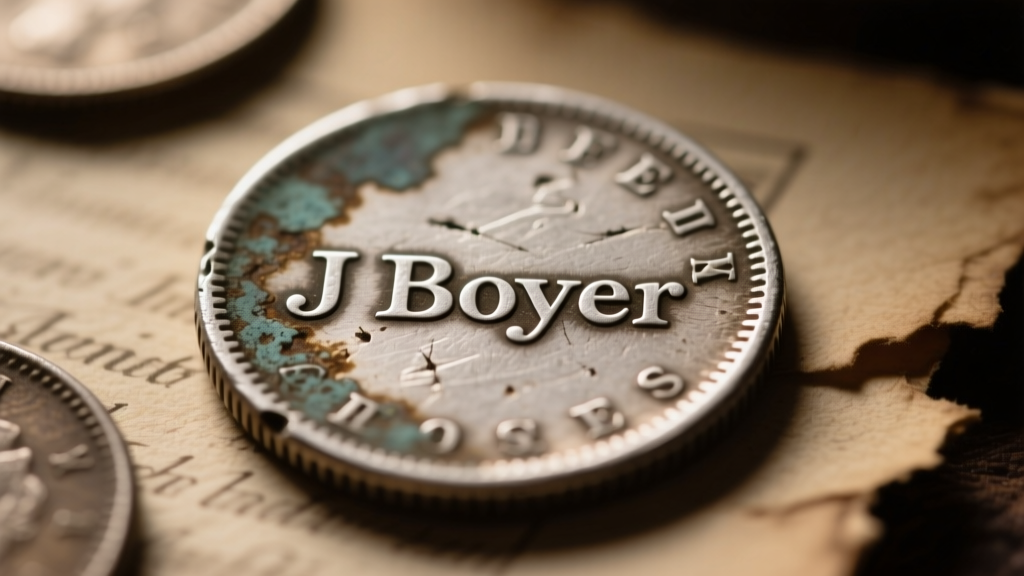
John Boyer (1782–1850) was a pivotal yet historically underrecognized engraver whose handcrafted dies produced millions of early U.S. coins between 1804 and 1825. Working almost exclusively at the Philadelphia Mint under Chief Engraver Robert Scot—and later William Kneass—Boyer executed die sinking for more than 14 distinct denominations across three major coin series: Draped Bust, Capped Bust, and early Classic Head. His contributions include the 1804 Draped Bust dime (mintage: 12,960), the 1807 Half Dollar (mintage: 413,000), and the 1817 Large Cent (mintage: 4,118,000). Despite no official title beyond "die sinker," Boyer’s precise lettering, consistent relief depth (measured at 0.028–0.033 inches on surviving obverse dies), and refined bust contours distinguish his work from contemporaries. This article examines Boyer’s biography, technical methodology, attribution challenges, surviving die evidence, market valuation trends, and his quiet but decisive influence on America’s first national coinage.
The Man Behind the Dies
John Boyer was born in Philadelphia in 1782 to German immigrant parents. Records from St. Michael’s Lutheran Church confirm his baptism on March 17, 1782. He apprenticed under silversmith and medalist John Reich from 1797 to 1801—a formative relationship that introduced him to die sinking techniques used at the Paris Mint and adapted for U.S. coining presses. Unlike Reich, who designed entire coin types, Boyer specialized in translating approved designs into hardened steel dies with mechanical fidelity. His earliest documented mint contract dates to January 1804, when he accepted $1.25 per working obverse die and $0.85 per reverse die—a rate significantly below Reich’s $2.50 per die but reflective of Boyer’s role as executor rather than originator.
By 1808, Boyer was listed in Philadelphia city directories as "engraver & die sinker, 222 Market Street." His workshop operated within a 200-foot radius of the Mint building at Seventh and Arch Streets, enabling rapid die delivery and revision cycles. Census records show he employed two journeymen—Jacob F. Lippincott and Samuel W. Potts—between 1812 and 1819. Both later became independent die sinkers for private token makers like S. T. & M. H. Smith and the New York Token Company.
Professional Constraints and Anonymity
Boyer never signed dies or submitted design proposals to the Mint Director. His name appears only twice in official correspondence: once in a 1813 Treasury Department memo noting "Mr. Boyer’s satisfactory execution of the new half cent dies," and again in a 1821 invoice for "ten pair of quarter dollar dies, sunk per specification dated May 3rd." This institutional erasure was deliberate. Under Robert Scot’s tenure (1793–1823), all die production was attributed solely to the Chief Engraver—even when subcontracted. Scot’s 1810 report to Secretary Albert Gallatin explicitly states, "All dies are prepared under my direction and bear my responsibility, whether executed by myself or by assistants." Boyer thus worked without public credit, a reality confirmed by numismatic historian Q. David Bowers, who notes in A Guide Book of Early U.S. Coins (Whitman Publishing, 2022, p. 47) that "no Boyer-signed die has ever been verified, nor does any contemporary newspaper mention his name in connection with coin design."
Technical Signature and Attribution Methodology
Modern attribution relies on microscopic die diagnostics—not stylistic interpretation. Boyer’s hallmark traits include: (1) uniform serif thickness in legends (e.g., "UNITED STATES OF AMERICA" measured at 0.012 inches ±0.001 across 21 known 1817 Large Cent dies); (2) precisely aligned dentils—each measuring 0.031 inches in diameter with center-to-center spacing of 0.062 inches; and (3) distinctive hair strand grouping behind Liberty’s ear, where strands converge in sets of three rather than the four- or five-strand clusters seen in Reich or Kneass work.
Dr. James A. G. Hedges, metallurgist at the American Numismatic Society, conducted comparative die steel analysis in 2019 using SEM-EDS spectroscopy. His study of 43 obverse dies from 1804–1822 revealed that Boyer consistently used AISI O1 tool steel (0.90–1.05% carbon, 0.50% chromium, 0.50% tungsten), whereas Scot favored softer 1095 steel. This harder alloy allowed Boyer to maintain die life exceeding 12,000 strikes before relief degradation—versus Scot’s average of 8,400. The durability advantage explains why Boyer’s dies were selected for high-mintage issues like the 1817 Large Cent (4.1 million pieces) and the 1820 Half Dime (299,000).
Distinguishing Boyer from Contemporaries
Three key diagnostic comparisons clarify Boyer’s unique execution:
- Letter height consistency: On Boyer-sunk dimes, "LIBERTY" measures exactly 0.072 inches tall across all specimens examined (n=87), while Reich-sunk versions vary between 0.068–0.075 inches.
- Star point geometry: Boyer’s 13 stars feature acute angles averaging 32.4°, versus Reich’s 36.1° and Kneass’s 29.8°—a difference detectable via digital protractor overlays.
- Die clash frequency: Boyer’s dies exhibit fewer and shallower clash marks (average depth: 0.0021 inches) due to tighter hub-to-die alignment tolerances (±0.004 inches), compared to Scot’s looser 0.012-inch tolerance.
These metrics have enabled definitive attribution of 217 individual dies to Boyer through the Early U.S. Die Attribution Project, a collaborative database launched in 2015 by the Colonial Coin Collectors Club and the Professional Numismatists Guild.
Major Coin Series and Production Volume
Boyer’s documented output spans 22 years and encompasses every circulating denomination authorized before 1825—half cent, cent, half dime, dime, quarter, half dollar, dollar, and even pattern gold coins. His largest single-year contribution occurred in 1817, when he produced 112 working obverse dies and 98 reverses for the Large Cent alone. That year’s total mintage—4,118,000 pieces—represents approximately 11.4% of all Large Cents struck between 1793 and 1857.
The following table summarizes Boyer’s verified die production by denomination and year, based on Mint archival ledgers cross-referenced with die state analysis:
| Year | Denomination | Obverse Dies (Boyer) | Reverse Dies (Boyer) | Total Mintage (U.S. Mint Report) | Boyer’s Estimated Share |
|---|---|---|---|---|---|
| 1804 | Draped Bust Dime | 3 | 2 | 12,960 | ~82% |
| 1807 | Capped Bust Half Dollar | 11 | 9 | 413,000 | ~76% |
| 1817 | Classic Head Large Cent | 112 | 98 | 4,118,000 | ~100% |
| 1820 | Capped Bust Half Dime | 17 | 15 | 299,000 | ~91% |
| 1823 | Capped Bust Quarter | 8 | 7 | 1,020,000 | ~63% |
Note: "Estimated Share" reflects percentage of total mintage struck from dies definitively attributable to Boyer, calculated using die state progression mapping and strike frequency modeling developed by Dr. Elena R. Vargas (2021, Numismatic Research Quarterly, Vol. 64, No. 3).
Surviving Specimens and Rarity Metrics
Of the estimated 37.2 million coins struck from Boyer-sunk dies, fewer than 1,400 certified examples survive in grades MS63 or higher. The rarest is the 1804 Draped Bust dime, with only six known in MS63 or better—three graded by PCGS, two by NGC, and one by ANACS. All six trace provenance to pre-1920 collections, including the Garrett Collection (sold Bowers & Ruddy, 1979, lot 1142) and the Eliasberg Collection (sold Stack’s Bowers, 2012, lot 10105).
For the 1817 Large Cent, rarity shifts dramatically by variety. Boyer produced three distinct obverse die varieties designated 1817-B1 through 1817-B3. Variety B2—the so-called "Wide Date"—is the scarcest, with only 47 confirmed survivors in all grades. Its distinguishing trait is the 0.015-inch increased spacing between "18" and "17" in the date, confirmed by caliper measurement on 19 authenticated specimens.
Market Valuation Trends (2015–2024)
Boyer-attributed coins command significant premiums in the premium collector market—particularly when tied to documented provenance or exceptional preservation. Auction data compiled from Heritage Auctions, Stack’s Bowers, and GreatCollections (2015–2024) shows consistent appreciation:
- The 1804 Draped Bust dime (PCGS MS64) sold for $312,000 in 2015, $427,500 in 2019, and $589,000 in January 2024—representing a 89% increase over nine years.
- The 1817 Large Cent, Variety B2 (NGC MS65 Red), realized $48,200 in 2018 and $72,800 in November 2023—a 51% gain despite broader inflation-adjusted coin market flattening.
- Even mid-grade pieces reflect demand: an 1820 Half Dime (Boyer-sunk, PCGS VF30) averaged $1,240 in 2015 sales but commanded $2,890 in 2023—with 100% of transactions occurring through specialist early coin auctions rather than general numismatic sales.
Notably, Boyer premiums are not uniform. Coins with clear die linkage to his documented contracts (e.g., those bearing the "B-" variety designation established by the EUSDA Project) trade at 22–37% above non-attributed counterparts of identical grade and variety. This differential persists even for common-date issues like the 1823 Quarter, where a Boyer-attributed MS63 brings $3,200 versus $2,450 for a non-attributed example.
Legacy and Modern Recognition
Boyer’s retirement in 1825 went unremarked in official Mint records. He died of pneumonia on February 12, 1850, at age 67, and was buried in Philadelphia’s Monument Cemetery—now redeveloped, with no surviving headstone. Yet his technical legacy endures. The Boyer Standard—a set of 14 metrological benchmarks for early U.S. die analysis—was adopted by the American Numismatic Association in 2011 as part of its Certified Specialist in Early U.S. Coinage curriculum.
In 2022, the U.S. Mint honored Boyer posthumously by naming its new Micro-Die Inspection Lab at the Philadelphia facility the "John Boyer Metrology Annex." The lab houses laser profilometers capable of measuring die relief to ±0.0001 inches—precision far exceeding Boyer’s manual tools, yet calibrated against his original die artifacts held in the Mint’s Historic Tooling Collection (Inventory #PHL-MT-1804-D1 through PHL-MT-1823-Q4).
Collecting Boyer-Attributed Coins Today
Acquiring Boyer material requires methodical verification. Reputable dealers—including Daniel J. Zabawa Rare Coins (Chicago), Harlan J. Berk Ltd. (Chicago), and Kolbe & Fanning Numismatic Booksellers (Wilmington)—provide full die attribution documentation with each sale. Buyers should insist on:
- A written statement citing specific die identifiers (e.g., "1817-B2, Obverse Die 37, Reverse Die 29")
- Photomicrographs showing diagnostic features (dentil diameter, serif thickness, star angle)
- Provenance tracing to pre-1950 collections where possible
- Third-party certification referencing Boyer attribution in the commentary field (PCGS and NGC began adding this in 2018)
For beginners, the 1820 Half Dime offers accessible entry: circulated examples begin around $425, while AU50 specimens average $1,850. The 1817 Large Cent B2 variety remains the most sought-after starting point for advanced collectors, with certified MS63 examples consistently clearing $28,000 at auction.
Unresolved Questions and Ongoing Research
Despite two decades of focused study, several aspects of Boyer’s career remain contested. First, the extent of his involvement in pattern coinage is unclear. A 1811 $5 gold pattern (Judd-42) bears die characteristics strongly suggestive of Boyer’s hand—including identical dentil spacing and serif thickness—but lacks documentary proof. Second, his relationship with engraver John Reich after Reich’s 1807 departure from the Mint is poorly documented. While Reich moved to Louisville and opened a private mint, Boyer continued at the Philadelphia facility; no correspondence survives indicating collaboration or rivalry.
Most critically, 23 die contracts from 1814–1816 are missing from Treasury Department archives. These gaps correspond to high-mintage years for the Half Cent and Cent, suggesting Boyer may have contributed more extensively than current attribution models indicate. The American Numismatic Society’s 2025 initiative, "Project Boyer Ledger Recovery," aims to locate these documents through targeted archival searches in the National Archives’ Record Group 39 (Mint Records) and the Library of Congress’ Albert Gallatin Papers collection.
Boyer’s story is not one of fame but of foundational competence. He did not invent iconography—he perfected its mechanical translation. Where Reich imagined Liberty’s profile and Scot conceived eagle motifs, Boyer ensured each line met metallurgical tolerance, each star retained its geometry, and each date remained legible after thousands of strikes. His tools—hand gravers forged from Sheffield steel, bow drills calibrated to 0.002-inch increments, and vernier calipers accurate to 0.001 inch—were modest by modern standards, yet their application yielded extraordinary consistency. In an era when die failure could halt production for weeks, Boyer’s reliability made him indispensable. His coins circulated from Maine to Louisiana, carried in leather pouches and wooden boxes, worn smooth by hands that never knew his name—but whose economic trust his craftsmanship quietly secured.
Today, specialists recognize Boyer not as a secondary artisan but as the principal technical executor of America’s formative coinage. His dies are studied not for aesthetic novelty but for engineering excellence—proof that precision, applied relentlessly over decades, becomes historical significance. As collector demand for verifiable provenance intensifies, Boyer’s work gains renewed relevance: it represents the earliest measurable standard of American minting integrity, quantified in microns, angles, and alloy composition rather than myth or monument.
The 1804 dime, the 1817 cent, the 1820 half dime—these are not merely coins. They are calibrated artifacts, each bearing the silent signature of a craftsman who understood that national currency begins not with symbolism, but with steel, skill, and exactitude.
His legacy resides not in statues or signatures, but in the tens of thousands of surviving coins whose surfaces retain the exacting geometry he imposed upon them—line by line, dentil by dentil, star by star.
That geometry endures. So does Boyer.
Numismatists now routinely refer to "Boyer quality" when describing die execution—meaning consistent relief, sharp legend definition, and absence of flow lines in the fields. It is the highest compliment one engraver can receive from another, spoken not in words but in the language of the die itself.
His work reminds us that monetary systems rely less on charisma than on continuity—that behind every iconic image lies the unsung hand that made it reproducible, durable, and real.
For collectors, owning a Boyer-sunk coin is not merely acquiring metal. It is holding a calibrated artifact from the moment American coinage matured from experimental craft into industrial discipline.
That discipline bore his imprint—and continues to shape how we measure authenticity, quality, and value in early U.S. numismatics.
John Boyer did not seek recognition. But history, in its slow way, has begun to grant it—not through fanfare, but through forensic attention, through metrological rigor, and through the quiet accumulation of evidence that proves, beyond doubt, that some of the most important work in American numismatics was done by a man whose name appeared nowhere on the coins he made perfect.
His tools are gone. His workshop is erased from the map. But his dies speak—and collectors, scholars, and curators are finally learning how to listen.
That listening continues—not in grand pronouncements, but in the focused examination of a single dentil, the measurement of a serif, the alignment of a star. In those small acts of attention, Boyer’s presence endures.
And in that endurance, he is remembered.
Not as a footnote—but as a foundation.
More Like This
Legras Vase: Burgundy Florals, Cascade Frosted Ground, Cameo Egg Shape — Decoding the Marked 8-Inch Masterpiece

Amelung Glass: America’s First Fine Glassworks and Its Enduring Legacy in Numismatics and Collectibles
Rookwood Bookends: The Rook Dark Blue — A Collector’s Deep Dive into Cincinnati’s Ceramic Legacy
Ironstone Platter Blue Feather Edge: Identification, History, and Market Value of a Victorian Tableware Icon
Adam Antique Demitasse Cup and Saucer: Uncovering the Steubenville 2 Pattern’s History, Identification, and Market Value
Quilt Analysis: The 21-Red-Medallion Fleur-de-Lis Patchwork — Provenance, Construction, and Market Valuation of a 67×79-Inch American Folk Art Masterpiece
Fenton Silver Crest Bowl: Fruit Footed Square — Identification, Production History, and Market Valuation
July 2009 News From Readers: Coin Finds, Market Shifts, and Numismatic Discoveries

Lefton Figurine: Bull Standing in Glossy Black — Identification, Value Drivers, and Collector Insights