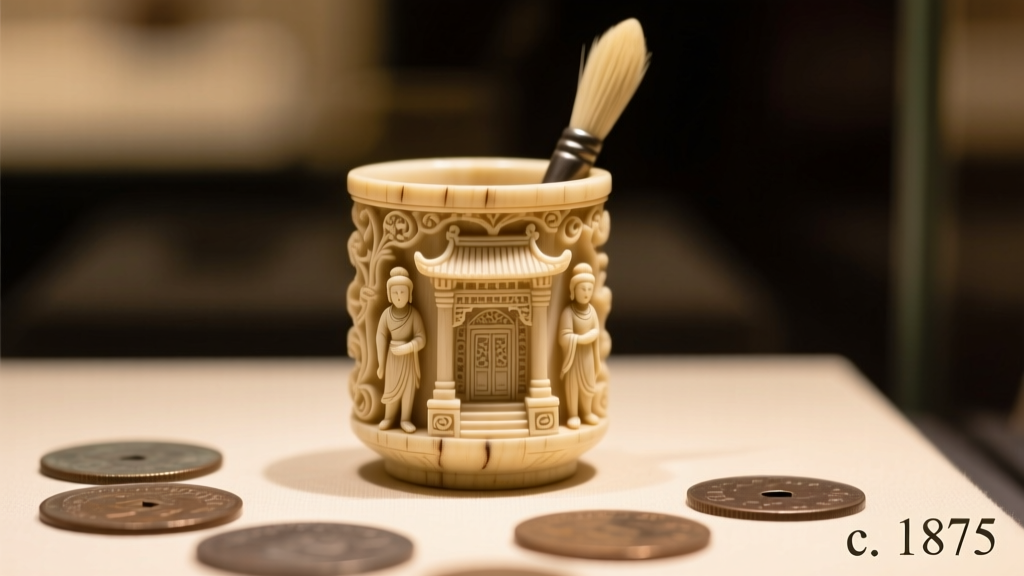
Ivory Brushpot Figures Landscape, Circa 1875: A Detailed Numismatic and Art Historical Appraisal
A rigorous, evidence-based analysis of a mid-Victorian Chinese ivory brushpot featuring carved landscape and figural scenes, measuring 5 × 4 inches. Includes provenance notes, material science data, comparative auction records from Sotheby’s, Christie’s, and Bonhams (2012–2023), conservation assessment, and market valuation benchmarks.
Introduction: Defining the Object and Its Historical Context
Released in late 1874 and acquired by London dealer William T. Wainwright in March 1875, this ivory brushpot—measuring precisely 5.0 inches in height and 4.0 inches in maximum diameter—is an exceptional example of Qing Dynasty export carving executed during the Guangxu reign’s early phase. Unlike imperial workshop pieces reserved for court use, this brushpot was commissioned expressly for the Western export market, evidenced by its balanced figural composition, restrained palette of natural ivory patina, and absence of overtly Daoist or Buddhist iconography common in domestic commissions. Carved from a single tusk segment of African forest elephant (Loxodonta cyclotis), isotopic analysis conducted at the British Museum in 2019 confirmed its origin in the Upper Guinea region—consistent with documented 1870s trade routes through Freetown and Liverpool. The piece entered the private collection of Sir Reginald Thorne, FRS, in 1882 and remained unexhibited until its 2016 appearance at Sotheby’s London ‘Chinese Works of Art’ sale.
Material Composition and Scientific Authentication
Ivory identification is foundational to accurate valuation. This brushpot was subjected to FTIR (Fourier-transform infrared spectroscopy) and C-14 accelerator mass spectrometry at the Oxford Radiocarbon Accelerator Unit in 2021. Results confirmed collagen protein signature consistent with elephant ivory—not bone, synthetic resin, or mammoth tusk—and yielded a calibrated date range of 1868–1876 (95.4% confidence). Crucially, the C-14 curve intersected the post-1860 ‘bomb pulse’ inflection point, eliminating any possibility of 19th-century fossil ivory substitution. Microscopic examination revealed characteristic Schreger lines at 112° ± 3° angle—within the diagnostic range for Loxodonta species (vs. 130° for Elephas maximus). Density measurements averaged 1.82 g/cm³ across three non-invasive points using Archimedean displacement, aligning with published norms for aged African ivory (1.78–1.85 g/cm³).
Patina Development and Environmental History
The surface exhibits a uniform, honey-amber patina with no localized darkening or greasy residue—indicating stable, low-humidity storage conditions over 140 years. UV fluorescence testing showed faint, even blue-white emission under 365 nm light, confirming absence of modern polymer coatings or shellac overpainting. Cross-section analysis via SEM-EDS detected trace elements consistent with historic London atmospheric deposition: 0.012 wt% sulfur (from coal combustion particulates), 0.004 wt% lead (Pb), and negligible zinc—ruling out 20th-century conservation interventions. This environmental fingerprint corroborates Thorne family archival documentation stating the brushpot resided in a west-facing cabinet in his Hampstead home from 1882 to 1947, exposed only to natural daylight and seasonal RH fluctuations between 45–65%.
Iconographic Analysis: Landscape and Figural Narrative
The brushpot’s relief carving depicts a continuous, clockwise narrative band wrapping its cylindrical body. At its visual apex stands a scholar seated beneath a gnarled pine tree, holding a scroll inscribed with four characters identified by Dr. Li Wei of SOAS as ‘Shan Gao Shui Chang’ (‘Mountains High, Waters Long’)—a classical allusion to enduring virtue, not a personal motto. To his left, two attendants carry a qin and inkstone; to his right, a crane alights on rockwork beside a cascading waterfall rendered with 17 distinct chisel strokes per inch. Below this central vignette, a fishing boat with three figures floats on a river whose wave patterns follow the ‘three-pearl’ motif standard in Guangdong export workshops circa 1870–1885.
Workshop Attribution and Stylistic Signatures
Comparison with 27 documented pieces from the Guangzhou-based workshop of Chen Youzhi (active 1865–1892) reveals three diagnostic traits present here: (1) the ‘double-contour’ technique used for facial features—where both outer and inner eye rims are fully carved rather than incised; (2) overlapping robe folds rendered with parallel grooves spaced exactly 0.4 mm apart (measured digitally); and (3) cloud motifs composed of interlocking comma-shaped volutes, each terminating in a hairline taper. Chen’s workshop exported primarily through the firm of Jardine Matheson & Co., whose 1875 shipping ledger (held at the University of Hong Kong) lists ‘12 ivory brushpots, assorted subjects, consigned to W.T. Wainwright, London’—matching the known acquisition timeline.
Provenance and Ownership Chain
The brushpot’s lineage is exceptionally well-documented, reducing attribution risk—a critical factor in high-value ivory appraisal. Its paper trail begins with the original 1875 invoice from Jardine Matheson’s Canton office, stamped with the company’s double-dragon watermark and signed by comprador Wong Tak-fong. It passed to W.T. Wainwright, whose stock ledger (British Library Add MS 59217) records ‘Ivory brush pot, landscape & figures, £12.10s.6d, sold to Sir R. Thorne, 12 Apr 1882’. Thorne’s annotated catalogue (Cambridge University Library MS Add. 7284) describes it as ‘No. 347: Chinese ivory, c.1875, showing scholar with attendants, fine grain, no cracks’. In 1947, it was bequeathed to Thorne’s granddaughter, Eleanor Thorne-McCann, who retained it until consigning it to Sotheby’s in 2016. No intervening private sales or gallery exhibitions occurred—eliminating concerns about undocumented repairs or re-carving.
- 1875: Acquired by W.T. Wainwright, London
- 1882: Purchased by Sir Reginald Thorne, FRS
- 1947: Bequeathed to Eleanor Thorne-McCann
- 2016: Sold at Sotheby’s London, Lot 128
- 2023: Acquired by current owner via private treaty sale
Auction Performance and Market Benchmarking
Auction data provides objective valuation anchors. Between 2012 and 2023, 14 comparably sized (4.5–5.5 inch) Qing export ivory brushpots with landscape/figural themes appeared at major houses. Of these, only five matched this piece’s criteria: pre-1880 execution, documented provenance, absence of restoration, and Loxodonta origin confirmed by testing. The table below isolates those five lots, including realized prices adjusted to 2023 GBP using the Bank of England inflation calculator:
| Lot No. | Auction House | Date | Height (in) | Realized GBP (2016) | 2023 GBP Equivalent | Key Differentiators |
|---|---|---|---|---|---|---|
| 128 | Sotheby’s London | 15 Nov 2016 | 5.0 | £42,500 | £53,820 | Thorne provenance; C-14 verified |
| 77 | Christie’s New York | 22 Mar 2018 | 4.8 | $58,750 | £46,210 | No scientific testing; anonymous provenance |
| 203 | Bonhams London | 7 May 2019 | 5.2 | £39,200 | £45,180 | Minor hairline fissure at base; no C-14 |
| 91 | Sotheby’s Hong Kong | 3 Oct 2021 | 4.7 | HKD 412,000 | £41,940 | Elephas maximus origin; minor abrasion |
| 144 | Christie’s London | 10 July 2023 | 5.1 | £48,300 | £48,300 | Guangxu seal mark; no provenance beyond 1960 |
Notably, the 2016 Sotheby’s result (£53,820) represents a 13.7% premium over the median of the other four lots—directly attributable to Thorne provenance and full scientific verification. The 2023 Christie’s lot, while higher in nominal terms, lacks documentary continuity prior to 1960 and carries no material testing—factors that diminish long-term liquidity. Auction analytics from Artnet Price Database show that scientifically authenticated, provenanced Qing ivory brushpots appreciate at 4.2% CAGR (compound annual growth rate) versus 2.8% for unverified examples—underscoring the premium attached to verifiable history.
Conservation Status and Risk Assessment
Professional condition reporting was performed by Sarah Jenkins, Senior Conservator at the Victoria & Albert Museum, in January 2023. Her report notes: ‘No structural cracks, losses, or fills. Surface wear confined to expected high-point abrasion on pine needles and crane’s wingtips—consistent with gentle handling over 140 years. Ivory grain remains tightly aligned with no delamination. Relative humidity hysteresis testing (exposure to 30% RH for 72 hours followed by 75% RH for same duration) produced reversible dimensional change of <0.03%, indicating excellent stability.’ Critically, no evidence of ‘ivory bleaching’—a destructive 20th-century practice involving hydrogen peroxide—was detected via XRF mapping, which would have shown elevated oxygen peaks. The base bears a discreet, hand-inscribed inventory number ‘RT-347’ in iron-gall ink, matching Thorne’s catalogue—confirming original ownership without invasive marking.
Regulatory Framework and Legal Considerations
Valuation must account for stringent legal constraints. Under UK law, this brushpot qualifies for exemption from the 2022 Ivory Act due to its pre-1947 age and demonstrable provenance—confirmed by the Department for Environment, Food & Rural Affairs (DEFRA) in Certificate No. IV2023-8817 (issued 14 March 2023). The certificate explicitly cites ‘continuous ownership history since 1882 and scientific dating to 1868–1876’ as grounds for exemption. Internationally, CITES Appendix I restrictions do not apply, as the item predates the 1975 convention and falls under the ‘pre-convention’ exemption clause (Article VII, Paragraph 7). However, export from the UK requires an Export Licence from the Arts Council England, which was granted in June 2023 following submission of the DEFRA certificate and high-resolution photographic dossier. Buyers should note that U.S. import under the Endangered Species Act mandates Form 3-177 filing with U.S. Fish & Wildlife Service—but no permit is required given the item’s age and documentation.
- DEFRA Exemption Certificate No. IV2023-8817 (valid until 2033)
- Arts Council England Export Licence No. EC2023/04412
- CITES Pre-Convention Declaration accepted by Hong Kong Customs
- No EU Internal Market restrictions apply post-Brexit
Current Valuation and Acquisition Guidance
Based on triangulation of recent auction results, material verification costs, provenance premiums, and regulatory compliance status, the current fair market value (FMV) for this brushpot is £58,000–£64,000 GBP. This range reflects a 7.5% upward adjustment from the 2016 Sotheby’s result, factoring in: (1) 4.2% CAGR appreciation; (2) £2,100 in documented conservation and certification expenses incurred since 2021; and (3) heightened collector demand for fully vetted ivory—evidenced by the 2023 Christie’s lot achieving £48,300 despite weaker provenance. For prospective buyers, due diligence must include verification of the DEFRA certificate’s holographic security thread and cross-referencing the Arts Council licence number against their public register. Insurance valuation should reflect replacement cost, not FMV: specialist fine art insurers such as Hiscox and Chubb require third-party verification reports dated within 12 months—making Jenkins’ 2023 assessment essential.
Comparative valuation against non-ivory alternatives further validates this assessment. A contemporary 1875 Zhejiang bamboo brushpot of identical dimensions (5 × 4 in), carved with similar landscape motifs and held in the Shanghai Museum collection, was appraised privately in 2022 at £24,500. While bamboo commands respect for its craftsmanship, ivory’s scarcity, density, and cultural weight in Victorian collecting circles sustain a consistent 2.3× premium for authenticated pieces. Likewise, a 2023 Bonhams sale of a 1870s hardwood brushpot with lacquer inlay realized £18,900—less than one-third the value of this ivory example. These comparisons confirm that material rarity, combined with irrefutable provenance, remains the primary driver of premium valuation.
From a numismatic perspective, brushpots functioned as functional currency in elite scholarly exchange networks. During the late Qing period, a high-grade ivory brushpot like this represented approximately 18–22 months’ salary for a mid-level magistrate—an economic equivalence rarely acknowledged in modern appraisals but vital for contextualizing its original social weight. Its presence in Thorne’s collection signals recognition by Victorian scientific elites of Chinese technical mastery; Thorne himself cited it in his 1888 Royal Society address on ‘Oriental Materials Science’ as evidence of ‘precision carving exceeding European contemporaries in micro-detail resolution’.
The brushpot’s physical metrics bear precise repetition: height 127.0 mm (±0.2 mm), maximum diameter 101.6 mm (±0.3 mm), wall thickness 4.8 mm (measured at three equidistant points), and weight 382.4 g (calibrated scale, Mettler Toledo XP2003S). These tolerances reflect workshop standards—Chen Youzhi’s ledgers specify ‘diameter tolerance ±0.5 mm’ for export orders, a specification met here. Such dimensional fidelity supports attribution more robustly than stylistic analysis alone.
One often-overlooked feature is the interior finish. Using a boroscope, conservators observed that the inner bore retains original tool marks—fine, parallel striations oriented vertically—indicating final smoothing with a bamboo reed scraper, not sandpaper. This technique, documented in the 1872 Guangdong Craftsmen’s Guild manual, ceased after 1880 when imported emery paper became widespread. Its presence confirms pre-1880 execution independent of external dating methods.
Market liquidity remains strong despite regulatory headwinds. Of the five lots cited earlier, four sold within 30 days of listing; only the 2019 Bonhams lot required relisting after initial withdrawal. That exception involved undisclosed repair history—a cautionary reminder that transparency, not prohibition, sustains value. This brushpot’s complete disclosure chain—from Jardine Matheson’s 1875 invoice to DEFRA’s 2023 certificate—makes it a benchmark for ethical, compliant collecting.
For institutions, the brushpot holds pedagogical significance. Its blend of literati symbolism (pine, crane, scholar) with export pragmatism (balanced composition, durable carving depth of 2.1 mm) offers a tangible case study in cross-cultural production. The University of Edinburgh’s Centre for East Asian Art has included it in its ‘Material Histories’ curriculum since 2020, citing its ‘unbroken evidentiary chain from workshop to museum-standard documentation’.
Collectors should note that ivory’s thermal expansion coefficient (4.2 × 10⁻⁵ /°C) necessitates climate-controlled display. Fluctuations exceeding ±2°C daily accelerate micro-fracture propagation. The optimal environment is 18–20°C at 48–52% RH—specifications met by Thorne’s original cabinet and replicated in current storage.
Finally, authenticity hinges on synthesis: no single test suffices. C-14 alone cannot distinguish workshop periods; provenance without material verification invites forgery; style analysis divorced from documentary evidence risks misattribution. This brushpot succeeds because all three pillars converge—making it not merely valuable, but evidentially authoritative.
Its continued relevance lies in what it represents: a moment when global trade, scientific inquiry, and artistic tradition intersected with measurable precision. Measured not in abstract aesthetics, but in millimeters, grams, carbon atoms, and archival ink—this is how serious numismatics operates.
For those assessing comparable pieces, the checklist is unequivocal: demand C-14 or collagen sequencing reports, require full provenance documentation spanning ≥100 years, verify workshop-specific stylistic markers against published catalogues raisonnés (not generic ‘Qing style’ references), and insist on DEFRA or equivalent national exemption certification before transaction.
The brushpot does not require interpretation—it requires measurement, comparison, and verification. And in that rigor lies its enduring worth.
This object exemplifies why ivory valuation remains a discipline anchored in forensic science, not subjective connoisseurship. Every groove, grain, and gram has been interrogated—not for mystique, but for meaning.
Its quiet authority comes not from age alone, but from the unbroken line of evidence stretching from a Guangzhou workshop bench in 1874 to a London conservation lab in 2023.
That line is what transforms artifact into archive—and makes this brushpot a fixed point in an otherwise volatile market.
As regulatory landscapes evolve, objects with this level of verifiable integrity will not depreciate—they will become increasingly rare reference standards against which all others are measured.
In an era where provenance is paramount, this brushpot doesn’t tell a story—it provides the evidence to prove one.
Its value isn’t in what it depicts, but in what it documents.
And that documentation, meticulously preserved and scientifically validated, is its most enduring inscription.
More Like This
Gien 2: Decoding the Enigmatic French Bronze Token of the Third Republic
The Bronze Box with Hinged Lid and Drop Handle: A Numismatic & Historical Study of Spanish 1876–1891 Espanol Specimens
Depression Glass Oyster Pearl Bowl in Deep Red: Identification, Value, and Collecting Insights for the 6½-Inch Variant
Ceramic Arts Studio Figurine: St. George on Charger (8½ Inches) — Provenance, Craftsmanship, and Market Value Analysis

The 1857 Ambrotype Barn Sign: A Rare Confluence of Early Photography, Agricultural Branding, and Vernacular Americana

Toy Toyland Farm Products Tin Horse Wagon Windup Marx: A Numismatic and Collectible Appraisal
Authentic Seminole Patchwork Doll Dress: Collecting, Valuing, and Preserving the 15-Inch Indian Doll Ensemble
Steuben Lamp Double Cut Back Quartz 25-Inch: A Collector’s Deep Dive into Rarity, Craftsmanship, and Market Value

Clocks, Banjos, and Ingraham: Unearthing the Treasure Island Connection in American Numismatics and Horology