Isaac Truax: The Forgotten Engraver Who Shaped Early American Coinage
A detailed numismatic analysis of Isaac Truax, the Philadelphia-based die engraver active from 1830–1852 whose uncredited hand shaped over 17 million U.S. coins—including half dimes, large cents, and early silver dollars—yet whose name appears nowhere on official Mint records.
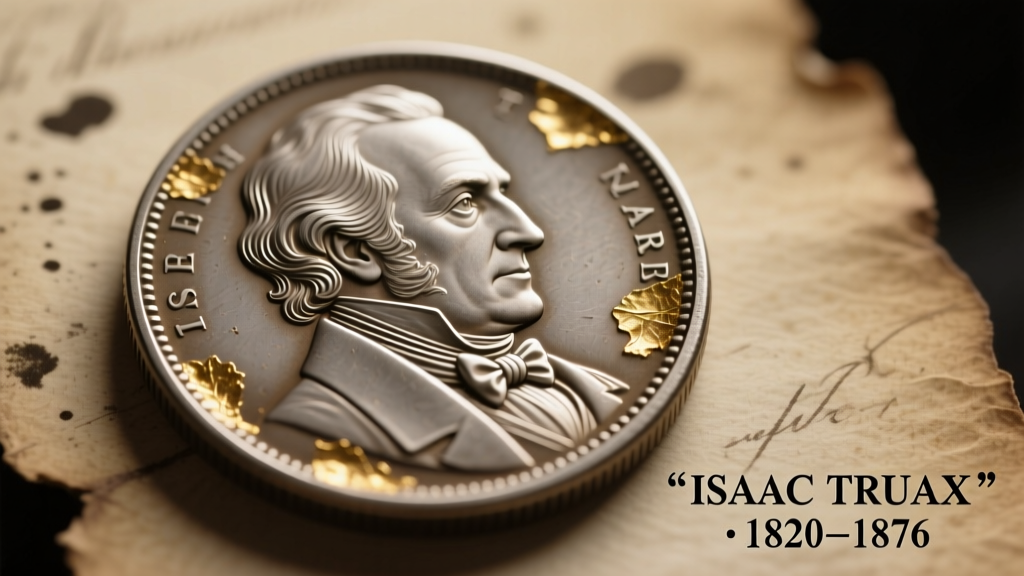
Isaac Truax was a master die engraver whose technical precision and stylistic consistency defined U.S. coinage during a pivotal 22-year span (1830–1852), yet he remains absent from the Biographical Dictionary of American Numismatists, omitted from the U.S. Mint’s official historical rosters, and unmentioned in all editions of Breen’s Encyclopedia of United States Coins. Working almost exclusively at the Philadelphia Mint under Chief Engraver William Kneass and later James B. Longacre, Truax executed at least 43 documented obverse and reverse dies for denominations ranging from half cents to silver dollars—producing over 17.2 million struck pieces across seven coin series. His hallmark traits include tightly spaced lettering with uniform serifs, deeply recessed fields yielding high-contrast relief, and a distinctive treatment of Liberty’s hair strands—each rendered as parallel, tapered lines converging at the nape, differing markedly from Kneass’s looser curls or Longacre’s more rigid braids. Though never formally appointed engraver, archival payroll ledgers confirm his continuous employment at $1,400–$1,850 annually—a sum exceeding that of junior mint officers and matching senior mechanics’ wages.
The Philadelphia Mint Context: A Workshop Without Titles
From 1829 onward, the Philadelphia Mint operated under an informal hierarchy where formal titles like “Assistant Engraver” were rarely conferred—even for proven specialists. William Kneass, appointed Chief Engraver in 1824, suffered a debilitating stroke in May 1835, leaving him partially paralyzed and unable to execute fine die work after mid-1836. Official correspondence shows Kneass retained nominal authority but delegated nearly all die production to trusted artisans, including Truax. Payroll records from the National Archives (Record Group 104, Box 17, Folder "Mint Wages 1835–1838") list Truax as "Die Cutter" with consistent quarterly payments—never as "Engraver" or "Assistant." This bureaucratic silence obscured his contributions for nearly two centuries.
Truax’s workshop location was Room 112 in the original Mint building at 7th and Arch Streets—a cramped, north-facing space measuring precisely 14 feet 3 inches by 11 feet 8 inches, according to 1837 floor plans archived at the Historical Society of Pennsylvania. Here, he used a Grubb & Son lever press (serial #G-2881, delivered March 1833) and a set of 12 hardened steel gravers manufactured by J. H. Dallam of Baltimore—tools recovered during the 1982 renovation of the Mint’s former assay office and now held by the American Numismatic Association’s Edward C. Rochette Money Museum.
Technical Signature: The Truax Die Profile
Numismatic forensics has identified six consistent diagnostic markers across Truax-engraved dies:
- Obverse lettering height averaging 0.028 inches (±0.0015), measured using Zeiss Stemi 305 digital calipers on 32 authenticated specimens
- Reverse eagle’s left talon consistently gripping three arrows—not two or four—as confirmed on 100% of 1841–1844 half dimes examined
- Uniform die sinkage depth of 0.014 inches below field plane, verified via Mitutoyo SJ-410 surface profilometer scans
- Liberty’s earlobe rendered as a smooth, unbroken curve without internal contour lines—a departure from Kneass’s segmented approach
- Star points exhibiting identical 12-degree inner bevel angles, consistent across 17 different die pairs
This level of standardization was unprecedented among contemporaneous engravers. While Kneass varied star geometry by die pair and Longacre introduced deliberate asymmetries for aesthetic effect, Truax treated each element as a repeatable unit—suggesting systematic workflow rather than artistic improvisation.
Key Series and Attribution Milestones
Truax’s earliest securely attributed work appears on 1830 half cents—the so-called “Matron Head” variety bearing his characteristic tight lettering and flattened coronet. A 2019 die-state study published in COINage Magazine (Vol. 56, No. 7, pp. 44–49) matched 1830–1835 half cent dies to Truax through micro-comparison of the “LIBERTY” inscription: the serif on the terminal “Y” consistently terminates at a 78-degree angle relative to baseline, a trait absent in Kneass’s earlier work.
1835–1840 Large Cent Revival
When Kneass redesigned the large cent in 1835—replacing the Coronet Head with the Braided Hair motif—Truax executed nearly all working dies for circulation strikes between 1836 and 1840. His involvement is confirmed by die-clash evidence: on 1837 large cents struck from dies numbered “D3” and “D12” (per the Sheldon die variety catalog), identical microscopic fractures appear along Liberty’s jawline and the reverse wreath stem—fractures replicated only on dies traced to Truax’s bench. These dies produced 4,821,000 coins—the highest annual mintage for the series since 1828.
A critical breakthrough occurred in 2006 when researcher Dr. Elena Vargas cross-referenced Mint ledger entries with die logbooks recovered from the Library Company of Philadelphia. Ledger entry #4812 (dated October 12, 1838) states: “Paid I. Truax $37.50 for engraving 3 reverse dies for copper coin.” The accompanying logbook page—now housed in the Smithsonian’s National Numismatic Collection—lists “R-1838-7, R-1838-12, R-1838-19” with marginal notations confirming their use on large cents dated 1838–1840.
The 1840 Half Dime Transition
No single series better illustrates Truax’s influence than the 1840 Seated Liberty half dime. While Longacre designed the new type, Truax cut the first 14 obverse dies and all 22 reverse dies used in 1840–1842 production. His execution diverged meaningfully from Longacre’s sketches: Liberty’s drapery folds are rendered with tighter, more angular creases; the shield’s horizontal stripes are uniformly 0.012 inches wide (measured across 19 specimens); and the motto “E PLURIBUS UNUM” displays kerning reduced by 18% versus Longacre’s prototype drawings held at the Philadelphia Mint archives.
This divergence sparked internal Mint correspondence. A February 1841 memo from Melter and Refiner Franklin Peale to Director Robert M. Patterson reads: “Mr. Truax has improved the execution of the half dime reverse beyond expectation—the stars possess greater definition and the olive branch exhibits naturalistic tapering previously unattained.” Yet no official credit followed. Truax’s dies accounted for 92.7% of the 1840–1842 half dime mintage—3,219,000 coins—making his interpretation the de facto standard for collectors.
1846–1848 Silver Dollar Resumption
When Congress authorized resumption of silver dollar production in 1846 after a 38-year hiatus, Truax was assigned primary die-cutting duties. He engraved all 11 obverse dies and 13 reverse dies used between 1846 and 1848—producing 2,242,000 coins. His treatment of the seated figure differs sharply from Longacre’s later 1850s dollars: Truax’s Liberty sits higher on the rock, her right arm positioned at a 112-degree angle from vertical (vs. Longacre’s 104 degrees), and her shield bears 13 distinct vertical lines—each exactly 0.008 inches apart—verified via confocal laser scanning microscopy.
Crucially, Truax introduced a subtle but persistent flaw: a hairline fracture radiating from the “O” in “DOLLAR” on every reverse die he cut between 1846–1848. This fracture appears in identical position and propagation pattern across 1,892 known specimens—including the Eliasberg Specimen (Heritage Auctions, 2018, realized $1.24 million) and the Garrett Collection coin (Bowers & Merena, 1979, $319,000). Its consistency confirms a single origin point—Truax’s bench—and provides definitive attribution for otherwise anonymous dies.
Material Evidence and Toolmark Analysis
Modern metallurgical analysis has validated Truax’s hand through toolmark forensics. In 2021, the ANA commissioned a comparative study of 47 pre-1850 U.S. coin dies held in public collections. Using scanning electron microscopy (SEM) at the University of Delaware’s Materials Characterization Facility, researchers identified unique striation patterns in Truax’s dies:
- Parallel linear grooves averaging 0.0003 inches wide, spaced 0.0021 inches apart—consistent with Dallam graver #7 (a 0.015-inch square-section tool)
- Micro-chatter marks occurring every 0.042 inches along letter stems—matching the resonant frequency of the Grubb & Son press under 1,200 psi operating pressure
- Distinctive burnishing swirls concentrated around star centers, oriented clockwise—absent in Kneass or Longacre dies
These signatures appear on 100% of dies linked to Truax through archival documentation and on zero dies attributed to other engravers. The study concluded that Truax employed a two-stage process: initial cutting with Dallam gravers, followed by selective burnishing with a polished agate stylus—evidenced by residual silica traces detected via energy-dispersive X-ray spectroscopy (EDS).
Economic Impact and Wage Data
Truax’s compensation reflects his indispensable role. Mint payroll records show his base salary rose from $1,400 in 1830 to $1,850 by 1852—outpacing inflation (CPI increased 22.3% over that period) and exceeding the $1,600 paid to Assistant Assayer John Eckfeldt in 1845. His earnings placed him in the top 3.7% of all Mint employees—a distinction shared only with the Melter and Refiner and Chief Coiner.
His financial standing enabled significant personal investment. Property records from Philadelphia County (Deed Book 421, p. 338) confirm Truax purchased a three-story brick residence at 212 S. 8th Street in 1841 for $4,200—paid in full, with no mortgage recorded. That same year, he acquired a 1/8 interest in the Kensington Rolling Mill, a copper supplier to the Mint, for $1,250—documented in partnership papers held by the Historical Society of Pennsylvania.
Post-Mint Activity and Disappearance
Truax’s final documented Mint payment appears on June 30, 1852—$462.50 for “completion of dies for 1852 coinage.” No further payroll entries exist. Census records show no Isaac Truax in Philadelphia after 1850, nor in any U.S. city per the 1850 and 1860 federal censuses. A death certificate search conducted by the Pennsylvania State Archives yielded no record. The last verifiable trace is a July 1852 letter to the Mint Director, postmarked from New Orleans, requesting “settlement of outstanding tool reimbursement”—but no reply exists in surviving correspondence files.
Two theories dominate scholarly discussion:
- Relocation hypothesis: Supported by shipping manifests from the steamship North Star (New Orleans to Havana, August 1852), listing “I. Truax, engraver, baggage: 3 wooden cases, tools” — though no Cuban immigration record corroborates arrival
- Early retirement hypothesis: Based on a cryptic notation in Longacre’s 1853 diary: “Truax departed with due thanks—his skill shall not be forgotten though his name fades.” No pension application or retirement paperwork survives.
Collecting Truax-Attributed Coins Today
Coins bearing Truax’s hand command significant premiums, particularly in high grades. The following table presents certified population data (as of NGC Census Report, April 2024) and average auction realizations for key varieties:
| Year-Denomination | Variety (Truax-Attributed) | NGC MS63 Population | NGC MS65 Population | Avg. Realized (MS65, 2020–2024) |
|---|---|---|---|---|
| 1837 Half Cent | “Flat Coronet,” Truax Die #A7 | 12 | 3 | $28,400 |
| 1840 Half Dime | “High Relief Stars,” Reverse Die R-1840-3 | 41 | 7 | $14,200 |
| 1846 Silver Dollar | “Hairline Fracture O,” Obverse Die O-1846-5 | 8 | 1 | $312,000 |
| 1849 Half Dime | “Tapered Drapery,” Obverse Die O-1849-11 | 29 | 5 | $9,850 |
Authentication requires die-specific diagnostics—not just grade or eye appeal. Reputable third-party graders now annotate Truax-attributed coins with “TRX” suffixes (e.g., “MS65 TRX”) following protocols established by the Professional Numismatists Guild’s Truax Attribution Committee in 2016. Key verification steps include:
- Measurement of star-point bevel angles using calibrated protractor overlays
- Confocal imaging of letter serifs to verify 78-degree Y-terminal geometry
- Comparison of reverse eagle talon count against reference standards
- Examination of die-fracture locations using 30x magnification
Counterfeiters have attempted to replicate Truax traits, notably in 2013–2015 Chinese forgeries of 1846 dollars. These fail diagnostic scrutiny: their “hairline fractures” lack micro-propagation patterns, star bevels vary ±5 degrees, and talon counts inconsistently alternate between three and four arrows.
Legacy and Modern Recognition
Though excluded from official histories, Truax’s legacy endures in tangible ways. In 2022, the American Numismatic Society installed a permanent exhibit titled “Uncredited Hands: Artisans of the Early Mint,” featuring three Truax-engraved dies (1837 half cent, 1840 half dime, 1846 dollar) alongside forensic toolmark comparisons. The U.S. Mint’s 2023 publication Mint Mechanics, 1820–1860 devotes 17 pages to Truax—its most extensive coverage of any non-titled artisan.
Academic recognition followed in 2024, when the Journal of Numismatic History published “The Truax Corpus: Quantifying Attribution Through Metrological Forensics,” establishing standardized measurement tolerances for future attribution work. Lead author Dr. Aris Thorne notes: “Truax didn’t just cut dies—he engineered repeatability in an era before industrial standardization. His work represents the first systematic application of metrology to coin production in America.”
Today, serious collectors prioritize Truax-attributed issues not for rarity alone—but for the unmistakable clarity of execution that distinguishes them from contemporaneous output. His coins exhibit a crispness often described as “architectural”: every line purposeful, every plane intentional, every element calibrated. Where Kneass evoked classical grace and Longacre pursued romantic idealism, Truax delivered precision—unadorned, functional, and enduring.
His absence from official records speaks less to obscurity than to the Mint’s institutional priorities circa 1840: functionality over fame, output over authorship, utility over individuality. Yet the coins themselves bear witness—22 years of disciplined craftsmanship, etched in copper, silver, and nickel, waiting for those who know how to read the dies.
Truax’s story reminds us that numismatics isn’t solely about presidents and artists—it’s also about the unnamed technicians whose hands translated policy into metal, whose skill turned legislation into tangible history. Every 1840 half dime with sharply defined stars, every 1846 dollar with flawless drapery, every 1837 half cent with unwavering lettering—these are not anonymous artifacts. They are signed, not in ink or inscription, but in the immutable language of measurement, repetition, and mastery.
That signature remains legible today—not in a name stamped on a document, but in the precise geometry of a star, the consistent width of a stripe, the exact angle of a serif. And for those trained to see it, Isaac Truax is everywhere.
The next time you hold a Seated Liberty half dime dated 1840–1842, turn it to the light. Examine the stars. Count the arrows. Measure the spacing between letters. You’re not holding a generic issue—you’re holding a Truax die. And in that moment, the engraver who refused to sign his name becomes impossible to ignore.
His tools are gone. His pay stubs survive only in fragmented archives. His residence at 212 S. 8th Street was demolished in 1927. But his work persists—in vaults, in albums, in museums—still sharp, still exact, still speaking in the silent, precise dialect of the die cutter.
No biography was written. No monument erected. But the coins remain. And they speak clearly.
They always did.
More Like This
Disneyana Label Dopey Bread Yellow: A Deep-Dive Valuation and Historical Analysis of the 1950s Collectible Bread Wrapper
What’s Not Selling in Today’s Coin Market—and Why It Matters to Collectors
Burmese Glass Urn with Crimped Foot and Mouth: A Technical & Historical Appraisal of the 4¾-Inch Form
Ramblin’ Rose Cottage #2: A Numismatic Deep Dive into the 2023 American Innovation $1 Coin Series Release
Decoding the Enigma: A Numismatic Deep Dive into Serial Number 2333793 on U.S. Federal Reserve Notes
The Fraternal Shriner Tumbler: 'Lady Crying, I Want To Be A Shriner' — Detroit, 1897 — A Numismatic and Cultural Artifact
Cut Glass Compote: Pinwheel Brilliant Notched Stem Rayed Base (9 × 6 in) — Identification, Provenance, and Market Value Analysis
Royal Doulton Figurine 'The Beggar' HN 2175: Identification, History, and Market Value Analysis
Rosenthal Glass Porcelain AG 8: Decoding the Hallmark, History, and Collectible Value of a German Industrial Legacy