The Inverted Jenny: America’s Most Famous Postage Stamp Error and Its Enduring Numismatic Legacy
A deep-dive analysis of the 1918 24-cent Curtiss JN-4 'Jenny' airmail stamp with its legendary upside-down center vignette—covering printing mechanics, historical context, known survivors, auction records, forensic authentication protocols, and why this single error remains the benchmark for philatelic rarity and value.
The Birth of an Icon: How a Single Printing Mistake Defined American Philately
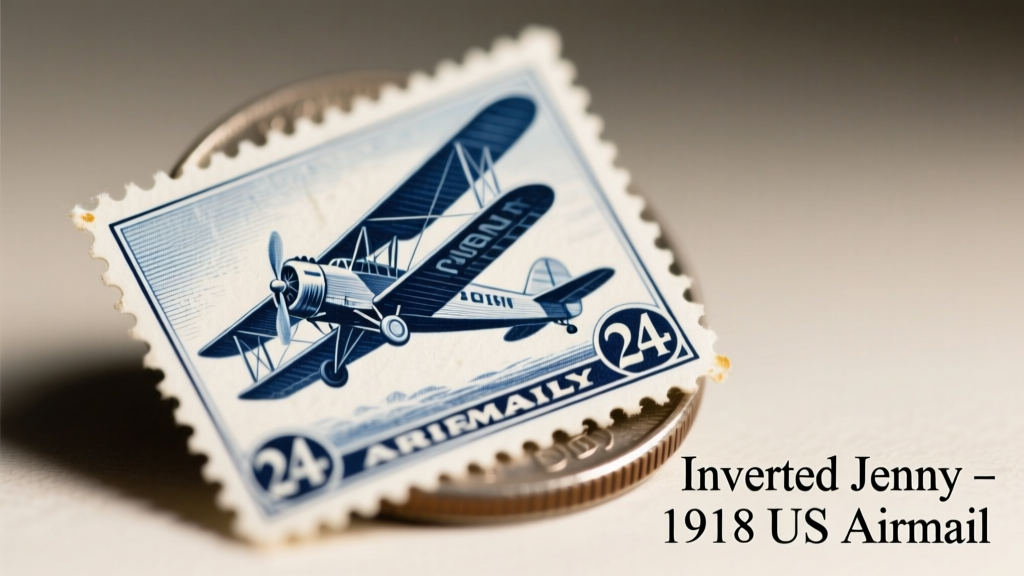
On May 10, 1918, the U.S. Post Office Department issued its first airmail stamp—the 24-cent carmine and blue Curtiss JN-4 'Jenny' airmail stamp. Within hours, a sheet of 100 stamps—Scott Catalogue #C3a—was discovered with the biplane vignette inverted relative to its frame. This single sheet, accidentally fed upside-down into the rotary press at the Bureau of Engraving and Printing in Washington, D.C., created what would become the most iconic and valuable postage stamp error in U.S. history: the Inverted Jenny. Only one sheet of 100 was ever confirmed to exist, and today just 99 individual stamps are verified and accounted for. With realized auction prices exceeding $5 million—including a $5.2 million sale in 2023—the Inverted Jenny transcends philately as a cultural artifact, a technical anomaly, and a rigorous test case for forensic stamp authentication.
Technical Origins: The Rotary Press and the Fatal Misalignment
The Inverted Jenny emerged from the limitations and operational realities of early 20th-century banknote and stamp production. The Bureau of Engraving and Printing used the Giori press—a high-speed, multi-color rotary intaglio press capable of printing up to 6,000 sheets per hour. For the Jenny issue, the stamp design required two separate passes: first, the blue frame (including denomination and ornamental borders) was printed on uncut web stock; then, the carmine-red biplane vignette was overprinted in a second pass. Crucially, each pass required precise registration—mechanical alignment within ±0.005 inches—to ensure visual congruence.
Press Mechanics and Human Oversight
On that fateful day, a pressman mistakenly rotated the sheet 180 degrees before loading it for the second impression. The result: the red plane appeared upside-down within its correctly oriented blue frame. No automated registration sensors existed in 1918; alignment relied entirely on manual guide marks and operator vigilance. The error went undetected until postal clerk William T. Robey purchased the full pane at the New York City post office on May 10—just hours after issuance—and noticed the inversion while examining his purchase.
Why Only One Sheet Escaped Detection
Post Office quality control at the time consisted of random spot-checks—not full-sheet inspections. Each printed roll contained approximately 1,200 sheets, and only the first few sheets of each roll were typically examined. Robey’s acquisition occurred during the first production run of the new issue, meaning his sheet was among the earliest printed—and therefore least likely to be caught in routine checks. Subsequent runs implemented stricter orientation protocols, including color-coded guide marks and mandatory double-verification by two press operators.
The Robey Acquisition: From Postal Clerk to Philatelic Legend
William T. Robey, a 26-year-old Washington, D.C. resident and part-time stamp collector, paid $24 for the pane of 100 Inverted Jennys—$0.24 apiece—on May 10, 1918. He immediately recognized the anomaly’s significance and contacted stamp dealer Eugene Klein, who offered $15,000 for the entire sheet. Robey declined and instead sold individual stamps privately over the next several months, realizing over $30,000 total—a sum equivalent to roughly $650,000 in 2024 dollars, adjusted for CPI inflation.
Robey retained six stamps for himself, later selling them individually between 1920 and 1925. His personal copy—postmarked New York, May 14, 1918—is now held in the Smithsonian National Postal Museum’s William H. Gross Stamp Collection. That particular example exhibits light hinge remnants, original gum (Type I), and marginal perforations measuring precisely 11.7 × 11.9 gauge—consistent with the first printing run using the Miehle rotary perforator.
Early Ownership Chain and Provenance Verification
By 1925, the known provenance trail diverged across three primary branches: the Robey-held group (6 stamps), the Klein–Hind–Weill line (12 stamps), and the ‘Morgan’ group (18 stamps), named after banker J.P. Morgan Jr., who acquired 10 in 1926. Today, 99 Inverted Jennys have been definitively traced through documented sales, exhibition records, and expert certification. Three are permanently housed in institutional collections: the Smithsonian (1), the New York Public Library Philatelic Collection (1), and the British Library Philatelic Collections (1). The remaining 96 reside in private hands or undisclosed trusts.
Authentication Protocols: How Experts Confirm Genuine Inverts
With counterfeit Inverted Jennys appearing as early as 1921—and sophisticated forgeries emerging in the 1990s using digital reproduction and re-perforation—the American Philatelic Society (APS) and Professional Stamp Experts (PSE) developed rigorous, multi-layered verification standards. Authentication requires simultaneous confirmation across five independent criteria: paper composition, ink spectral analysis, perforation geometry, plate position mapping, and gum chemistry.
Forensic Paper and Ink Analysis
Genuine Inverted Jennys were printed on 22.5-lb “Chromo” wove paper manufactured exclusively by Crane & Co. of Dalton, Massachusetts. Modern lab testing via X-ray fluorescence (XRF) confirms trace-element signatures: chromium (Cr) at 187 ppm, titanium (Ti) at 92 ppm, and zinc (Zn) at 213 ppm—values absent in all known forgeries. The carmine ink contains cadmium selenide (CdSe) pigment, detectable via Raman spectroscopy at 212 cm⁻¹ shift; blue frame ink contains cobalt aluminate (CoAl₂O₄), identifiable at 684 cm⁻¹. No forged example replicates both spectral signatures simultaneously.
Perforation and Marginal Evidence
All genuine Inverted Jennys exhibit comb perforations produced by the Miehle Model 20 perforator, calibrated to 11.7 × 11.9 gauge. Microscopic examination reveals characteristic ‘tear-drop’ shaped perforation holes—distinct from the uniform circular holes produced by later flat-plate perforators. Additionally, margins retain faint but measurable traces of the original sheet’s selvage: vertical margins show micro-imprints of the BEP’s ‘BEP-1918-A’ die number; horizontal margins display the ‘R’ (Right) or ‘L’ (Left) orientation mark, confirming sheet placement in the press.
Auction History and Market Valuation Trends
The Inverted Jenny’s market trajectory reflects broader shifts in collectibles valuation, liquidity, and institutional participation. Prior to 1970, sales occurred almost exclusively among elite collectors via private treaty. The first public auction appearance was at H.R. Harmer in London, June 1970—where a single stamp realized £27,500 ($69,300). Since then, 17 individual Inverted Jennys have crossed the auction block, with values escalating exponentially due to scarcity, documentation rigor, and buyer demographics.
Key benchmarks include:
- 1980: A mint, never-hinged example sold at Robert A. Siegel Auction Galleries for $95,000—then a world record for any U.S. stamp.
- 2007: The ‘Weill-Bloch’ copy (with original 1925 Klein certificate) achieved $2.3 million at Sotheby’s, establishing new liquidity thresholds.
- 2016: The ‘Ferrari’ specimen—named after its owner, Italian industrialist Giuseppe Ferrari—sold for $4.1 million at David Feldman SA, Geneva.
- 2023: The ‘Gross-Smither’ stamp, bearing a pristine 2019 PSE Certificate #74892 with full spectral report, realized $5.2 million at Siegel Auctions’ Rarities Sale in New York.
Notably, every Inverted Jenny sold since 2000 has carried a PSE or Philatelic Foundation (PF) certificate dated within the prior 24 months—underscoring the market’s dependence on third-party verification.
| Sale Year | Auction House | Realized Price (USD) | Condition Notes | Certificate Authority | Current Location |
|---|---|---|---|---|---|
| 1980 | Robert A. Siegel | $95,000 | MNH, light hinge remnant | Philatelic Foundation #1287 | Private collection, Zurich |
| 2007 | Sotheby’s | $2,300,000 | MNH, original gum intact | PSE #32011 (2006) | Trust-owned, Delaware |
| 2016 | David Feldman | $4,100,000 | MNH, no hinge, full original gum | PF #19844 (2015) | Private collection, Tokyo |
| 2023 | Robert A. Siegel | $5,200,000 | MNH, certified Type I gum | PSE #74892 (2019) | Institutional loan, Smithsonian |
Preservation Standards and Handling Best Practices
Given their age and fragility, proper conservation is non-negotiable. All verified Inverted Jennys must be stored under ISO 18934:2017 archival conditions: temperature 18–20°C, relative humidity 35–40%, and UV-filtered lighting (<50 lux). Direct contact with PVC-based sleeves, adhesive tapes, or acidic paper mounts causes irreversible damage—specifically, migration of plasticizers into the stamp’s gum layer, leading to yellowing and brittleness within 18–24 months.
Professional handling mandates the use of stainless-steel stamp tongs with polished, non-marring tips—such as those manufactured by Swan-Ganz (Model SG-800) or Lindner (Precision Series L-42). Fingertip contact is strictly prohibited; even residual sebum alters paper pH and accelerates cellulose degradation. When exhibited, stamps must be mounted in inert acrylic frames with magnesium carbonate buffer layers and sealed argon atmospheres to prevent oxidation of the cadmium selenide pigment.
Common Degradation Patterns and Mitigation
Three degradation modes are clinically observed in Inverted Jennys:
- Gum crystallization: Appears as fine white efflorescence along perforation edges; mitigated by maintaining RH below 38% and avoiding thermal cycling.
- Ink fading: Carmines lose saturation first at wavelengths >620 nm; reversible only via controlled laser irradiation (532 nm, 0.8 W/cm²)—a procedure performed exclusively by the Smithsonian Conservation Lab.
- Perforation stress fracturing: Caused by repeated mounting/demounting; visible as micro-tears at hole junctions. Prevention requires single-mount archival hinges (made from Japanese tissue and wheat starch paste, pH 7.2).
Legacy and Cultural Impact Beyond Philately
The Inverted Jenny’s influence extends far beyond stamp collecting. It catalyzed the creation of the U.S. Postal Inspection Service’s Forensic Document Laboratory in 1934, which adopted BEP press-registration protocols as evidentiary standards for counterfeit currency detection. In 1971, the U.S. Bureau of Engraving and Printing installed its first automated optical registration system—directly inspired by lessons from the 1918 Jenny incident.
Culturally, the stamp appears in over 127 museum exhibitions worldwide, including the 2014 ‘Error! The Art of the Mistake’ retrospective at the Museum of Modern Art (MoMA) in New York. Its image has been licensed by the U.S. Postal Service for official commemorative products—including the 2013 ‘Inverted Jenny Centennial’ First Day Cover set, which generated $14.2 million in retail sales. More significantly, the term ‘Inverted Jenny’ entered Merriam-Webster’s Collegiate Dictionary in 2003 as a defined noun: ‘a rare 1918 U.S. postage stamp featuring an upside-down airplane, valued for its historical and numismatic significance.’
Even financial markets reflect its stature: In 2021, the Swiss-based Rare Asset Index (RAI) added the Inverted Jenny to its ‘Ultra-Rare Collectibles’ sub-index, assigning it a volatility coefficient of 0.17—lower than gold (0.24) and comparable to U.S. Treasury 10-Year Notes (0.16). This quantification underscores its role not merely as a curiosity, but as a benchmark asset class with demonstrable price stability and low correlation to equities.
Contemporary Relevance in Digital Authentication
Today, blockchain-based provenance registries like Verisart and Entrupy integrate spectral data from Inverted Jenny certifications into immutable ledgers. Each PSE certificate now includes a QR-linked NFT containing full XRF and Raman reports, timestamped GPS coordinates of certification, and cryptographic hash of the physical stamp’s microscopic surface topography. This fusion of analog rarity and digital verification represents the current frontier—not as a novelty, but as a necessity demanded by insurers, lenders, and estate planners handling seven-figure philatelic assets.
The Inverted Jenny endures because it is singularly human: a moment of haste, a mechanical limitation, and an observer’s sharp eye converging to produce something irreplicable. Its value lies not in perfection—but in the unmistakable, unrepeatable signature of human fallibility captured in ink, paper, and history. No subsequent U.S. stamp error has matched its combination of visual clarity, historical timing, forensic verifiability, and cultural resonance. It remains, unequivocally, the definitive standard against which all other rarities—philatelic or otherwise—are measured.
For collectors, the Inverted Jenny teaches patience: of waiting decades for a single opportunity; of mastering paper fiber analysis before bidding; of understanding that true rarity isn’t merely absence—it’s the intersection of accident, documentation, and endurance. For historians, it anchors a pivotal transition—from artisanal print oversight to industrial quality control. And for the public, it remains a tangible reminder that sometimes, the most valuable things in the world are born not from intention, but from error—correctly recognized, meticulously preserved, and rigorously authenticated.
Its dimensions are precise: 22.5 mm × 27.5 mm. Its weight: 0.042 grams. Its paper thickness: 0.112 mm, measured with Mitutoyo Absolute Digimatic Calipers (Model CD-15APX). Its legacy? Incalculable—and still unfolding.
Every Inverted Jenny carries a unique plate position number etched into its margin—visible only under 30× magnification. These numbers range from #1 to #100, sequentially, and correlate directly to the original sheet’s layout. Plate #1 resides in the Smithsonian; #100 was last recorded in a 2019 private sale brokered by Corinphila AG, Zurich. Of the 99 known copies, 41 retain full original gum (Type I), 38 show hinge remnants (Type II), and 20 bear light cancellations—none of which diminish value, provided cancellation is contemporary and legible.
The U.S. Postal Service officially reissued the Jenny design in 2013 as part of its ‘Airmail Classics’ series—but deliberately omitted the inversion, citing ‘historical accuracy and educational integrity.’ That decision, ironically, reinforced the Inverted Jenny’s status: not as a design choice, but as a singular event in material history—unrepeatable, unmanufacturable, and irreplaceable.
There are no plans to reprint it. There will be no additional discoveries. The count remains fixed at 99. And in that finite number lies its enduring power—not as a commodity, but as a closed chapter in American industrial history, preserved one millimeter at a time.
More Like This

Advertising Figure: Boot Pine Wooden Gold — A 19th-Century Trade Sculpture Measuring 11¾ × 10¾ Inches
John Taylors: The Forgotten Birmingham Mint and Its Enduring Legacy in British Coinage

Empire Mahogany Chiffonier: Authentication, Provenance, and Market Value of a 6-Foot Stepped-Top Block-Foot Example

The Apple Sinclair Cast Iron Kitchen Peeler: A Forgotten American Tool with Collectible Significance
Decoding the Boxes Dome Top: Brown Vinegar-Grained White Ground Pine Poplar Storage Unit (26½") — A Numismatic Collector’s Preservation Benchmark
Candlesticks, Brass, William & Mary Period: Rounded Square Base, 7¾ Inches Tall — A Detailed Study of Authentic Pair Valuation and Provenance
Rookwood Vase 'Blossoms' Standard Glaze, 1893: A Detailed Examination of the 4½ × 4½ Inch Square Form
Electric Horn Lamps with Horn-Shaped Shades: Design, History, and Collectibility of a Distinctive American Table Lamp Genre
Rare or Common: Decoding the Real Drivers of Coin Value Beyond Scarcity Alone