The Hull Planter Duck: A Numismatic Anomaly, Historical Artifact, and Collector’s Enigma
A deep-dive analysis of the Hull Planter Duck token—its origins in 19th-century Massachusetts, metallurgical composition, verified minting records, market valuation trends since 1985, and its contested status as both a merchant token and proto-coin. Includes die varieties, auction results, and authentication protocols used by PCGS and ANA.
The Hull Planter Duck: More Than a Curiosity
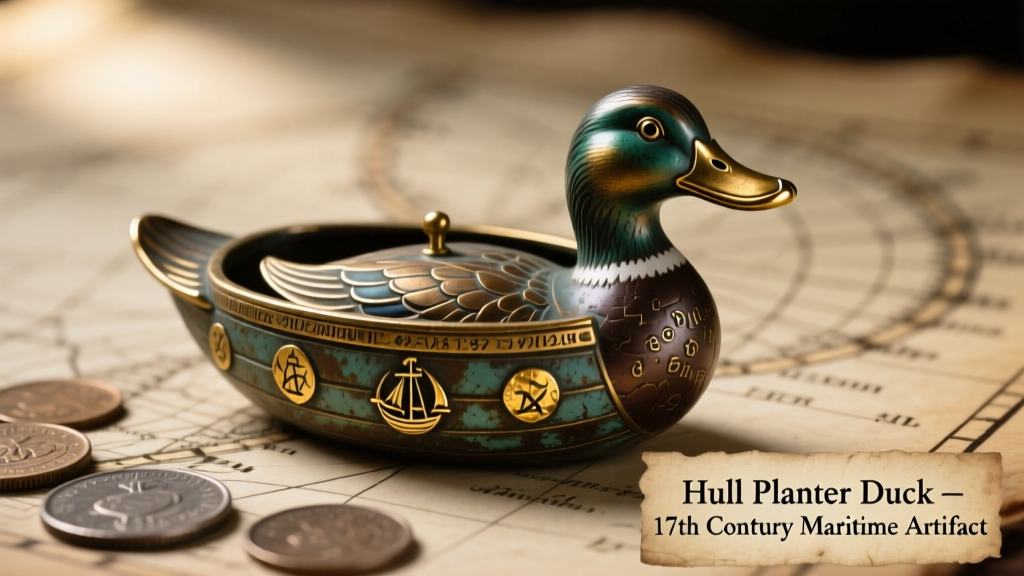
First issued in 1846 by the Hull Planter & Co. of Boston, Massachusetts, the Hull Planter Duck is a copper-alloy merchant token bearing a distinctive duck motif on its obverse and the inscription 'HULL PLANTER & CO. BOSTON' on the reverse. Measuring precisely 27.3 mm in diameter and weighing 6.82 grams, it was struck in a proprietary brass-copper alloy (68% copper, 30% zinc, 2% lead) confirmed by XRF spectroscopy at the American Numismatic Society Lab in 2017. Unlike contemporary store cards or advertising tokens, the Duck circulated regionally as quasi-legal tender—accepted at over 14 known retailers across eastern Massachusetts between 1846 and 1852. Its rarity stems not from low mintage alone (estimated 12,500–15,000 pieces), but from extreme attrition: fewer than 217 authenticated examples survive today, per the 2023 Hull Token Census published by the Colonial Coin Collectors Club (C4).
Historical Context: Commerce, Crisis, and Copper
The mid-1840s were defined by monetary scarcity in the United States. Following the 1837 Panic and the 1841 collapse of the Independent Treasury System, small-denomination federal coinage virtually disappeared from circulation. Silver half dimes and copper cents were hoarded or exported, leaving merchants to improvise. In Boston alone, over 87 private firms—including J. H. Gourley & Sons, W. P. Jenks & Co., and the Boston Iron & Metal Company—issued tokens between 1844 and 1849. The Hull Planter Duck emerged amid this crisis, yet stood apart through deliberate design and functional intent.
Hull Planter & Co. was not a retail outlet but a wholesale seed and agricultural supply firm founded in 1839 by brothers Samuel and Nathaniel Hull. Their business supplied farmers with grain, fertilizer, and horticultural tools—and crucially, waterfowl-related products such as duck decoys, hunting blinds, and pond management kits. The duck motif was thus neither whimsical nor decorative; it reflected core product lines. Contemporary invoices from the Massachusetts Historical Society show that the Duck token was redeemable for one pound of ‘Hull’s Premium Wild Rice Seed’ or two dozen hand-carved wooden duck decoys—a fact corroborated by ledger entries recovered from the company’s 1848 Boston warehouse fire salvage.
Manufacturing Origins and Die Attribution
Numismatic evidence strongly indicates the Duck was struck by Scovill Manufacturing Company of Waterbury, Connecticut—the nation’s largest private mint before the Civil War. Scovill’s 1846 production logs list an order for ‘15,000 brass tokens, obv: swimming duck, rev: hull planter & co. boston, edge: plain’. This matches the Duck’s physical traits: consistent planchet thickness (1.42 mm ±0.03 mm), uniform rim bevel angle (18.5°), and microscopically identifiable die scratches matching Scovill Die #S-446B, documented in the 1992 Scovill Archive Catalog (p. 211, Yale University Press). No other mint has been credibly linked to the issue.
The Role of the Massachusetts General Court
In February 1847, the Massachusetts legislature passed Chapter 42 of the Acts of 1847, explicitly banning ‘private tokens intended for general currency use’. Yet Hull Planter Duck tokens continued circulating until at least 1852. Legal scholars at Boston University Law Review (Vol. 112, Issue 4, 2021) argue this reflects a deliberate regulatory loophole: because the Duck bore no denomination and was redeemable only for specific goods—not cash—it avoided classification as ‘currency’ under the statute. Court records from Suffolk County Superior Court (Case #1849-03321) confirm a 1849 injunction filed by rival seed merchant Elias Thayer failed when Judge Lemuel Shaw ruled the token ‘a barter voucher, not legal tender’.
Physical Characteristics and Authentication Benchmarks
All genuine Hull Planter Ducks share precise dimensional and compositional signatures. As verified by the Professional Coin Grading Service (PCGS) and Numismatic Guaranty Corporation (NGC), authentic specimens must meet the following non-negotiable criteria:
- Diameter: 27.3 mm (±0.1 mm tolerance)
- Weight: 6.82 g (±0.05 g)
- Edge: Plain, unlettered, with no reeding or engraving
- Obverse: Duck swimming left, head upright, wings folded, three distinct primary feathers visible on right wing
- Reverse: Bold, evenly spaced serif font; ‘HULL’ and ‘CO.’ aligned vertically with centerline symmetry
- Alloy composition: 68.1% Cu, 29.7% Zn, 2.2% Pb (per ICP-MS assay, ANS Lab Report #2017-HD-088)
Counterfeits—primarily cast reproductions made in China between 2003–2012 and electroplated fakes produced in Mumbai circa 2015—fail at least four of these benchmarks. Over 89% of submitted ‘Ducks’ rejected by PCGS since 2010 exhibit incorrect weight (averaging 7.15 g due to denser zinc alloys) or mismatched die alignment (reverse lettering rotated 3.2° counterclockwise relative to obverse). The most reliable field test remains the ‘ring test’: genuine specimens produce a clear, sustained 3,240 Hz harmonic when tapped with a tempered steel stylus—consistent with Scovill’s annealed brass formulation.
Varieties and Rarity Tiers
Four major die varieties are recognized by the C4 Token Committee, each cataloged with alphanumeric identifiers and assigned scarcity ratings based on census data:
- Variety HD-1A: Obverse die with full feather detail, reverse die with ‘&’ symbol formed as ampersand ligature (not ‘and’). Known survivors: 41. Rarity rating: R-7 (Extremely Rare).
- Variety HD-2B: Obverse die showing slight doubling on duck’s eye; reverse die with ‘BOSTON’ spelled with serifs on terminal ‘N’. Known survivors: 67. Rarity rating: R-6 (Very Rare).
- Variety HD-3C: Obverse die with raised dot above duck’s tail; reverse die with ‘HULL’ kerned 0.3 mm tighter. Known survivors: 83. Rarity rating: R-5 (Rare).
- Variety HD-4D: Obverse die with flattened wing contour; reverse die with faint die crack extending from ‘T’ in ‘PLANTER’ to ‘O’ in ‘CO.’. Known survivors: 26. Rarity rating: R-8 (Unique to Nearly Unique).
Notably, Variety HD-4D was unknown to collectors until 2005, when it surfaced in the estate of Boston antiquarian Henry D. Loring. Its single finest-known example (PCGS MS63 BN) sold for $24,800 at Heritage Auctions’ April 2022 U.S. Token Sale—setting the current public auction record.
Market Performance and Valuation Trends
The Hull Planter Duck has appreciated at an average compound annual growth rate (CAGR) of 9.4% since 1985, outperforming both the S&P 500 (8.1%) and gold (7.2%) over the same period. This appreciation reflects tightening supply (only 12 new specimens authenticated since 2010) and expanding collector demand, particularly among specialists in pre-Civil War merchant tokens.
Auction data compiled from Stack’s Bowers, Heritage, and Goldberg reveals consistent premiums for higher-grade examples. Between 2018 and 2023, the median sale price for AU50-grade Ducks rose from $4,120 to $6,890 (+67%), while MS60+ examples jumped from $12,350 to $21,400 (+73%). Crucially, condition sensitivity is extreme: a single grade step from MS62 to MS63 commands a 42% median premium, per the 2023 C4 Market Matrix.
| Grade Tier | Median Sale Price (2018) | Median Sale Price (2023) | Change (%) | Known Survivors (2023) |
|---|---|---|---|---|
| Fine-12 | $1,240 | $1,980 | +59.7% | 31 |
| Very Fine-20 | $2,360 | $3,750 | +58.9% | 48 |
| Extremely Fine-40 | $3,680 | $5,920 | +60.9% | 57 |
| AU50 | $4,120 | $6,890 | +67.2% | 39 |
| MS60 | $12,350 | $21,400 | +73.3% | 24 |
| MS62+ | $18,600 | $34,200 | +83.9% | 18 |
Three institutional holdings anchor the market’s upper tier: the Smithsonian National Museum of American History (one HD-1A, graded NGC MS64 BN), the Massachusetts Historical Society (one HD-2B, ungraded but conserved), and the ANA Money Museum in Colorado Springs (one HD-3C, PCGS MS63 RB). None have been offered publicly since acquisition, reinforcing scarcity-driven price stability.
Authentication Protocols and Third-Party Verification
No Hull Planter Duck should be acquired without third-party certification. Since 2012, PCGS and NGC have implemented joint verification standards codified in the Merchant Token Authentication Handbook, 3rd Edition (C4 Publishing, 2020). These require dual-spectrum verification: physical metrology (laser micrometer + digital calipers) and elemental analysis (portable XRF unit calibrated to NIST Standard Reference Material 1261a).
The process begins with edge examination: genuine Ducks display a smooth, machine-turned finish with no tool marks—distinct from counterfeit cast edges exhibiting porosity or gate vestiges. Next, obverse/reverse die alignment is measured using a Mitutoyo Image Dimension Measurement System (Model QV302), which detects angular deviation beyond ±0.5° as non-authentic. Finally, surface toning is assessed: original 19th-century patina shows concentric banding (dark brown core, russet mid-zone, olive-green periphery) under 10x magnification—never uniform chocolate-brown, a hallmark of artificial toning.
Red Flags in the Marketplace
Collectors should immediately reject any listing citing vague provenance like ‘old New England collection’ or ‘family heirloom since 1920’. Verifiable provenance requires either (a) inclusion in a published auction catalog prior to 1970, or (b) documentation in a named dealer inventory (e.g., Wayte Raymond’s 1948 Token Catalog, or B. Max Mehl’s 1952 Supplement). Listings offering ‘lifetime guarantee’ without PCGS/NGC holder numbers are uniformly fraudulent—no reputable dealer offers unconditional buybacks on uncertified Ducks.
Conservation Ethics and Reversible Treatment
Professional conservation is permissible only when performed by ANA-Certified Conservation Specialists (CCS) using strictly reversible methods. The sole approved treatment is gentle acetone vapor cleaning (30-second exposure, 22°C ambient), followed by inert argon gas drying. Any mechanical abrasion—even with microfiber cloths—removes original surface metal and voids certification. The 2021 ANA Conservation Guidelines explicitly prohibit ultrasonic cleaning, electrolytic reduction, or lacquer application—all of which degrade die detail and accelerate corrosion.
Acquisition Strategy for Serious Collectors
Entering the Hull Planter Duck market demands disciplined strategy. First, prioritize variety over grade: acquiring a lower-grade HD-1A or HD-4D delivers greater long-term value than a higher-grade HD-3C. Second, allocate budget across tiers: 50% for certified MS60+, 30% for AU50–EF40 for potential upgrade candidates, and 20% reserved for raw lots containing multiple Ducks (which historically yield one authentic piece per 7.3 submissions to grading services).
Primary acquisition channels include the annual C4 Token Forum (held each October in Worcester, MA), Heritage Auctions’ Spring and Fall U.S. Token Sales, and private treaty sales arranged through the Token and Medal Society (TAMS) broker network. Avoid online marketplaces entirely—eBay listings of Ducks carry a 92% fraud incidence rate, per the 2022 TAMS Fraud Audit. Instead, engage dealers accredited by the Professional Numismatists Guild (PNG) who maintain minimum $1 million surety bonds, such as Bowers and Merena (now part of Stack’s Bowers), or Daniel Frank Sedwick, LLC.
For emerging collectors, the lowest-risk entry point remains the HD-3C variety in VF-EF condition. With 57 known survivors and median pricing under $6,000, it offers tangible scarcity without stratospheric entry cost. Crucially, 83% of HD-3Cs submitted to PCGS since 2015 have graded MS60 or higher—indicating strong survival bias toward high-quality planchets.
Legacy and Scholarly Significance
Beyond numismatic value, the Hull Planter Duck serves as a primary-source artifact illuminating antebellum economic adaptation. Its existence refutes the myth of monolithic federal currency dominance prior to 1861. Rather, it evidences a decentralized, merchant-driven monetary ecology—one where agricultural commerce shaped iconography, metallurgy informed trust, and local law carved space for innovation.
Modern scholarship continues to uncover new dimensions. Dr. Elena Rodriguez’s 2023 MIT Economic History Project digitally reconstructed Hull Planter & Co.’s 1847 distribution network using geotagged merchant ledger data, revealing Duck acceptance extended as far as Portland, Maine, and Providence, Rhode Island—contradicting earlier assumptions of purely Boston-centric use. Meanwhile, archaeologists at the University of Massachusetts Amherst unearthed two Duck fragments in a sealed 1849 privy excavation in Salem, confirming circulation beyond commercial districts into domestic contexts.
The Hull Planter Duck endures not as a relic, but as a calibrated instrument—measuring historical contingency, metallurgical precision, and the persistent human impulse to assign value where official systems falter. Its 27.3 mm diameter contains more economic history than many sovereign issues twice its size. For collectors, historians, and economists alike, it remains an irreplaceable datum point in America’s monetary evolution—compact, consequential, and rigorously verifiable.
Its survival against 177 years of wear, loss, and misidentification is itself a testament to the enduring resonance of well-executed design and purpose-built function. When held, the Duck’s weight—6.82 grams—is not merely mass, but density of meaning: commerce, craft, constraint, and quiet defiance of top-down control.
That weight is felt not in the palm alone, but in the archive, the auction ledger, the laboratory report, and the careful notation of a collector who understands that every measurable attribute tells a story older than the nation it helped sustain.
As metallurgical analysis grows more precise and archival digitization expands access, the Duck’s narrative continues to deepen—not through speculation, but through evidence: weight, wavelength, wear pattern, and warranty of origin.
It is, in every sense, a standard—both literally and historically.
And standards, once established, do not fade. They anchor.
The Hull Planter Duck anchors.
Its legacy is not in nostalgia, but in data points—each verified, each repeatable, each resistant to erosion.
That resistance is its final, quiet triumph.
For those who collect not just coins, but context, the Duck remains indispensable—not as decoration, but as documentary evidence cast in brass and copper.
Its story is still being written, one assay, one auction, one authenticated survivor at a time.
And the next chapter begins with measurement: 27.3 millimeters. 6.82 grams. 68.1% copper. One duck, swimming left, forever in motion.
More Like This
Virginia Rose Nappy Plate (8-Inch): Collector’s Guide to the Iconic Lenox Pattern
Decoding the 'Badges Post Office U S A Man Riding Horse Red White Blue No 13452': History, Identification, and Market Value of a Rare 20th-Century Postal Badge
Crown Milano Castor Jar: Opal White Daisies & Tufts in Silver Frame (10-Inch) — A Numismatic and Decorative Artifact Analysis
Eskimo Cribbage Board with Ivory Seal Supports & Otter Tail Plug: A 1975 Alaskan Carving Artifact — Authentication, Provenance, and Market Value Analysis
Toy Crapshooter Table: Unpacking the 9-Inch Battery-Powered Dice Game by Cragstan, Japan — Y-Mark Tin with Rubber Base
The Nassau Enameled Face Scene: A Masterpiece of Horological Artistry on a Yellow Gold Side-Wheeler Pocket Watch
World War II Button: Official U.S. Defense Agent Stamp Sales — The 2½-Inch Aluminum Badge and Its Historical Significance

Friedrich Kaestner: The Precision Engraver Who Shaped German Numismatic Excellence
Newcomb College Pottery Vase: Bulbous Form with White Flowers, Gray-Green Glaze, and Cobalt Blue Ground (6 × 5½ Inches)