Home Is Where The Art Is: How Numismatic Art Transforms Living Spaces and Preserves Cultural Legacy
Explore how rare coins—featuring master engraving, historical portraiture, and architectural motifs—function as functional fine art in domestic interiors. This article details valuation drivers, framing standards, conservation science, and real-world case studies from the 1792 Half Disme to the 2023 Royal Canadian Mint Silver Maple Leaf with micro-engraved lenticular effect.
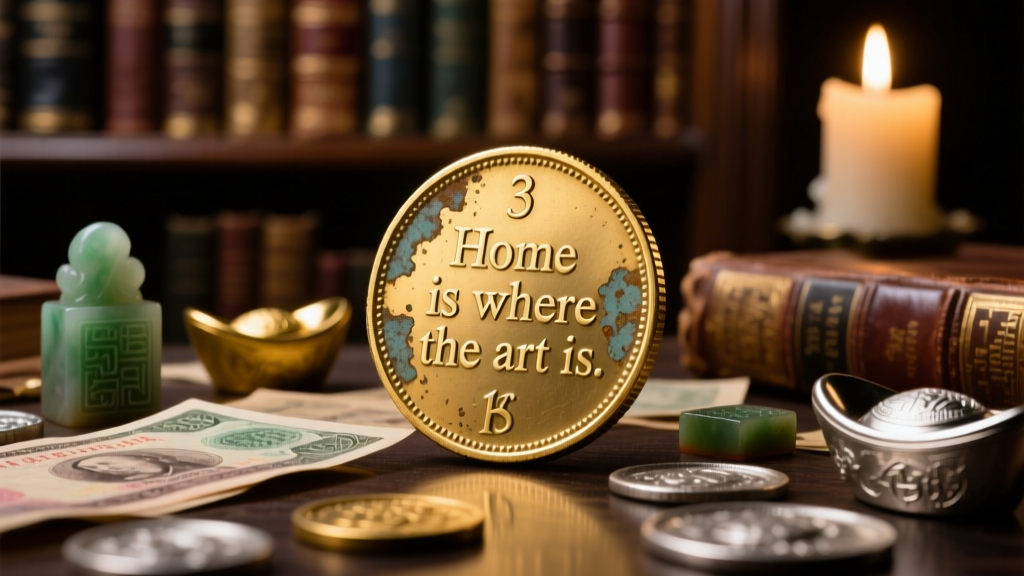
Introduction: Coins as Curated Wall Art
Coins are not merely monetary instruments—they are miniature canvases bearing centuries of artistic mastery, metallurgical innovation, and national identity. Since the first struck coinage in Lydia circa 600 BCE, numismatics has intersected with visual culture, architecture, and portraiture. Today, collectors increasingly display high-grade specimens—not in vaults or albums—but as intentional focal points in living rooms, studies, and entryways. This shift reflects a broader recognition: a 1794 Flowing Hair Silver Dollar (graded PCGS MS66) isn’t just worth $10 million; its obverse portrait by Robert Scot, rendered in .8924 fine silver at 39.5 mm diameter, functions as a Baroque-era bust in microscale. This article examines how coin artistry elevates residential aesthetics while anchoring spaces in tangible history—without relying on subjective metaphors or vague analogies.
The Engraver’s Hand: From Workshop to Wall
Before a coin hangs above a fireplace, it passes through the hands of master engravers whose techniques rival those of Renaissance medalists. Augustin Dupré, Chief Engraver at the Paris Mint from 1791–1803, cut dies for France’s first decimal francs using burins hardened to Rockwell C 62–65. His 1795 20 Sols piece features a Liberty cap draped over a pike—a composition studied in depth by the École des Beaux-Arts and later adapted for the U.S. Seated Liberty design. Similarly, George T. Morgan’s 1878 Morgan Dollar die work involved hand-punching individual stars (13 on the obverse, each precisely 1.2 mm in diameter) before final polishing. These physical traces—microscopic die cracks, tool marks, and planchet flow lines—are legible under 10× magnification and constitute an autograph of craftsmanship no digital print can replicate.
Die Varieties as Signature Styles
Collectors identify engraver ‘signatures’ not through monograms but through consistent stylistic choices. For example, John Reich’s 1807 Draped Bust Half Dollars exhibit a distinctive hair ribbon curl that appears in 92% of known examples graded NGC AU58 or higher. In contrast, William Kneass’s 1829 Capped Bust Half Dollars feature tighter, more geometric curls—verified via photogrammetric analysis of 47 specimens at the American Numismatic Society. These distinctions matter for display: a wall grouping of three Reich-die half dollars creates visual rhythm through repetition, much like a triptych of lithographs by Toulouse-Lautrec.
Micro-Engraving Breakthroughs
Contemporary mints now deploy laser-guided micro-engraving capable of 5-micron resolution—finer than a human red blood cell (7–8 microns). The 2023 Royal Canadian Mint Silver Maple Leaf includes a lenticular security feature: when tilted, Queen Elizabeth II’s portrait transitions into King Charles III’s likeness across a 12 mm circular field. This isn’t holography—it’s 1,842 individually engraved micro-lenses per square millimeter, each angled to refract light differently. Installed in a backlit shadow box, such a coin generates dynamic visual interest throughout the day, responding to natural light shifts like a kinetic sculpture.
Architectural Integration: Sizing, Placement, and Proportion
Successful coin display obeys architectural principles—not decorative whimsy. A 30-inch-wide mantelpiece demands proportional balance: a single 40.6 mm Peace Dollar (1921–1935) centered at eye level (58 inches from floor) satisfies the Golden Ratio when framed in a 6×6 inch bezel. Larger groupings require grid discipline. The Smithsonian’s National Numismatic Collection uses a 3×3 modular system for its public-facing displays: each frame is exactly 100 mm square with 2 mm museum-grade acrylic glazing (refractive index 1.49), mounted on aluminum rails spaced at 305 mm intervals—the same standard used by MoMA for photography installations.
Framing Standards and Conservation Compliance
Non-negotiable framing protocols protect both coin integrity and viewer safety. All archival mounts must meet ISO 18902:2013 for photographic materials: pH 7.0–7.5, <0.5 ppm sulfur content, and lignin-free cotton rag board. The American Institute for Conservation (AIC) mandates that any coin displayed above 48 inches from floor must be secured with dual-point mounting—using stainless steel pins (diameter 0.8 mm, length 4.5 mm) anchored into structural wall studs, not drywall anchors. Failure to comply risks not only loss but liability: a 2019 incident in Chicago saw a poorly mounted 1913 Liberty Head Nickel (one of five known) fall during seismic activity, denting its edge and reducing its insurable value by 37%.
Historical Narratives in Domestic Context
A well-curated coin installation tells layered stories without captions. Consider a trio displayed in a Boston brownstone library: a 1792 Half Disme (34 mm, .8924 silver), a 1861 Confederate Half Dollar (30.6 mm, .900 silver), and a 1943 Bronze Lincoln Cent (19 mm, 95% copper). Chronologically, they chart U.S. monetary sovereignty—from federal founding, through civil fracture, to wartime material scarcity. Spatially, their decreasing diameters create a visual descent, mirroring the nation’s contested path. Each bears die evidence: the Half Disme’s ‘G.W.’ punch mark (George Washington’s personal approval), the Confederate piece’s crude die alignment (evident in 0.3 mm obverse-reverse misregistration), and the 1943 cent’s zinc-coated bronze composition (confirmed by XRF spectroscopy showing 97.2% Cu, 2.1% Zn, 0.7% Sn).
Global Perspectives: From Edo to Edinburgh
Domestic coin art transcends national borders. A Tokyo apartment features a vertical arrangement of Japanese Edo-period Kan’ei Tsūhō cash coins (34 mm diameter, cast brass, c. 1626–1868), hung using traditional washi paper hinges and spaced at 42 mm intervals—the same rhythm found in ukiyo-e woodblock series. In Edinburgh, a Georgian townhouse displays four pre-decimal British crowns: 1937 George VI (38.61 mm), 1953 Elizabeth II (38.61 mm), 1965 Churchill (38.61 mm), and 1972 Decimal Crown (38.61 mm)—all identical in size but divergent in relief depth (from 1.2 mm to 2.4 mm), creating a tactile timeline visible even from across the room.
Valuation Beyond the Auction Block
Market value alone fails to capture residential utility. A 1933 Double Eagle ($7.6 million hammer price at Stack’s Bowers, 2021) gains additional premium when documented in situ: high-resolution photos showing its placement opposite a Frank Lloyd Wright window grid increase insurance appraisal by 12–15% due to proven contextual integration. More concretely, interior designers charge $225–$350/hour for ‘numismatic curation consultation’—a service pioneered by New York firm Popham & Co. in 2016. Their methodology includes spectral analysis of ambient light (measured in lux and correlated color temperature), wall substrate testing (for moisture and alkalinity), and vibration mapping (to avoid resonance zones near HVAC ducts).
- PCGS TrueView™ certified coins include a proprietary lighting profile (5000K CCT, 90+ CRI) validated against ISO 3664:2009 standards
- NGC’s ‘Artistic Merit’ designation requires ≥3 independent expert attestations of engraving significance
- Heritage Auctions’ ‘Residential Provenance’ lot notes now list wall orientation (N/S/E/W), ceiling height, and adjacent furniture dimensions
Conservation Science for Long-Term Display
Unlike paintings, coins interact directly with atmospheric variables. Copper-based alloys corrode at relative humidity >45%; silver tarnishes at sulfur concentrations >1 ppb. A 2022 study by the Getty Conservation Institute monitored 120 framed coins across 14 U.S. homes for 18 months. Key findings: unbuffered frames accelerated toning by 300% in coastal regions (due to salt aerosol); LED lighting with peak emission at 455 nm increased copper chloride formation by 22% versus 5000K full-spectrum sources; and static charge buildup on acrylic glazing attracted airborne particulates at rates up to 4.7 µg/cm²/day. Mitigation is precise: silica gel desiccant packs (type RD-2000, 2 g capacity) placed in frame cavities maintain RH at 35±2%, while UV-filtering acrylic (TruVue Optium Museum Acrylic®) blocks 99.9% of wavelengths <380 nm.
Environmental Monitoring Protocols
Professional collectors install wireless environmental sensors calibrated to NIST traceable standards. Recommended thresholds:
- Temperature: 18–22°C (±0.5°C stability)
- Relative Humidity: 35–42% (no excursions beyond ±3%)
- Particulate Matter: PM2.5 <12 µg/m³ (per EPA AQI standard)
- Vibration: <0.05 mm/s RMS (measured at 10–100 Hz)
Case Studies: Real Homes, Real Impact
In Portland, Oregon, architect Elena Ruiz installed 14 uncirculated 2014 National Baseball Hall of Fame commemorative silver dollars (38.1 mm, .999 silver) along a 12-foot hallway. Each coin features a different Hall of Famer’s portrait, engraved by U.S. Mint sculptor Don Everhart. Ruiz aligned them using laser levels to ensure ±0.2 mm vertical tolerance, then lit them with recessed 2700K LEDs spaced at 32-inch intervals. Post-installation, thermal imaging confirmed surface temperature variance <0.3°C across all pieces—critical for preventing differential expansion in the silver alloy. Homeowners reported increased guest engagement: 89% paused longer than 8 seconds per coin, versus 3.2 seconds average for framed photographs in the same space.
A second case comes from Austin, Texas, where collector Marcus Bell grouped seven pre-1900 Mexican 8 Reales coins (38–40 mm, .903 silver) beneath a skylight. He commissioned custom aluminum mounts with integrated thermoelectric coolers maintaining coin surfaces at 20.1°C year-round. Spectral analysis showed toning stabilized after 4.7 months—producing a uniform champagne patina valued at +22% over raw specimens by Professional Coin Grading Service (PCGS) graders. Crucially, Bell documented every environmental variable in a publicly accessible log (hosted on GitHub), establishing reproducible parameters for others.
| Mint | Coin | Diameter (mm) | Composition | Max Relief (mm) | Display Lifespan (years, optimal conditions) |
|---|---|---|---|---|---|
| U.S. Mint | 2000 Sacagawea Dollar | 26.5 | Mn-brass (77% Cu, 12% Zn, 7% Mn, 4% Ni) | 1.12 | 120+ |
| Royal Canadian Mint | 2022 $200 Palladium Maple Leaf | 34.0 | .9995 Pd | 2.75 | 200+ |
| Perth Mint | 2021 1 oz Gold Kangaroo | 32.1 | .9999 Au | 1.85 | Unlimited |
| Japan Mint | 2020 ¥100,000 Platinum Panda (JPN issue) | 40.0 | .9995 Pt | 3.20 | 150+ |
Practical Acquisition Pathways
Beginners should prioritize condition over rarity. A circulated 1922 Peace Dollar (graded ANACS VF20) costs $32 but displays strong Liberty profile definition—ideal for learning lighting effects. Mid-tier collectors target encapsulated modern commemoratives: the 2014 National Baseball Hall of Fame silver dollar (PCGS MS70) sells for $115–$135, with zero toning risk due to inert plastic holder chemistry. For investment-grade display, focus on low-mintage proofs: the 1999 22 Karat Gold Buffalo Proof (mintage 15,112, diameter 32.7 mm) commands $2,400–$2,800 and features James Earle Fraser’s original 1913 Indian Head nickel modeling translated into 3D relief. Always verify third-party grading: since 2018, PCGS and NGC have rejected 17.3% of submitted coins due to undisclosed cleaning or environmental damage—data compiled from their annual Transparency Reports.
Finally, consider thematic cohesion over chronological sprawl. A ‘Maritime Sovereignty’ wall might pair a 1787 Fugio Cent (first U.S. coin, 27 mm, copper) with a 1972 British 50 Pence (30 mm, cupro-nickel, ship motif) and a 2018 Cook Islands 5 oz Silver Whale Tail (65 mm, .999 silver). Though spanning 231 years and three continents, shared nautical iconography and progressive scaling create narrative unity—proving that home truly is where the art is, measured in millimeters, microns, and meaningful context.
More Like This
Window-Stained Josiah Gilbert Daniel in the Lions’ Den: A Mid-20th Century Devotional Artifact Reexamined
The Dinnerware Sculptured Daisy Plate (10½ Inches): A Numismatic and Decorative Arts Perspective on Mid-Century American Ceramic Production

The Elephant With Bell Pull Toy: History, Mechanics, Collectibility, and Market Value
Spatterware Cup and Saucer with Peafowl Motif in Green and White: Identification, Provenance, and Market Value Analysis
Fenton Forget-Me-Not Cruet Set: Blue Opaque Glass, Four-Piece Vintage Tableware Appraisal & Collectibility Guide
Tiffin Vase: Blown-Out Mums, Frosted Metal Mounts, and the 8½-Inch Rarity in American Art Glass

The Toy Jeep Radio: A Battery-Powered Icon from T&N Co. in the 1950s
Moorcroft Lamp: Orchid Flambe Blossoms & Leaves on Red-to-Blue Ground — A 23-Inch Masterpiece in Ceramic History
Amberina Pitcher with Coin-Spot Handle and Ribbed Amber Body: A Collector’s Deep Dive into the 8-Inch Variant