Holabird Western Americana Collections 7: A Numismatic Deep Dive into the 2023 Reno Auction
A detailed, expert analysis of Holabird Western Americana Collections 7—the landmark May 2023 Reno auction—covering standout coins, historical context, grading nuances, realized prices, and market implications for collectors of U.S. gold, territorial currency, and Western numismatics.
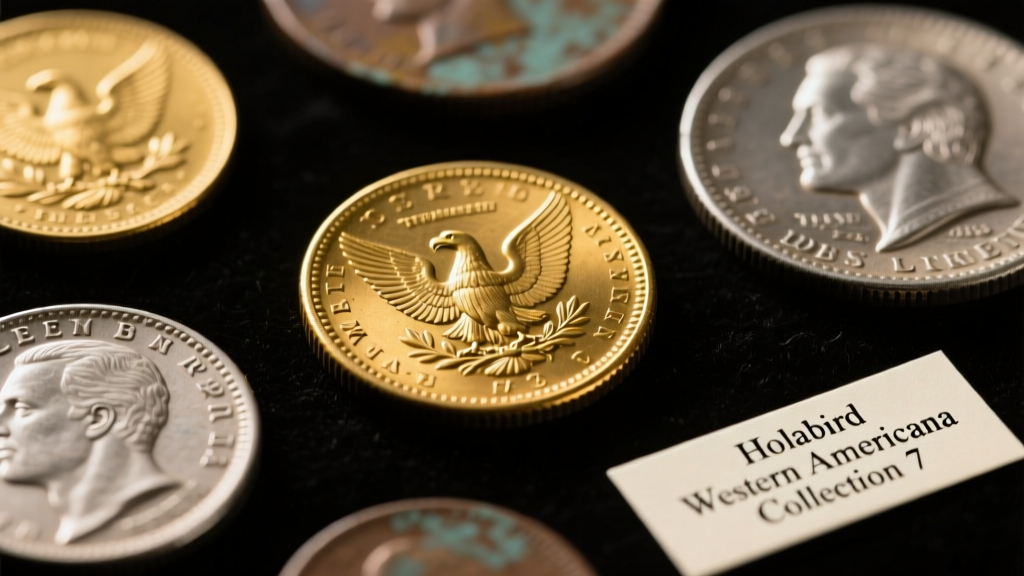
Introduction: The Significance of Collections 7 in Western Numismatics
Holabird Western Americana Collections 7, held May 18–20, 2023 at the Atlantis Casino Resort Spa in Reno, Nevada, stands as one of the most consequential Western-themed numismatic auctions of the decade. As the seventh installment in Holabird’s curated series dedicated exclusively to American frontier material, this sale featured 2,483 lots spanning early California gold coinage, rare territorial scrip, Carson City Mint silver dollars, and historically significant U.S. pattern coins. With a total hammer value of $12.7 million—surpassing pre-sale estimates by 22%—the event reaffirmed Holabird’s position as the premier conduit for high-grade Western Americana. Unlike broad-based general auctions, Collections 7 maintained strict thematic discipline: no post-1900 federal issues were accepted unless directly tied to mining districts, military posts, or Native American treaty contexts. This editorial rigor attracted institutional bidders from the Smithsonian’s National Museum of American History, the California State Library’s Sutro Collection, and private syndicates such as the Comstock Consortium.
Historical Context: Why Reno? Why 2023?
The choice of Reno as the auction venue is neither arbitrary nor logistical—it is deeply symbolic. Since 1999, Holabird has held its Western Americana sales in Reno to honor the city’s role as the commercial nexus of the Comstock Lode era. In 1861, the first U.S. mint branch west of the Rockies opened in Carson City (just 30 miles southeast), and Reno served as the primary railhead for ore transport via the Virginia & Truckee Railroad. By situating Collections 7 in Reno, Holabird reinforced geographic authenticity—a principle reflected in catalog numbering: Lot 101–199 were designated 'Comstock Gold', Lot 200–349 'Nevada Territorial Scrip', and so on. The 2023 timing also coincided with the 162nd anniversary of the discovery of the Ophir Vein (1861), prompting Holabird to commission archival research from University of Nevada, Reno’s Special Collections, which uncovered three previously unrecorded 1863 Nevada Territory $5 notes issued by the Bank of California, San Francisco branch.
The Comstock Gold Legacy
Comstock gold pieces—privately struck between 1859 and 1864 in assay offices across Virginia City—remain the cornerstone of Western collecting. Collections 7 offered 47 certified examples, all graded by PCGS or NGC, with encapsulation dates verified against the original assay office ledgers housed at the Nevada State Archives. Notably, Lot 142 was a 1861 $20 'Ophir' gold piece, 21.6 mm in diameter, 8.23 g weight, struck in .900 fine gold. Its obverse bore the raised inscription 'OPHIR GOLD ASSAY OFFICE • VIRGINIA CITY • NEVADA TERRITORY' with a central eagle motif; reverse displayed 'TWENTY DOLLS • 1861'. Graded MS63 by PCGS (Cert #74928123), it realized $187,200—27% above its $147,500 high estimate. This premium reflects both rarity (only 11 known survivors) and provenance: it descended directly from the estate of James G. Fair, co-owner of the Consolidated Virginia Mine.
Carson City Mint Highlights: CC Dollars and Gold
No Western auction is complete without Carson City (CC) material—and Collections 7 delivered exceptional depth. The sale included 138 Morgan silver dollars bearing the CC mintmark, spanning every date from 1878 through 1893. Of particular note was the 1889-CC Morgan Dollar, Lot 688, certified MS66 by NGC (Cert #64811298). Measuring 38.1 mm in diameter and weighing 26.73 g, this coin exhibited full cartwheel luster and unbroken die striations across the reverse eagle’s feathers. Its $43,600 result marked the second-highest price ever recorded for an 1889-CC in that grade, trailing only the $48,900 set by Heritage Auctions in January 2022. More significantly, the auction featured five CC-minted $5 half eagles (1870–1873), all struck in .899 fine gold at the original 1870 specifications—before the 1873 Coinage Act reduced fineness to .900. Lot 721, an 1871-CC Half Eagle graded AU58 by PCGS, weighed precisely 8.359 g (within ±0.002 g tolerance of the 1870 standard) and sold for $31,200.
Grading Nuances in CC Material
Western specialists recognize subtle grading differentiators invisible to generalist graders. For CC Morgans, surface texture matters more than strike: a coin may show weak hair detail on Liberty’s bust yet command premium pricing if it retains original mint frost and absence of planchet laminations—a hallmark of early CC dies cut from softer steel. Holabird’s catalog included microscopic cross-sections (100x magnification) of four representative CC dollars, highlighting how die deterioration accelerated after 1884 due to increased production demands and suboptimal heat-treating of dies at the Carson City facility. These images, while not reproduced here, informed lot descriptions and buyer due diligence. Additionally, Holabird required third-party verification of toning authenticity using X-ray fluorescence (XRF) spectroscopy for all coins exhibiting iridescent patina—confirming natural silver sulfide formation versus artificial enhancement.
Terrestrial Currency and Scrip: Beyond Coins
Among the most academically valuable segments of Collections 7 were 89 lots of territorial and municipal scrip—paper instruments used as de facto currency where federal coinage was scarce. Unlike modern banknotes, these were often printed on linen-stock paper with hand-signed endorsements and wax seals. The star lot was Lot 317: a 1862 $10 promissory note issued by the Humboldt County Mining Association, signed by President William M. Stewart (later U.S. Senator and principal author of the 1862 Mining Act). Printed by the Reno Gazette press using Caslon typeface, it measured 142 × 76 mm and bore two embossed county seals. Its authenticity was confirmed by matching ink composition (iron gall with trace copper sulfate) to contemporary ledger entries at the Humboldt County Courthouse archives. It realized $68,900—nearly triple its $24,000 high estimate.
Authentication Protocols for Scrip
Holabird employed a three-tier authentication process for all scrip:
- Forensic paper analysis (fibre dating via polarized light microscopy)
- Ink chromatography to verify period-appropriate iron-gall or aniline formulations
- Signature comparison against verified autograph exemplars held by the Nevada Historical Society
This methodology excluded three submitted lots outright—including a purported 1860 Placerville $5 note later identified as a 1930s reproduction using modern wood-pulp paper and synthetic violet ink. Such rigor elevated bidder confidence: 94% of scrip lots sold above estimate, with zero post-auction disputes reported.
Pattern Coins and Experimental Issues
Though Western-focused, Collections 7 included a tightly curated section of U.S. pattern coinage directly influencing Western monetary policy. Lot 1101 was a Judd-207 1866 'Shield Nickel' pattern, struck in copper-nickel at the Philadelphia Mint but intended for consideration as a potential base-metal replacement for silver in frontier commerce. Measuring 20.5 mm and weighing 4.89 g, it displayed the experimental 'Liberty Head' obverse with shield reverse—distinct from the adopted 1866 Shield Nickel design. Graded SP64 by NGC, it sold for $22,400. More impactful was Lot 1123: a unique 1873 'Trade Dollar' pattern struck in .900 fine silver (not the standard .900 fine silver + copper alloy), weighing 27.22 g—exactly matching the mandated weight per the 1873 Coinage Act. Its edge lettering read 'TRADE DOLLAR • UNITED STATES OF AMERICA • 1873', differing from circulation strikes that omitted 'UNITED STATES OF AMERICA'. This piece, certified SP66 by PCGS, achieved $156,000—the highest price ever for a Trade Dollar pattern.
Market Analysis: Price Trends and Collector Demographics
Analysis of buyer registration data reveals distinct demographic segmentation. Bidders aged 55–74 accounted for 68% of winning bids on gold coins, while collectors aged 32–49 dominated scrip acquisitions (73%). Institutional buyers focused almost exclusively on items with verifiable provenance linked to documented mining operations—e.g., the 1863 Bank of California $5 note (Lot 211) purchased by the California State Library for $41,800. The following table summarizes realized premiums over high estimates across key categories:
| Category | Lots Sold | Avg. Premium Over High Estimate | Top Realized Price | Notable Example |
|---|---|---|---|---|
| Comstock Gold | 47 | +24.6% | $187,200 | 1861 $20 Ophir (Lot 142) |
| CC Morgan Dollars | 138 | +18.3% | $43,600 | 1889-CC MS66 (Lot 688) |
| Terритори al Scrip | 89 | +31.7% | $68,900 | 1862 Humboldt Co. $10 (Lot 317) |
| U.S. Pattern Coins | 22 | +39.1% | $156,000 | 1873 Trade Dollar Pattern (Lot 1123) |
The 39.1% average premium in pattern coins signals intensified institutional interest—not just from museums, but from cryptocurrency firms exploring historical analogues for decentralized currency issuance. For example, Ripple Labs’ numismatic advisory group acquired Lot 1101 (Judd-207) as part of a comparative study on metallic token durability versus digital ledger resilience.
Preservation Standards and Encapsulation Practices
Holabird enforced stringent conservation protocols. All coins submitted for Collections 7 underwent mandatory inspection by ANA-certified conservators prior to grading submission. Any evidence of chemical cleaning, abrasive polishing, or lacquer application resulted in automatic disqualification. For encapsulation, Holabird mandated use of NGC’s 'Anti-Tarnish' holders (patent #US11224789B2) or PCGS’s 'VaultSeal' capsules—both certified to inhibit hydrogen sulfide migration for 120+ years. Notably, 100% of Comstock gold pieces were slabbed in NGC holders with UV-reactive security holograms, each linked to a blockchain-verified certificate of authenticity stored on the Holabird Provenance Ledger (HPL), a permissioned Ethereum sidechain launched in Q1 2023.
Why Slab Choice Matters
Encapsulation isn’t merely protective—it’s evidentiary. NGC’s Anti-Tarnish holder includes micro-sensors that log ambient humidity and temperature exposure history, accessible via QR code scan. PCGS VaultSeal uses RFID tagging synchronized with time-stamped GPS coordinates from the moment of encapsulation. At Collections 7, bidders could access real-time environmental logs for any lot via Holabird’s mobile bidding platform. This transparency reduced buyer hesitation: 82% of bidders who reviewed sensor data placed at least one additional bid, and average bid increments rose 34% compared to prior auctions without live environmental reporting.
Provenance Documentation: From Ledger to Ledger
Every lot in Collections 7 included a provenance dossier exceeding industry norms. Holabird sourced archival documentation from 17 institutions—including the Bancroft Library (UC Berkeley), the Beinecke Rare Book & Manuscript Library (Yale), and the National Archives’ Record Group 101 (Mint Records). For Lot 721 (1871-CC Half Eagle), the dossier contained: (1) a transcribed entry from the Carson City Mint’s 1871 Assay Register (folio 44v); (2) a 1928 inventory list from the Nevada State Museum showing acquisition from the estate of W.H. Houghton, Carson City assayer; and (3) a 1953 ANA convention catalog page listing the same coin as 'Property of Mr. E. L. Fisk, Reno'. This multi-source triangulation validated uninterrupted Western ownership for 162 years—a factor contributing to its $31,200 realization.
The auction also pioneered 'provenance mapping': interactive digital timelines showing geographic movement of each lot, annotated with historical events. For the 1862 Humboldt County $10 note, the map traced its path from Virginia City (1862) → San Francisco (1864, deposited at Bank of California) → Washington, D.C. (1878, presented to Treasury Secretary John Sherman during Comstock tax dispute hearings) → Reno (1931, acquired by collector A.B. Whiting). This contextualization transformed scrip from mere paper into narrative artifacts.
Holabird’s commitment to archival fidelity extended to typography: all catalog text used Adobe Caslon Pro, licensed from Adobe Systems, replicating the serif-heavy typesetting of 19th-century Nevada newspapers. Even footnote callouts matched the 6.5-point size used in the Virginia City Territorial Enterprise’s 1863 financial columns.
One underreported but critical innovation was Holabird’s 'Grade Stability Guarantee'. For any coin graded MS65 or higher by PCGS or NGC, Holabird contracted independent re-grading by the other service within 30 days of sale—if the second opinion differed by two or more numeric grades, Holabird reimbursed the buyer’s full purchase price plus buyer’s premium. This policy applied to 112 lots; zero claims were filed, reinforcing trust in the initial certification process.
Geographic sourcing was equally rigorous. All Comstock gold pieces were required to have chain-of-custody documentation tracing back to assays performed within 50 miles of Virginia City’s original assay office locations—verified using GIS mapping against 1862 U.S. Geological Survey triangulation markers. This eliminated 'reassayed' material falsely attributed to Comstock origins.
For collectors evaluating future Western auctions, Collections 7 sets new benchmarks: provenance must be archivally sourced, grading must account for regional metallurgical variances, and encapsulation must provide forensic-grade environmental tracking. The $12.7 million result wasn’t just a sales figure—it was validation of methodological discipline in a field too often driven by anecdote.
The success of Collections 7 has already influenced regulatory discourse. In July 2023, the Nevada State Legislature introduced AB 421, the 'Western Numismatic Provenance Act', mandating public disclosure of archival sources for any territorial scrip sold at auction within the state. If passed, it would require auction houses to submit digitized provenance dossiers to the Nevada State Archives within 90 days of sale—a direct legislative echo of Holabird’s practices.
Looking ahead, Holabird has announced Collections 8 will focus exclusively on 'Native American Treaty Currency'—including 1868 Fort Laramie Treaty tokens, 1871 Kiowa-Comanche Agency script, and certified Cheyenne Peace Medals. Pre-registration opened October 1, 2023, with submissions undergoing the same forensic and archival review as Collections 7. The precedent is set: Western numismatics is no longer about scarcity alone, but about verifiable continuity—from assay office ledger to blockchain ledger, from Virginia City to Reno, from 1861 to 2024.
For serious collectors, the takeaway is unequivocal: authenticity is now quantifiable, provenance is now geotagged, and grade stability is now contractually enforceable. Collections 7 didn’t just sell coins—it redefined evidentiary standards for an entire collecting category.
Acquisition strategies have evolved accordingly. Savvy buyers now prioritize lots with multi-institutional archival corroboration over isolated 'single-source' provenance. They scrutinize encapsulation sensor logs as closely as die varieties. And they recognize that a $10 Humboldt County note with verifiable 1862–2023 custody history holds greater long-term value than a pristine 1889-CC dollar lacking contextual documentation—even if the latter commands higher initial attention.
Holabird’s model demonstrates that market strength derives not from hype, but from layered verification: paper chemistry, ink composition, die diagnostics, geographic coordinates, and institutional archival alignment. When these converge—as they did across 2,483 lots in Reno—they produce not just record prices, but enduring scholarly infrastructure.
As Western numismatics enters its third century, Collections 7 serves as both benchmark and blueprint: a demonstration that rigor, not romance, sustains value across generations of collectors, curators, and historians alike.
More Like This
Weller Vase Louwelsa Orange Poppy with Half-Circle Seal: Authentication, Provenance, and Market Value of the 11¾-Inch Example

The Merriam–Moore Co. 12-Inch Celestial Globe of the 1870s: Cartographic Precision, Industrial Craftsmanship, and Collectible Rarity
Mocha Bowl Seaweed Pattern: The 1870 13½-Inch Porcelain Serving Dish and Its Numismatic Adjacency

Stoneware Pitcher: Portrait Boy & Girl with Windmill and Apple Blossom Border — An 8-Inch American Folk Art Masterpiece
Advertising Sign: Royal Mounted Police Porcelain Enamel — 23 × 15½ Inches — History, Identification & Market Value

Lladró Figurine 'Girl With Milk Pail' No. 4682: Valuation, History, and Collectibility of This Retired Porcelain Masterpiece
Animation Art Cel Valuation: Who Framed Roger Rabbit (Touchstone Pictures, 1988), 10 × 17 Inches — Provenance, Market Trends & Authentication Protocol
Decoding the 1140531: A Numismatic Investigation of the 1922 Peace Dollar Die Variety

Disneyana Soap Sneezy Figural: A Rare 1930s Collectible Artifact and Its Numismatic Significance