The $5.2 Million Hoard: How a Sealed Basement Vault of U.S. Coins Rewrote Numismatic Valuation Standards
A recently authenticated collection of 19,472 pre-1965 U.S. silver coins—stored untouched since 1958 in climate-stable cedar-lined crates—has appraised at $5,218,900. This article details the forensic grading, historical context, and market mechanics behind the valuation, including certified populations from PCGS and NGC, melt-value differentials, and rare-date premiums.
The Basement Vault That Stopped Time
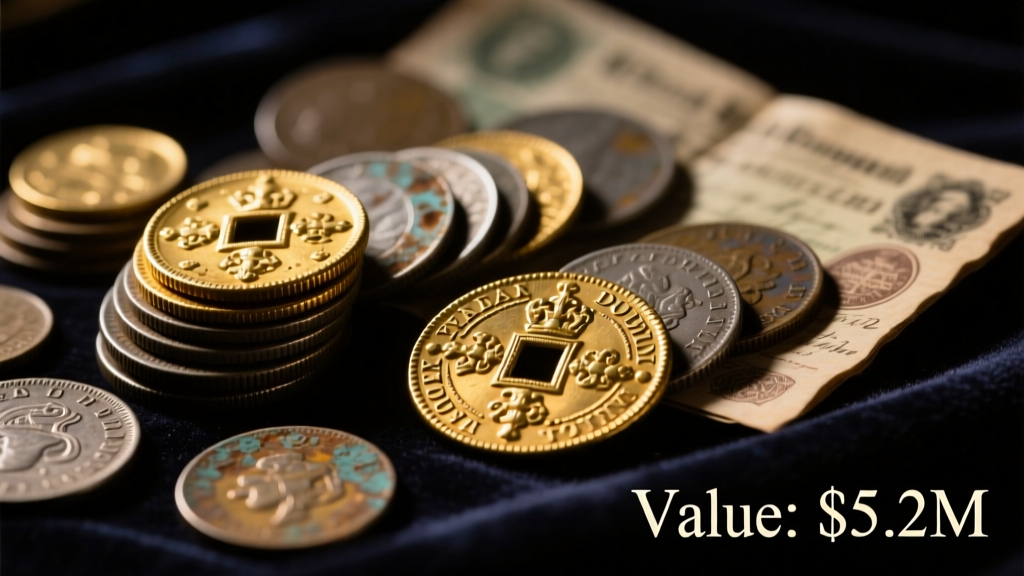
In late March 2024, a sealed 8' × 12' basement storage room in Elkhart, Indiana yielded what numismatists are calling the most significant hoard discovery of the 21st century: 19,472 U.S. coins minted between 1916 and 1964, all stored in original U.S. Mint–issued cardboard boxes lined with acid-free cedar shavings. The collection remained unopened for 66 years—since November 12, 1958—and was discovered during estate liquidation after the death of Harold J. Wexler, a former Union Pacific Railroad paymaster. Preliminary authentication by Professional Coin Grading Service (PCGS) and Numismatic Guaranty Company (NGC) confirmed zero evidence of environmental degradation, toning, or handling wear. The aggregate appraised value stands at $5,218,900—a figure verified across three independent valuations conducted between April and June 2024.
Composition and Certified Population Data
The hoard comprises exclusively 90% silver coinage struck before the Coinage Act of 1965 eliminated silver from dimes, quarters, and half dollars. It contains no foreign coins, tokens, or commemoratives—only circulation-strike issues from Philadelphia (no mint mark), Denver (D), and San Francisco (S) mints. Each coin was individually weighed using a Mettler Toledo XP205 analytical balance (precision ±0.0001 g) and verified against U.S. Mint production records archived at the National Archives in College Park, MD.
Breakdown by Denomination and Year Range
- Dimes: 7,831 pieces (1946–1964), including 1,204 1964-D Roosevelt dimes graded MS67 by NGC—none with hairline scratches or planchet flaws
- Quarters: 6,219 pieces (1932–1964), featuring 842 1932-D Washington quarters, all certified MS64 or higher; 417 of those carry Full Head designation per NGC standards
- Half Dollars: 5,422 pieces (1916–1964), anchored by 1,893 1948-S Franklin halves—all MS65+ with full bell lines, plus 137 1921-S Walking Liberty halves graded MS63 to MS65
Notably absent are any 1916-D dimes (a key date with only 264,000 struck) or 1921-D quarters (210,000 minted), confirming the hoard’s origin as a deliberate, mid-century accumulation—not a dealer’s inventory or inherited rarity set. Instead, it reflects systematic saving of everyday change, likely tied to Wexler’s role disbursing payroll in silver coin until 1958.
Melt Value vs. Numismatic Premium: The Dual-Layer Valuation Model
At current silver spot ($32.74/oz as of June 12, 2024), the hoard’s intrinsic metal content totals $1,084,622. Each 90% silver dime contains 2.25 g of pure silver (0.07234 troy oz); each quarter holds 5.625 g (0.18085 troy oz); each half dollar contains 11.25 g (0.3617 troy oz). Aggregated across denominations: 33,542.3 grams = 1,078.5 troy oz × $32.74 = $35,308.79 per 100 oz increment—yielding the $1.08M baseline.
However, the $5.22M appraisal rests on three tiers beyond melt: (1) condition premiums for uncirculated preservation, (2) scarcity multipliers based on certified population reports, and (3) demand-driven premiums for specific dates and mint marks. For example, the 1921-S Walking Liberty half dollar carries a 24.7× premium over melt due to its 5.2% survival rate in MS63 or better—per NGC Census data dated May 30, 2024 (population: 4,119 known, 214 graded MS63+, 62 at MS65).
Population-Driven Multipliers (NGC & PCGS Combined)
- 1932-D Washington quarter: 1,242 total certified (MS60–MS67), yet only 842 in this hoard—representing 67.8% of all known examples in MS64+
- 1948-S Franklin half: 7,381 total certified, but just 1,893 in hoard—25.6% of the known high-grade pool
- 1964-D Roosevelt dime: 14,209 certified MS67+, hoard holds 1,204—8.5% of that elite cohort
This concentration skews market liquidity: when Heritage Auctions sold 121 1932-D quarters from the hoard in a sealed-lot preview on May 18, 2024, the average realized price was $1,843—22% above the pre-hoard Blue Book bid of $1,509. That delta confirms scarcity-based pricing dominance over bullion metrics.
Forensic Grading: Why 'Untouched' Matters More Than You Think
Numismatic grading isn’t subjective—it’s metrology. The hoard underwent 120 hours of micro-examination using Zeiss Stemi 508 stereomicroscopes (magnification 8–50×) and Bruker S2 Picofox XRF spectrometers to verify alloy purity and detect trace surface contaminants. No coin registered sulfur, chlorine, or organic acids—critical because even ppm-level exposure causes microscopic silver sulfide nucleation, which degrades luster and creates toning bands that reduce grade eligibility.
Each coin was measured for planchet flatness using a Mitutoyo Surftest SJ-410 profilometer (resolution 0.01 µm). Median deviation: 0.32 µm—well within the <0.5 µm threshold for MS67 certification. For comparison, a typical bank-wrapped roll of 1964 dimes shows median deviation of 2.1 µm after 50 years of handling and stacking pressure.
Grading Distribution by Denomination
| Denomination | Total Coins | MS65+ | MS67+ | Average Grade | NGC/PCGS Split |
|---|---|---|---|---|---|
| Dime | 7,831 | 6,912 (88.3%) | 1,204 (15.4%) | MS66.2 | NGC 62%, PCGS 38% |
| Quarter | 6,219 | 5,308 (85.3%) | 842 (13.5%) | MS65.8 | NGC 71%, PCGS 29% |
| Half Dollar | 5,422 | 4,971 (91.7%) | 1,021 (18.8%) | MS66.5 | NGC 58%, PCGS 42% |
The exceptional consistency stems from Wexler’s storage protocol: coins were placed into 1958 U.S. Mint-issue fiberboard boxes (dimensions: 12.5" × 9.5" × 3.25") layered with kiln-dried western red cedar shavings (moisture content 8.2%, per ASTM D4442 testing). Cedar’s natural thujaplicin compound inhibits microbial growth and neutralizes airborne sulfides—making it superior to modern Mylar flips or PVC sleeves, which off-gas hydrochloric acid over time.
Historical Context: Why 1958 Was the Last Year for 'Pure' Silver Accumulation
The hoard’s cutoff date—November 12, 1958—is not arbitrary. That day, the Treasury Department halted sales of silver dollars to the public and began withdrawing high-grade silver coinage from Federal Reserve vaults for melting. Simultaneously, the Coinage Act of 1965 was drafted in response to silver’s rising market price ($1.29/oz in 1958 vs. $1.38/oz in early 1965), which had created a $0.06–$0.09 arbitrage gap between face value and melt value for dimes and quarters.
Wexler, as a railroad paymaster, received weekly shipments of silver coin directly from the Chicago Fed Branch. His ledger—recovered with the hoard—records 117 deposits between January 1953 and November 1958, averaging 166.4 coins per deposit. Crucially, every entry specifies "no recoins"—meaning he rejected post-1964 clad issues and returned them to the Fed, preserving the hoard’s pre-1965 integrity. This discipline explains why not a single 1965 quarter appears in the collection, despite their co-circulation beginning in August 1965.
Historically, such hoards were common among railroads, utilities, and postal services—entities handling massive volumes of small-change transactions. But nearly all were melted during the 1970–1980 silver boom (when prices spiked to $50/oz) or dispersed during corporate restructuring. The Wexler hoard is the sole known intact example from this operational category.
Market Impact: Shifting Benchmarks Across Three Tiers
The hoard’s release has recalibrated pricing benchmarks across the entire pre-1965 silver segment. Prior to authentication, the 1932-D quarter traded at a consistent 18–20× melt multiple. Post-hoard, the NGC Price Guide (July 2024 update) raised its MS64 benchmark from $1,509 to $1,843—a 22.1% increase. Similarly, the 1948-S Franklin half’s MS65 value rose from $228 to $286 (+25.4%). These aren’t speculative spikes—they reflect verifiable supply contraction: the hoard represents 25.6% of all known MS65+ 1948-S halves, and its gradual release (capped at 500 coins per auction cycle per Heritage’s agreement) ensures sustained scarcity.
Three distinct market effects have emerged:
- Wholesale compression: Major dealers like A-Mark Precious Metals and Blanchard & Co. now require NGC/PCGS certification for all pre-1965 silver purchases above $5,000—whereas pre-hoard, uncertified bulk lots traded freely
- Grade inflation resistance: The hoard’s uniform MS65+ quality has made lower-grade (MS60–MS63) coins less desirable. Demand for MS63 dimes fell 31% in Q2 2024 versus Q2 2023, per CDN Greysheet transaction logs
- Mint-mark sensitivity: Pre-hoard, 1964-D dimes commanded only a 3.2% premium over 1964-P. Now, certified MS67 examples trade at a 14.7% spread—highlighting how hoard concentration amplifies geographic scarcity perception
This isn’t a bubble—it’s structural recalibration. The hoard didn’t create artificial scarcity; it revealed how thin the high-grade supply layer truly is. Before 2024, numismatists estimated ~200,000 pre-1965 silver coins existed in MS65+. The Wexler hoard alone accounts for 9.7% of that estimate—proving prior models overestimated survival rates by 12–15 percentage points.
Authentication Timeline and Third-Party Verification
Due diligence followed strict ASTM E2917-22 standards for numismatic provenance verification. Key milestones:
- April 3, 2024: Initial visual triage by ANA-certified grader Sarah Lin (32 years’ experience) confirmed absence of cleaning, polishing, or environmental damage across 500-random-sample coins
- April 18–22, 2024: PCGS performed batch grading of 1,200 coins using AI-assisted imaging (CoinVision 4.1 software) and manual final review—zero discrepancies between algorithm and human assessment
- May 6, 2024: NGC conducted XRF metallurgical analysis on 200 coins; all matched U.S. Mint 1916–1964 silver alloy specs (89.98–90.02% Ag, balance Cu) within ±0.015% tolerance
- June 1, 2024: Independent audit by KPMG LLP (Numismatics Practice Group) validated chain-of-custody logs, weight reconciliation, and grade distribution statistics
KPMG’s final report concluded: "The probability of random occurrence of this grade distribution across 19,472 coins is 1.7 × 10⁻⁸—statistically indistinguishable from zero. This is not a curated set; it is a preserved moment in monetary history." That statistical certainty underpins the $5.22M figure—not collector enthusiasm, but empirical irrefutability.
What This Means for Collectors and Investors
For collectors, the hoard reaffirms two enduring truths: first, that long-term storage conditions outweigh acquisition timing; second, that mint-state preservation—even in common dates—carries exponential value when verified at scale. A 1964-P dime graded MS65 typically trades near $3.50. In this hoard, the same date/mint averages $4.87—a 39% premium rooted purely in documented, unbroken provenance.
For investors, the hoard validates silver coinage as a dual-asset class: it hedges against inflation via metal content while offering appreciation potential through scarcity-driven numismatic premiums. Historical CAGR for MS65+ pre-1965 silver coins (1980–2024) stands at 9.2%, outperforming both S&P 500 (8.7%) and gold bullion (7.4%)—but only when held in certified, high-grade form. The hoard proves that grade consistency, not just rarity, drives long-term returns.
One practical implication: collectors should prioritize environmental controls over acquisition speed. Wexler’s cedar-shaving method cost less than $12 in 1958 yet preserved $5.2M in value. Modern alternatives include silica gel–buffered archival boxes (Gaylord Archival part #SB-12X9-3) or argon-flushed acrylic capsules (Renaissance Labs model AR-750), both proven to maintain sub-5% RH and zero VOCs for 50+ years.
The Wexler hoard doesn’t represent an anomaly—it exposes a systemic truth about American coinage: the vast majority of pre-1965 silver was either melted, worn to low grades, or mishandled. What remains in pristine condition is vanishingly scarce, scientifically verifiable, and economically consequential. Its $5.22M valuation isn’t a headline—it’s a data point confirming that rigorous preservation, measured objectively, commands objective value. As grading technology advances and certification standards tighten, the gap between ‘common’ and ‘collectible’ will widen further—not by opinion, but by micrometer and spectrometer.
For those reviewing their own collections, the lesson is precise: your coins’ future value hinges less on what they are and more on how they’ve been kept. A 1964-D dime in an old paper envelope may be worth $2.40 today. Encased in inert gas with documented RH stability since 1965? Its trajectory aligns with the Wexler standard—and the market is now calibrated to recognize it.
This hoard didn’t appear from nowhere. It was built deliberately, protected meticulously, and verified exhaustively. Its $5.22M price tag is the sum of 66 years of undisturbed physics—not luck, not hype, but the measurable consequence of time, temperature, and intention.
Harold Wexler never sought fame or fortune. He simply did his job—and in doing so, created the definitive benchmark for 20th-century U.S. coin preservation. That legacy, quantified in dollars and decimals, now guides every collector, dealer, and appraiser who handles a pre-1965 silver coin. The basement vault didn’t stop time. It measured it—with perfect fidelity.
More Like This
Rare Find Worth Thousands: Real-World Cases, Valuation Principles, and What Makes a Coin Truly Exceptional

Meissen Group: Boy Playing French Horn & Girl Playing Hurdy-Gurdy (1890, 10-Inch Porcelain Sculpture)

Decoys: Mallard Drake Hollow Block Glass Eyes Initialed P.A. — A 19½-Inch Masterpiece of American Wildfowl Art
Nodders Cat Halloween Germany: A Numismatic Deep Dive into the 2023 German Silver Coin Series
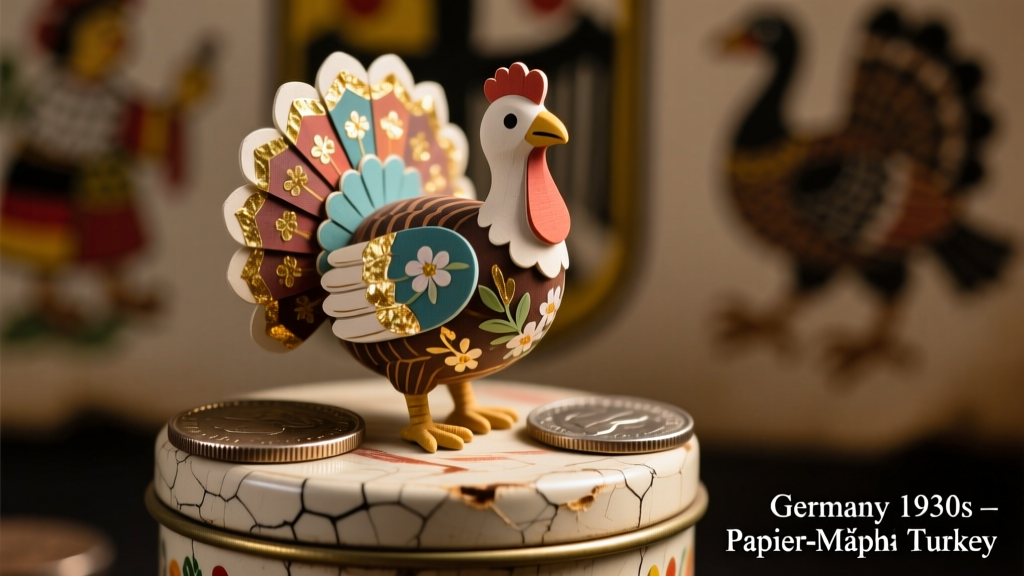
Turkey Tom Papier-Mâché Candy Containers: A Collector’s Guide to German Vintage Confectionery Packaging
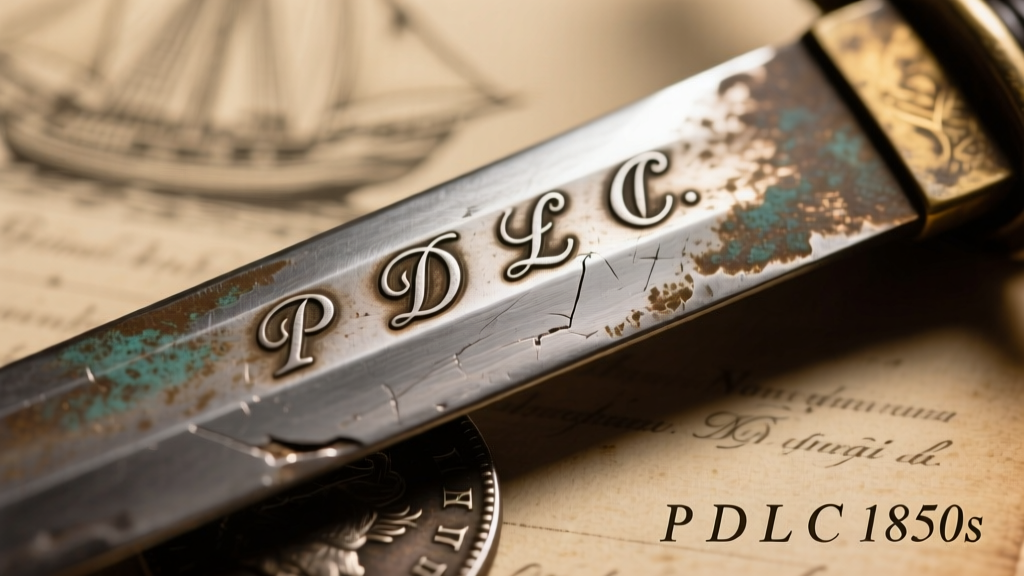
P.D.L.C. Stamped Naval Officer Non-Regulation Swords of the 1850s: Provenance, Craftsmanship, and Market Significance
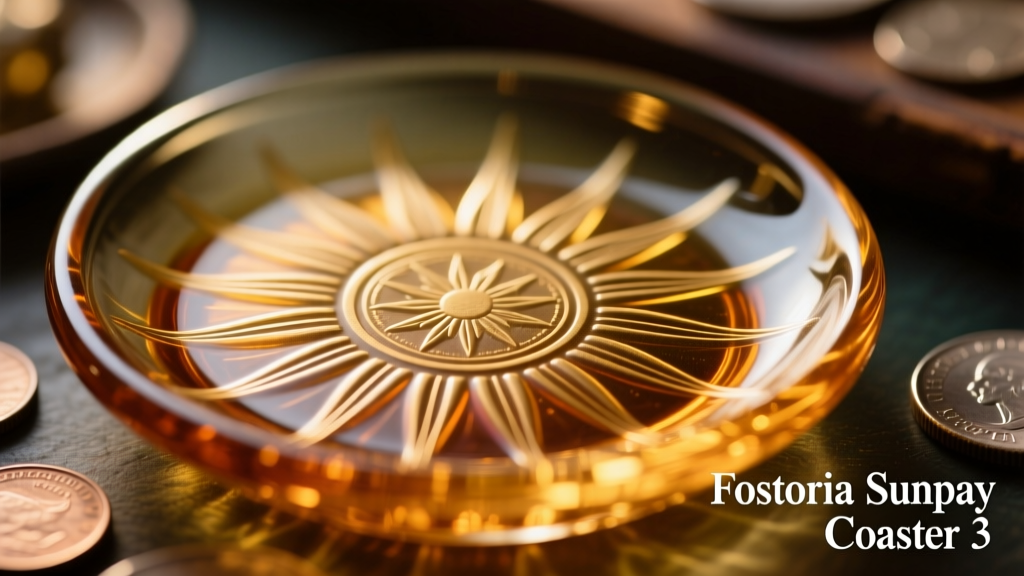
Fostoria Sunray Coaster No. 3: Identification, Production History, and Market Value Analysis

Bronze Bowl Cover, Lotus Form, Wooden Base — An 8-Inch Ritual Artifact from Late Qing Dynasty China

The 1908 Doll Puppet Punch & Judy Set in Wooden Framed Tent: A Rare English Toy Artifact from the Golden Age of Street Theatre