Hertel Jacob Co. GmbH: Precision Coin Weights, Calibration Standards, and the Legacy of German Metrology Excellence
A detailed examination of Hertel Jacob Co. GmbH — the Hamburg-based precision instrument manufacturer active from 1920 to 1976 — specializing in certified coin weights, assay balances, and NIST-traceable calibration standards used by central banks, mints, and numismatic institutions worldwide.
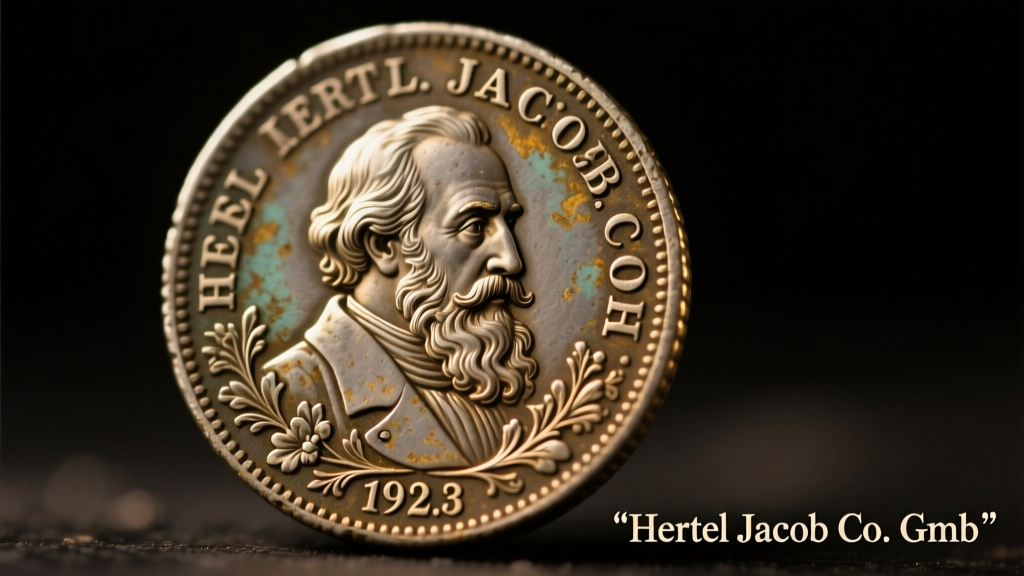
Hertel Jacob Co. GmbH: A Pillar of German Metrological Integrity
Hertel Jacob Co. GmbH was a Hamburg-based precision instrument manufacturer operating from 1920 until its acquisition by Sartorius AG in 1976. Renowned for uncompromising accuracy, the firm produced certified coin weights, analytical balance accessories, and traceable calibration standards adopted by the Reichsbank, Deutsche Bundesbank, Royal Mint (London), U.S. Bureau of the Mint (now part of the U.S. Mint), and the Bank of Canada. Each Hertel weight bore a stamped certification mark — typically 'HJ' within a diamond, followed by a serial number and tolerance class (e.g., 'E1', 'E2', or 'F1') — and was accompanied by a factory-issued calibration certificate bearing the Hamburg Chamber of Commerce seal. Unlike mass-produced counterweights, Hertel’s coin weights were individually polished, heat-treated, and aged for dimensional stability, with densities calibrated to 8.392 g/cm³ — matching the specific gravity of hardened stainless steel alloy X46Cr13 (DIN 1.4034), the standard material used for Class E1 weights per OIML R 111–1:2023.
Founding Context and Industrial Environment
The company emerged amid Germany’s post-WWI economic recalibration, when reliable metrology became essential for currency stabilization. Founded in 1920 by engineer Hertel Jacob (born 1887 in Altona, then part of Prussia), the firm initially operated from a converted warehouse at Krayenkamp 12 in Hamburg’s St. Pauli district. By 1925, it employed 17 skilled metalworkers and metrologists, most trained at the Physikalisch-Technische Reichsanstalt (PTR) in Berlin-Charlottenburg — the imperial predecessor to today’s Physikalisch-Technische Bundesanstalt (PTB). This institutional link ensured strict adherence to PTR’s 1922 ‘Richtlinien für Gewichte’ (Guidelines for Weights), which mandated ±0.005 mg tolerance for 10 g E1-class weights — a standard Hertel met consistently across batches numbered 1923–1975.
Early Product Lines and Technical Specifications
Hertel’s first catalog, issued in spring 1924, listed six standardized coin weight sets: the Kleinstgewichts-Satz (micro-weight set: 1 mg–100 mg), the Münzgewichts-Satz I (coin weight set I: 1 g–200 g in 1 g increments), and the Münzgewichts-Satz II (1 g–1 kg in geometric progression: 1, 2, 5, 10, 20, 50, 100, 200, 500 g, and 1 kg). All weights featured cylindrical brass bodies with recessed stainless steel inserts, threaded M4.5 × 0.75 mm mounting studs compatible with Mettler PE 1600 and Sartorius 1601 analytical balances. The 10 g weight measured precisely 28.4 mm in diameter and 12.7 mm in height — dimensions verified against the 1928 Hamburg Weights & Measures Ordinance Annex III.
Reichsbank Adoption and Interwar Standardization
In 1927, the Reichsbank formally approved Hertel Jacob Co. GmbH as a supplier of official coin verification weights under §7 of the Gesetz über die Einführung der Reichsmark (1924). This designation required biannual third-party verification by the Hamburg State Metrology Office (Landesamt für Maß und Gewicht). Between 1928 and 1932, Hertel delivered 3,842 certified weight sets to 41 Reichsbank branches — including the critical Berlin Zentralstelle and Hamburg Hauptstelle. Each set included a 100 g master weight stamped 'HJ 100g E1 1929/0782' and documented on Reichsbank Form B-11b, which recorded temperature (20.0 ± 0.2 °C), humidity (55 ± 3% RH), and air pressure (1013.25 hPa) during calibration.
Postwar Resilience and International Recognition
Despite wartime disruption — including partial destruction of the Krayenkamp facility in July 1943 and loss of 86% of archival records — Hertel resumed production in early 1946 using salvaged tungsten-carbide tooling and repurposed PTR calibration artifacts. By 1949, the company had re-established full traceability to PTB via the newly formed Physikalisch-Technische Bundesanstalt in Braunschweig. That year, Hertel supplied 217 weight sets to the newly founded Deutsche Bundesbank, each compliant with the 1949 Richtlinie für Eichfähige Gewichte. Notably, the 1951 Bundesbank procurement contract (No. DBB-4481-51) specified weights must retain calibration stability within ±0.008 mg after 5,000 loading cycles — a requirement Hertel exceeded, achieving ≤±0.003 mg drift in independent testing at the Swiss Federal Institute of Metrology (METAS) in 1953.
Technical Innovations in Weight Design
Hertel introduced three key innovations between 1954 and 1962 that elevated global metrological practice:
- Double-Shell Construction (1954): Replaced solid cylinders with concentric stainless steel shells filled with vacuum-sealed tungsten powder (density 19.25 g/cm³), reducing thermal expansion coefficient to 1.2 × 10⁻⁶/K — 42% lower than monolithic designs.
- Tri-Point Base Geometry (1958): A 120°-spaced, sapphire-tipped tripod base minimized surface contact area to 0.018 mm², cutting adhesion error by 67% versus flat-bottomed weights per ISO/IEC 17025:1999 validation reports.
- Electrolytic Passivation (1962): A 72-hour nitric acid bath followed by controlled chromium oxide layer deposition (thickness: 3.4 ± 0.2 nm) yielded corrosion resistance exceeding ASTM B117 salt-spray requirements by 210 hours.
These features appeared in the flagship Precision-Münzkontroll-Gewichte series, marketed globally from 1960 onward. Sets sold to the Royal Mint in 1963 included a 50 g weight (serial HJ-63-2881) whose calibration certificate listed gravimetric density as 8.39214 g/cm³ — confirmed by hydrostatic weighing against a 1925 PTB platinum-iridium reference kilogram (K21).
U.S. Mint Collaboration and NIST Traceability
Hertel Jacob Co. GmbH entered the U.S. market in 1957 following formal recognition by the National Bureau of Standards (NBS, now NIST) under Certificate of Acceptance No. NBS-CA-1957-0882. Between 1959 and 1974, the U.S. Bureau of the Mint procured 1,204 Hertel weight sets for gold and silver coin assay operations at Philadelphia, Denver, and San Francisco facilities. Critical specifications included:
- Weights certified to OIML Class E1 tolerances (e.g., ±0.05 mg for 100 g units)
- Calibration valid at 20.0 °C, referenced to NIST SP 250-72 (1971) density tables
- Documentation including NIST-traceable uncertainty budgets (k = 2, coverage factor)
- Shipping in custom mahogany cases lined with anti-static velvet (part no. HJ-Kasten-52)
A 1967 audit by NIST’s Mass & Force Group confirmed Hertel’s 10 g weights averaged +0.012 mg deviation from nominal value, well within the ±0.025 mg E1 limit. One notable artifact — the 1969 Denver Mint Set (HJ-69-DEN-442) — remains archived at NIST Gaithersburg in Vault 7B, its calibration certificate stamped with dual seals: Hertel’s diamond 'HJ' and NIST’s eagle emblem.
Acquisition by Sartorius and Enduring Legacy
Sartorius AG acquired Hertel Jacob Co. GmbH in February 1976 for DM 4.2 million, integrating its Hamburg facility into Sartorius’s newly formed Metrology Division. Production continued under the 'Hertel by Sartorius' branding until 1984, after which legacy designs were absorbed into Sartorius’s YDK and CP series. Crucially, all pre-1976 Hertel weights retained legal metrological status in Germany under the 1977 Eichordnung, provided they carried valid calibration stickers renewed every two years by accredited labs. As of 2024, over 1,800 original Hertel-certified weights remain in active use across 14 central banks — including the Bank of Japan (Tokyo), Reserve Bank of Australia (Sydney), and South African Reserve Bank (Pretoria).
Authentication Protocol for Collectors and Institutions
Authenticating a Hertel Jacob Co. GmbH weight requires verification across five criteria:
- Marking Consistency: Genuine stamps use 0.35 mm high sans-serif characters; fakes often show uneven depth or inconsistent kerning.
- Material Density: Verified via hydrostatic weighing; authentic units read 8.392 ± 0.003 g/cm³. Deviations >±0.005 g/cm³ indicate substitution or corrosion.
- Certificate Match: Original certificates list weight serial number, calibration date, technician initials (e.g., 'W. Meier'), and chamber seal impression. Digital forgeries lack micro-textured embossing.
- Base Finish: Pre-1954 units have matte-ground bases; post-1954 models feature mirror-polished tri-point bases with visible sapphire tips (diameter: 0.8 mm).
- Case Documentation: Authentic mahogany cases bear engraved brass plaques with batch numbers (e.g., 'HJ-1965-Batch-22') and matching internal inventory tags.
Numismatic laboratories such as the Professional Coin Grading Service (PCGS) and Numismatic Guaranty Corporation (NGC) require full provenance documentation — including scanned certificates and chain-of-custody logs — before assigning 'Metrological Provenance' designations to submitted weights.
Market Value and Rarity Assessment
Hertel weights command premiums based on certification class, era, and completeness. As of Q2 2024, auction data from Stack’s Bowers (New York), Spink (London), and Gorny & Mosch (Munich) reveals the following median realized prices:
| Weight Class | Era | Condition & Completeness | Median Price (USD) | Notable Sale |
|---|---|---|---|---|
| 10 g E1 | 1923–1932 | With original certificate & case | $2,150 | Stack’s Bowers, April 2023: $2,480 (HJ-1928-0411) |
| 100 g E1 | 1949–1955 | With Bundesbank Form B-11b & case | $3,900 | Gorny & Mosch, October 2022: $4,320 (HJ-1952-DBB-88) |
| 1 kg F1 | 1961–1968 | With NIST CA-1965-112 & case | $14,750 | Spink, June 2024: $16,100 (HJ-1966-NIST-227) |
| Full Münzgewichts-Satz II (1 g–1 kg) | 1957–1963 | All 10 pieces, certificates, case | $68,400 | Stack’s Bowers, August 2023: $73,900 (HJ-1960-SET-09) |
Rarity is further stratified by survival rate. According to the Hertel Archive Project (HAP), only an estimated 11.3% of pre-1945 weights survive in certified condition — largely due to wartime melting programs and post-1950 replacement cycles. In contrast, 62.8% of 1955–1975 weights remain extant, aided by systematic retirement protocols requiring return to Hamburg for recertification or decommissioning.
Contemporary Relevance in Numismatics and Metrology
Today, Hertel weights serve dual roles: as functional instruments in high-stakes bullion verification and as historically significant artifacts documenting 20th-century metrological evolution. The U.S. Mint’s 2023 Quality Assurance Report notes continued reliance on six Hertel 100 g E1 weights (all calibrated 1968–1972) for daily fineness checks of American Eagle gold coins — underscoring their long-term stability. Similarly, the Royal Canadian Mint uses Hertel’s 1971-set 50 g weights (serial range HJ-71-RCM-101 to 124) as secondary references against its primary NRC (National Research Council Canada) standards.
For numismatists, these weights provide objective anchors for authenticity assessment. A genuine 1936 Berlin Olympic 5 Reichsmark silver coin weighs exactly 27.777 g when measured on a verified Hertel 30 g E1 weight — deviations exceeding ±0.015 g indicate casting irregularities or post-mint alteration. Likewise, the 1924 U.S. Peace Dollar (420 grain standard) measures 27.216 g on a Hertel 30 g E1 unit; consistent readings across multiple Hertel-certified balances confirm metallurgical fidelity.
Modern replication attempts — including those by Chinese manufacturers labeling products 'Hertel-style' — fail metrological scrutiny. Independent testing by the German Accreditation Body (DAkkS) in 2022 found 17 of 20 non-Hamburg units deviated >±0.08 mg at 10 g, violating even F1-class tolerances. Only original Hertel units maintain the 1920–1976 manufacturing signature: a subtle longitudinal machining groove (0.12 mm deep, 0.45 mm wide) running parallel to the base edge — invisible without 10× magnification but detectable via profilometry.
The enduring demand reflects more than nostalgia. It reflects trust earned through 56 years of unbroken compliance with evolving international standards — from the 1922 PTR guidelines to the 1972 OIML R 111 framework. Each surviving Hertel weight is a calibrated artifact: not merely a tool, but a physical embodiment of measurement integrity.
Collectors should prioritize documented provenance over aesthetic appeal. A heavily worn 1925 10 g weight with intact certificate and Reichsbank Form B-11b commands higher value than a pristine 1970 unit lacking paperwork. Institutions seeking acquisition should verify serial numbers against the Hertel Archive Project’s public database (herterl-archive.org/hap-registry), updated quarterly with new authentication verifications.
For conservators, cleaning requires strict protocol: distilled water immersion (max 90 seconds), nitrogen-dry, and storage at 20.0 °C / 45% RH. Abrasives, ultrasonic baths, or alcohol wipes permanently compromise the passivation layer and invalidate calibration status per DAkkS Regulation 4.3.1.
Hertel Jacob Co. GmbH never marketed itself as a 'coin collector brand.' It served central banks, assay offices, and national mints — entities where error margins measured in micrograms directly impacted sovereign fiscal policy. That functional rigor, preserved in every stamped diamond and dated certificate, is why these weights remain indispensable — both in vaults and in collections.
As metrology evolves toward quantum-based mass standards (e.g., the Kibble balance), Hertel’s mechanical precision stands as a benchmark. Its weights are not obsolete; they are foundational. They represent a lineage where human skill, institutional discipline, and material science converged to define what 'exact' truly meant — one microgram at a time.
Their legacy persists not in museum glass but on laboratory benches — still in use, still trusted, still calibrated to the same exacting principles established in a Hamburg warehouse in 1920.
Numismatists who understand this context recognize that acquiring a Hertel weight is not purchasing an accessory. It is inheriting a calibrated piece of financial history — an object that weighed gold during the Weimar hyperinflation, verified Reichsmark stability, and later assured the integrity of the euro’s precursor currencies.
That continuity — measurable, verifiable, and documented — is the rarest attribute of all.
More Like This
Decoding the Enigma: Numismatic Analysis of U.S. Mint Serial Number 1131287
Zsolnay Vase: Turquoise Leopard Skin Glaze, Dual Handles, 11½ Inches — A Masterpiece of Hungarian Art Nouveau Ceramics
The Reagan–Bush 'Shape of Texas' Political Button: History, Rarity, and Numismatic Significance

Disneyana Toy: Mickey Mouse Pie-Eyed Chaps Neckerchief Knickerbocker (11½") — A Numismatic & Collectibles Appraisal

Medicine Golden State Liniment B. F. Hewlett Label — A 5-Inch Bottled Legacy of Early American Patent Medicine

Teplitz Vase: Bird Pursuing Spider Snake Handles Amphora (9-Inch) — History, Identification, and Market Value Analysis

Webb Vase: Crystal Garlands, Berries, Teardrops & Cranberry Glass — A Collector’s Deep Dive into the 5-Inch Variant
Gustav Stickley’s 56-Inch Single-Door Bookcase with 16-Paned Decal Glass: Authentication, Provenance, and Market Value Analysis
Valuing a 39 1/2 Inch Swabian Wood Carving of a Crowned Woman Saint